Road Trip to Thargo

In late September I take a two-hour flight from Brisbane to Charleville to meet my son Joe and his family.

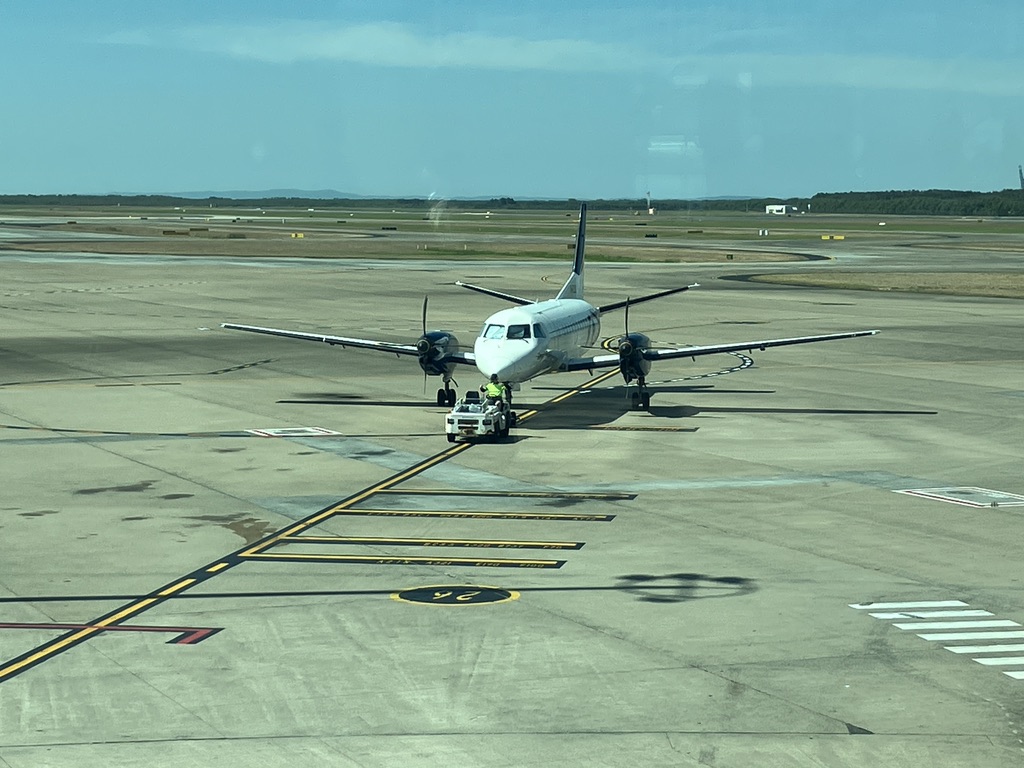
Rex Airlines is subsidised by the government for regional flights like this. In a two-prop Saab 340 with seats for about 30, with only a dozen or so passengers, I fly west over the ranges. Smoke from bush fires rises from the forests below.

Rex plane for flight to Charleville

We’re told we can pick up our checked luggage from the carousel in the terminal. There is no carousel in the tiny Charleville Terminal. The bags are lined up on the floor.

I remember the Burketown airport, years ago, where a small tractor drew up outside the terminal and we grabbed our bags off its trailer at random. Joe tells me of a regional flight in Russia when their bags were tipped out unceremoniously in a pile in the snow.

Outside the terminal I’m greeted by Danny and Pete, aged 11 and 9. With Joe and Isabel they’ve driven 1,325 kms from their home at Babinda, south of Cairns; equivalent to driving from London to Edinburgh and back, but with less traffic. And fewer people.

They’ve spent nights at Charters Towers (pop. 8,040 in the 2021 census according to Wikipedia) and Blackall (pop. 1,365), with stops at Torrens Creek (pop. 46), Barcaldine (pop. 1,540) and Augathella (pop. 328).

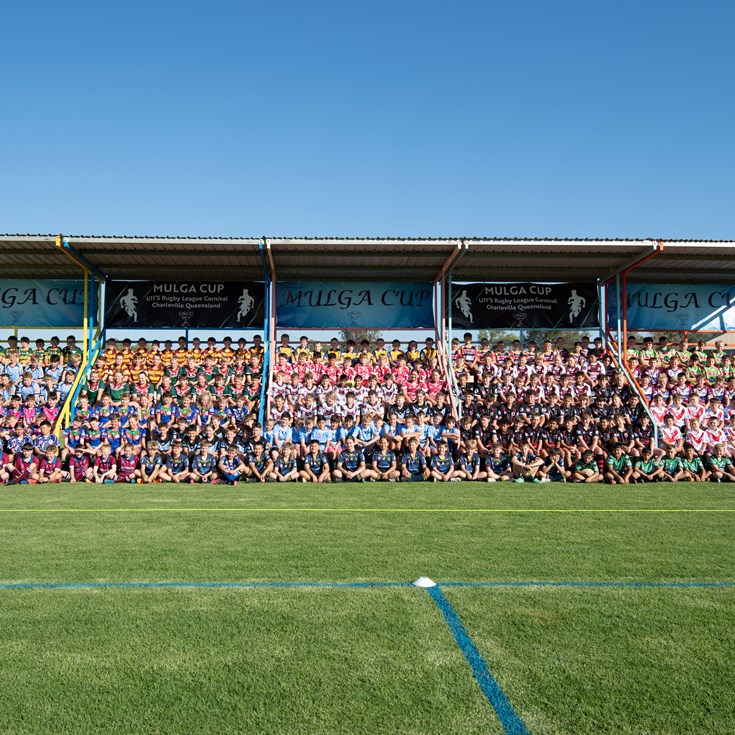
This school holiday weekend, the Mulga Cup is being held in Charleville. Two hundred under 11 rugby league players in twenty-two teams, from as far away as the Gold Coast, are in town, with their families. Accommodation is hard to find.

The teams for the 2025 Mulga Cup in Charleville qrl.com.au/news

In western Queensland, towns are far apart. We can either backtrack to Augathella, 84kms to the north, where there is one room available in the motel behind the pub, or head out to Quilpie, 211kms; but the whole of Quilpie (pop. 530) is booked out because there’s a wedding in town this weekend.

Before leaving Brisbane, I’d rung my list of Charleville motels again, and found a lucky cancellation. We get to stay here and see the Bilby Experience, look at the stars and planets at the Cosmos Centre, and visit the Royal Flying Doctor Service Visitors Centre.

At the Visitors’ Centre I give Pete a fifty dollar note to post in the donations box. He looks at me in surprise, but I’m remembering the two Flying Doctors emergency flights I’d had out of Burketown, years before. The RFDS is vital in the bush.

Then we’re off to the west.

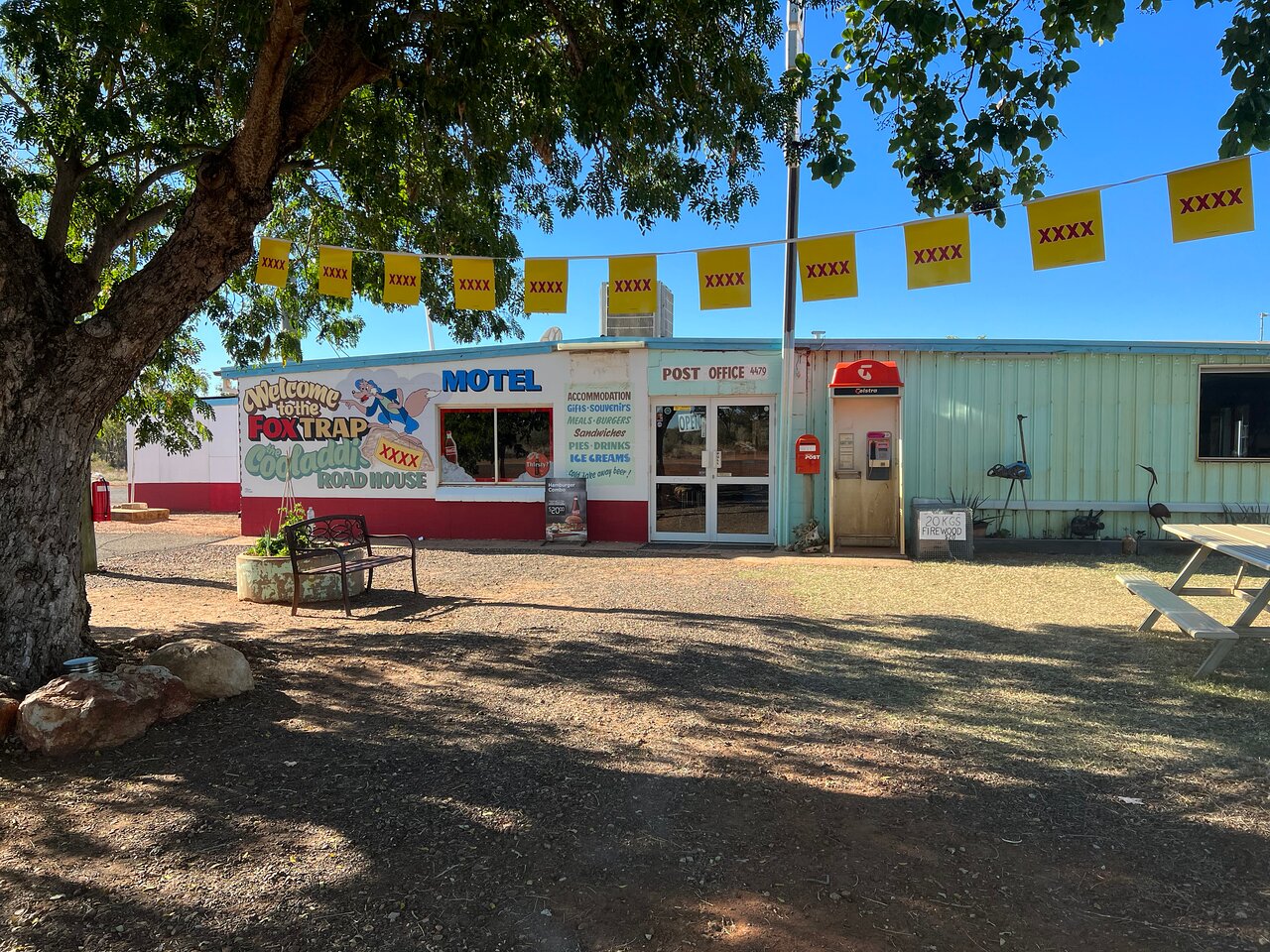
90 kms out on the Diamantina Developmental Road to Quilpie, we stop at the iconic Foxtrap Roadhouse. This is a place with many stories to tell.

Foxtrap Cooladdi Roadhouse Tripadvisor

While we’re there, a man and a woman in work clothes come in and settle on stools near us. They’re from the cattle station across the road, and they smell like hard work and horses.

“I’ve been mustering and branding all morning”, the woman tells us. We have an interesting conversation. As a tourist it’s not often that you get to really talk to locals. It turns out that this little roadhouse, seemingly isolated, is the centre of a local community of station people and workers, and not lonely at all.

Much of western life is invisible in the towns. It lies down those unsealed side roads, marked sometimes by a sign, a mailbox and a cattle grid, that lead to the homesteads and outbuildings of cattle stations; or the roads leading to mines or gas fields.

People from the stations go to town only occasionally – for council meetings, the pub, the rodeo or the races, the doctor, or the school if they’re on a school bus route.

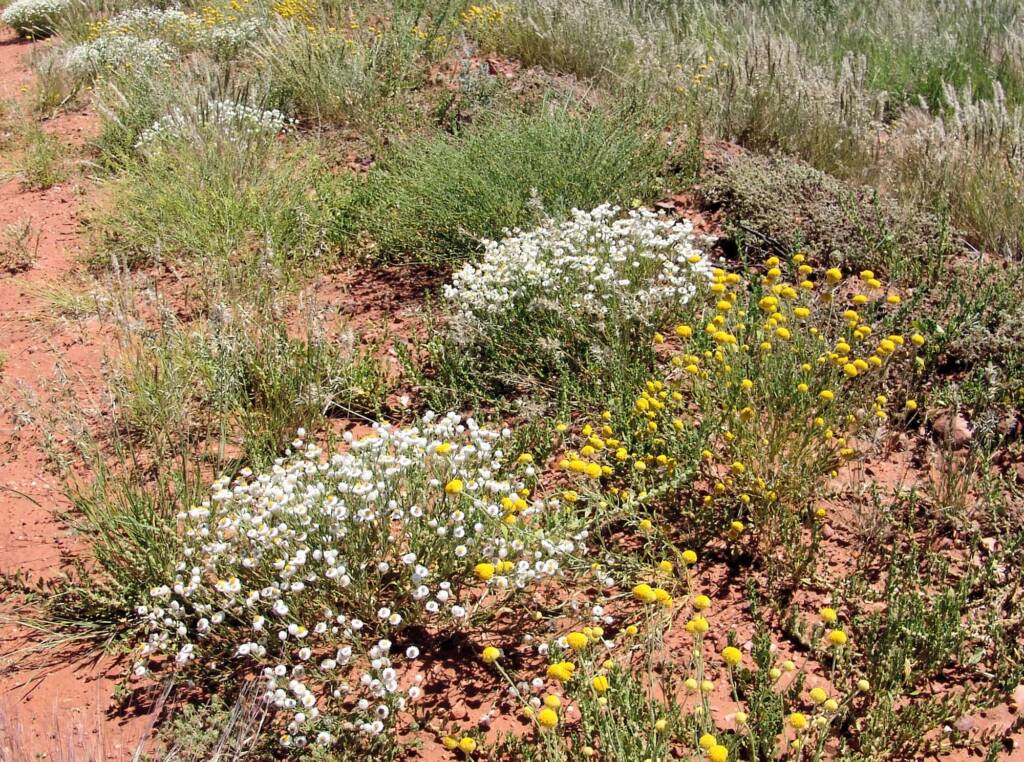
From Quilpie we turn south on the road to Thargomindah (pop. 220), with white and yellow wildflowers carpeting the verges and spreading across the paddocks in every direction. It’s springtime, and this country has had more rain than usual.

White paper daisies and other wildflowers that spread across inland Australia in Spring ausemade.com.au/flora-fauna


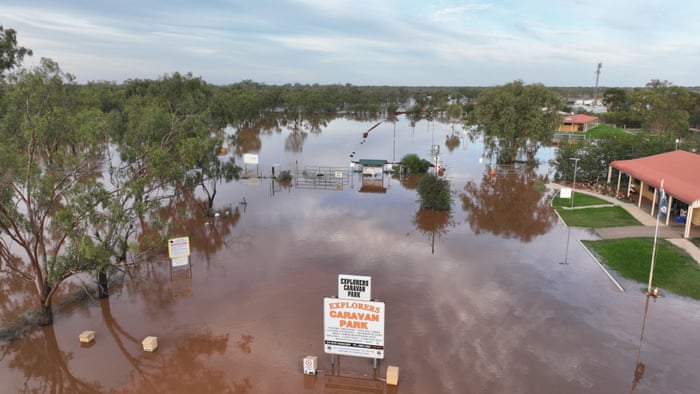
In the Thargomindah Explorers Caravan Park we stay in comfortable units built high enough to have avoided the flood that almost wiped out the town in mid-April 2025. Much of the Park looks as if the rushing water swept it bare.

Thargomindah caravan park under flood water, April 2025 The Guardian

What the locals call Thargo is on the banks of the Bulloo River, and it was the Bulloo that did the damage. According to news reports, every business in Thargo and 90% of homes were inundated. Most of the population was air-lifted out of town, with some staying on higher ground at the airport in cars and campervans until the water went down.

https://www.abc.net.au/news/2025-04-14/outback-floods-thargomindah-levee-river-gauges-water-levels/105170880

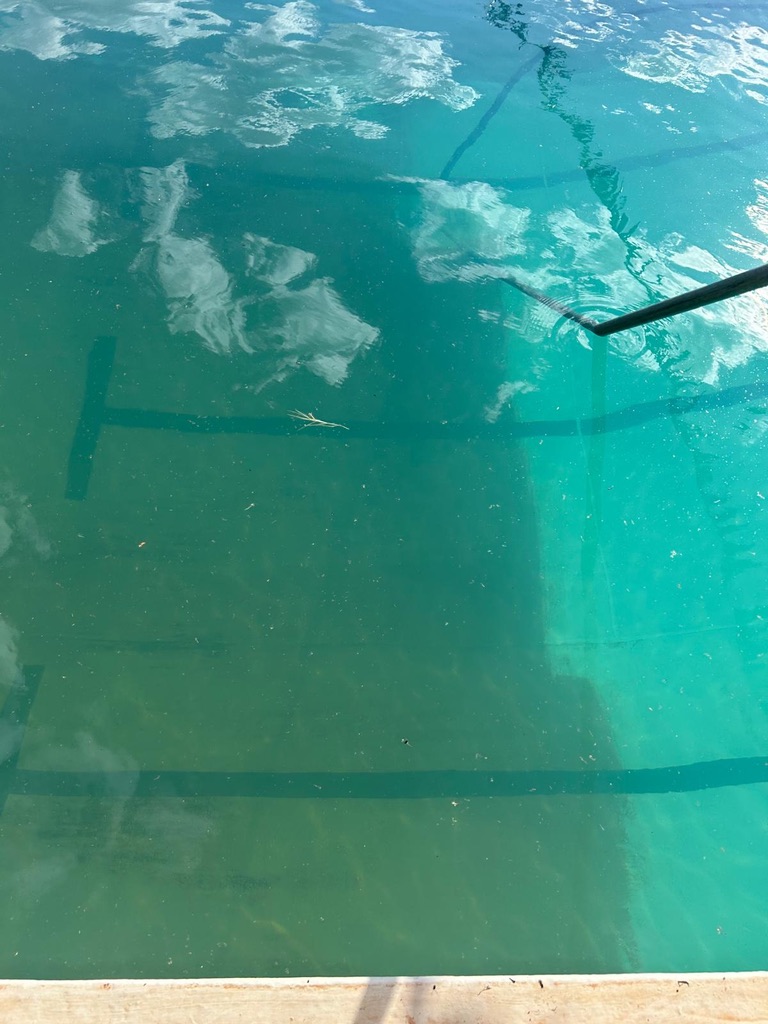
Isabel visits the town swimming pool with the boys, but it’s closed, being cleaned for the third time to get rid of lingering mud.

Thargomindah town pool being cleaned of mud, with clouds reflected in the water Photo: Alexandra Knott

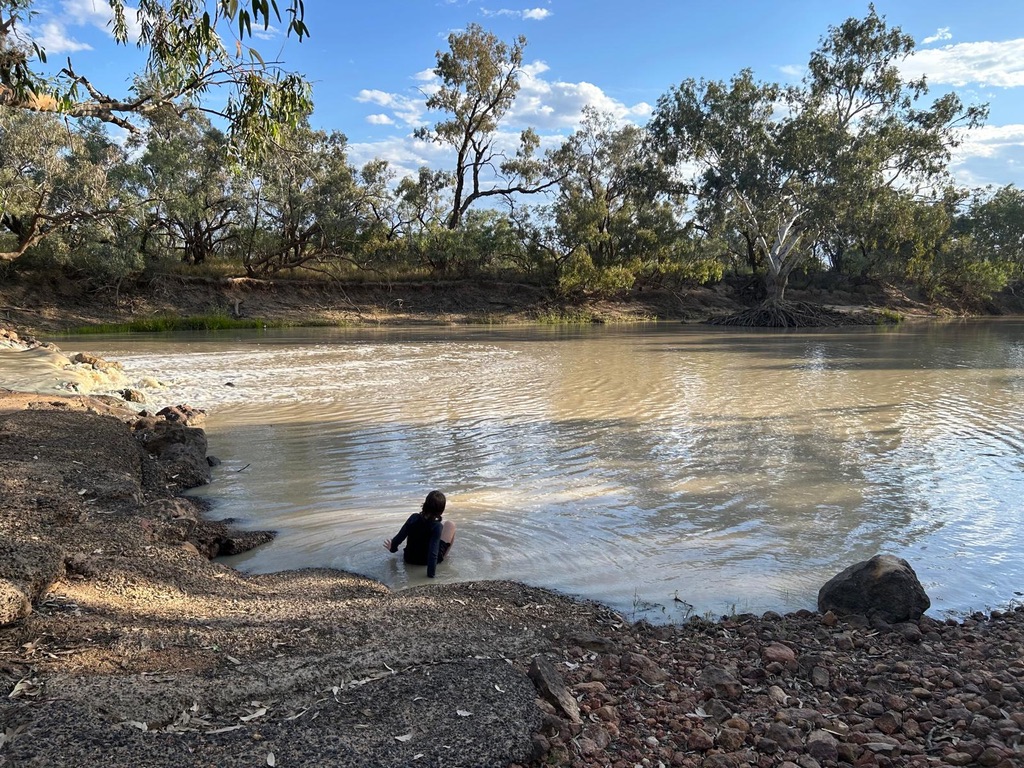
Instead, we walk down to the river, and she and the boys go swimming in that milk coffee coloured water. For children who’ve grown up in the pristine creeks of Far North Queensland, swimming in water you can’t see through is something new. At least out here in the west they don’t have to worry about crocodiles.

Swimming in the Bulloo River, Thargomindah Photo: Alexandra Knott

There are new houses and functioning businesses in town, and a sign-posted Heritage Trail, but to the boys, swimming in the river is the only interesting thing about Thargomindah.

Danny asks me, “Why are we driving all this way to places where there’s nothing to do and nothing to see?”

I try and explain.

“This is home for the people of Thargo. They need visitors like us to come and support their town after the flood. They’re Queenslanders like you, and they’ll be supporting the Broncos tomorrow night, just like you will be!”

The following night, the Brisbane Broncos meet the Penrith Panthers in a National Rugby League preliminary final. As Broncos supporters we must not miss the game.

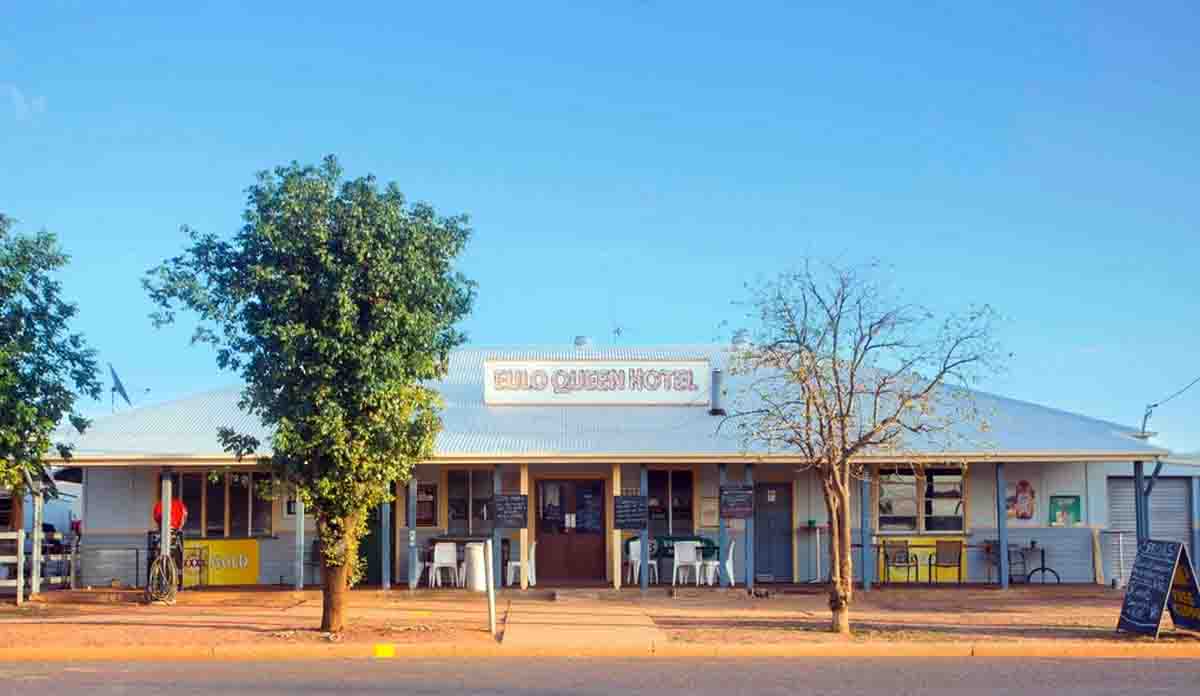
At Eulo (pop. 94), 67 kms west of Cunnamulla, I book cabins behind the Eulo Queen Hotel.

The Eulo Queen Hotel pubtic.com.au

The pub closes at 4pm on a Sunday, before the match is due to start, but the publican offers to take a television out to the shed. The new owners are from Tasmania, and I don’t know if they appreciate the importance of rugby league to Queenslanders. AFL would be a different matter.

There’s nowhere else in this tiny town to watch the game, except for private houses, so a number of people join us in the shed – the pub cook, a few travellers from the cabins, and a bloke from off the street. A fisherman, one of many heading out to catch yellowbelly in the brimming western rivers, comes along with his young son. It’s an exciting match, and to everyone’s delight the Broncos win.

From Eulo we pass through Cunnamulla (pop. 1233) to St George, a pleasant town (pop. 3130) where we stay in an old house restored as Airbnb accommodation. The boys and Izzie miss their anticipated swim in the Balonne River because there are brown snakes in the muddy water around the pontoon.

After Texas (pop. 790), on the New South Wales border, the road takes us through hilly sheep country to Stanthorpe (pop. 5286), the biggest town on this trip since Charters Towers.

Fine old towns like Barcaldine, Charleville and Cunnamulla were built on the wool industry, but these days it’s cattle across most of the state, and the towns have suffered. Fewer people, less money coming in.

In picturesque granite country, surrounded by orchards and vineyards, with a beautiful national park nearby, and within an easy drive of Brisbane, Stanthorpe has more obvious charm and prosperity that any of the other towns we’ve visited.

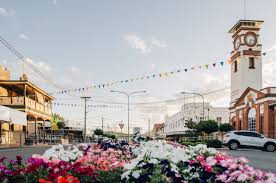
Maryland St, Stanthorpe granitebeltwinecountry.com.au

Con has come up from Brisbane to meet us, and next day he and I drive home together while the family heads further south.

Joe and his family have driven 2621 kms from Babinda to Stanthorpe, equivalent to driving from London to Prague and back. They’ll need a few days of rest before heading back to Brisbane, then starting the 1645km slog up the coastal Bruce Highway to their home.

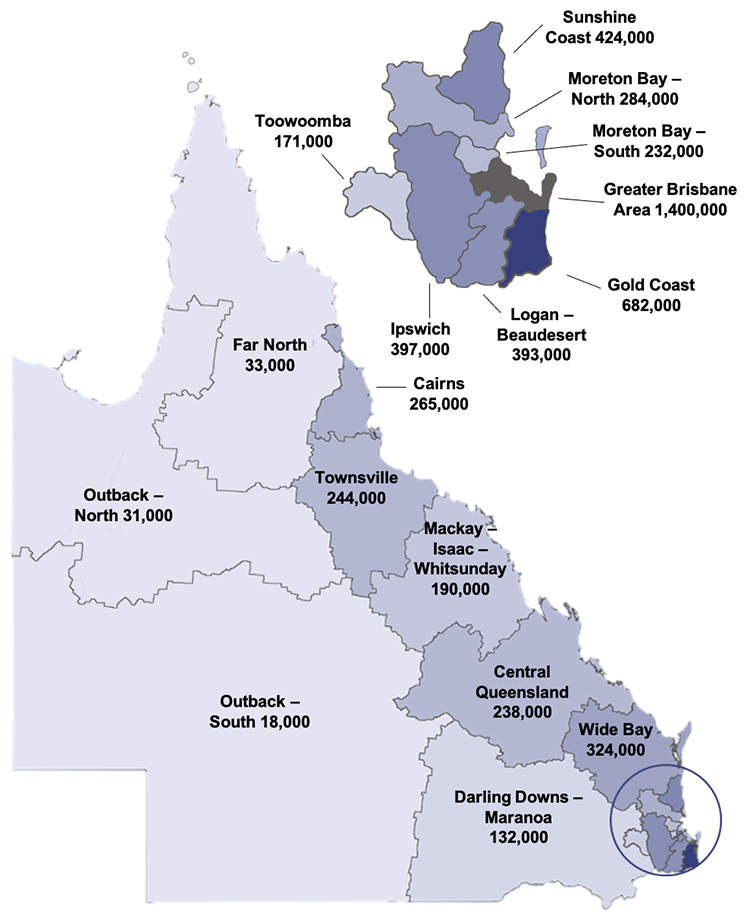
Queensland has an area of over 1,700,00 square kilometres and a population of under six million. According to Queensland Government statistics, only 2% of Queenslanders live in the outback; and in the southern outback region that includes Thargomindah that number is dropping.

Queensland’s population by Region 2023 qao.qld.gov.au/reports

Flood, fire and drought can and do hit everywhere in Queensland. It’s just that much harder in the isolated western regions. It’s great that more and more people from coastal Queensland are taking their caravans, campers and kids to see what lies out beyond the coastal ranges.

While they’re there, they should donate to the RFDS.

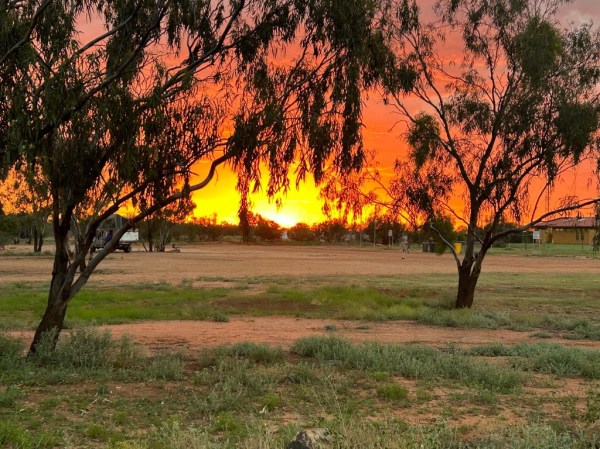
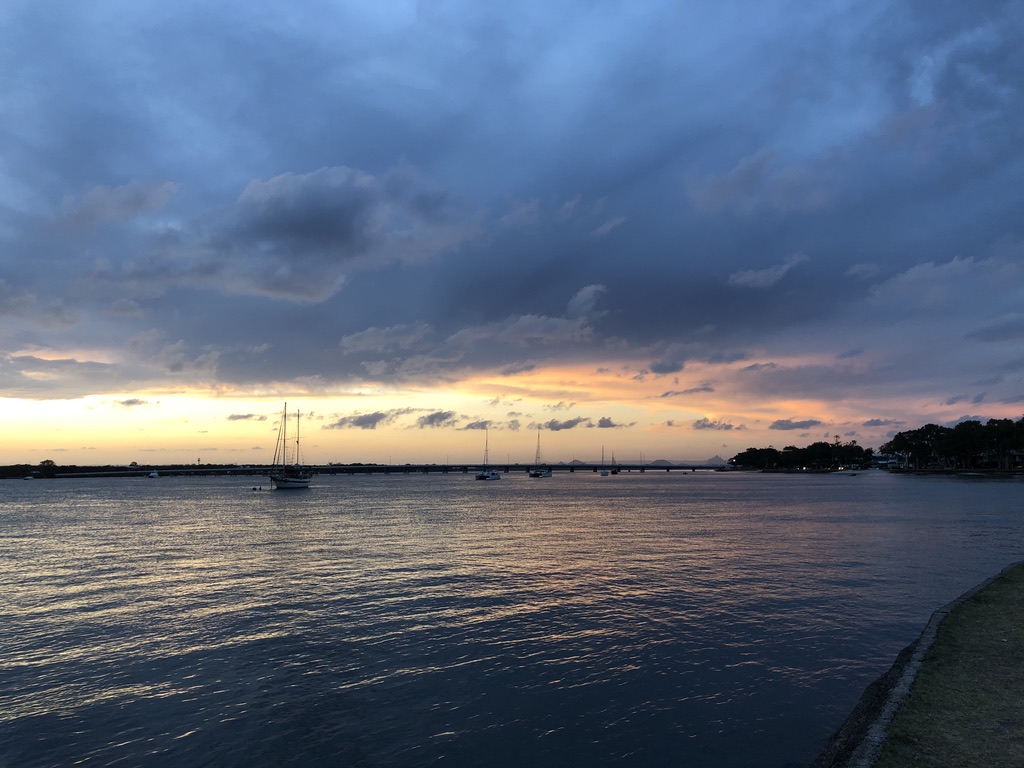
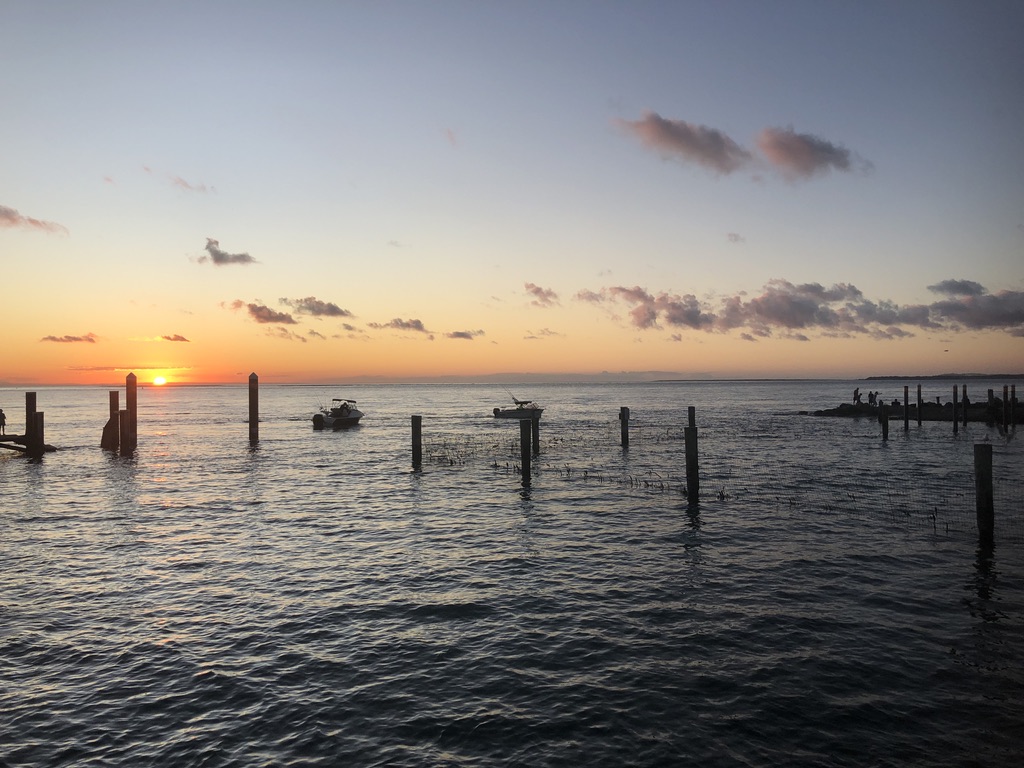
Main photo: Sunset over the Thargomindah Caravan Park photo: Alexandra Knott

Cricket and The Gabba

Back in the day, spectators of cricket matches at The Gabba were allowed to climb over the boundary fence and walk on to the field at lunch to “inspect the pitch”. Con and I did that during a Sheffield Shield match one day. I was heavily pregnant at the time.

When the call came out that play was about to resume and everyone should leave the field, I couldn’t get back over the fence. It was embarrassing. Con got over the fence and tried to help me. I, big as a whale, was the only person still on the field.

Eventually I got there, but that is all I remember of the day’s cricket.

Con has been playing and following cricket all his life. His brother and father taught him to bowl in the back yard in Innisfail, and he played at primary school, with a tennis ball, under the school buildings while it rained outside.

Con has lots of cricket stories from across Queensland. In the 1970s he joined other cricket lovers around Burketown, driving long distances to play.

“At Gregory Downs (120kms away) there was no cricket pitch, so we played on the road. We dragged out mats for the pitch.

“It was the same at Donors Hill (185kms). There, we played on the airstrip.”

He played in the Rosewood team in the Ipswich area, with away matches at towns like Haigslea and Marburg, old German settlement farming areas.

“ I once played a team with every player’s name starting with “z”. Even the dog!” he tells me, making a good story of it, “and the field was on top of a hill. You couldn’t see the bowler until he’d nearly finished his run-up!”

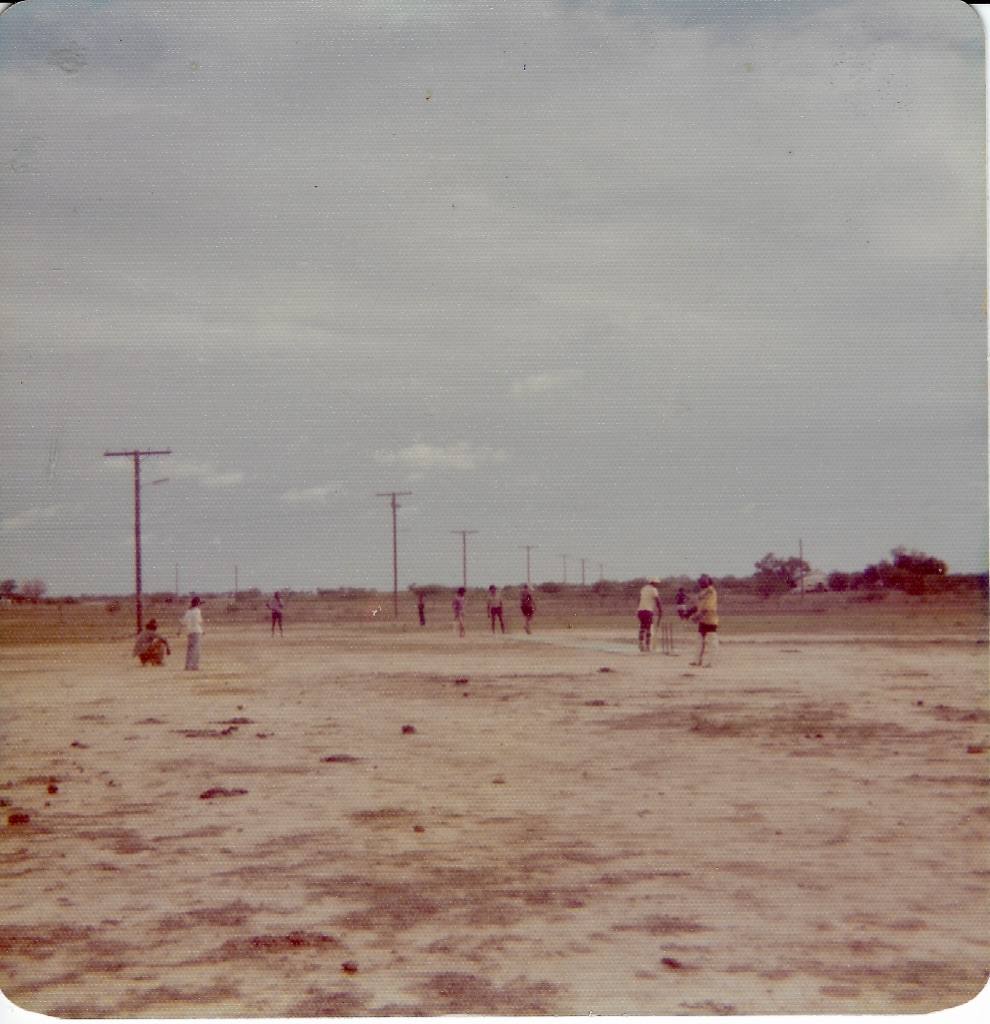
That wouldn’t have been a problem in Burketown, where the game was played on a salt pan behind the school. One of the players, a council worker, would bring the grader round before the game to clear the field of broken glass.

Cricket on the salt pan, Burketown, back in the day…

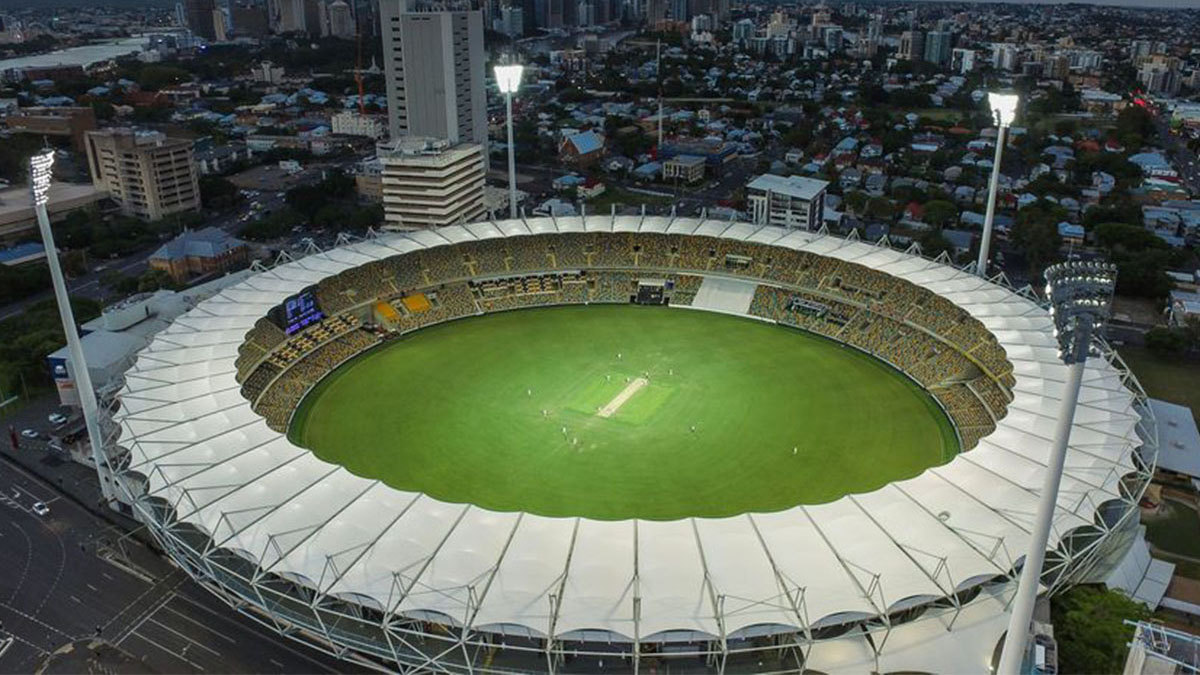
For Queensland, the sacred site for cricket has always been The Gabba: the Brisbane Cricket Ground at Woolloongabba, world-famous among cricketing nations. Overseas, we’ve travelled in cabs driven by Indian immigrants, and when the driver asks, “Where are you from?” Con tells him Brisbane. “We live ten minutes from the Gabba.”

“The Gabba!”

“The Gabba has hosted Test Cricket since 1931” austadiums.com

It’s on. Cricket talk all the way to the destination – especially if we’re in the USA, where people from the subcontinent are starved of their national passion.

At Buffalo, N.Y., in pouring rain, we took a cab to catch the midnight Amtrak train. The Indian driver demonstrated Tandulka’s cut shot as he drove.

In a Boston laundromat, a West Indian man, stiff from the day’s play, described the strong local cricket competition, with over twenty teams made up of immigrants from cricketing countries.

In a small restaurant in Florence, four businessmen from Chenai, in the leather trade, were delighted to talk cricket to someone who understood.

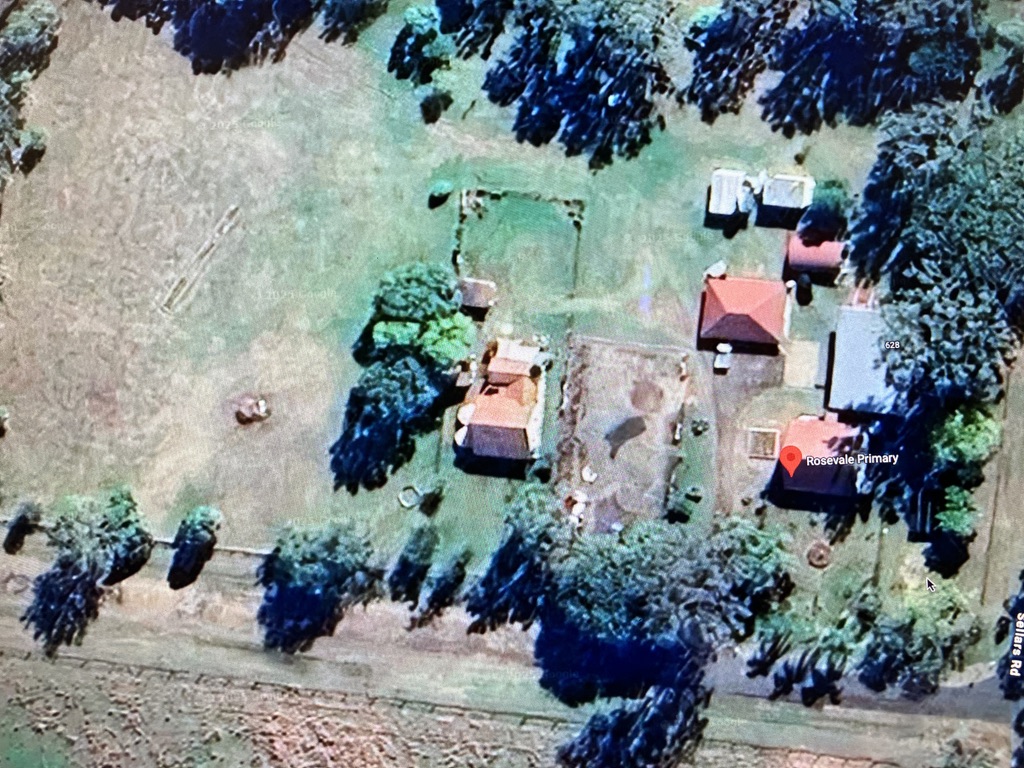
Beside the schoolhouse where we lived at Rosevale, on top of a rise in the beautiful country southwest  of Ipswich, there was a huge Chinese elm, and beyond it a field of long grass.

The school had a ride-on mower and soon after we moved there Con used it to mow the grassy field. To his delight he found a long-forgotten cricket pitch in the middle of the field. From above, that pitch still faintly visible.

Faint outline of the cricket pitch still to be seen beside the old Rosevale schoolhouse earth.google.com

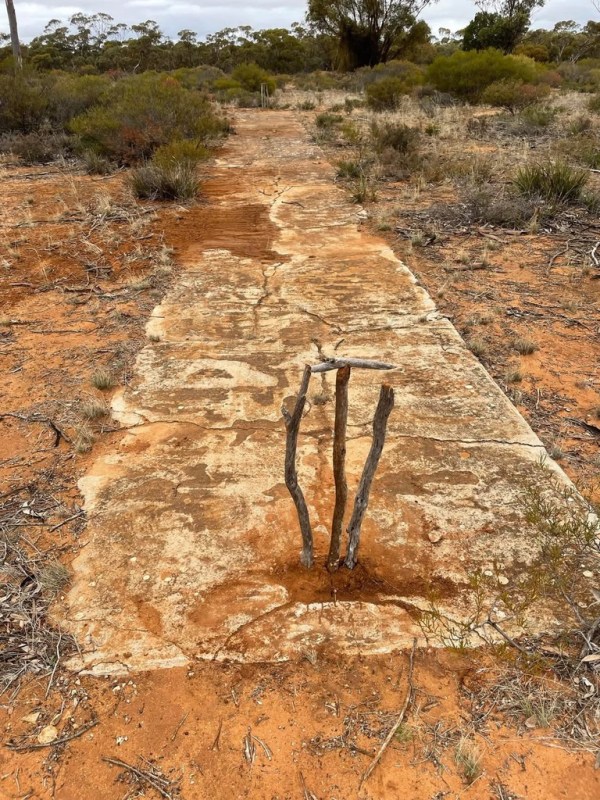
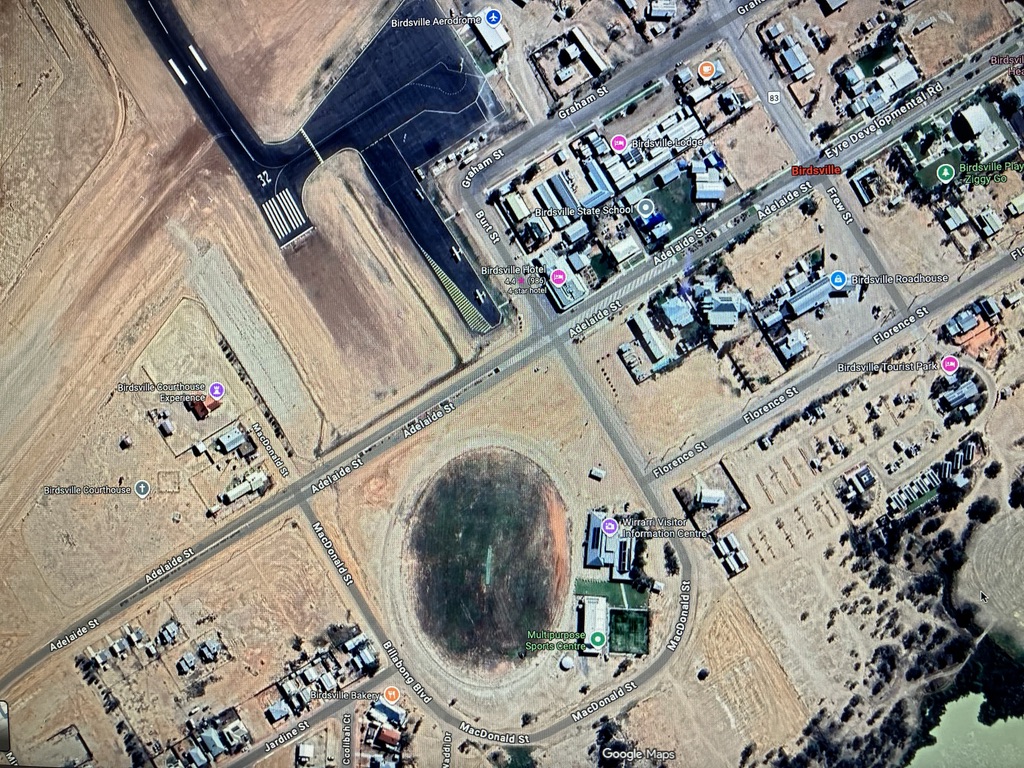
Wherever in Queensland you look on Google Earth, from cities to the smallest towns, certain features show up clearly on the satellite images: the straight line of an airport or airstrip; the racecourse and showground; and a cricket pitch.

From above, the fields may be brown with drought, or green and lovingly tended; but still the pitch show up clearly: a straight line, either concrete, or hard dirt pounded by players’ boots over many years. There are not a lot of entertainment options in bush towns, but sport has always been strong.

Birdsville, with airport and cricket pitch earth.google.com

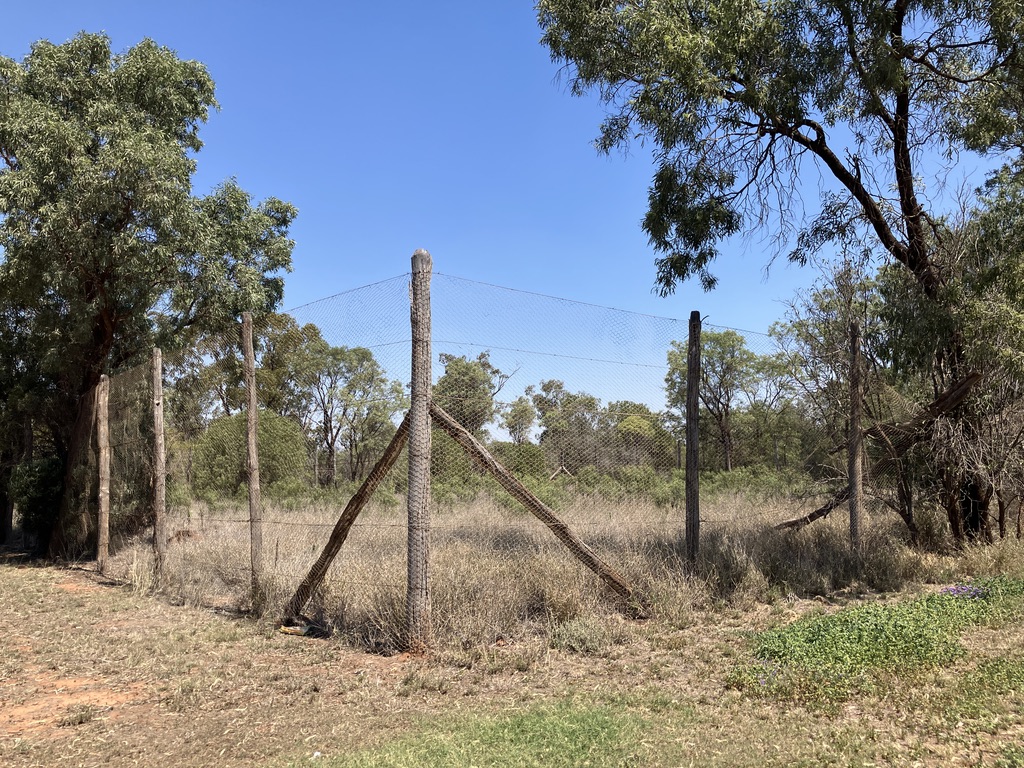
Some local cricket competitions have died out; but the pitch remains. At the tiny Barwon Highway settlement of Weengallon, west of Goondiwindi, the tennis court is abandoned and overgrown with long grass and prickly pear, but on the oval across the road, the shadow of a cricket pitch can still be seen.

Old tennis court, Weengallon

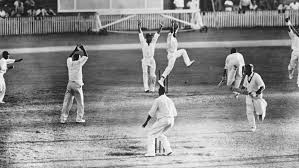
In December 1960 I went with my family to The Gabba. I didn’t know what an historic event that was to be: the Tied Test, Australia vs the West Indies. We sat on the grass of the Hill, under the old scoreboard. Both long gone now.

Climax of the tied test, The Gabba Getty Images

Now they say the Gabba will be torn down after the 2032 Brisbane Olympics. A new stadium, built for the Olympics, will be the venue for important cricket matches.

It won’t be the same.

As I write this, I can hear a familiar, peaceful sound: the “thock” of a cricket bat hitting a ball. In an old tennis court in the street behind our suburban house, every weekend afternoon someone practises batting. He wears pads and helmet, and he is serious about his training.

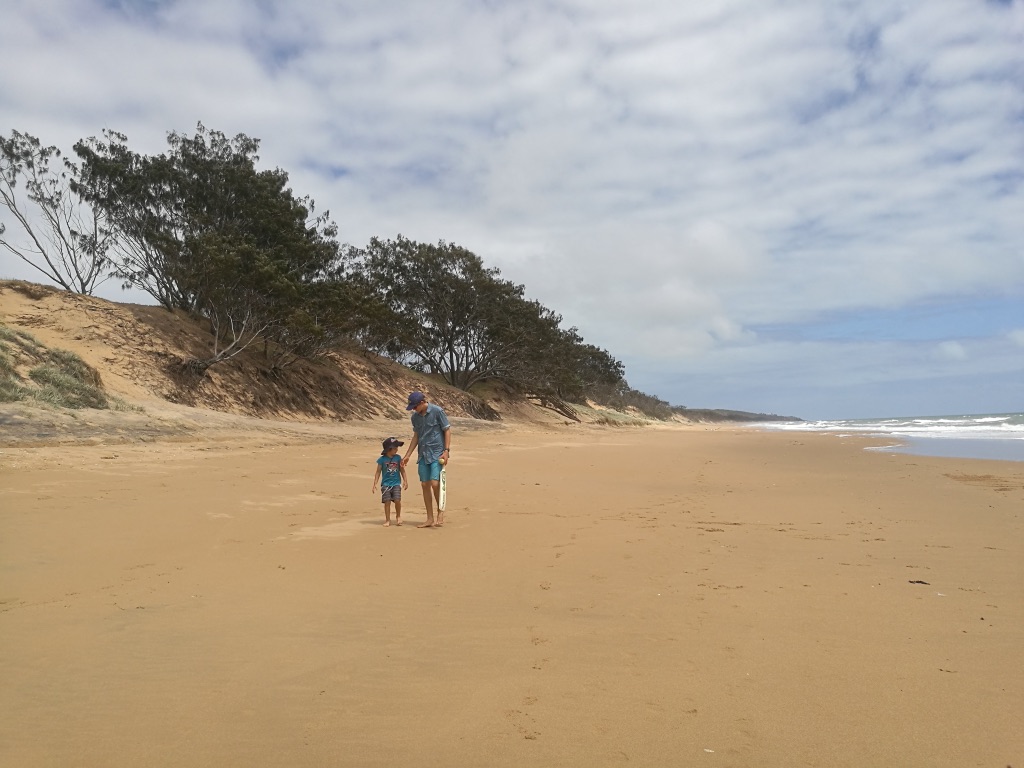
Perhaps he first learned to love the game as many other Queenslanders do, including my grandsons: playing with family and friends on a beautiful beach, somewhere up the long and beautiful Queensland coast.

Main image: from Facebook

Searching for Matthew Flinders

I’m always intrigued by place names and how they came about. Queensland places have had their names and their stories for tens of thousands of years; but when Europeans arrived, they knew nothing of ancient local cultures. For their maps and charts, they named places after important people and sponsors of their voyages, or their friends; their hometowns; dangers, accidents and incidents; places of home.

James Cook was the first to sail up the east coast. Among many other places, he named Queensland’s Glasshouse Mountains.

Matthew Flinders was next. He named Skirmish Point, at the southern tip of Bribie Island, because it was here after some trading of articles that the locals, laughing, tried to steal his hat, then threw a spear when the visitors were rowing away. That’s when the muskets came out, and locals were wounded.

Skirmish Point, Bribie Island

Flinders, on his extended mapping voyages along the coasts of Australia, had several positive encounters with locals, but when it came to a disagreement, conflicts were decided in the usual British military way, with guns; and that is what happened at Skirmish Point.

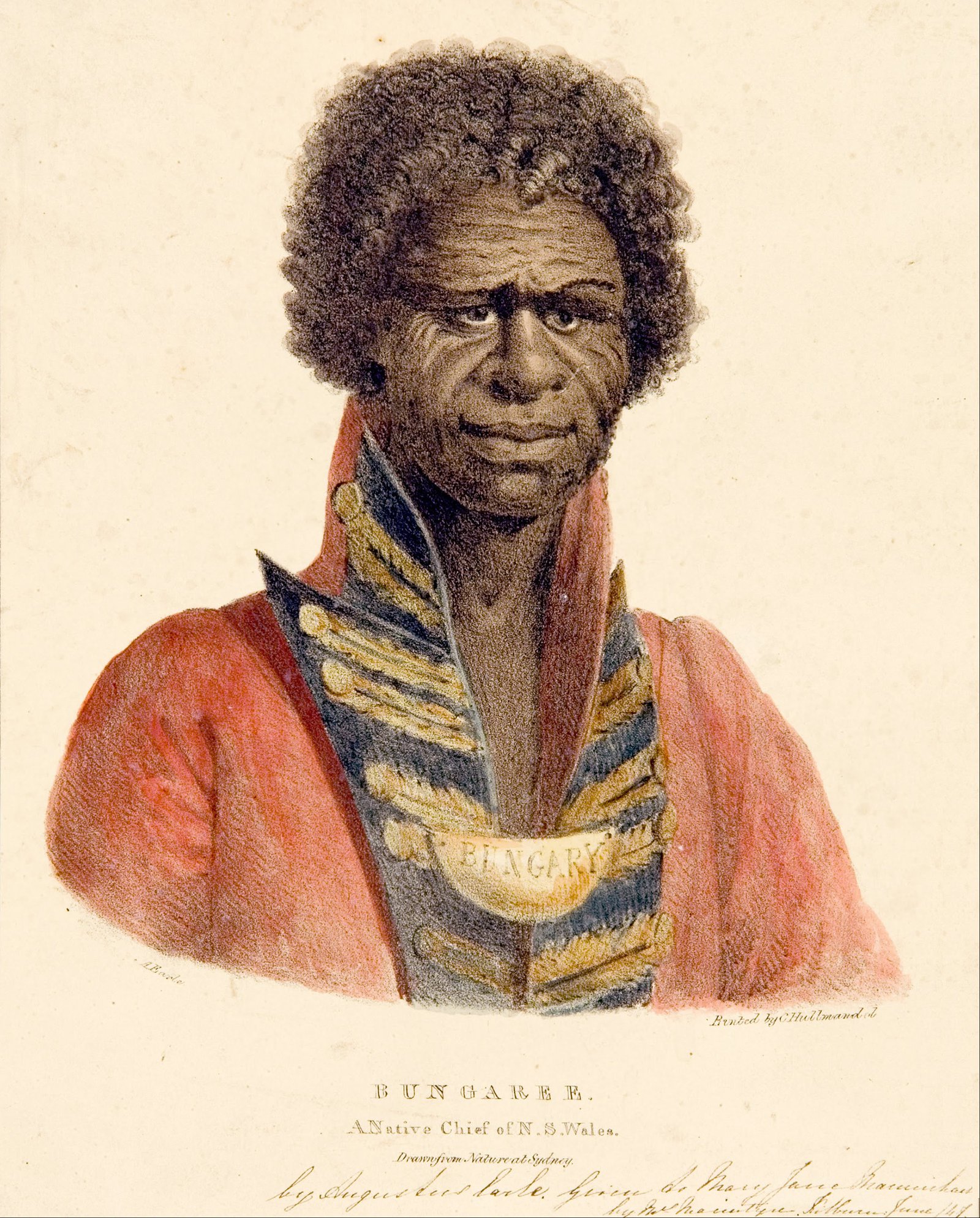
Bungaree, or Bongaree, after whom a suburb of Bribie Island is named, was a member of the Garigal clan of the Broken Bay people from north of Sydney, and he was recruited by Flinders for the voyage in the Norfolk, as well as the later Investigator voyage and others. Bungaree was respected as a person, and as an interpreter and diplomat, making positive contact with local people even though they mostly spoke different languages. Often, these were the first encounters between Europeans and Indigenous Australians.

“Bungaree”, by Augustus Earle australian.museum

This has been a Flinders year for me. In May, I visited the charming holiday town of Victor Harbor, in South Australia.

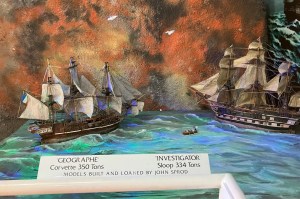
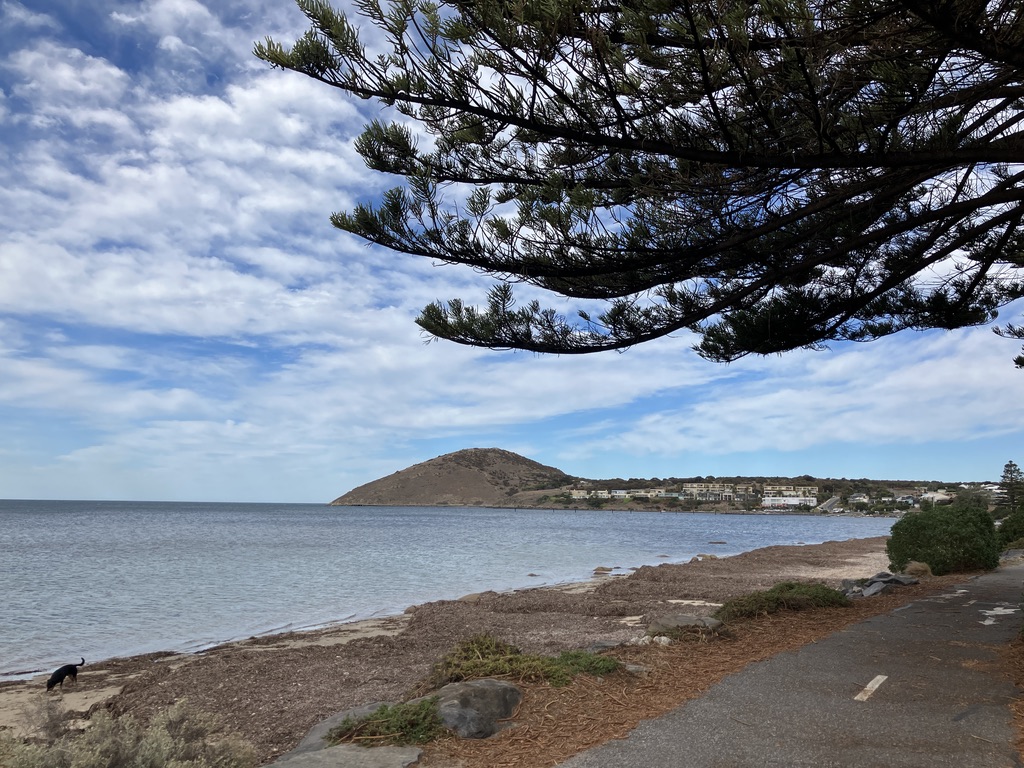
Victor Harbor sits on the shore of Encounter Bay, named by Flinders, near where in April 1802, as commander of HMS Investigator, Flinders met up with the French scientific and mapping expedition under Nicholas Baudin, commanding Le Géographe and Naturaliste.

Model of Flinders’ encounter with Nicholas Baudin’s expedition at Encounter Bay National Trust Museum, Victor Harbor
Encounter Bay, South Australia

The Investigator expedition, under Flinders, had been mounted by the British government for the “complete examination and survey” of the coast of New Holland, mainly to make sure the French didn’t lay claim to it, so this meeting was a tricky one, although friendly.

The National Trust Museum at Victor Harbor tells the story well.

Flinders had already mapped the southern coast, across the Great Australian Bight, past Kangaroo Island and Port Lincoln and many other points all named by him. He had climbed a mountain in what were later named the Flinders Ranges. The name now pops up all over the southern and eastern states of Australia. Australia itself was named by Matthew Flinders, and it’s said that his map of the continent was still being used until the mid-twentieth century.

During the arduous voyage in the leaky, unfit Investigator, ultimately circumnavigating Australia, Flinders named places in what would become Queensland. He named Bowen, and in exploring the Gulf of Carpentaria, named Mornington, Bentink and Sweers Islands.

It was Flinders who named the Great Barrier Reef(s).

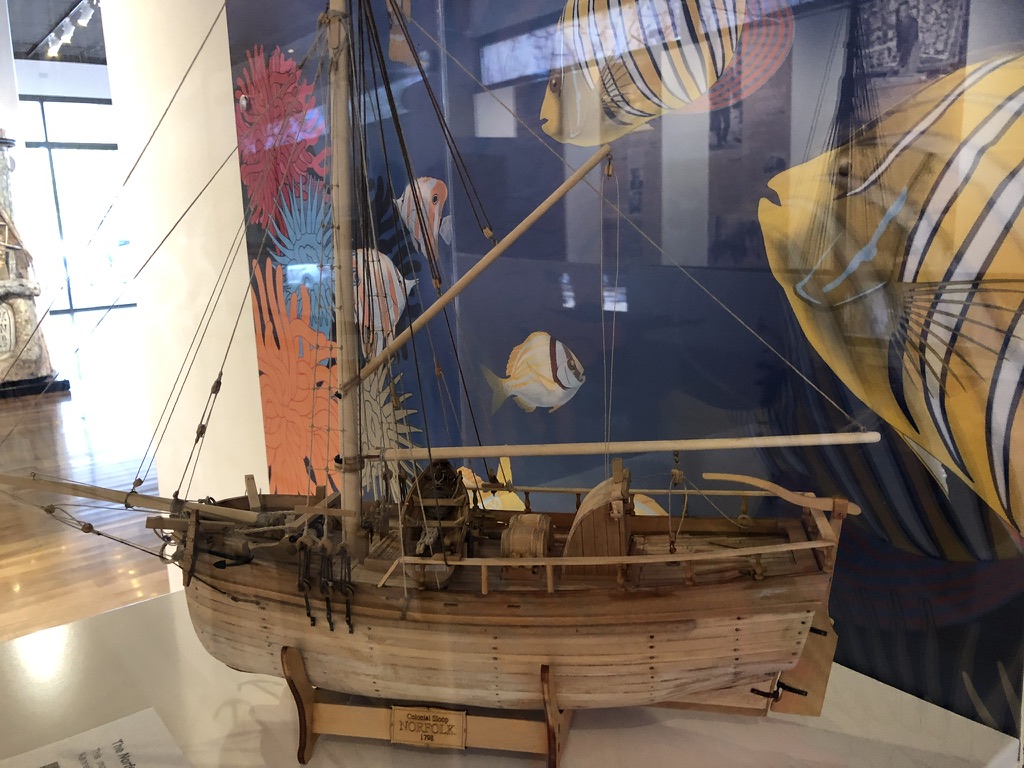
In 1799, three years earlier, Flinders had been commissioned to sail north from Sydney looking for rivers – potential harbours and ways to reach the unknown inland. Sailing through Moreton Bay in the tiny HMS Norfolk, he mapped and named several Moreton Bay islands and Red Cliff Point.

Model of HMS Norfolk Bribie Island Seaside Museum

The mangroves and sandbars of Moreton Bay hid from him the Logan, Brisbane and Pine Rivers, but he gave Pumicestone Passage its name, calling it, hopefully, Pumicestone River.

Anchored off the southern end of Bribie, Flinders went seeking a lookout point, heading for the nearby Glasshouse Mountains.

Flinders anchored near this spot, off the southern end of Pumicestone Passage

From near today’s Donnybrook, with Bungaree and two seamen, Flinders reached Beerburrum and climbed it. Tibrogargan, a little to the north, was too difficult, and the group camped nearby beside Tibrogargan Creek.

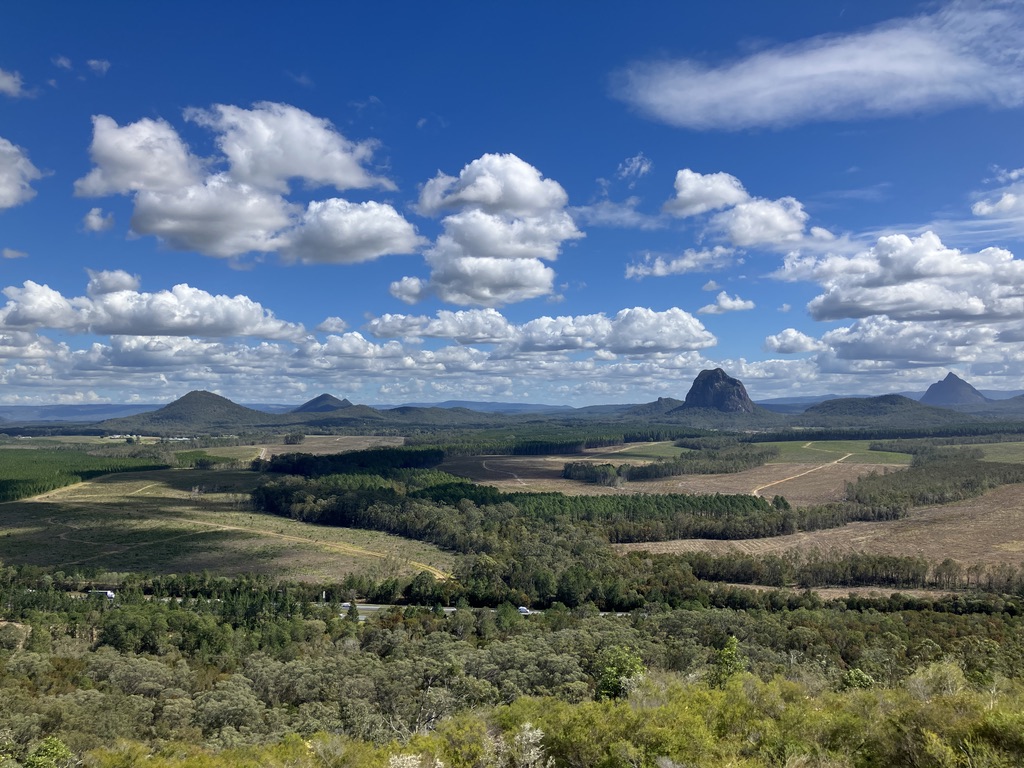
The Glasshouse Mountains, as seen from Wild Horse Mountain. Beerburrum on the left, Beerburrum the high mountain second from the right

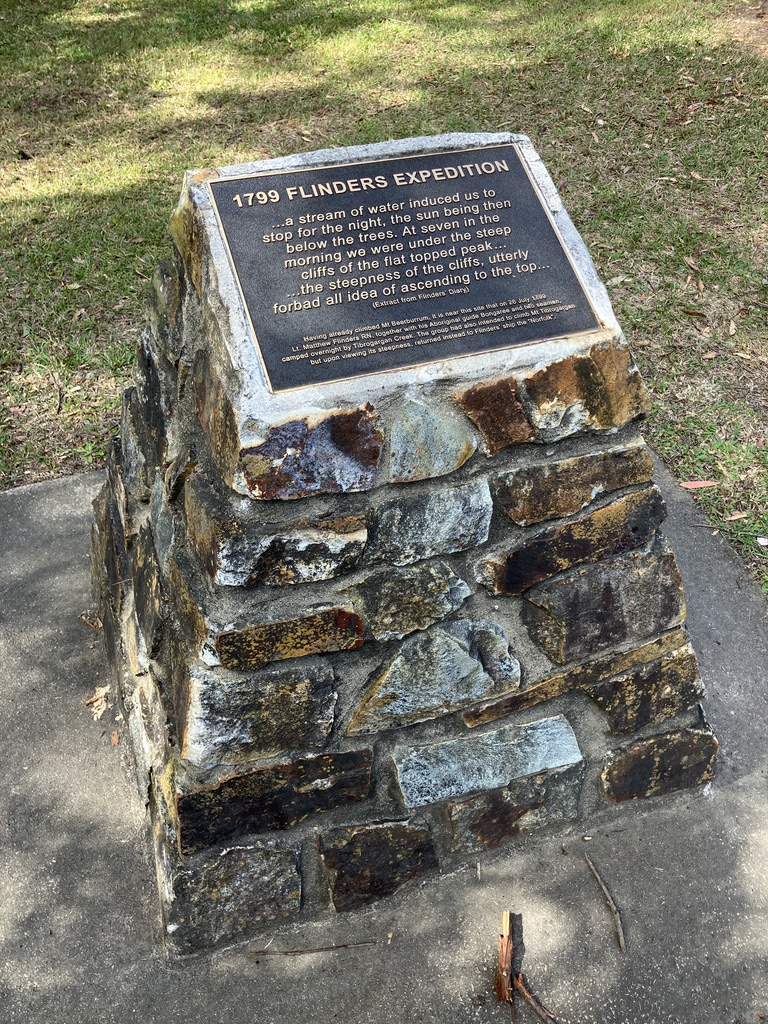
There is now a cairn commemorating the expedition in the Matthew Flinders Park Rest Area near their campsite.

Cairn in the Matthew Flinders Park Rest Area

In August 1803, Flinders left Sydney in the Porpoise for England to arrange a better ship for survey work. 450 kilometres off Keppel Bay (Emu Park) the Porpoise and companion ship the Cato were wrecked on the reef still known as Wreck Reef. The survivors were marooned on a sandbank, including Flinders and his cat.

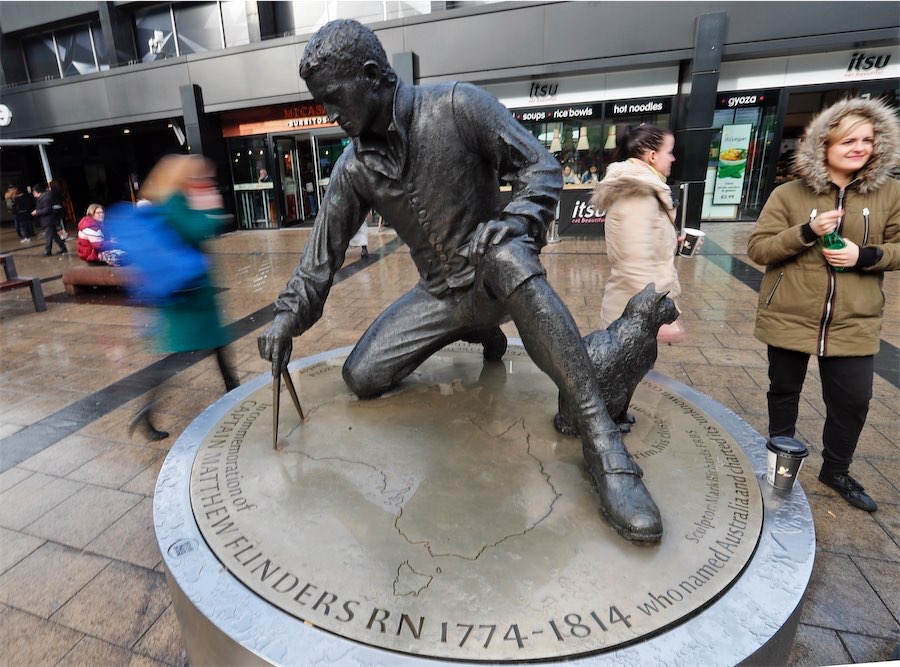
Trim, the cat, had been born on HMS Reliance in 1799, during its voyage to Sydney with Flinders as master’s mate. Trim and Flinders were companions during their voyages on the Norfolk, the Investigator, the Porpoise and the Cumberland. Wherever you find a statue of Matthew Flinders, his cat will be with him.

My favourite statue of Matthew Flinders and Trim, at Euston Station AP Photo
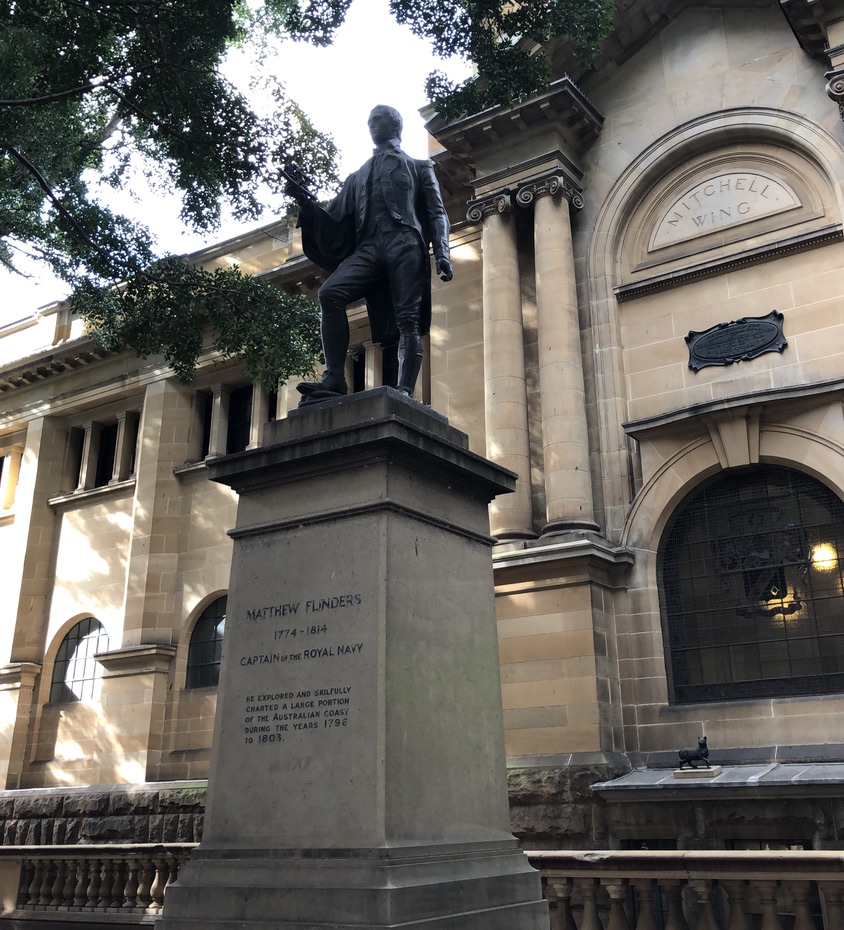
Matthew Flinders statue outside the Mitchell Library Sydney. Trim stands on the window ledge behind him

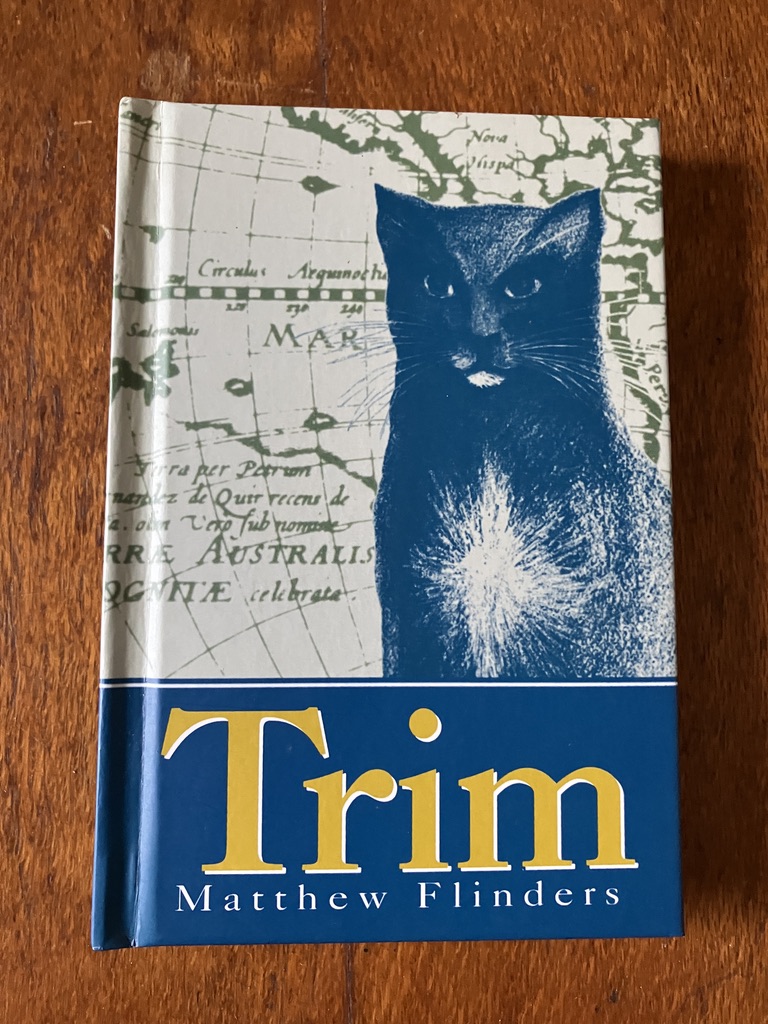
Flinders wrote charmingly about Trim, his account published in the little volume “Trim”, which I bought at Bribie Island Seaside Museum.

Stuck on a sandbank and expecting no rescue, Flinders with a crew of thirteen set off in a cutter to row and sail the 1100 kilometres back to Sydney for help. In less than two weeks they arrived there, and headed back in the small, barely seaworthy Cumberland, with two other ships, to rescue the stranded men, and the cat, from the sandbank.

Determined to get back to England and arrange his ongoing explorations, after the rescue of the marooned crew, most of whom returned to Sydney, Flinders headed north and west in the Cumberland, eventually landing for repairs at the French colony of Mauritius, not knowing that the French-British wars had broken out again. He was taken prisoner, and spent six and a half miserable years there before being allowed to return home.

It was on Mauritius that Trim was lost.

This long imprisonment contributed to Matthew Flinders’ death at the age of forty, in July 1814. “A Voyage to Terra Australis” the book that summarised his life’s work, was published the day before he died.

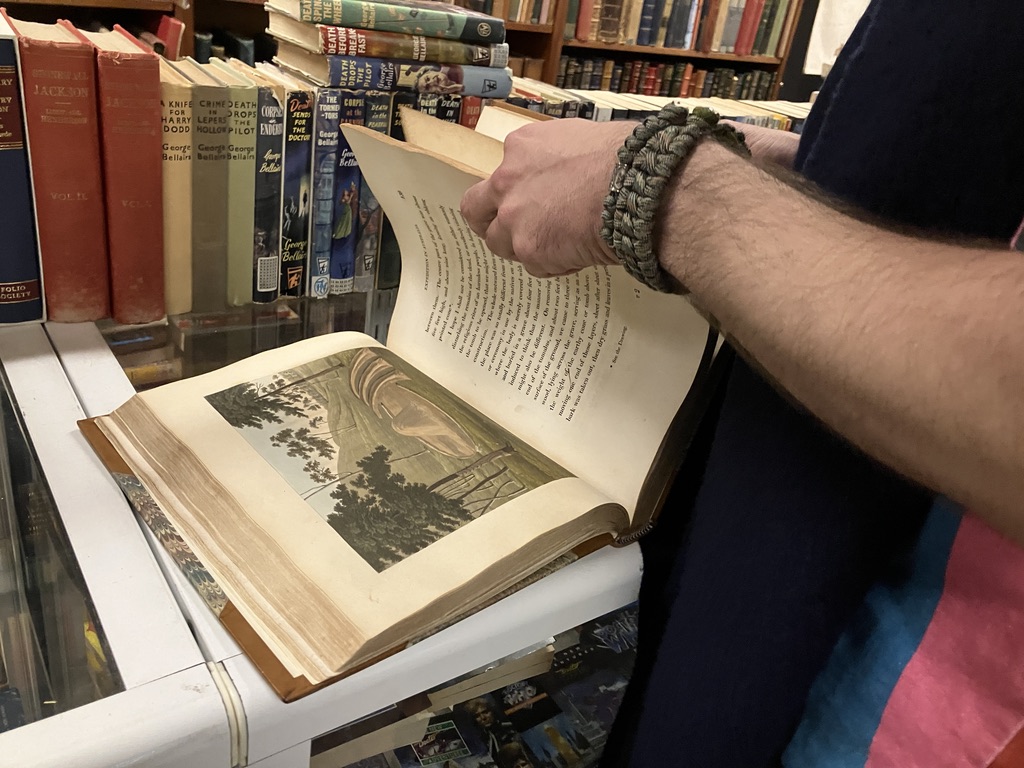
In the splendid O’Connell’s Bookshop in Adelaide I got to see a valuable copy of this work, the result of so much adventure, pain and determination.

In O’Connell’s Bookshop, Adelaide, being shown a copy of Flinders’ “A Voyage to Terra Australis”

Matthew Flinders was buried in a London church graveyard, but the site was redeveloped in later years and his grave was lost.  In 2019, archaeologists undertook a survey of the old graveyard, near Euston Station, prior to construction of a new branch of the London Underground, and found the lead breastplate which marked his grave.

It was exciting news. The “Matthew Flinders Bring Him Home” group began to work towards his reburial in his hometown of Donington, Lincolnshire.

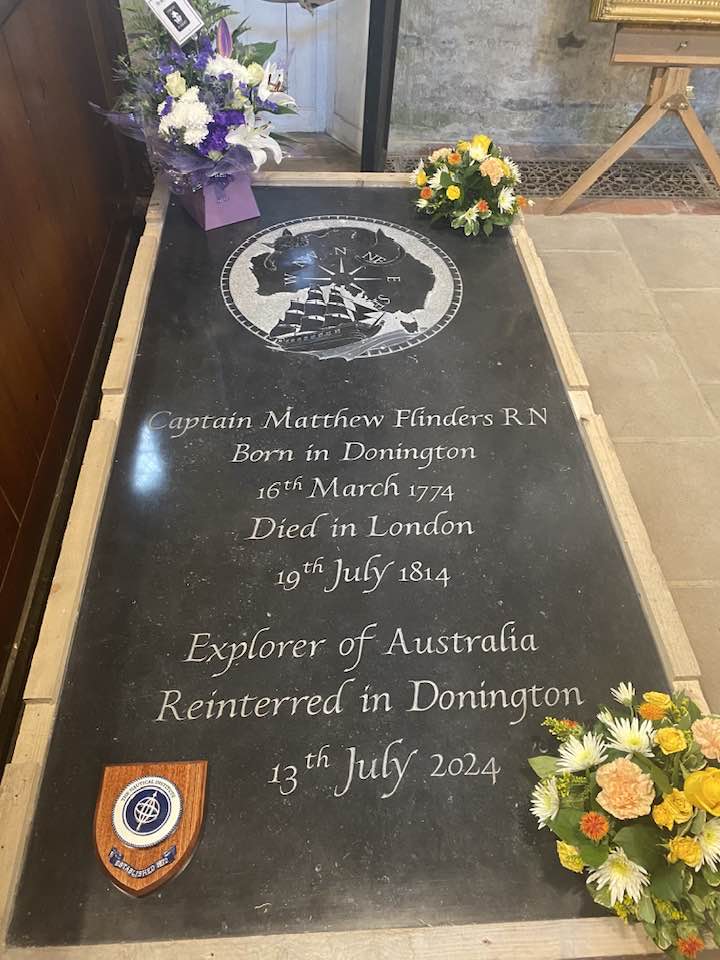
In July 2024, 210 years after his death and with full military honours,  Matthew Flinders was laid to rest in the Church of St Mary of the Holy Rood, Donington. As well as descendants of the Flinders family, two descendants of Bungaree were at the ceremony.

Matthew Flinders gravestone in the Church of St Mary and the Sacred Rood, Donington, UK, includes a mao of Austrlia and a picture of Trim Photo: “Matthew Flinders Bring Him Home” Group
Shad Tyler and Laurie Binison, descendants of Bungaree, at Matthew Flinders reburial Photo: pittwateronlinenews.com

The name of Flinders now appears all over Australia, including on major streets in both Melbourne and Townsville, and on Flinders Parade, Sandgate, where my great-grandparents lived a hundred years after the little Norfolk sailed by on its way up the bay.

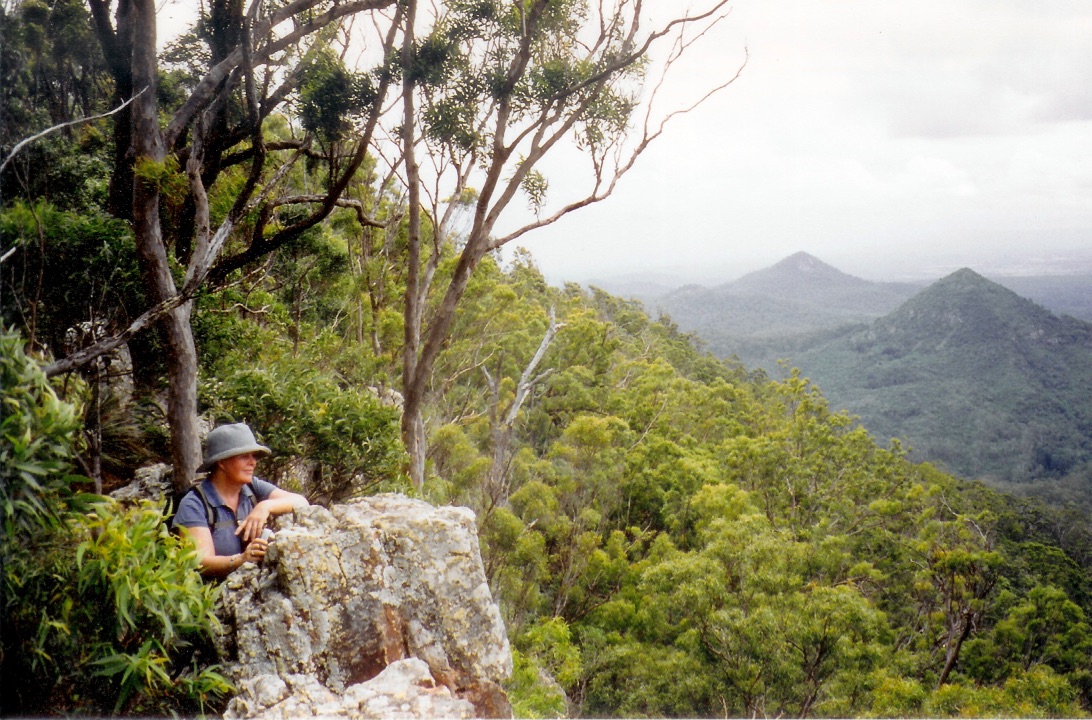
I’ve walked the track to the top of Beerburrum, and climbed Tibrogargan (the western, easier side); and I’ve also been to the top of a peak which can be seen to the south-west from many of Brisbane’s high points: Flinders Peak. It was a scramble in places, but worth it for the view.

The writer on Flinders Peak

In 1799 Flinders spotted the peak from the sea and named it “High Peak”. When John Oxley sailed this way twenty-five years later, searching for a suitable place to build the convict settlement that would later become Brisbane, he renamed it Flinders Peak.

Of course, like all of these places, it already had a name: Booroong’pah. Like all of these places, it already had its own long-established stories.

The Matthew Flinders story is just another story of Australia, and of Queensland; but it will always be a story both inspirational and moving.

About Matthew Flinders

  • “Flinders: The life, loves and voyages of the man who put Australia on the map”, Grantlee Kieza, 2023. Excellent biography, based on primary sources
  • “My Love Must Wait”, Ernestine Hill, 1941, my first introduction to the story Of Matthew Flinders
  • “A Biographical Tribute to the Memory of Trim”, Matthew Flinders, published 1977, from the archives of the National Maritime Museum, Greenwich
  • “In the Footsteps of Flinders: Memorial to great navigator unveiled,” article by Clem Lack for Royal Historical Society of Queensland, 1963, describing Flinders’ expedition to  Beerburrum.
  • “Matthew Flinders’ Cat”, Bryce Courtney, 2002. A novel of Sydney, with Trim’s story vividly told.

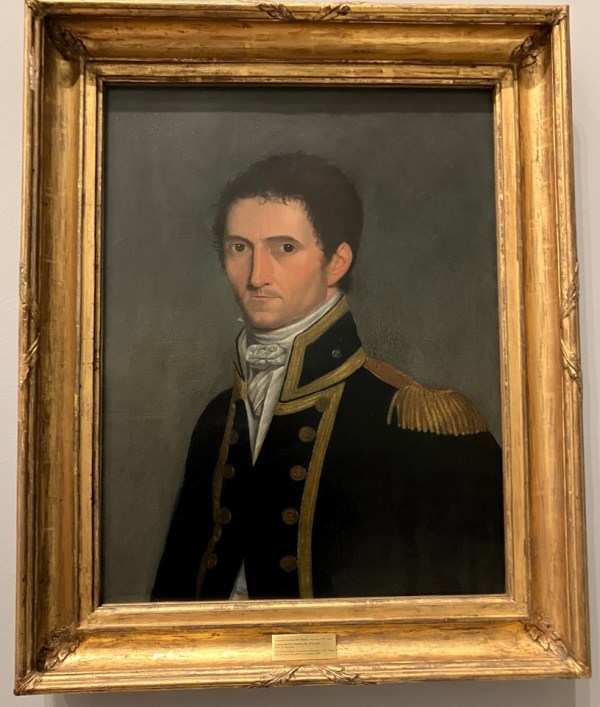
Main picture: Portrait of Captain Matthew Flinders, RN, 1774-1814. Toussaint Antoine de Chazal de Chamerel. 1806-07, Mauritius Art Gallery of South Australia

Choosing Our Olympics Mascots

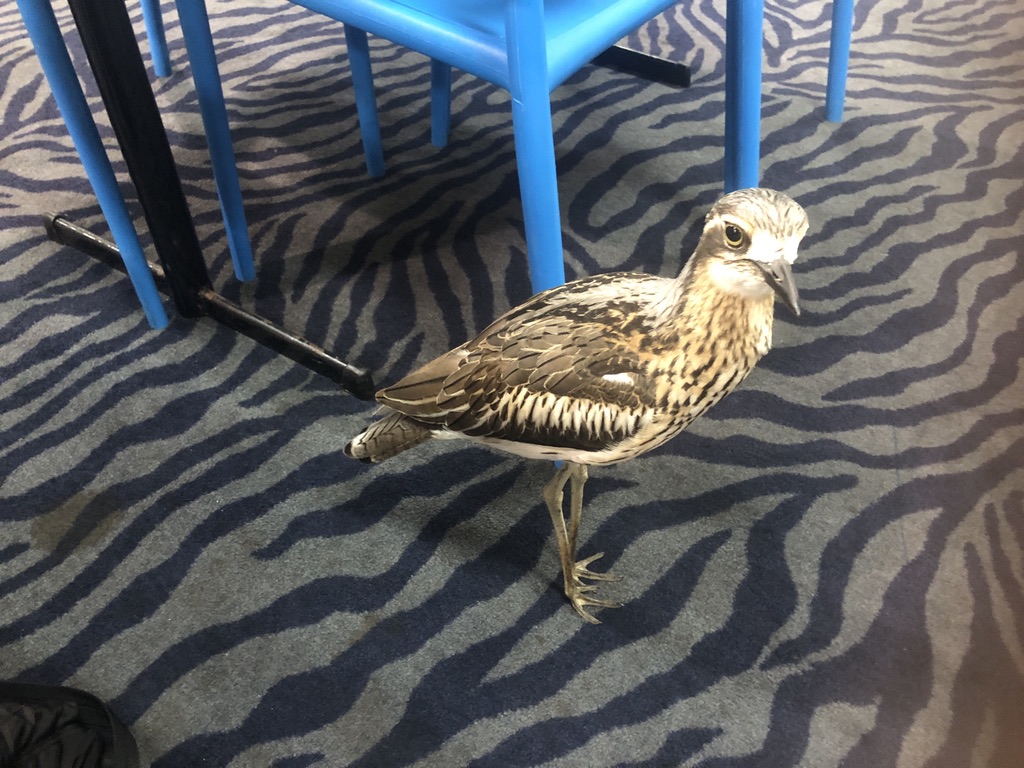
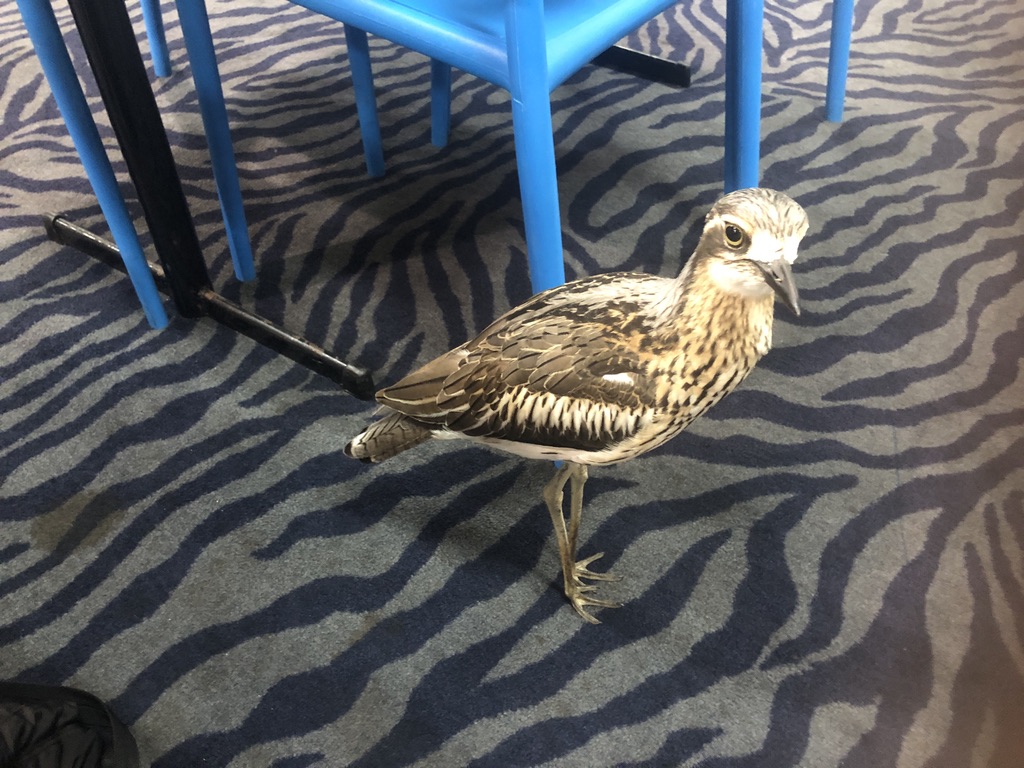
An alarm went off, late at night, and I heard terrible screaming.  Leaving the light off, I went out on to the verandah to take a look. Walking across the street were the sources of the screaming – two bush stone-curlews. They had been stirred up by the sound of the alarm.

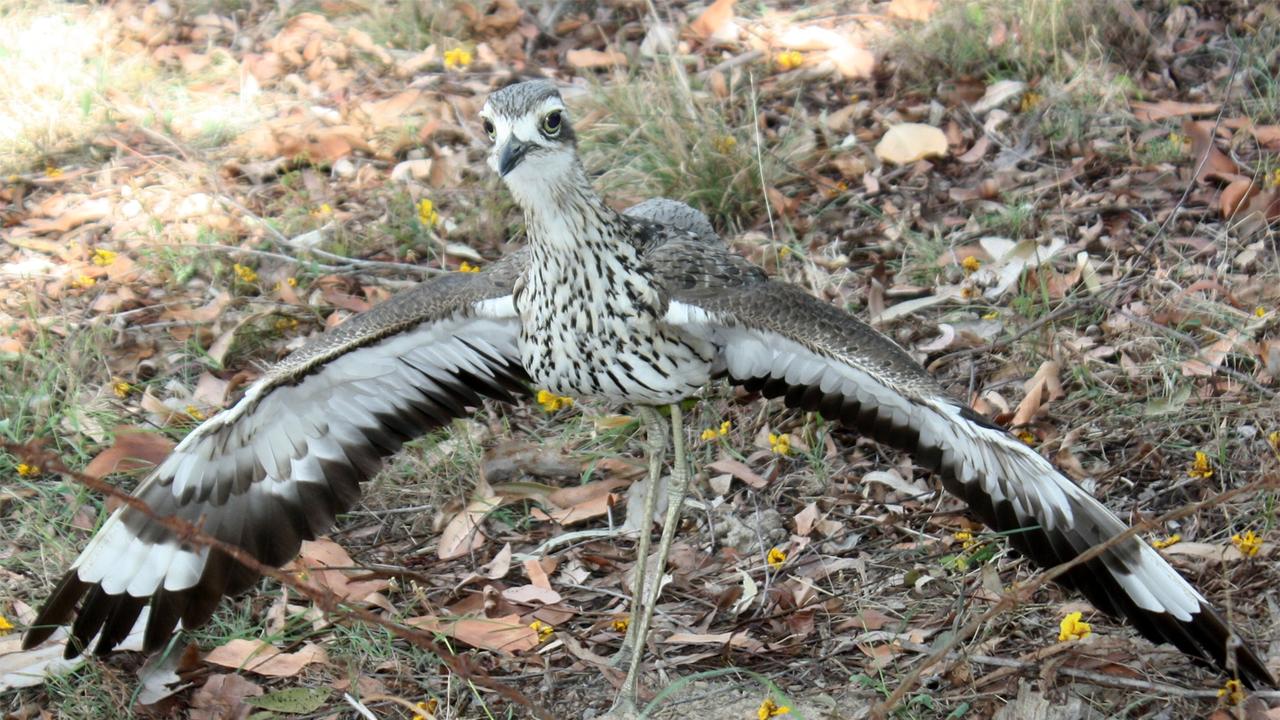
Bush stone-curlews are everywhere in Brisbane and up and down the Queensland coast. They are spooky birds, with huge yellow eyes and that piercing night-time shriek. https://www.youtube.com/watch?v=MnK6B0T5yDw

They protect themselves during the day by staying perfectly still, camouflaged by their streaky grey feathers, under trees and bushes or even out in the open. Artists like them.

Stone-curlew greeting card by Brisbane Artist Ingrid Bartkowiak, from her Australian Birds Collection

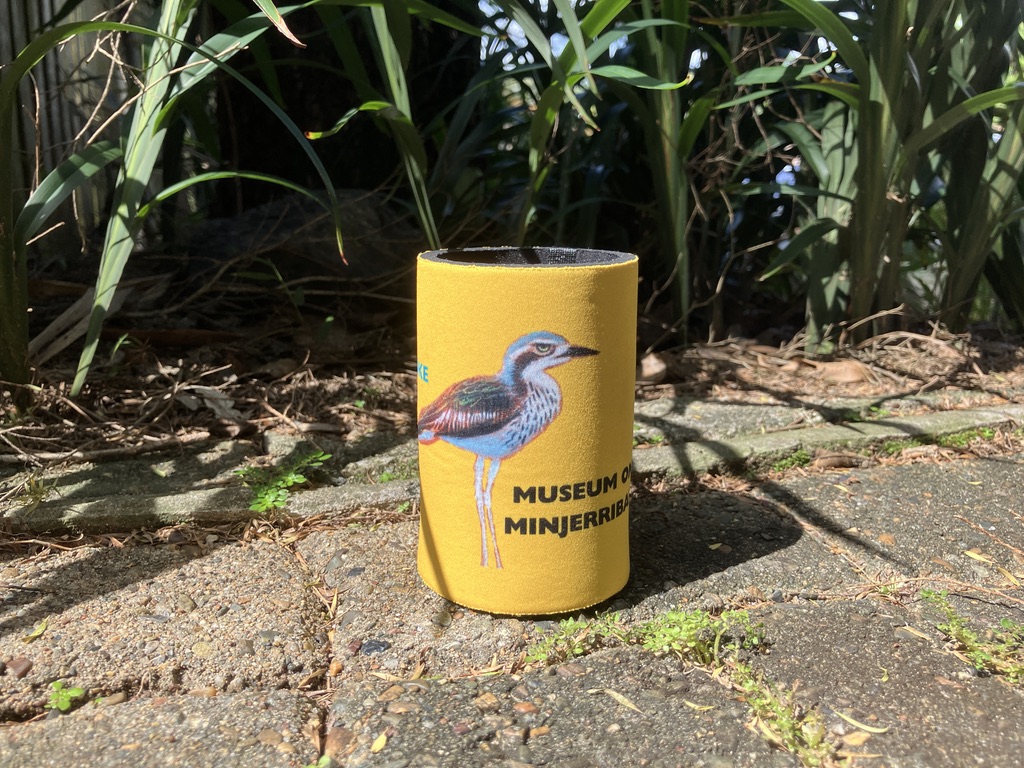
Coochiemudlo Island in Moreton Bay is a favourite haunt of stone-curlews, and if you have a  meal on the terrace of the Point Lookout Hotel on Stradbroke Island Minjerribah, or at the local bowls club, you’ll see them wandering among the tables.

Stone-curlew at the Bowls Club
Souvenir of Straddy

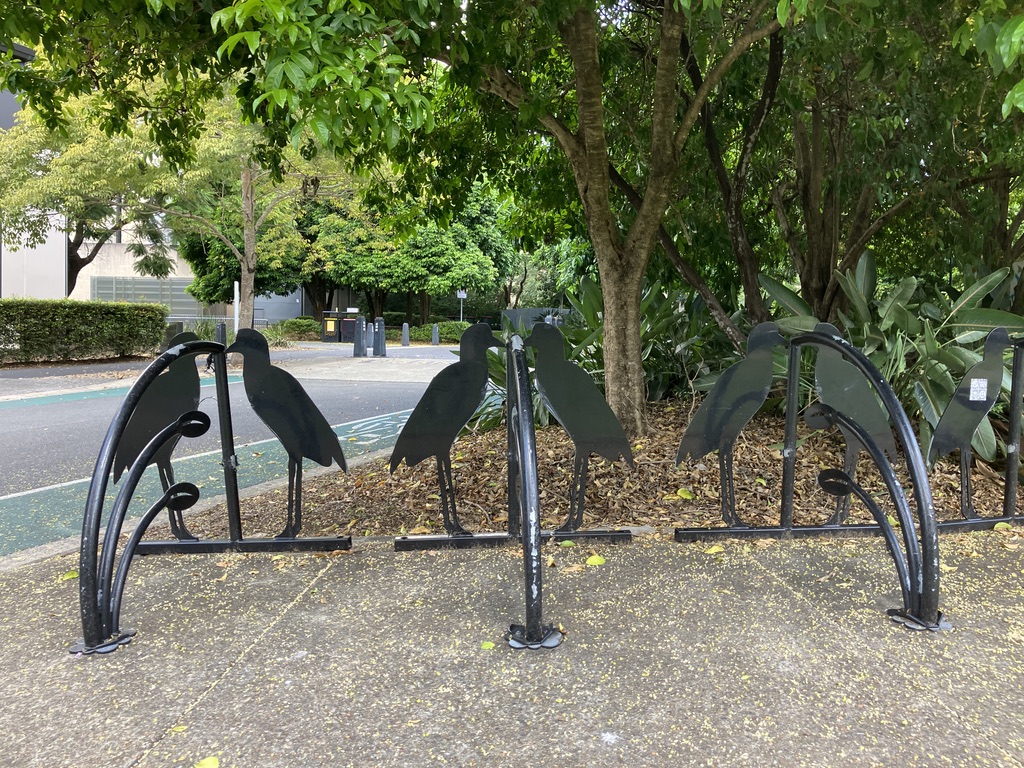
Stone-curlews haunt the leafy campus of the University of Queensland, which celebrates them with signage and curlew shaped bike racks.

Stone-curlew bike racks at UQ

The birds live in parks and bushland reserves and often lay their eggs in the open, in patches of scrappy landscaping, in the midst of commuters and office workers; screaming and shaking their wings at anyone who comes too close. I love them.

Bush stone-curlew warning intruders away Pic: townsvillebulletin.com.au

People from the southern states, when they think of Queensland, think of crocodiles and stingers, cyclones and floods and strange politicians. A beautiful, wild place, unpredictable, and just a bit scary.

In our choice of how to present ourselves to the world at the Brisbane Olympics, through mascots, promotions and merchandise, we should lean into these perceptions of what we are: beautiful, but a little bit scary.

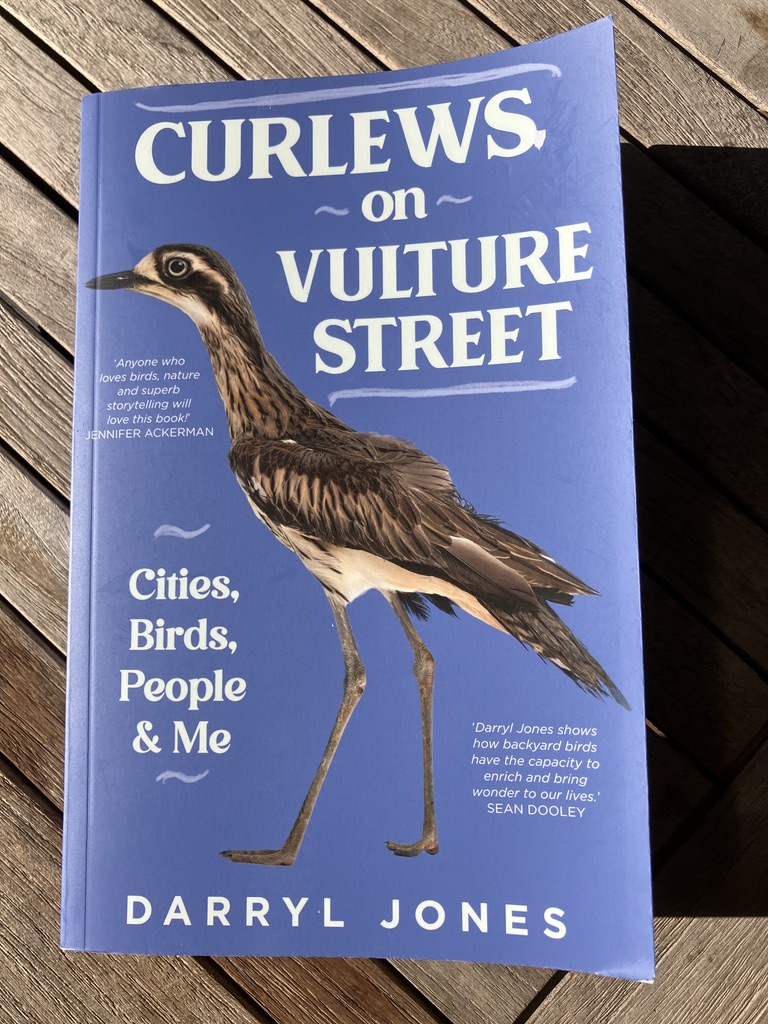
Bush stone-curlews would make a perfect mascot. Find out more about them, as well as other potential bird mascots like magpies, crows, bush turkeys and rainbow lorikeets, in Darryl Jones’s engaging book “Curlews on Vulture Street”.

Sydney’s 2000 Olympics had the platypus, echidna and kookaburra for its mascots.

Sydney Olympics mascots, Syd, Ollie and Millie. Also Lizzie, the frill-necked lizard, for the Paralympics Pic: en.wikipedia.org

The 2018 Commonwealth Games at the Gold Coast had a surfing koala.

Borobi, the Surfing Koala Pic: en.wikipedia.org

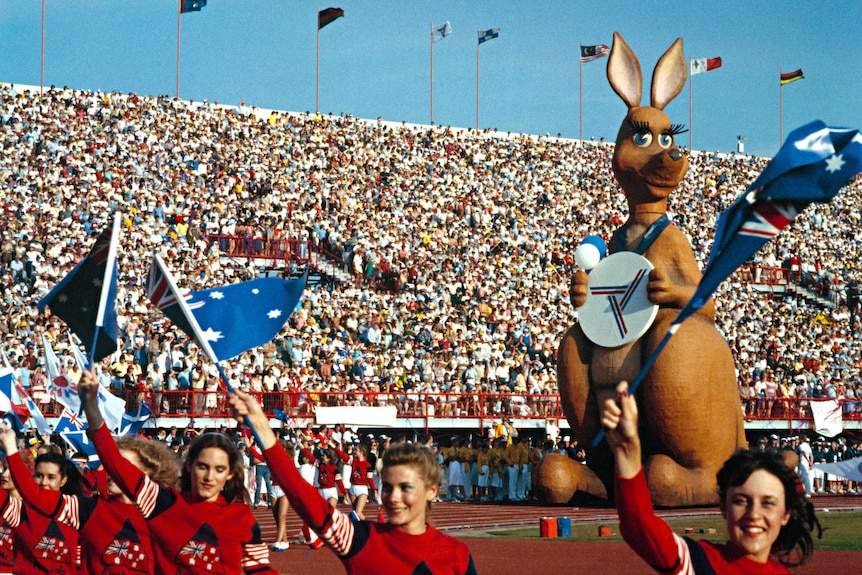
In 1982, the Brisbane Commonwealth Games had the red kangaroo as mascot.

Matilda the Red Kangaroo at the 1982 Brisbane Commonwealth Games Pic: National Archives of Australia

For our Olympics we should avoid the obvious creatures and go for something wilder, living up to our reputation.

After all, one thing we Queenslanders, and Australians, love to do is scare foreigners with stories of our dangerous wildlife.

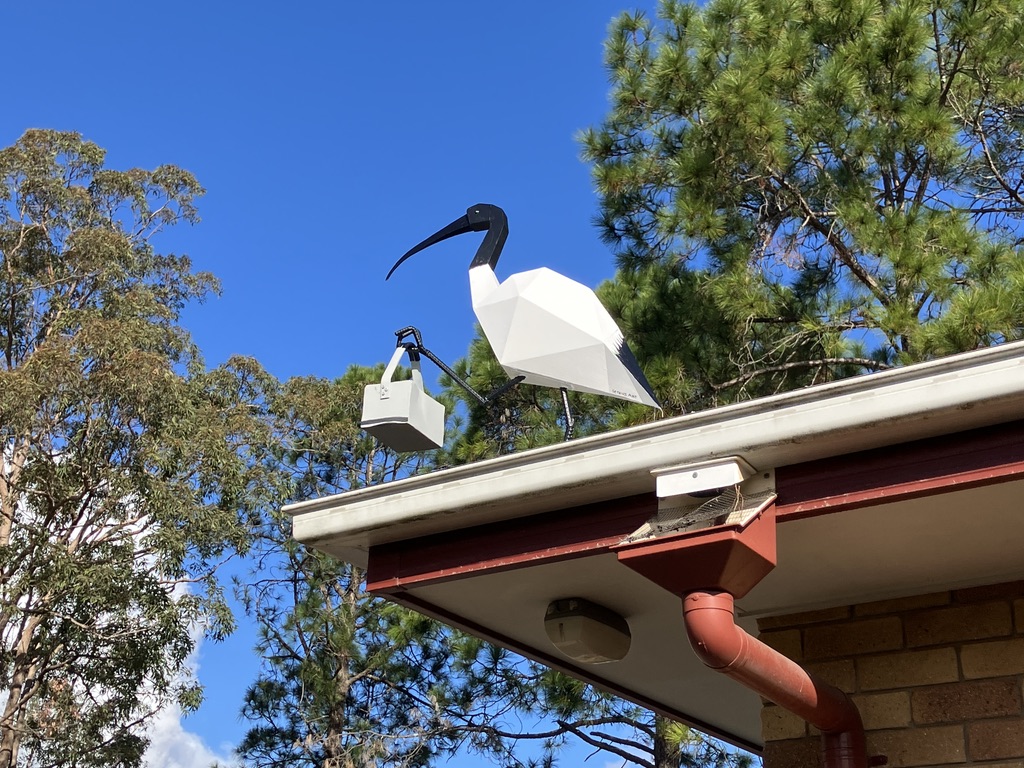
Please, let’s not choose the Australian white ibis for a mascot, the “bin chicken”. I can see the appeal –  the bin chicken is a kind of anti-hero, likeable for its persistence and boldness around Brisbane outdoor cafes. There is even a Bin Chicken Trail to celebrate them. https://www.sethius.art/binny

One of Sethius Art’s “bin chickens”, on the roof of Meals on Wheels, Mt Gravatt

There are plenty of other interesting and worthy candidates to choose as mascots, though, and not only birds.

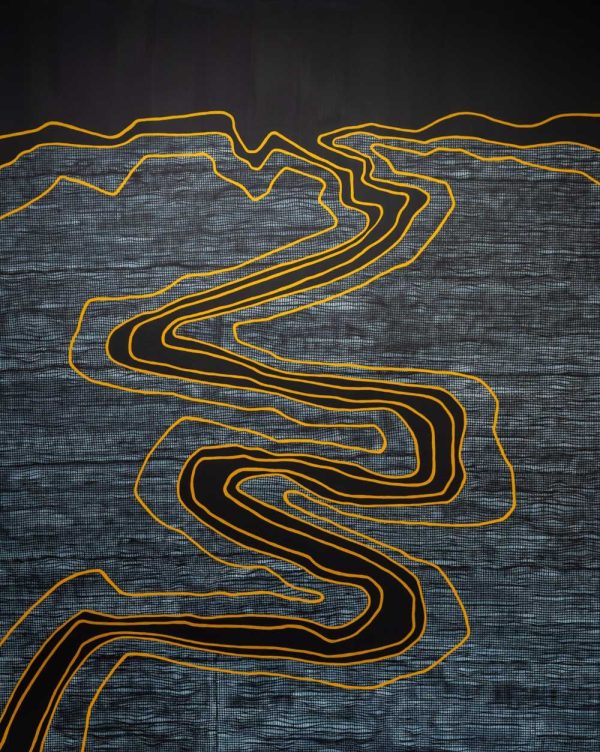
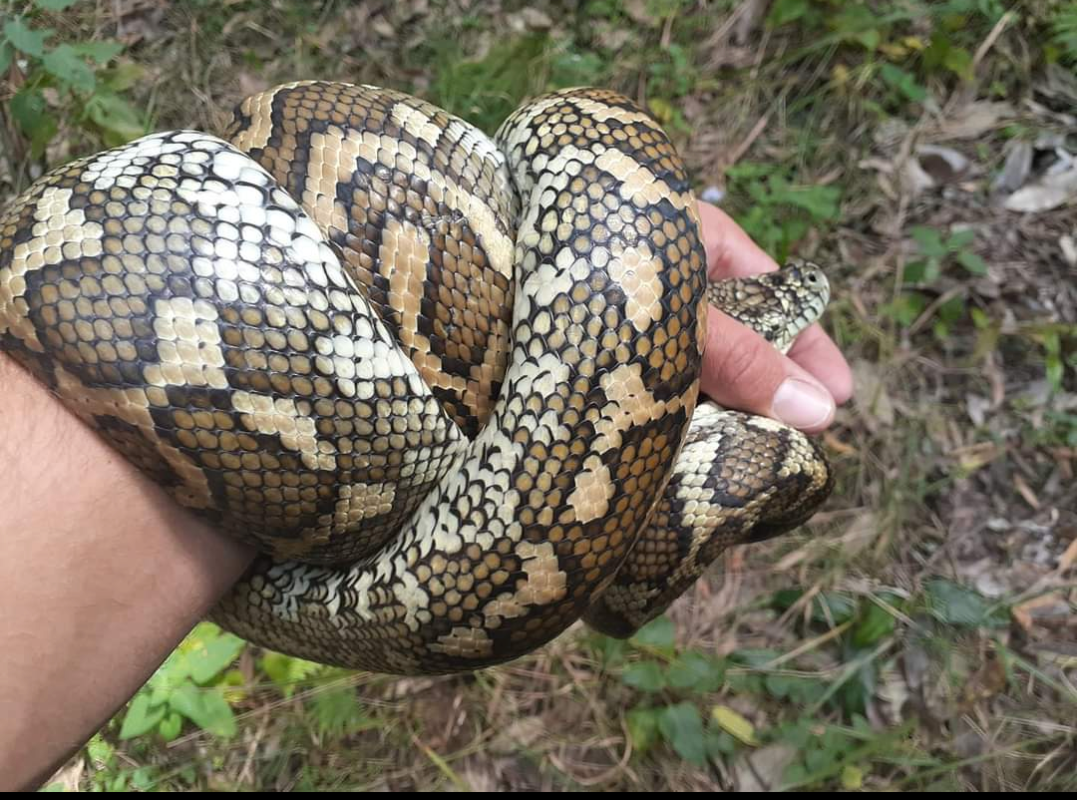
The Brisbane River curves like a snake, and our reptile emblem could be the beautiful and and useful carpet python, the creature that slithers through suburban houses and gardens keeping us free from rats, crawling along verandahs or coiling itself up  behind stag horn ferns.

“Maiwar, Brisbane River”, by Charmaine Davis

To the Gubbi Gubbi people of the area north of Brisbane, Caboolture is the place of the carpet python: Kabul, the Rainbow Serpent. Schools and sporting teams proudly feature snakes on their logos and uniforms. That gives the carpet python a special significance.

It would look good on Olympics souvenir t-shirts, too.

The beautiful carpet python Pic: seqsnakecatchers.com.au

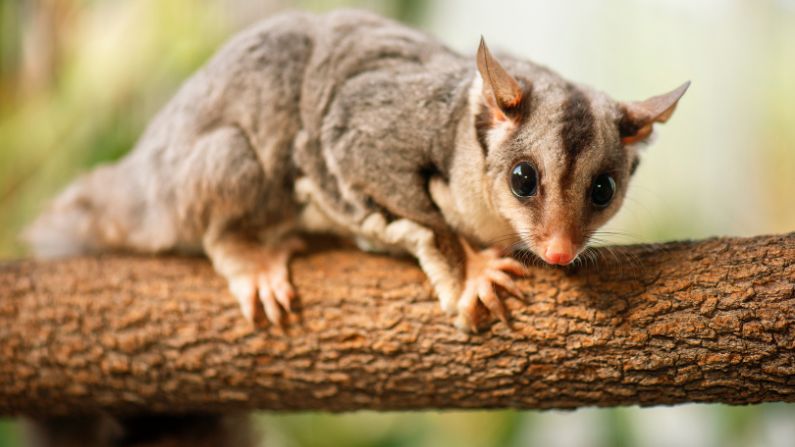
For a mammal, let’s choose the beautiful, shy and locally threatened squirrel glider, with its soft grey fur and black stripes, that lives quietly throughout Brisbane’s bushlands and wattle thickets.

Squirrel glider Pic: Wildlife Preservation Society of Queensland wildlife.org.au

We might choose the fruit bats that hang squabbling in their noisy colonies all day, then fly out each dusk to feast on suburban gardens. It’s an iconic sight – hundreds of bats streaming across the evening sky. But fruit bats carry lissa virus, which gives them the potential for real danger.

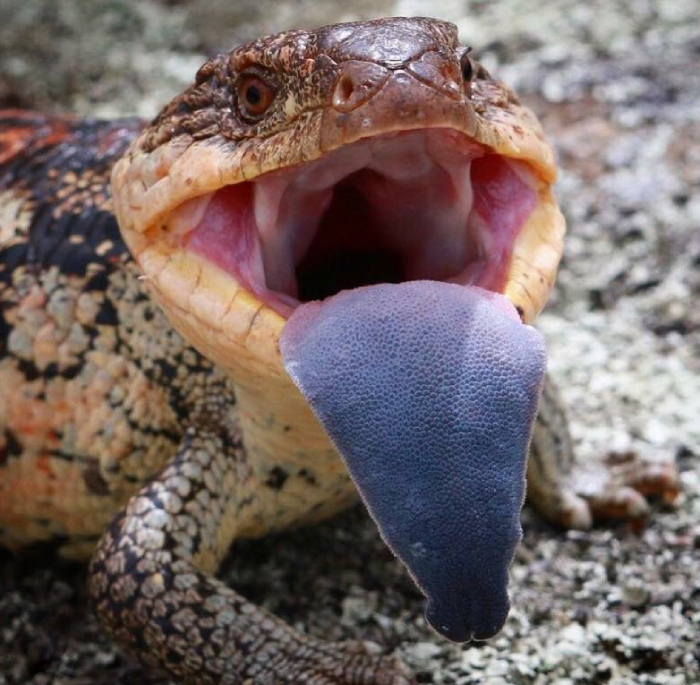
To give that sense of harmless wildness, we could choose the blue-tongued lizard, with its hiss and the bright blue tongue it shows when threatened, or the ubiquitous water dragon.

Blue-tongued lizard (a type of skink) Pic: abc.net.au/news

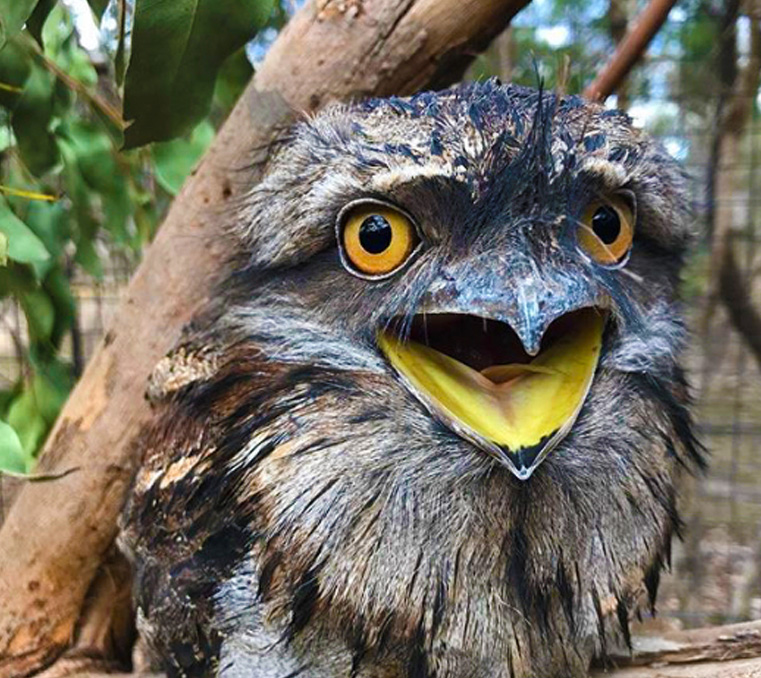
Or the tawny frogmouth that looks like a piece of bark in the tree until it opens its huge, yellow mouth.

Tawny frogmouth Pic: moonlitsanctuary.com.au

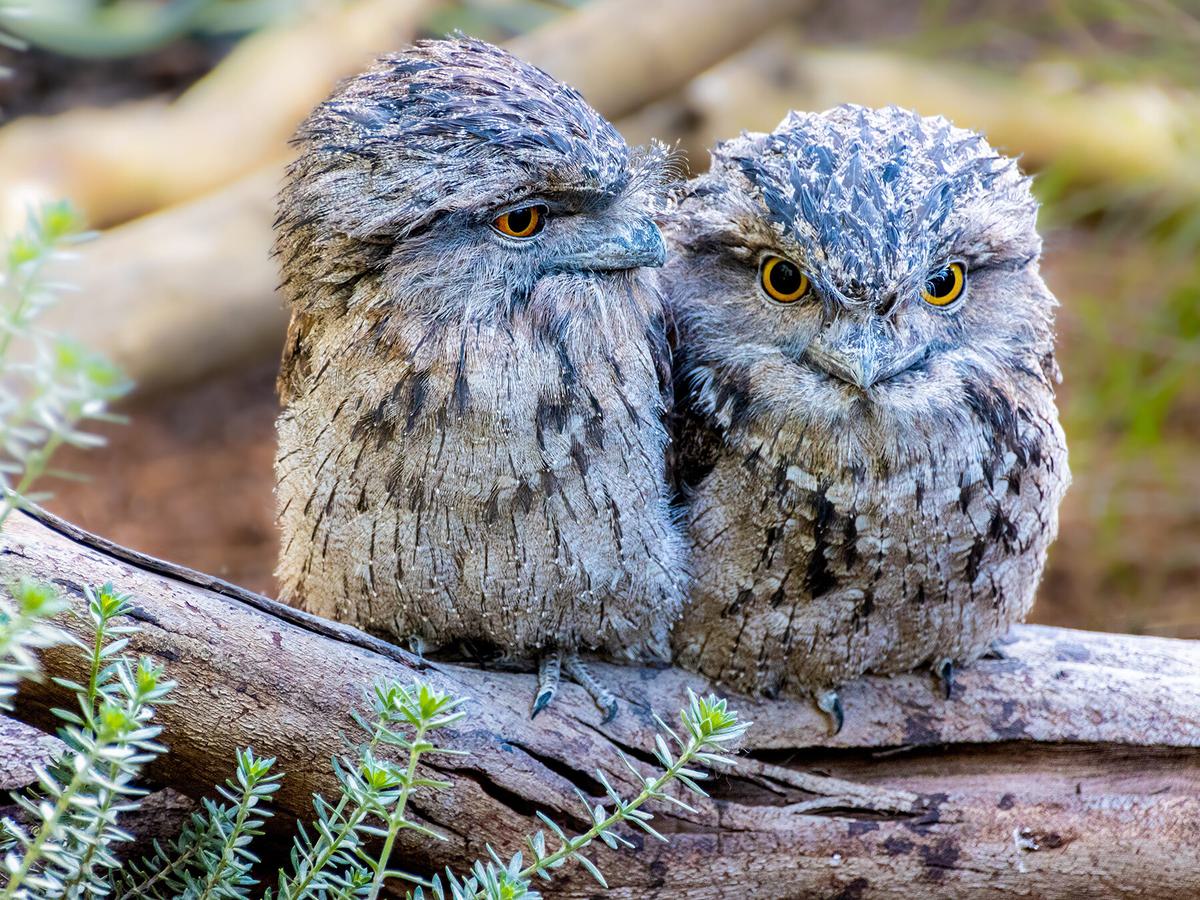
And tawny frogmouths have the cutest of babies.

Tawny frogmouth fledglings Pic: birdfact.com

The scrub turkey that wanders the streets and back yards of Brisbane, scratching up gardens and building huge nesting mounds wherever it chooses.

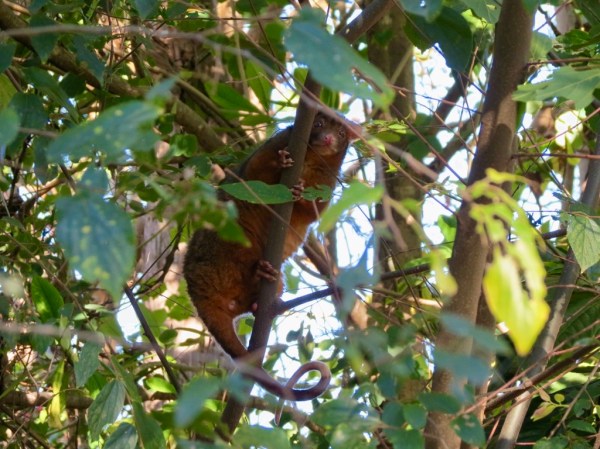
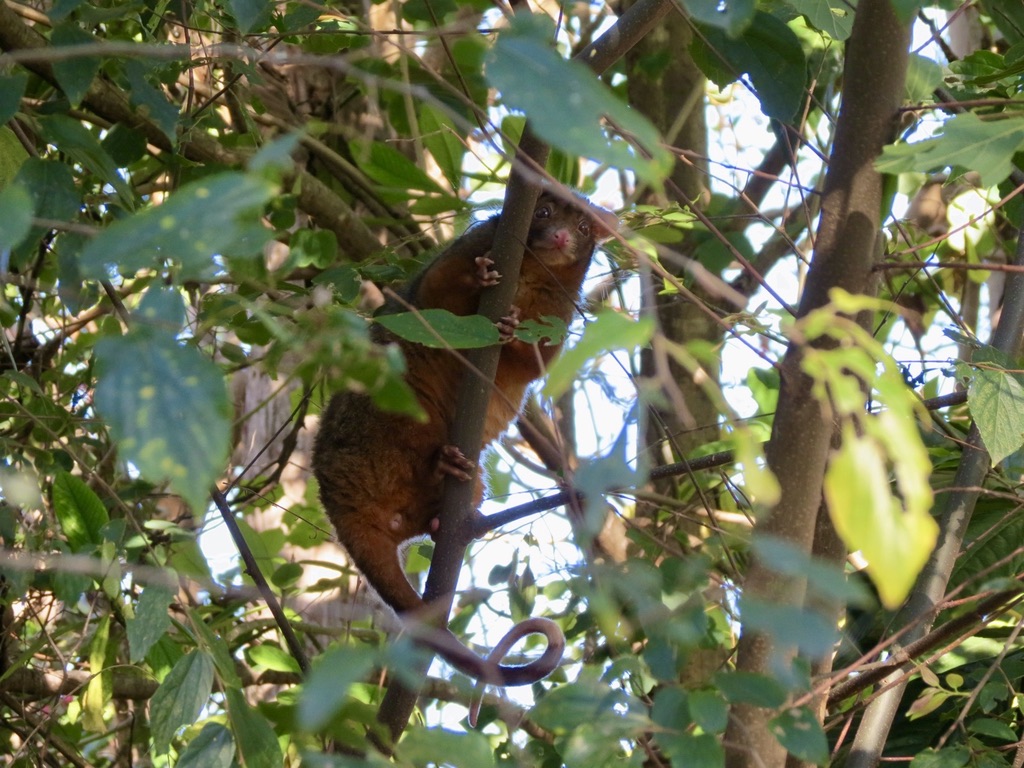
Or the possum. Most evenings, a brush tail or rarer ringtail possum runs across the power lines to our verandah, stops to stare at us, then gallops noisily across the iron roof to jump into the lillypilly tree out the back. Possums will come inside if they get a chance, and you might find one nesting in the ceiling, or sitting in your kitchen sink, chewing on a Weetbix.

Ringtail possum Pic: Michael Fox https://pollinatorlink.org

Most of these creatures live in other states as well, and perhaps a crocodile or a cassowary would be more appropriate. Wonderful Queensland creatures, but a bit too scary.

My friend Mila told me of another potential mascot. It’s not a living one, but I think it’s worth considering.

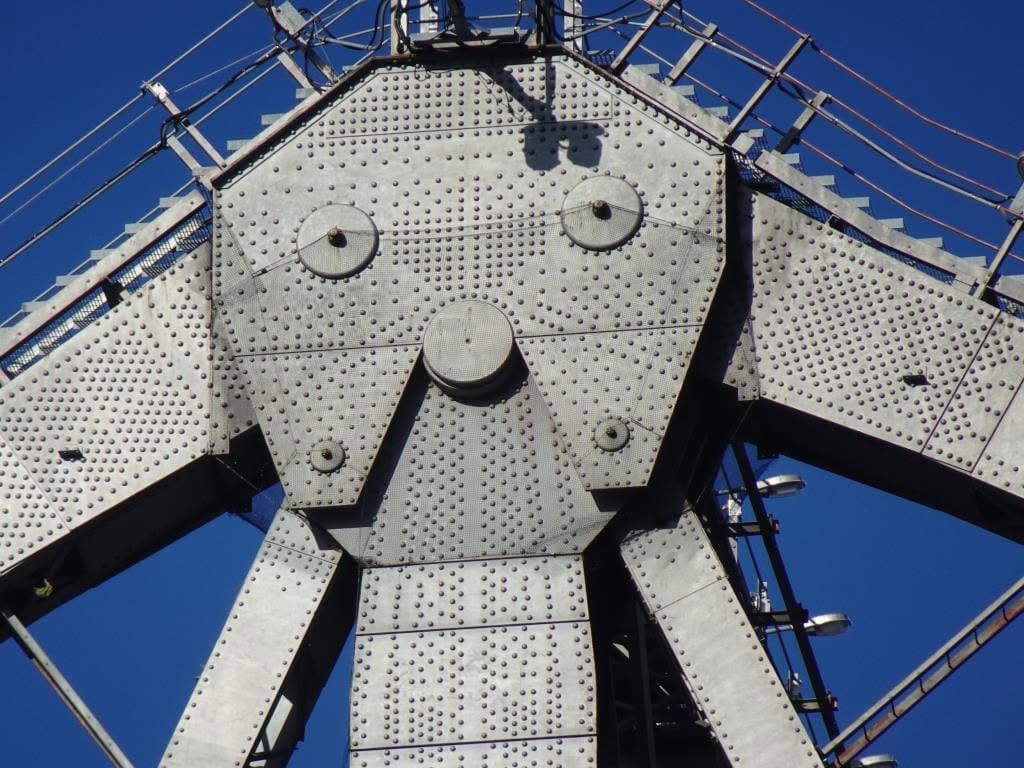
Mila tells me that one day when she was walking along the river she noticed a female face on the Story Bridge and now can’t un-see it.

Mila calls her Bridget Story, and she sent me a photo.

Mila’s photo of Bridget Story

As she says, Bridget Story has lots of potential for merch, and particularly for animations. Imagine the Story Bridge, striding across the city and the coast, welcoming people to the Games.

Bridget Story could even raise some money for the much-needed bridge repairs.

I love it.

Floods

Floods.

I’ve written many stories about many parts of Queensland on this blog, and so many of them describe floods.

Maryborough, Ipswich, Rockhampton. https://roseobrienwriter.blog/2024/02/06/maryborough/

Townsville, Bundaberg, Ingham, Charleville. https://roseobrienwriter.blog/2021/07/24/road-trip-to-ingham/

The Brisbane, Bremer, Mary, Burdekin and Flinders Rivers. https://roseobrienwriter.blog/2020/12/12/syphoning-petrol/

The Gulf Country, the Horror Stretch and the Cassowary Coast. https://roseobrienwriter.blog/2018/11/08/horror-stretch/

These are places I know well, and I feel for the people who live and work there; especially in the north. People wading through the ruins of their flood-damaged homes; cane, banana and beef farmers coping with the ruination of their hard-won livelihoods.

I remember the cattle farmers of the Flinders River catchment who, during the 2019 floods waited helplessly for the waters to go down as helicopters brought back images of mobs of cattle, including precious breeding herds and cows with calves, dead of cold and hunger, crowded against fences and on small patches of higher ground. It is estimated that 500,000 head of stock died in that flood.

And now floods have happened again – are still happening – in tropical Queensland. The State premier, an Ingham native, holds a press conference describing the community’s sorry situation: highway cut both north and south, houses flooded, no electricity, a breakdown in the water supply, supermarkets empty, and two lives lost. Further north, in and around Cardwell, houses flooded that have never been flooded before.

The Herbert River catchment of 9000 square kilometres has its headwaters in the Great Dividing Range near Herberton, and it collects a lot of tropical rain before it makes its way down to the flat canefields around Ingham. The Cardwell Range is steep and high and close to the town, so the catchment there is not nearly as big. But what is going to happen, when almost two metres of rain falls in three days?

The Burdekin River catchment of over 130,000 square kilometres is the size of England and stretches from north of Charters Towers and Greenvale to south of Alpha. Charters Towers has been flooding all week, and that water is heading for Ayr and Home Hill on the coast.

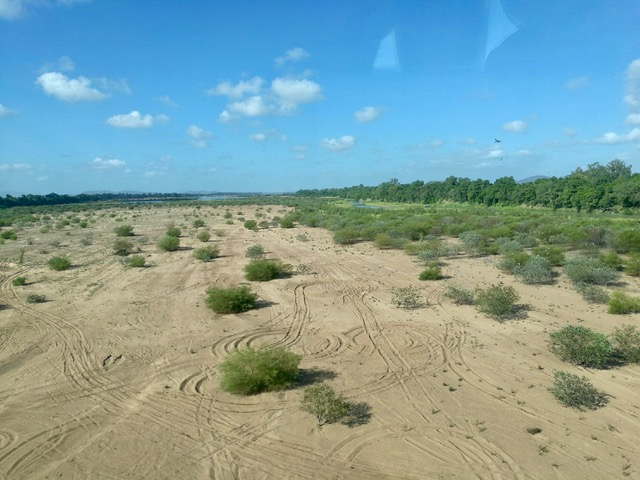
Burdekin River at Home Hill in the dry season, looking upstream from the Bridge
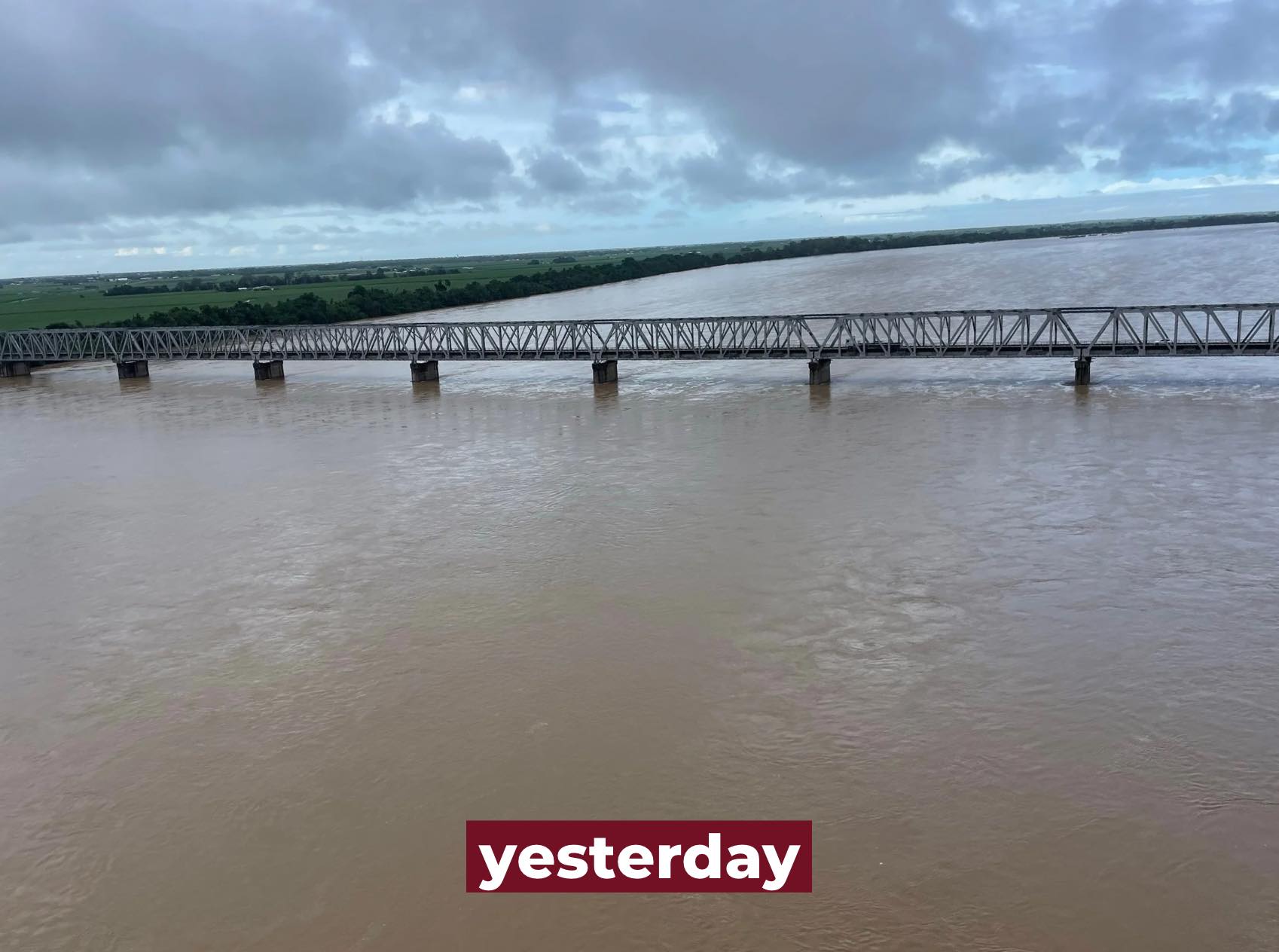
Burdekin River at Home Hill this week Dale Last, Member for Burdekin. Facebook

Sugarcane can be laid low by a flood, and recover, if the water doesn’t lie there too long. On the rich flood plains around Ingham, water has been lying for days, and still it rains.

An agriculturist, an expert in banana growing, told me that in the case of a cyclone, if a farmer lops the plants back they will survive and regrow. How would you go about that? It would take days, and a huge amount of work, and even with excellent modern forecasting, satellites and radar, cyclones are unpredictable. They can veer south or north or move back out to sea.
More heavy rain is forecast across North Queensland. The water will run to the coastal towns and farms and also to the vast plains of the inland, where rivers like the Flinders will break their banks and spread across the land, cutting the few sealed roads and the one railway line that runs east-west across the State.

In Queensland, rich in resources though it is – agriculture and mining in particular – we don’t have many people. The US state of Texas, iconic to Americans for its size, has an area of 697,000 square kilometres, compared to Queensland’s over 1,700,000 square kilometres. However, Texas has a population over five times the size of Queensland’s. That makes a huge difference when it comes to tax base and industry. It seems we don’t have the population, or the votes, to create better, more resilient transport infrastructure.

We also have a more extreme climate than Texas, especially when it comes to floods. Tornados are deadly, but they move quickly across the land. Rain depressions hang around.

Queensland has only one highway and one railway going along the coast, and because of shortage of population and extremes of climate, there are almost no entirely sealed roads west of the ranges linking north and south.

During this month’s major flood event in North Queensland, the one main railway line was soon cut in several places. https://www.railexpress.com.au/rail-bridges-submerged-as-floods-batter-north-queensland/

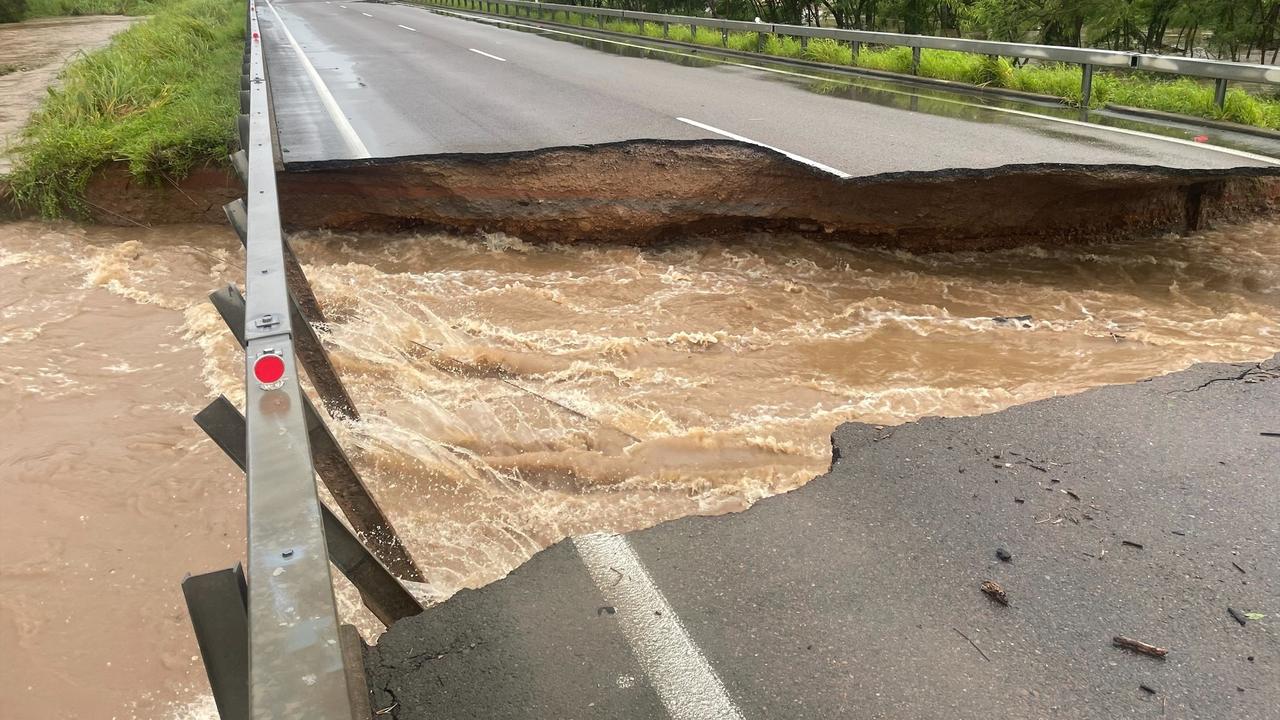
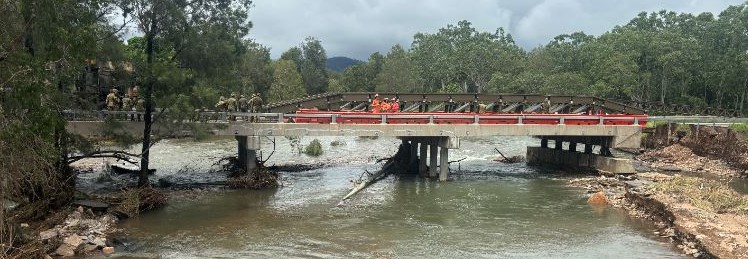
When the Bruce Highway bridge at Ollera Creek was washed away over the weekend, north of Townsville, Far North Queensland was cut off from the world except by air and sea.

Ellora Creek bridge washed away Townsville Bulletin
Ellora Creek bridge , as repaired by the army for emergency vehicles mypolice.qld.gov.au

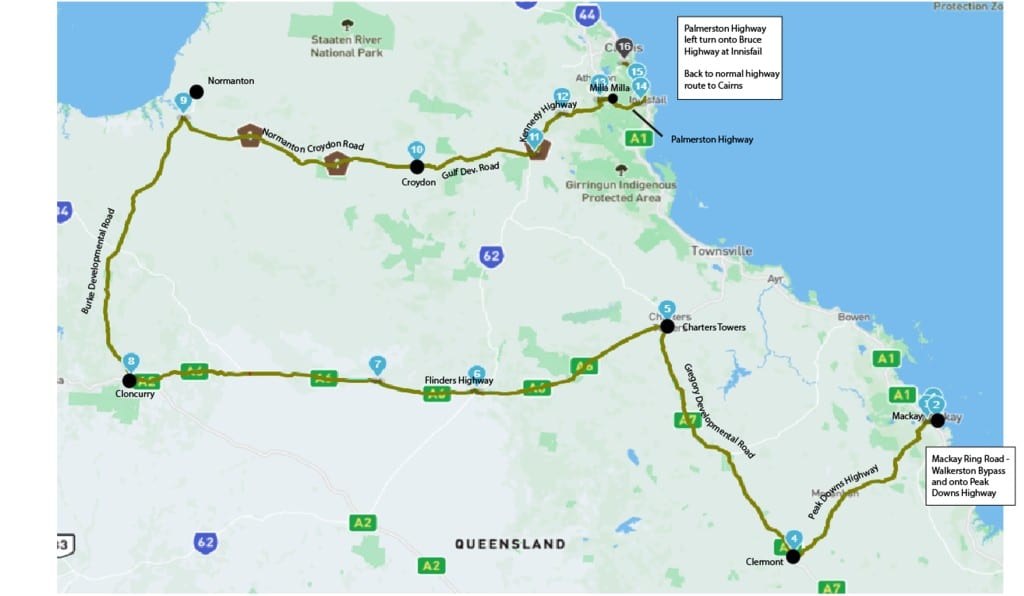
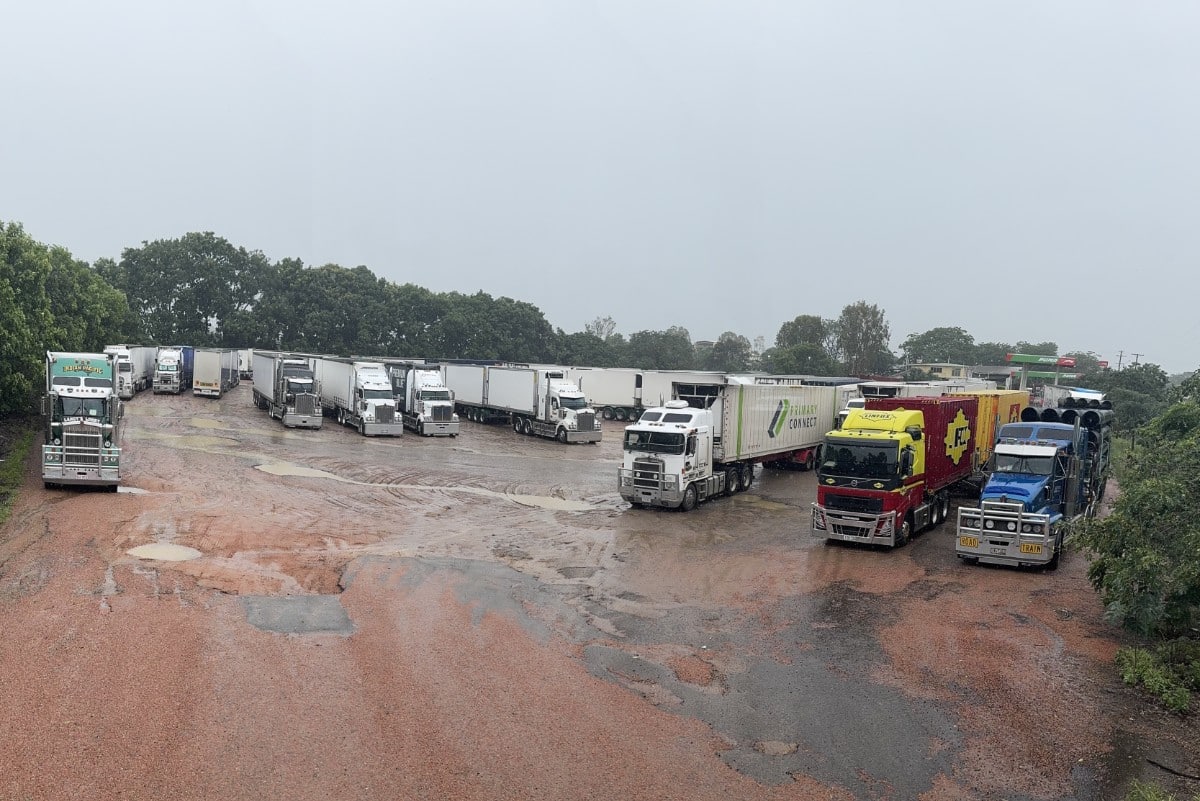
Trucks carrying supplies to the Far North and people trying to return home faced an extra 1200 kilometres’ journey, travelling by western Queensland sealed roads, to reach Cairns. And these roads are under threat of closure at any time. Many are stranded. https://qldtraffic.qld.gov.au/

Alternative route to flooded Far North Queensland Transport and Main Roads Department, bigrigs.com.au
Stranded truckies parked up at the Puma Roadhouse in Charters (Towers) Image: Deano Hutch bigrigs.com.au

If the continuing flood rain results in damage to the railway and highway linking Townsville and Mount Isa, as happens all too often, transport and supply of essential goods may be affected for weeks.

For all sorts of reasons, including strategic concerns, the continuing and increasing vulnerability of Queensland’s transport routes is a major threat to our way of life and security.

People who live and work in the north and west of the State feel bitter that regions that produce so much of Queensland’s wealth continue to be so vulnerable to the weather. And as climate change deepens, it will only get worse.

It’s a worry.

In the southern states and Canberra, people have always regarded Queensland with a kind of affection as a weird, distant place, a place of extreme weather, crocodiles, bogans and dodgy politicians. Greater Brisbane makes up half the population of the State, and a lot of Brisbane people seem to be largely ignorant of regional areas. To them, north means Noosa, and west means Toowoomba.

So where is the will to sink vast sums into flood-proofing North Queensland for the future? Bipartisanship in politics would be a start.
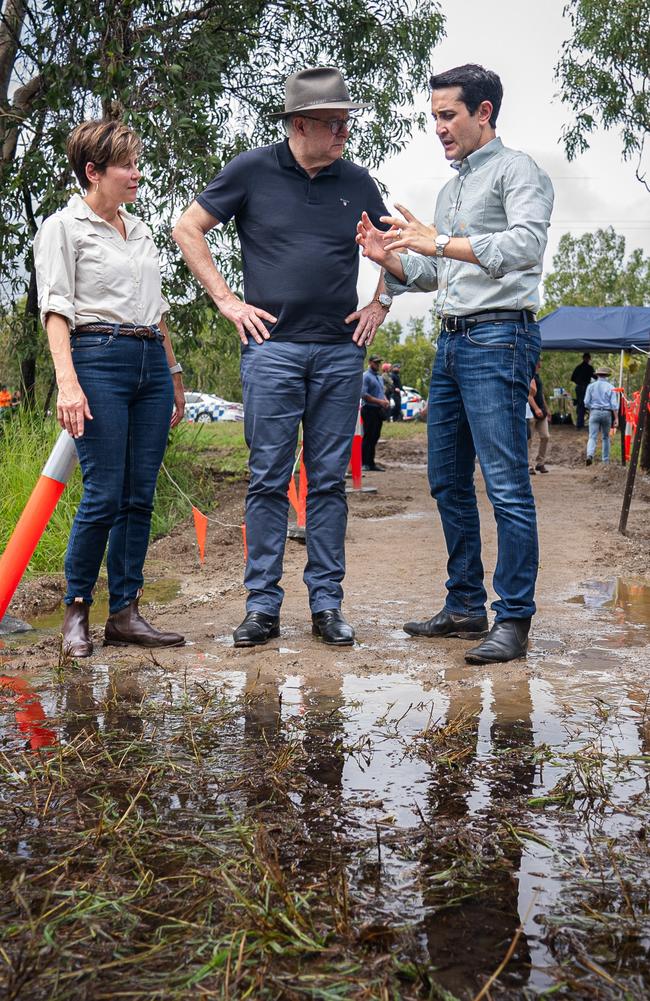
It’s a start. Federal Labor Senator Jenny MacAllister, Labor Prime Minister Anthony Albanese, and LNP Premier of Queensland David Crisafulli, taling about recovery in FNQ theaustralian.com.au

I’m tired of writing about floods.

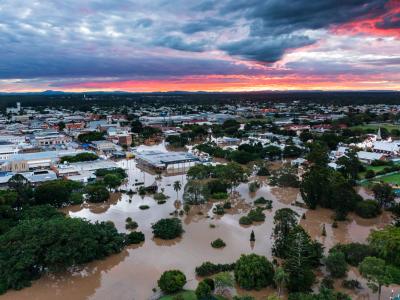
Main picture: Maryborough flooded at Sunset. 2022 Qld Reconstruction Authority

Doing the Washing

When we lived in Jandowae, on the northern Darling Downs, our clothesline was held up with a notched wooden prop.

Previously, we’d lived in houses with that backyard icon of the time, a Hills Hoist. It was efficient. The height could be adjusted, it rotated and it had lots of hanging space.

The Jandowae clothesline, perhaps ten metres long, was height adjustable too, in that you could stand the long prop up at an angle. It was unpredictable, though. A sudden wind gust could fling the drying sheets across to the other side of the line or drop them in the dirt.

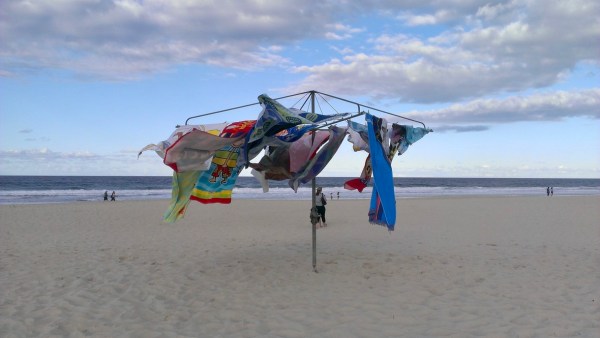
A sudden gust will just send a rotary clothesline into a fast spin. Sheets and towels will flap wildly, but they won’t fall in the dirt.

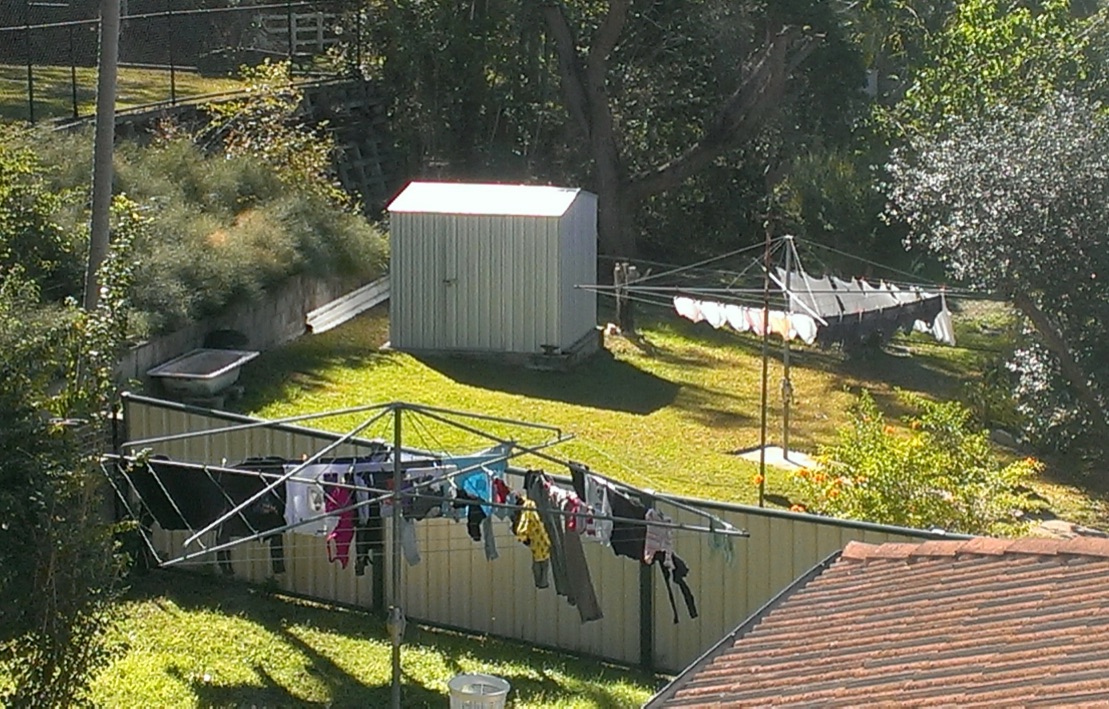
21st century Queensland backyards rarely have space for a Hills Hoist, or a prop line either, even though clothesline props are still being sold, in improved styles. The travelling clothes prop man is a thing of the distant past, and even rotating clothesline are becoming objects of nostalgia. Throughout the suburbs, and across the sprawling, grey roofed, close packed housing developments that surround so many country towns, there is scarcely room for plants.

Last Christmas, Con wrote his Christmas letter on a theme, as he does every year. This year the theme was “clotheslines”. He was searching for a subject more interesting than the usual screeds on family, travel, illnesses and renovations.

Replies to his letter were rich with humour and nostalgia.

One old friend has recently lost his wife of many years. He misses her. But there is a positive side, as he wrote, and it concerns how he hangs out the washing now she’s gone.

  • No more separate washing for whites and colours.
  • No more hanging tops from the bottom and bottoms from the top.
  • No more delicates.
  • No more taking pegs off the line and into the peg basket.
  • No more socks by the toes. No more pockets turned out.

Surely one of the small freedoms we can allow ourselves is to hang out the washing any way we  like. Leave the pegs on the line, or put them in the basket? Hang the socks in pairs, or randomly? Wooden pegs or plastic? One peg, or two? Please yourself.

From my verandah I can look across the next-door backyards with their rotary clotheslines and I notice how they hang out their washing. The young couple next door hangs clothes entirely randomly, and not always using pegs. Next yard across, the retired couple hangs theirs out according to a strict pattern. Six white knickers in a row, six black underpants, six singlets.

It seems they shop for underwear in an orderly way too.

Our friend in Chicago responded to Con’s letter wistfully. In the depths of winter and living in an apartment, she has no chance of drying her washing in a sunny, breezy garden.

Queensland climate varies dramatically across its huge area. When we lived in Burketown and Townsville, I had no problem drying the clothes either outdoors, or if it was raining, on lines strung under the house. However, Townsville, as they say, is a “dry old hole” most of the time; and Burketown is almost desert for a lot of the year. In Burketown, I would hang my washing under the house in the cool of the evening, and next morning everything would be dry.

Things changed when we moved to Yarrabah, on the coast near Cairns, with a ten-day old baby, and pouring rain and a cyclone predicted. Faced with the thought of managing wet cloth nappies, Con came home from the local store with a tumble drier.

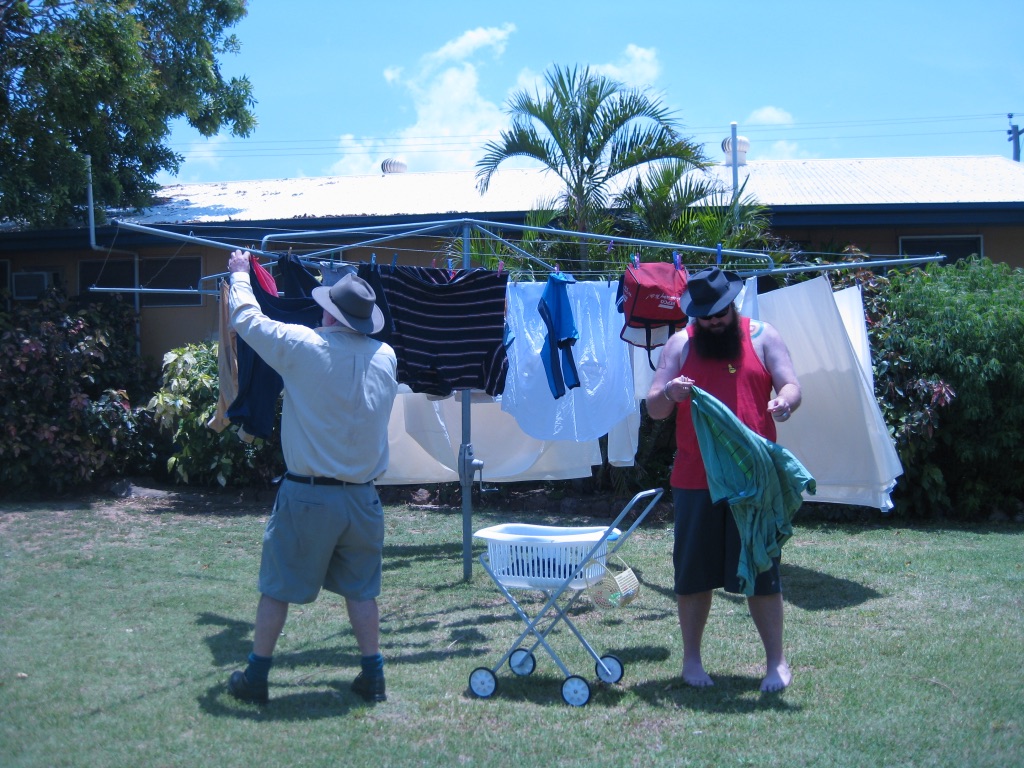
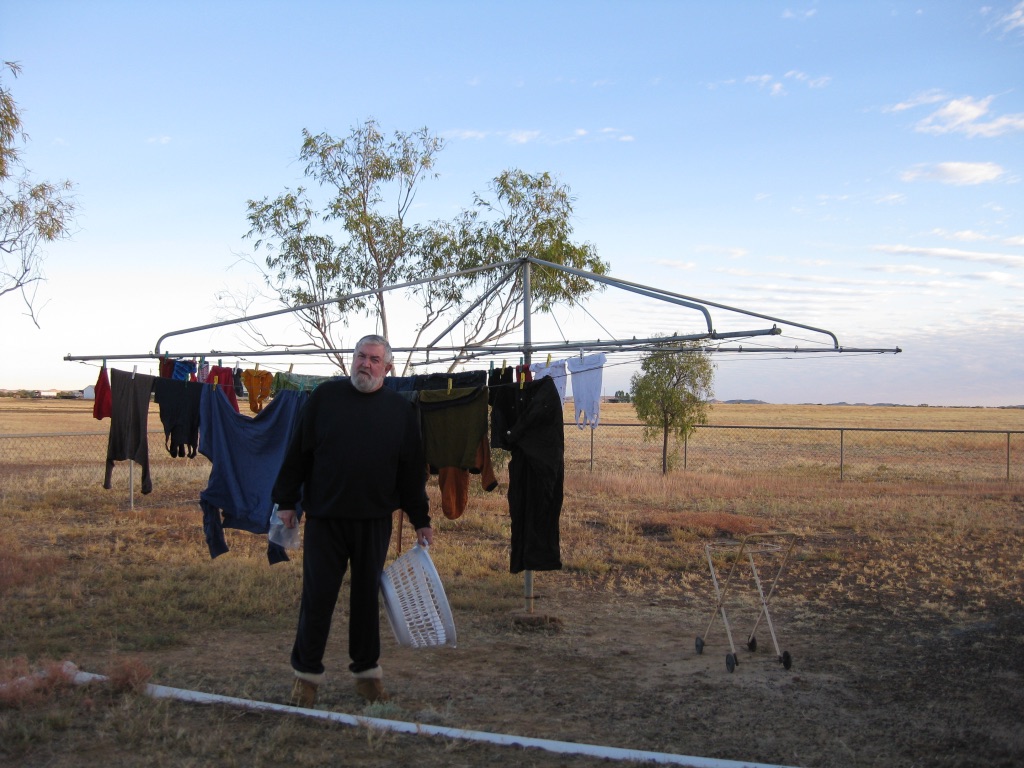
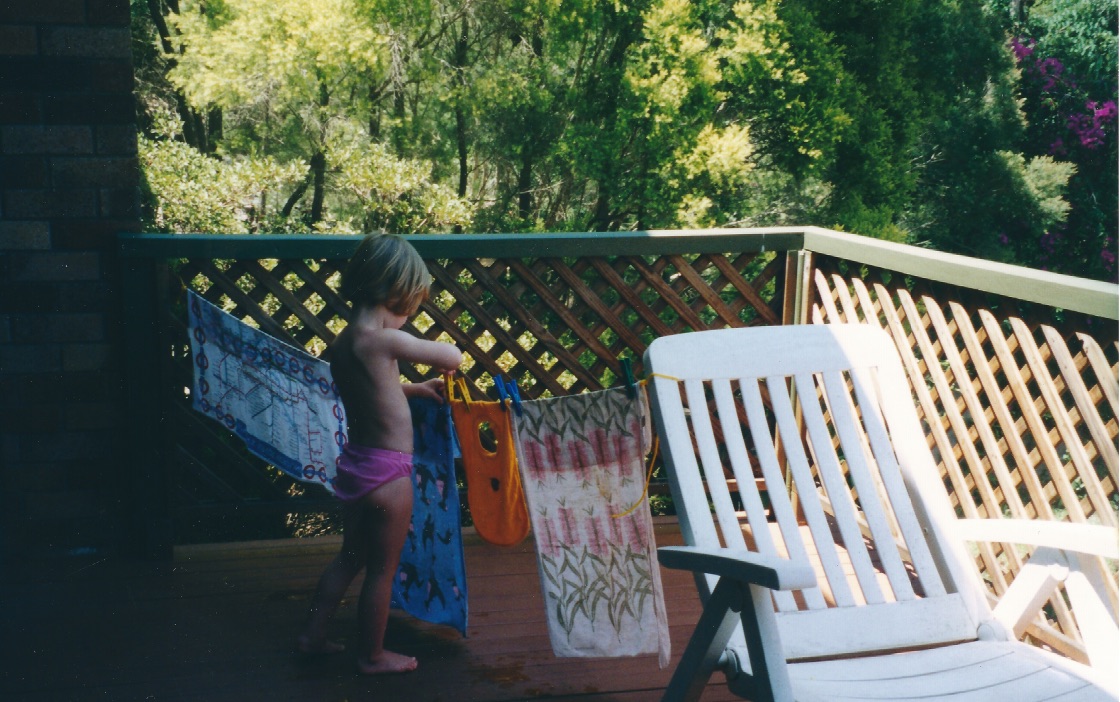
Con enjoys doing the washing. He has hung out clothes in Gulf Country heat at Karumba;

at the back of the old shearers’ quarters on Carisbrooke Station, west of Winton;

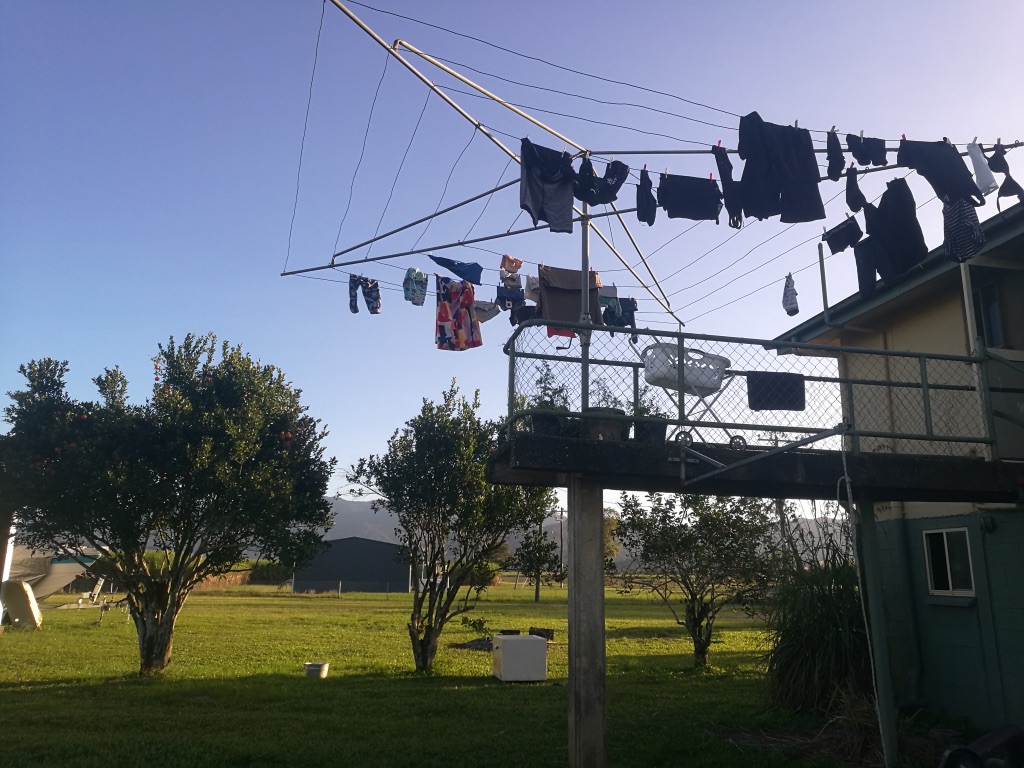
on the elevated clothesline behind a Silkwood farmhouse in Far North Queensland.

It’s a unique feature of elevated FNQ houses, a relic from the 1950s and ‘60s: a Hills Hoist mounted on the end of a concrete walkway leading from the back door.

Otherwise, hanging out washing in a wet, tropical climate is not easy. Taking advantage of the first good drying day following a week of downpour, you stand in rubber thongs in the mud, flinging towels and sheets across the line, hoping nothing drops or drags on the ground.

One North Queensland wet season we stayed with Con’s brother and sister-in-law at Balgal Beach, north of Townsville, for their wedding anniversary party.

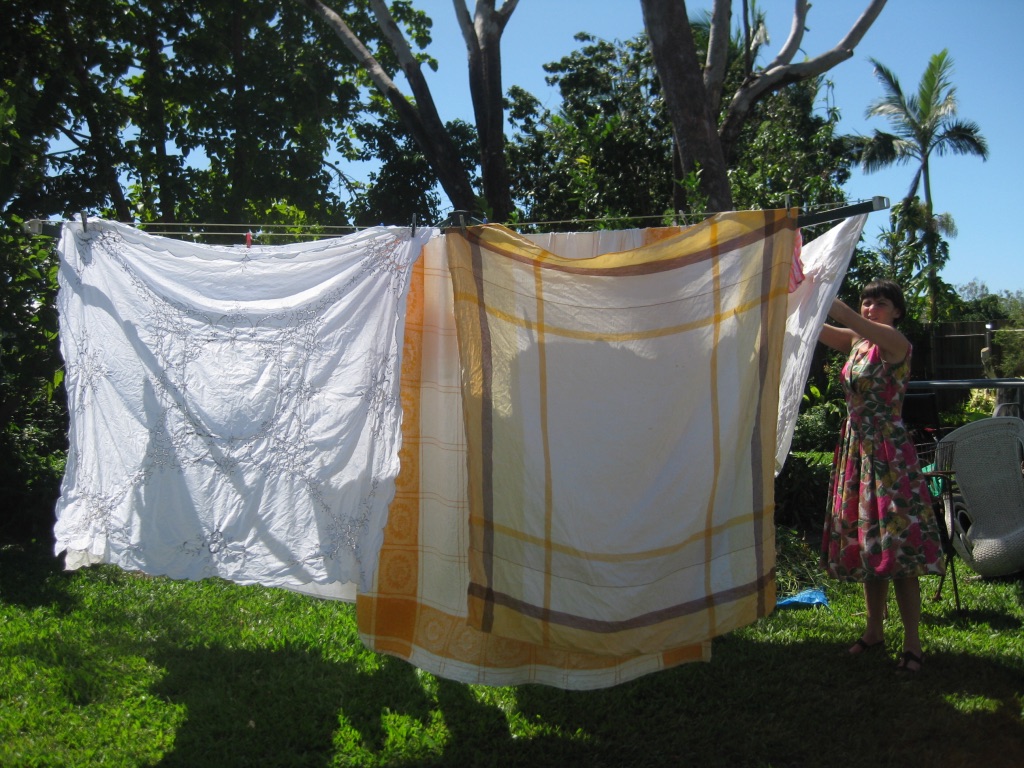
On the party tables, Margaret had used all her beautiful old tablecloths. Next morning we washed them. The grass was still soaked from a downpour, and it was tricky, hanging out those gorgeous old cloths without trailing them in the wet grass and mud.

Hanging out those beautiful tableclothes

Washing moving in the breeze can be beautiful. It’s the fresh air and sunshine, the colours, patterns and fabrics. The sight has inspired many artists.

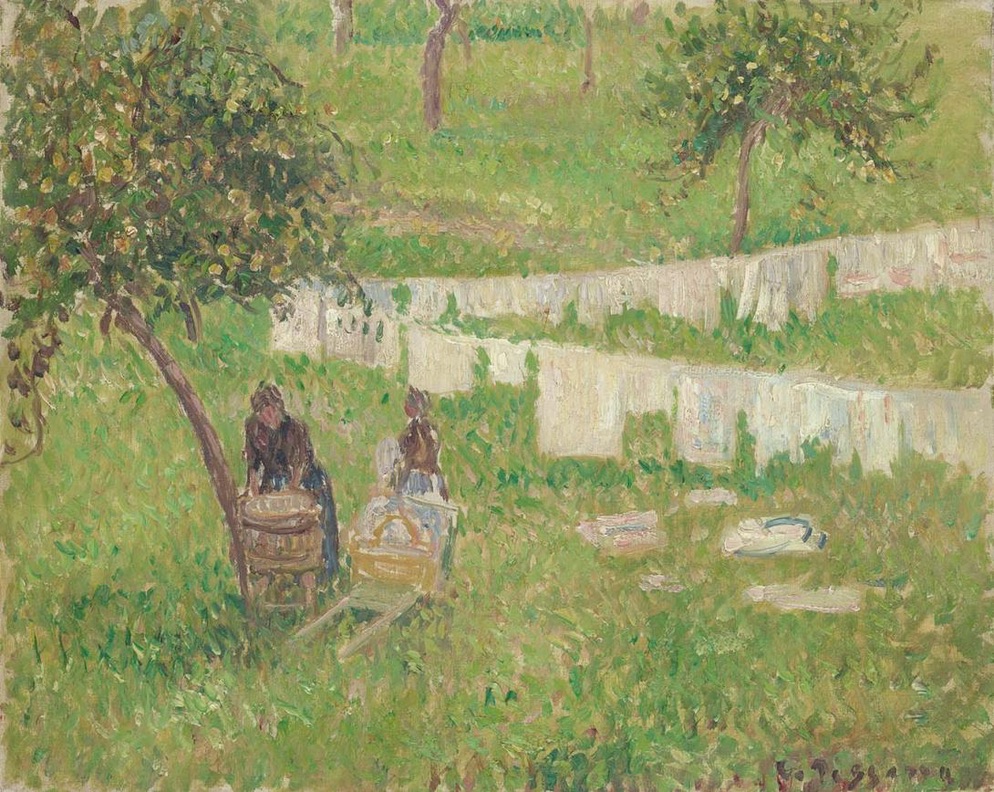
A feature of Queensland Art Gallery’s collection is “Washing Day at Éragny”, one of French Impressionist Camille Pissarro’s many beautiful paintings of women washing and drying clothes.

Washing Day at Éragny, Camille Pissarro. Queensland Art Gallery

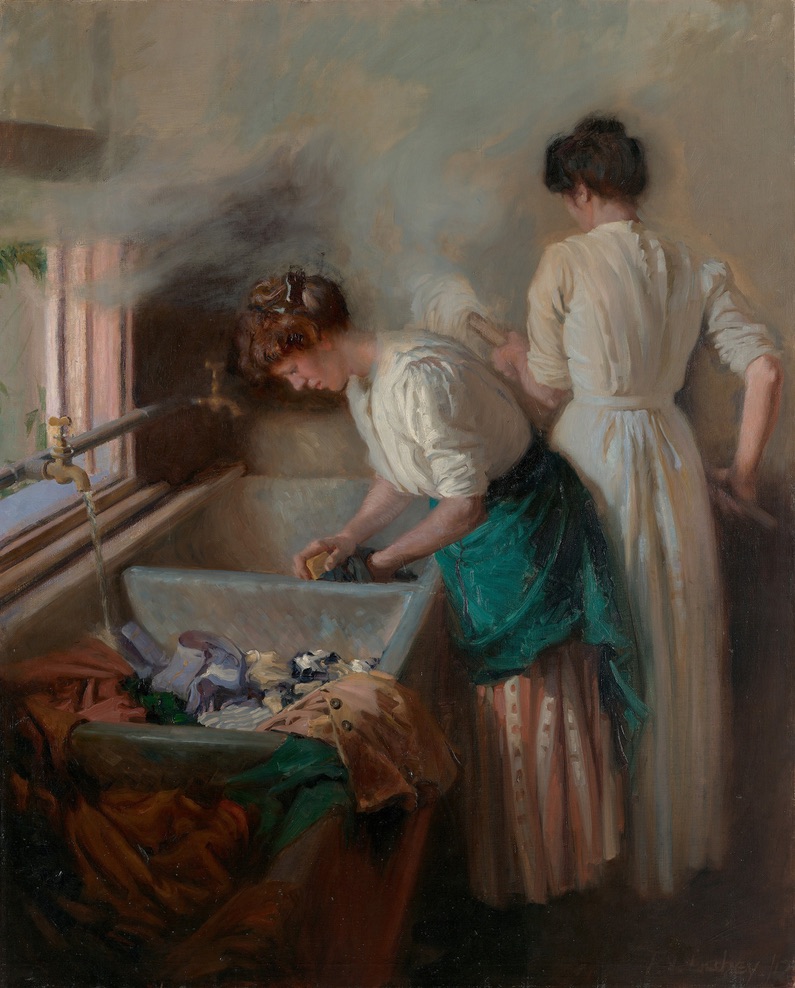
Another of QAG’s treasured paintings, “Monday Morning” by local artist Vida Lahey, depicts a traditional washing day, with women scrubbing clothes, bending over the concrete laundry tubs that were once a feature of Queensland laundries and are now seen in the bathrooms of trendy pubs.

Monday Morning, Vida Lahey. Queensland Art Gallery

Another friend reminded us of the work that went on around those laundry tubs. I can still see my hard-working Mum dragging the boiled sheets out of the copper with the boiler stick, then on to the hand-turned wringer and out on to the propped up washing line, only to sometimes blow down into the mud!

My friend Marion, married to a vet, also responded to Con’s Christmas letter.

For the first time in my life I no longer have a washing line. For years I’ve joked that it was my daily exercise, carrying baskets of washing up and down stairs, bending and stretching to hang the washing in the open air.

My worst washing memories are of cleaning Malcolm’s overalls after he had done a messy calving case out in a muddy paddock somewhere. No washing machine, no hot water in the accommodation we were living in, in the dairy country of the Illawarra. Had to use the bath for a while until we bought a second-hand washing machine. The memory still lingers, particularly the smell of muck and blood. Lovely new calves came into the world though. Clever vet.

The harsh Queensland sun dries towels and sheets fresh and clean. The sun is a great purifier, a killer of germs and mould, although I had an aunt, a meticulous housekeeper, who told me darkly what she thought of this theory as applied to lazy laundry habits: “Some people leave far too much to the sun…”

I had a near-disaster one washing day.

Our cat had gone to sleep among the dirty clothes in the top-loading washing machine. Not noticing, I added powder, closed the lid and started the wash cycle. Seeing some clothes I’d missed I opened the lid again to put them in. The wet and terrified cat jumped out, disappeared out the door and was not seen again for hours.

On my verandah

Main picture: Swell Sculpture Festival, Currumbin Beach, Queensland. 2015

Out of Brisbane

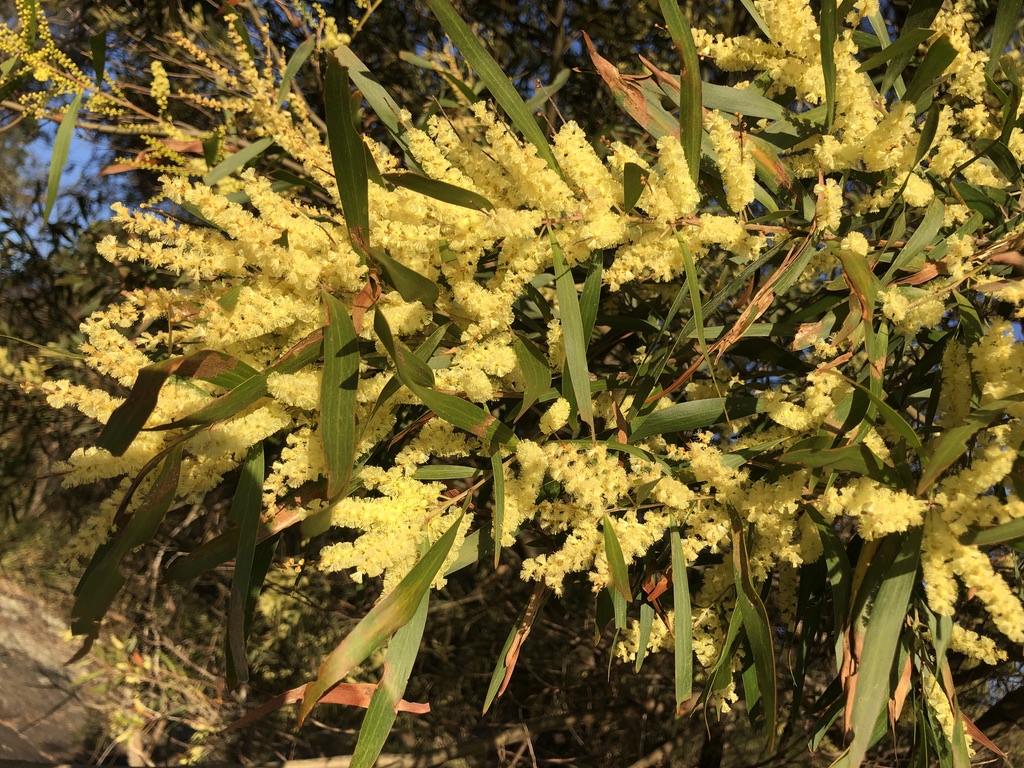
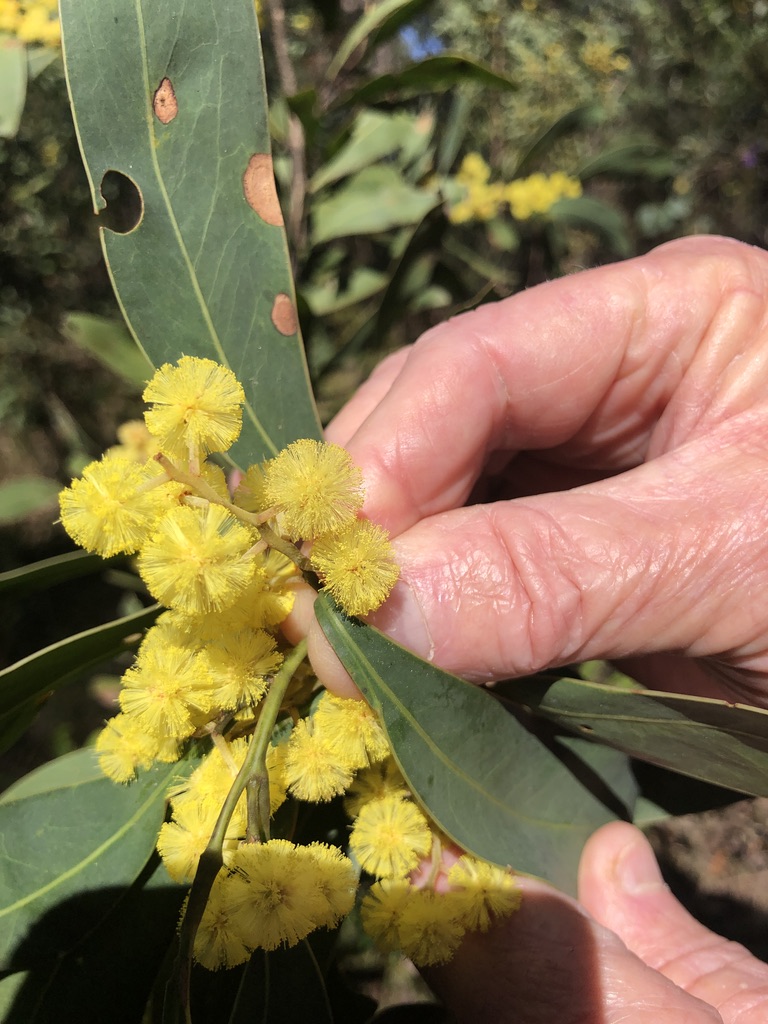
Along Quart Pot Creek, upstream from Heritage Park, the wattle trees are flowering.

Stanthorpe wattle

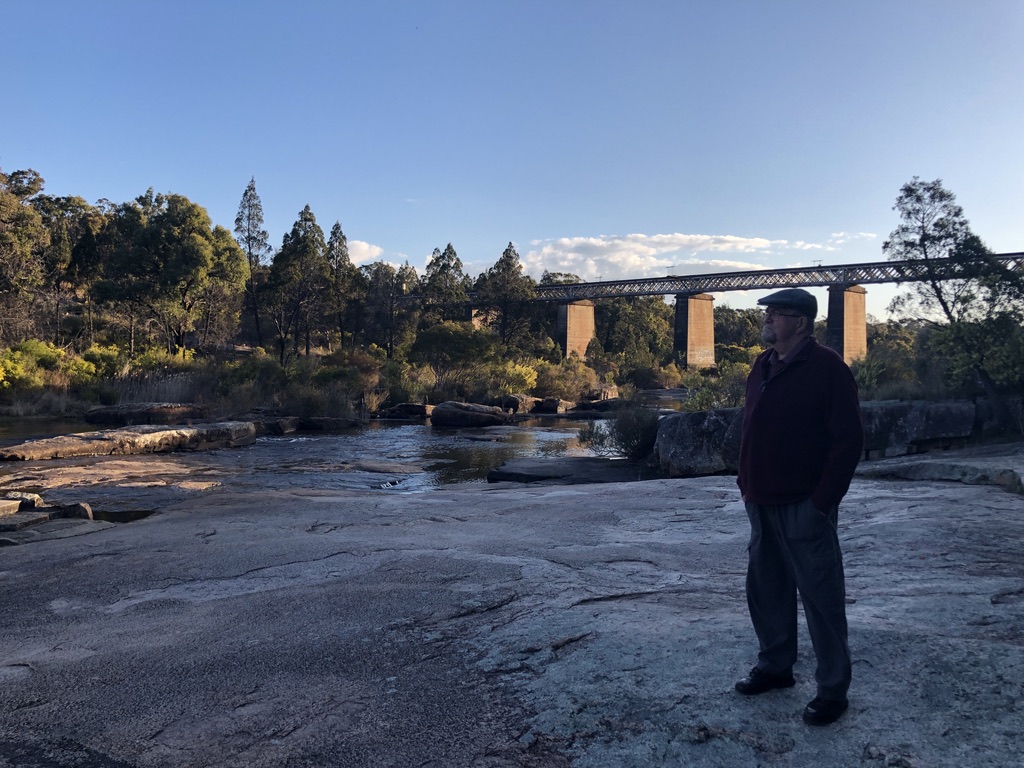
The path winds above the creek and under the railway bridge, across sloping granite to the creek and beyond. On the bank near the narrow footbridge, fairy wrens flit among the bushes.

Along Quart Pot Creek

In Stanthorpe this Spring when we visit, the water is cold. Not tempting. Perhaps in summer families come here to lie in the shallow pools and sunbake on the warm granite.

On this short trip out of Brisbane we are counting wattles. Leaving Stanthorpe, we drive over the New South Wales border to Bald Rock and then back home via the Bruxner Highway and Summerland Way, counting many varieties of wattles in bloom along the way. Green and gold everywhere.

Bald Rock wattle

In April 2023, I planned a fine road trip. It was the right time: the rivers were full but not flooding. The countryside was green. There was no threat of bushfires.

We would follow the inland rivers, from the Warrego at Cunnamulla, down the Darling to Burke and Menindee, to meet the Murray River near its mouth, at Gawler in South Australia. We would then trace the Murray upstream to where it meets the Darling at Wentworth in Victoria, then further east to Balranald, near where the Murray meets the Murrumbidgee. Following the Murrumbidgee to Wagga Wagga, we would then head north to the Lachlan River at Forbes; join the Newell Highway and cross the Macintyre back into Queensland at Goondiwindi.

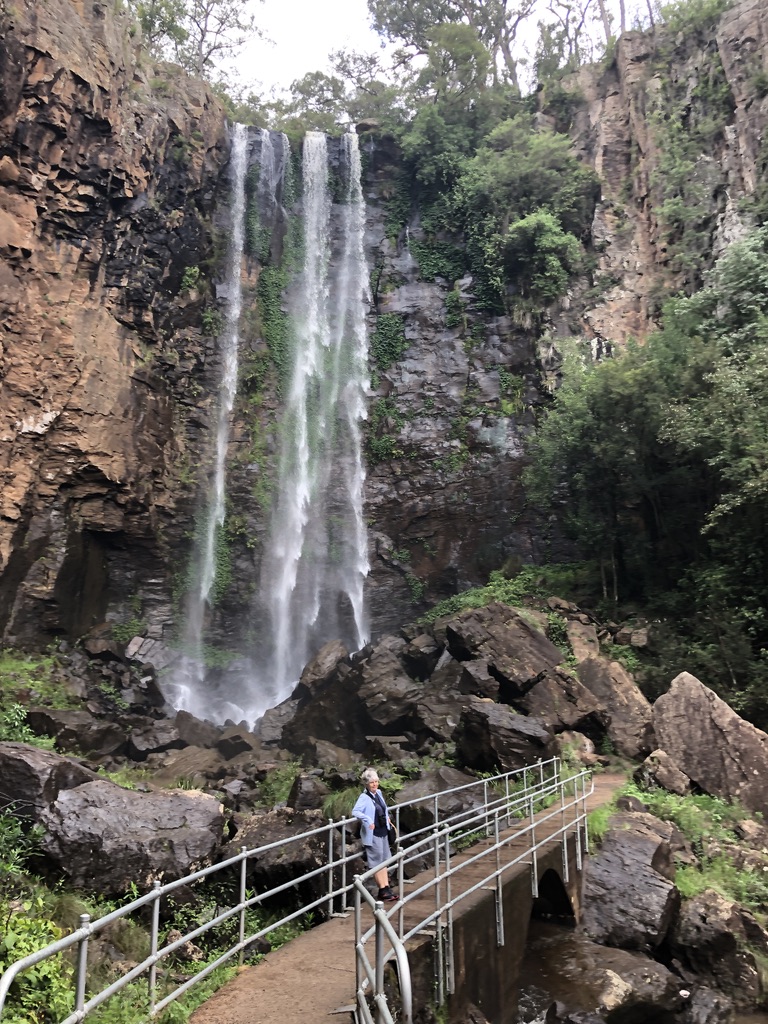
We’d meet the Condamine River at Warwick, then drive east to Queen Mary Falls where the river drops forty metres down from the ranges. Past towering Mount Superbus, the tallest mountain in south Queensland and the head of the Condamine catchment.

At Queen Mary Falls

In the right season, with plenty of rain and flow through the rivers, the water that plummets over Queen Mary Falls flows down the Darling and eventually ends up in the Southern Ocean at the mouth of the Murray, at the Coorong in South Australia.

What a neat trip that would have been. But life and illness got in the way, and we cancelled just days before we were due to leave.

That left us in Brisbane; but from Brisbane there are many interesting places to go for short trips. That is what we’ve been doing ever since.

In October last year we took a three-day trip to mainly new territory. A night in Dalby and a walk along Myall Creek in the middle of town, then up the Bunya Highway through Bell and Kingaroy to Murgon.

In Murgon there is a small but well set up Fossil Experience Museum called “55 Million Years Ago”. Local businesses, towns and shires seek for something that will encourage travellers to linger and spend. Federal, state and local governments support them. For places as widely spread as Murgon, Winton, Richmond, Hughenden, Eromanga, and even as far north as Chillagoe, Queensland’s finds of fossils and dinosaur bones attract visitors. Families plan holiday road trips to visit dinosaur sites.

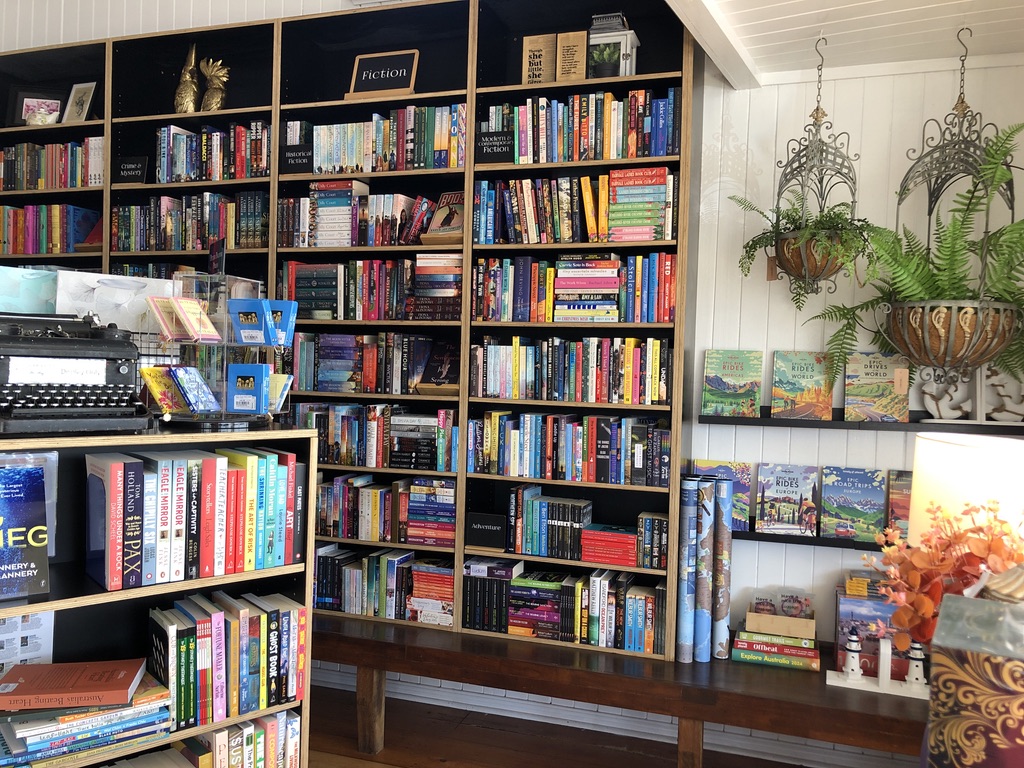
From Murgon we drove through Goomeri, stopping at the elegant Wimberley & Co Bookstore, then turned south to spend the night at Highfields, north of Toowoomba.

Wimberley & Co Bookstore, Goomeri

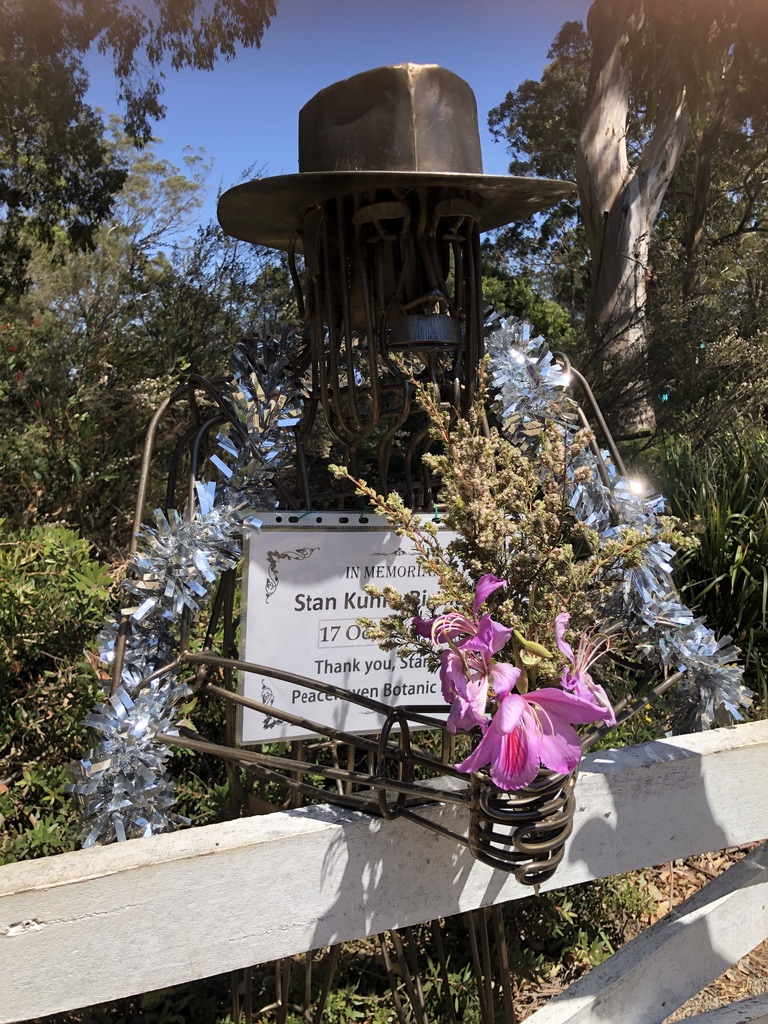
Highfields has a wonderful park – the 4.7-hectare Peacehaven Botanic Park. In 2004 local dairy farmer Stan Kuhl donated the land for a public park to promote peace.

Memorial to Stan Kuhl

The world is as far from peace as ever; but wandering these paths and plantings, watching parrots in the fine old eucalypts, with the Bunya Mountains in the distance, I appreciated old Stan’s intention.

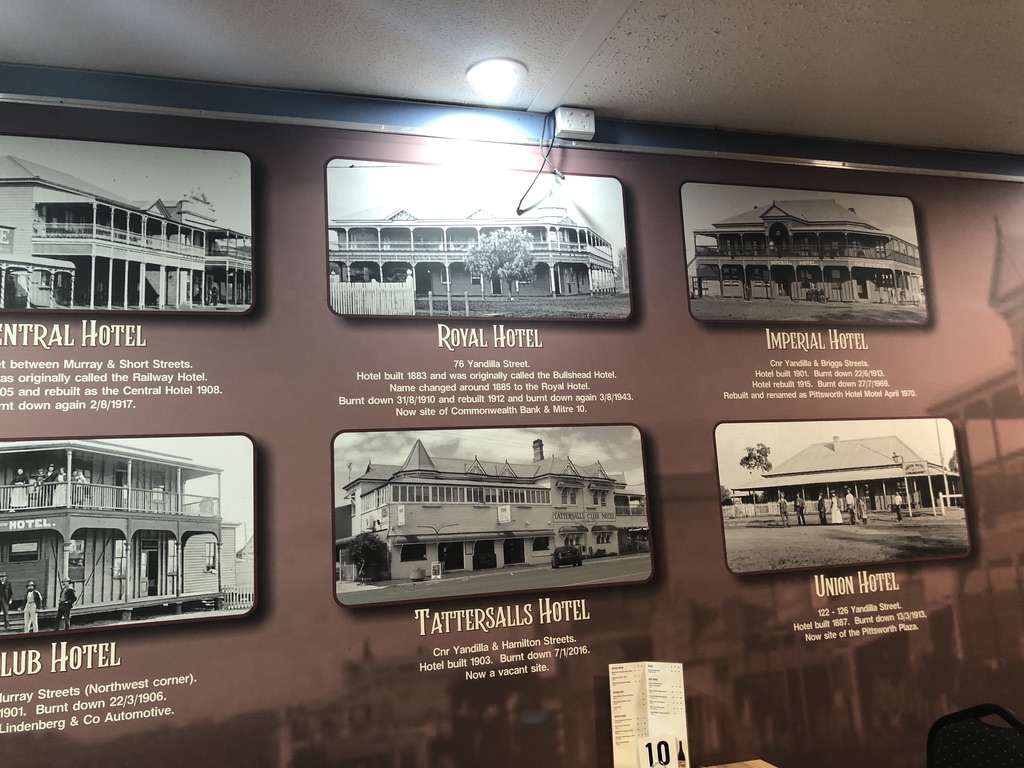
In the heat of February 2024, we took a three-day trip around the Darling Downs and out as far as Goondiwindi. The first night, we stayed in the humble motel behind the Pittsworth Hotel, “Pittsworth’s favourite hotel”. The only hotel in town as far as we can see, but its walls show a collection of photos of the many grand establishments that once existed here, only to succumb to fires, like so many old country hotels.

In the Pittsworth Hotel

Country towns celebrate their sports stars, from Rod Laver, the “Rockhampton Rocket”, to Laura Geitz, medal winner and former captain of the Australian netball team, celebrated in a bronze statue in her hometown of Allora.

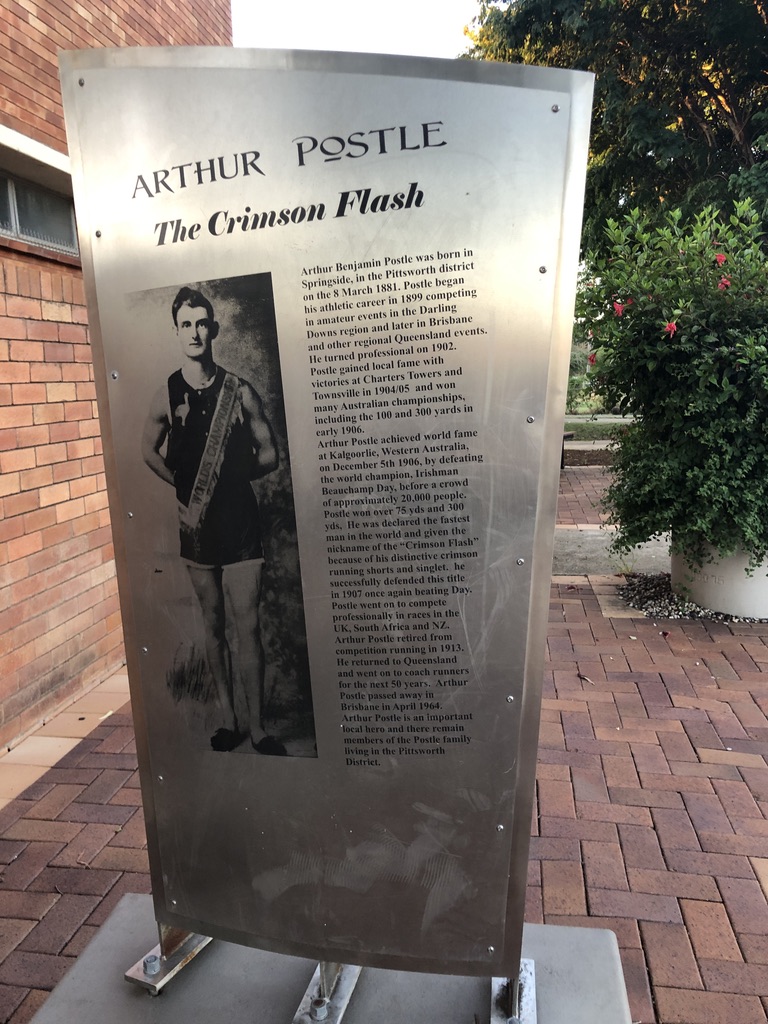
In Pittsworth, there is a memorial to Arthur Postle, the “Crimson Flash” – a local professional sprinter who won many Australian championships in the early twentieth century, even defeating a world champion.

On this trip we were exploring parts of the Darling Downs we hadn’t visited before, so I could look for old churches. My g-g-grandfather, James Matthews, was the Church of England Rector of Warwick between 1875 and 1886. In small farming settlements around the Downs, services in those days were held in inns or private houses; and James earned a name as a church builder. Perhaps he had the naming of them too, because at least one is dedicated to St James, and another to St Matthew.

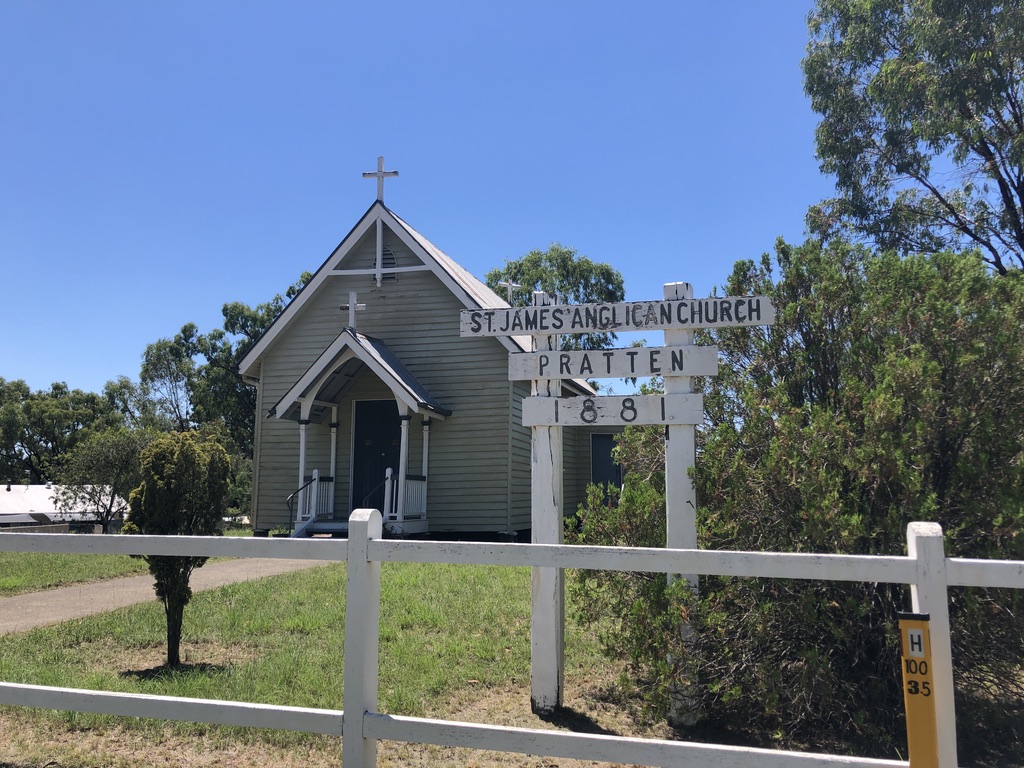
It was hot in Pratten, a tiny town west of Warwick and north of the Cunningham Highway. St James’s Church is a small wooden building on a hilltop, with a simple bell tower beside it.

The town lay still and silent under the sun, until Con pulled the rope and the church bell rang out.

Still, nothing moved.

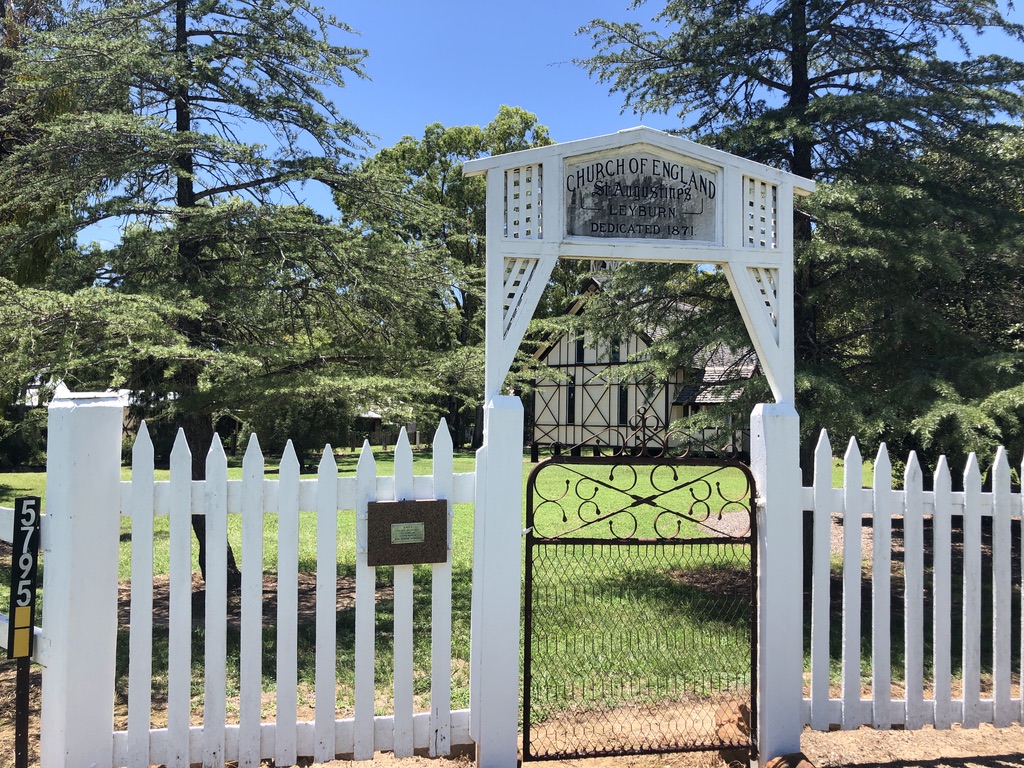
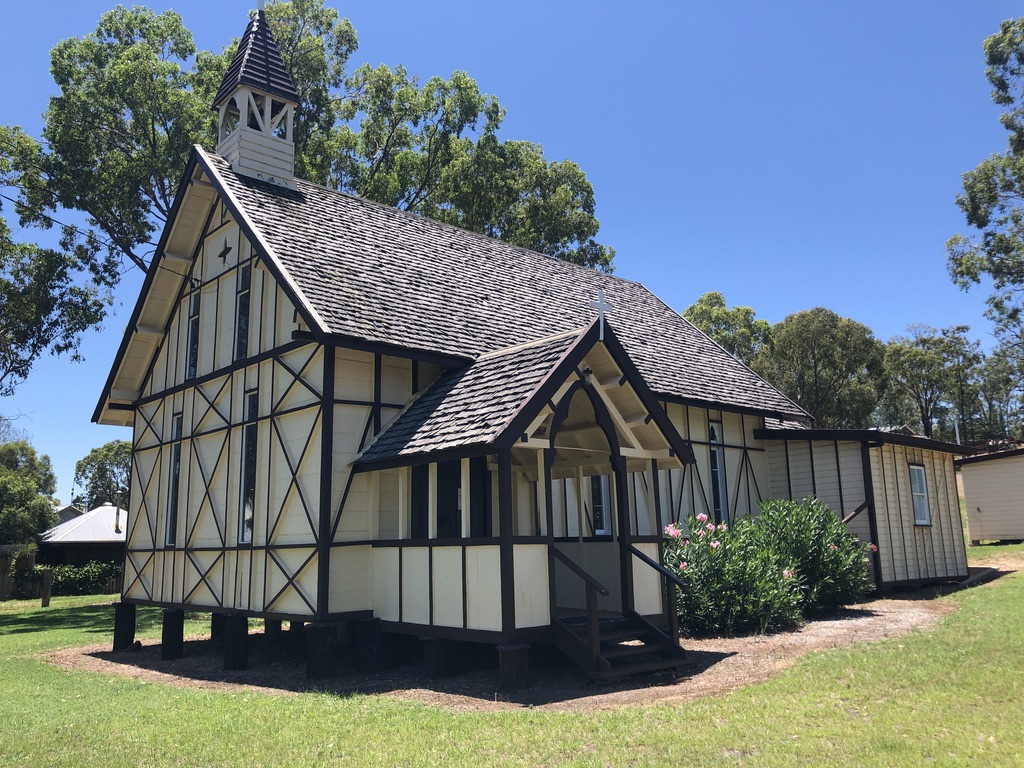
At the nearby town of Leyburn is another church visited by James Matthews. This attractive building was designed by architect Richard Suter, who designed Jimbour House, among many now heritage-listed buildings.

St Augustine’s Church, Leyburn

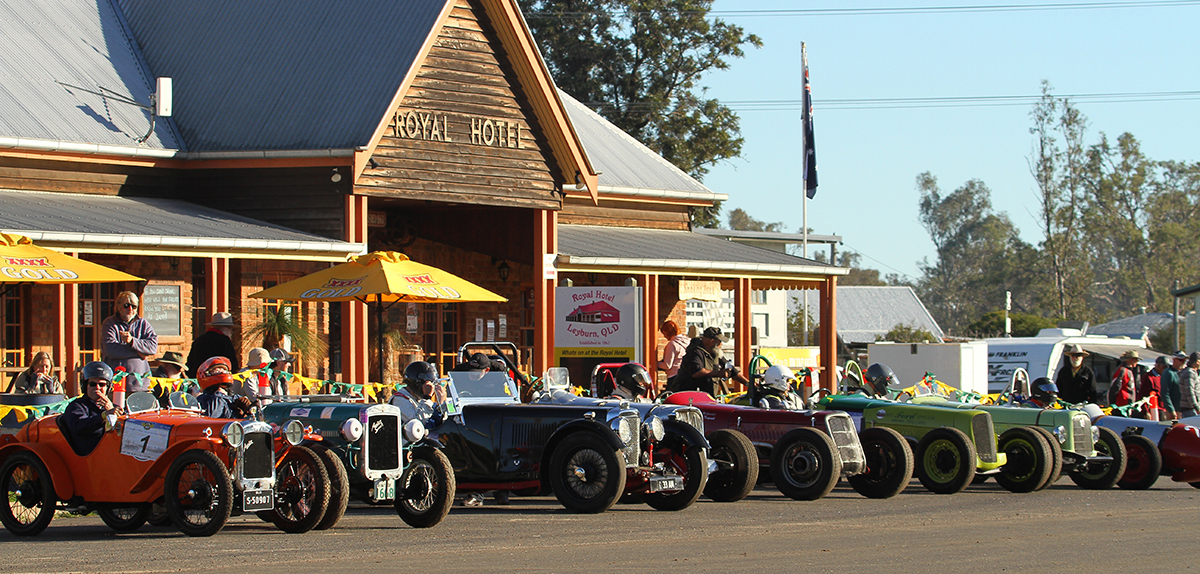
Leyburn has a pleasant pub, the Royal Hotel.  Along with the Grand View at Cleveland, it claims to be the oldest continuously licenced hotel in the state.  We were relieved to have our lunch in its air-conditioning.

Leyburn is known for motor racing. In 1949, seventy-five years ago this year, the Australian Grand Prix was held at here, attracting 30,000 visitors. The event has been recreated in the last few years as the Historic Leyburn Sprints, the main feature of a heritage festival with a motoring theme. The Sprints are held on a 137km route through the surrounding area, including Pratten. You wouldn’t have been able to hear the church bell ringing when the Sprint was running through town.

Royal Hotel, Leyburn, during the Historic Sprints festival

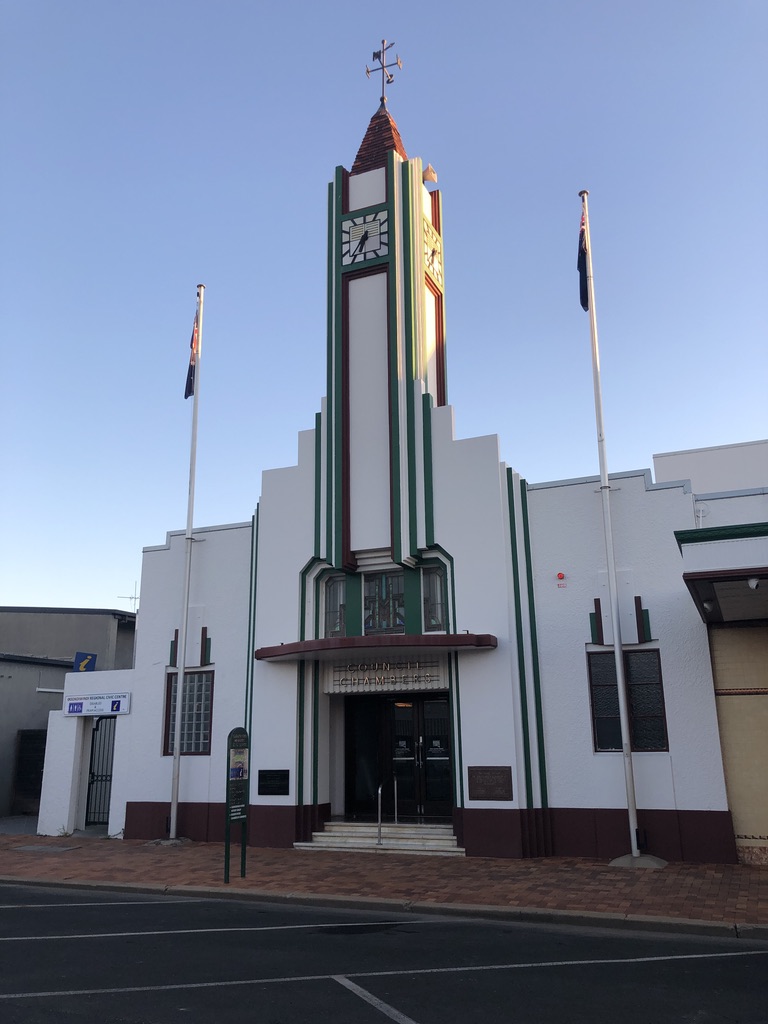
From Leyburn we headed to Goondiwindi to visit the Gunsynd Museum situated in the town’s elegant art deco council chambers. Another regional sporting hero, loved by Con.

Goondiwindi Council Chambers
In the Gunsynd Museum

Last May, for my birthday, we spent three nights on Minjerribah North Stradbroke Island. This place is a treasure; and so close to Brisbane. White sand beaches, clear water, gorgeous freshwater lakes and swamps (so fresh that Island water is pumped to the other Bay islands and the mainland); birdlife, headland views, and small town life, as well as a strong Indigenous cultural presence.

Sunset at Amity Point, Stradbroke Island

At the Point Lookout Hotel, perched above Cylinder Beach, I ate my birthday dinner accompanied by a beach stone-curlew that wandered among the terrace diners, searching for scraps with its huge, spooky eyes.

Straddie curlew

I’ve seen stone-curlews’ motionless forms and heard their haunting night-time cries from the suburbs of Brisbane to the tropics. Con tells me that on his first night at boarding school in Cairns he heard them and thought someone was being murdered.

We’ve made other out of town trips since our big trip was cancelled. Short trips to Grafton, Murwillumbah, Maryborough, Coolum, Toowoomba and Warwick.

Attractive ceramic art work at Coolum

We also went to Currumbin to enjoy the Swell Sculpture Festival.

Us reflected, at Currumbin Swell

What next? Out to Glenmorgan, to pay a return visit to the Myall Park Botanic Garden? The wattles and wildflowers out there would be beautiful in Spring.

And maybe, next April, we’ll set off on that fine rivers road trip. Unless the rivers are flooding, or the countryside is burning…

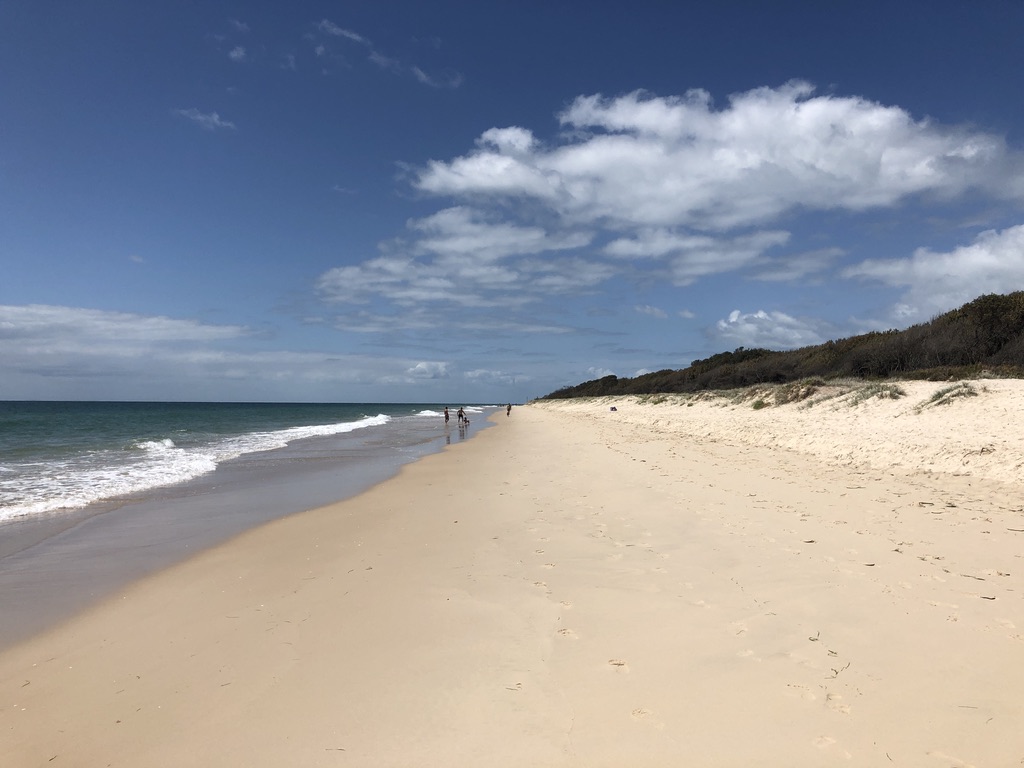
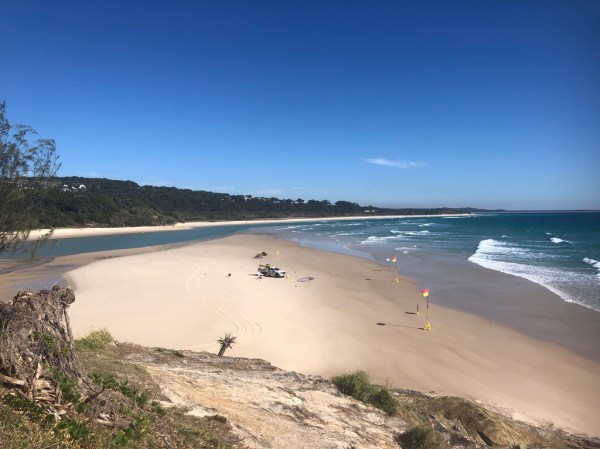
Main photo: Cylinder Beach, Minjerribah Stradbroke Island

About Reading and Longreach: a re-blog

I liked this little story by a noted reader, written after a visit to Longreach’s School of Distant Education. A teacher’s most important job is to turn children on to the pleasure of reading. If kids learn to love reading, they can achieve almost anything in life. Sadly, few teachers love reading themselves. Library teachers usually did, but they no longer exist in most schools.

Our Olympic Torch Relay

This is a Queensland story that is worth telling again and again.

The Opening Ceremony for the 2024 Olympics took place on 26 July, but the Olympic Torch had already arrived in Paris. I know it had, because my granddaughter sent me a video from Paris ten days earlier of the torch procession travelling down a Parisian boulevard. A tall young man dressed in white is running with the torch held high.

Con was moved by the thought of his granddaughter watching the Olympic Torch making its way through Paris, because as a young boy he’d watched an Olympic Torch being carried through Innisfail, Far North Queensland, by his brother Jim.

Con’s brother Jim

To qualify as a torch bearer for the 1956 Melbourne Olympics, you had to be able to run a mile in under seven minutes. And you had to be a man. Jim was a good miler, and he carried the torch from the Innisfail Shire Hall, down the hill and south across the river to hand it over to the next runner.

There was a huge crowd in town to watch the torch go through. Then as now, international events didn’t often touch Queensland towns.

The Torch Relay for the Melbourne Games began in Cairns on the ninth of November when the flame was flown in from Greece. The Relay caused excitement all the down the east coast of Australia. As the Relay passed through small towns and regional cities local people in huge numbers watched its progress.

The 1956 Torch Relay route olympics.com

The most testing sections of the Relay were in Queensland.

Setting up the Relay had been an epic in itself. Nineteen days earlier a convoy of army trucks and Holdens had set out from Melbourne on the road trip to Cairns, loaded with torches, fuel, medals for the runners and other equipment. The convoy was manned by army personnel and Melbourne university students.

The 1956 Olympic Torch carried through Bowen. Note the support truck with torches and support personnel slq.qld.gov.au

Perhaps the route had been planned using maps, not local knowledge, because heading north from Rockhampton through a stretch of country that was virtually unknown to the southern states, the convoy took the coastal route via the tiny railway town of St Lawrence, following the train line, instead of the Bruce Highway (such as it was), inland through Lotus Creek.

The coastal route was a dreadful track of creek crossings, potholes, swamps and cattle grids.

In the end, it was impossible. At St Lawrence the convoy was loaded on to a train to make the journey to Sarina, being bogged down once again before making it through to Mackay and the highway and on to Cairns.

Once the actual Relay began, the Torch was carried all the way south on foot, regardless of weather or time of day or night. Runners were dropped off at marker pegs a mile apart. When they’d run their section they would pass the torch in to the support truck and be tossed a commemorative medal before the truck disappeared on its way.

At the Burdekin River, the road crossing was flooded, and once again the Torch and the convoy crossed by train. From Mackay to Rockhampton, coming south, the Relay followed the inland route and wisely avoided the St Lawrence road.

Olympic Torch Relay Monument beside the old Bruce Highway at Lotus Creek tripadvisor.ca
Plaque on the Relay Monument at Lotus Creek tripadvisor.ca

Bringing the torch through was not easy, all the same. It was dark and raining. Each young runner in his white uniform would wait nervously by his marker for the previous runner to emerge from the gloom, torch in hand, to pass on the flame – relieved when at last the lights of the support trucks showed through the dark.

The torch weighed one point eight kilograms, and after a mile held at arm’s length it weighed heavily; and the runners found that if they held it too close to their bodies, sparks blew in their faces.

People came out with hot soup down that dark, muddy road and cheered the Relay on. Souvenir hunters followed after the support trucks, illegally pulling up the markers. There must still be relay markers in sheds and cupboards all down the coast. Family members clearing out Dad’s or Granddad’s bits and pieces may puzzle over what they could be.

Rutted, muddy roads, encounters with snakes and dogs, rainy nights, leeches, mosquitoes: those Melbourne University students went home with enough stories of the wild north to create legends in the south.

Thirteen days after leaving Cairns, right on time, the Torch arrived at the Melbourne Cricket Ground, the Olympic Stadium, and the Cauldron was lit.

Ron Clarke lighting the Olympic flame, Melbourne 1956 Fairfax, Archives, smh.com.au

On Friday, with the whole world watching, the 2024 Olympic Torch was carried over the iconic rooftops of Paris, and the Cauldron was lit under a magnificent hydrogen balloon that carried it off into the night sky.

Masked torch bearer across the Musee d’Orsay metro.co.uk

In 2032, Brisbane will be hosting the Olympic Games. I’ll be interested in how that Torch Relay is run. And I might want to tell this story again.

Paris 2024 Opening Ceremony: Flying Cauldron theguardian.com

Main photo: Don Craig, running with the 1956 Olympic Flame. cairnspost.com.au

Blog at WordPress.com.

Up ↑