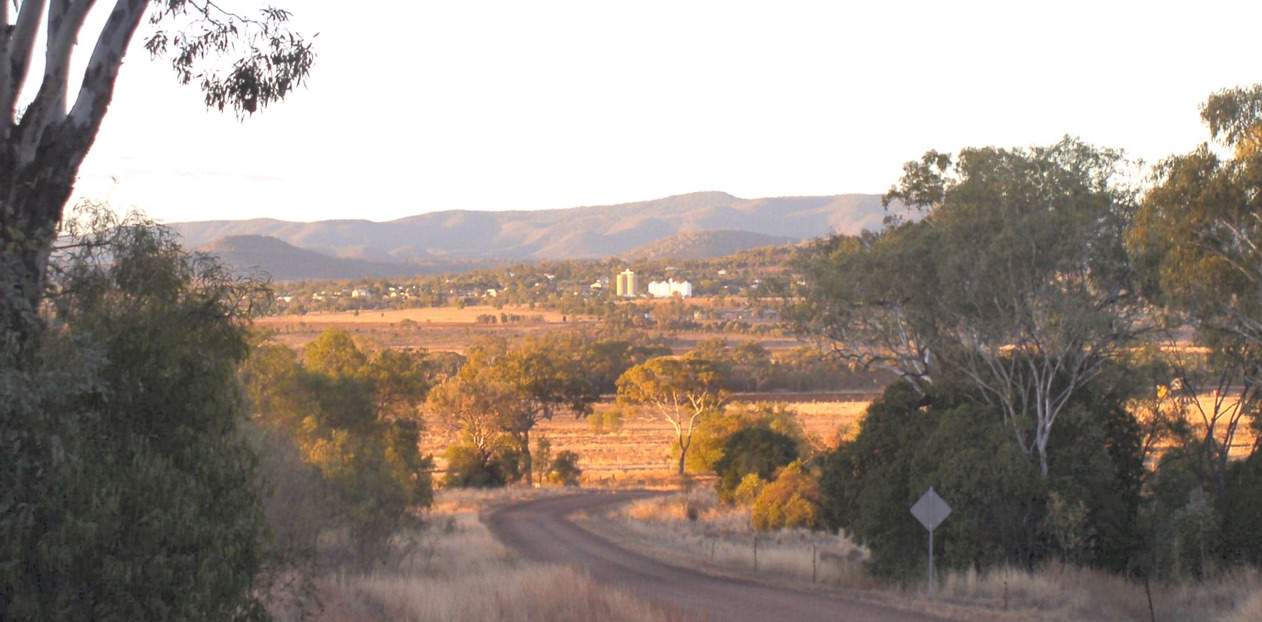
Bell, located on the Bunya Highway in the western foothills of the Bunya Mountains, 35kms north-east of Dalby, was rich dairy country when I was young, and trains carried away wheat, timber and cream.
When I visited here as a teenager, for the Bell Ball or church functions, the people were welcoming and the cream-filled sponge cakes were wonderful.
The Ball was held in the Memorial Hall. We danced gypsy taps and progressive barn dances to the music of local Darling Downs bands, with Pops wax flakes sprinkled on the floor to keep it fast, kids sliding on it between dances, and men outside around the cars passing bottles between them. And delicious suppers.

My father was the rector at St Paul’s Anglican Church, Jandowae, north of Dalby. Each Sunday, Dad would conduct a service at St Paul’s, then jump in the car and drive to a church at one of the other small towns in the parish, often on dirt roads, speeding to get there on time. Bell was one of these towns, along with Warra, Kaimkillenbun (The Bun), and Cooranga North.
I was away at boarding school, but my younger brothers often went with Dad on these trips, to serve as altar boys. According to them, Bell put on the best morning teas.
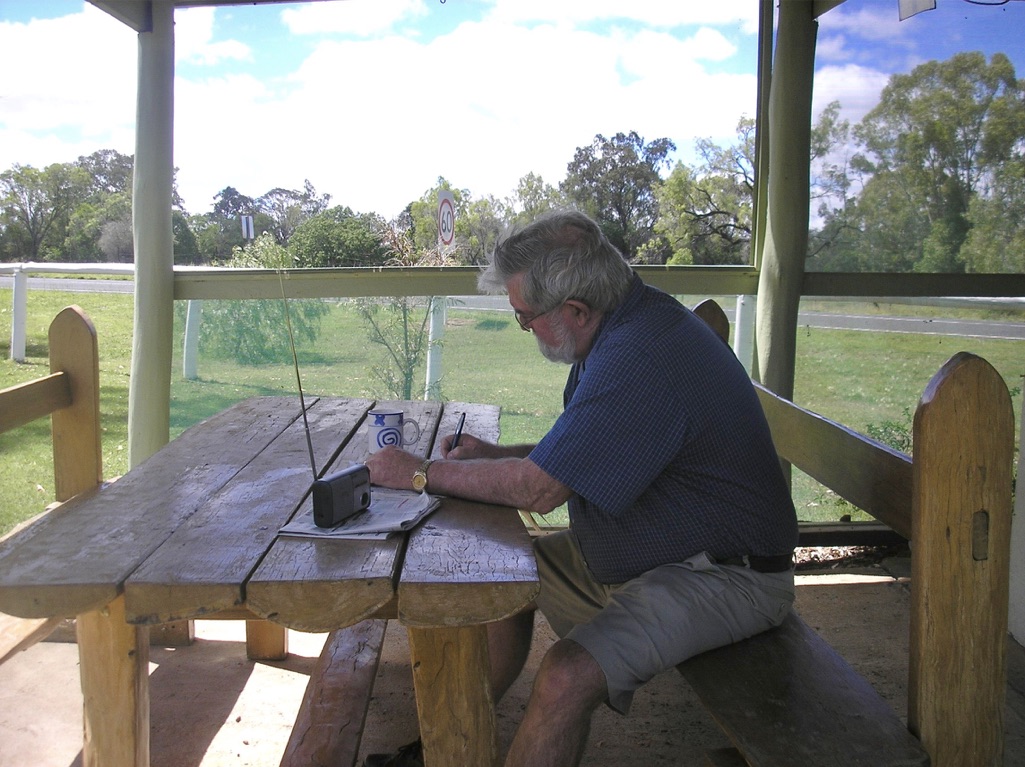
Around twenty years ago, I went back to Bell for the races. Con and I spent two nights in a cabin in the small caravan park. Con sat under a picnic shed with his newspaper and his little radio, getting the scratchings for the day, while I wandered around talking to people.
I spoke to a woman, a permanent resident, living in a caravan. In the shade behind it was an assortment of mismatched chairs, with empty coffee tins for ashtrays.
“That’s my beer garden,” she told me. “It’s for the old blokes who live in the other caravans. There’s nowhere for them to get together for a yarn, so they come here.
“I’m the only one with a car, too, so when they need to go to Dalby to the doctor or the bank, I drive them in.”
A young mother with two small kids was living in one of the basic cabins. I would see them as they walked to the amenities block. There was a newish sedan parked beside the cabin, and I wondered what her story was, and if she was hiding from someone.
That little caravan park had stories to tell.
And the Tea Room at the races did nice cakes and scones.
Last month, heading for a road trip through the South Burnett, we again stopped at Bell.
The Bell Tourist Park is still there, but it had no cabins available.
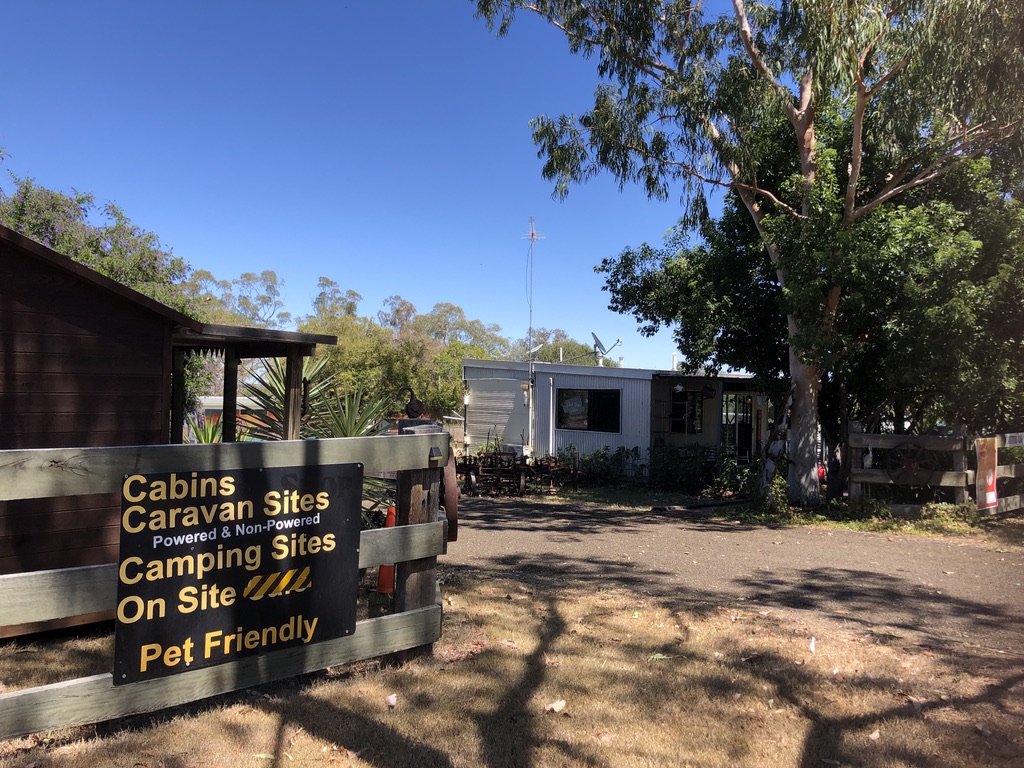
It’s still almost the only visitor accommodation in this town of about 500 population, apart from traditional pub rooms at the popular and cutely named Bellview Hotel, looking over the old railway line.
At the Bell Bunya Community Centre we ate scones with jam and cream, then drove up the hill to look for the old Anglican Church.
The small, wooden St Matthew’s Anglican Church and its quaint hall are tucked at the end of a curving driveway on the hill, almost out of sight of the town below. It was closed when we visited.
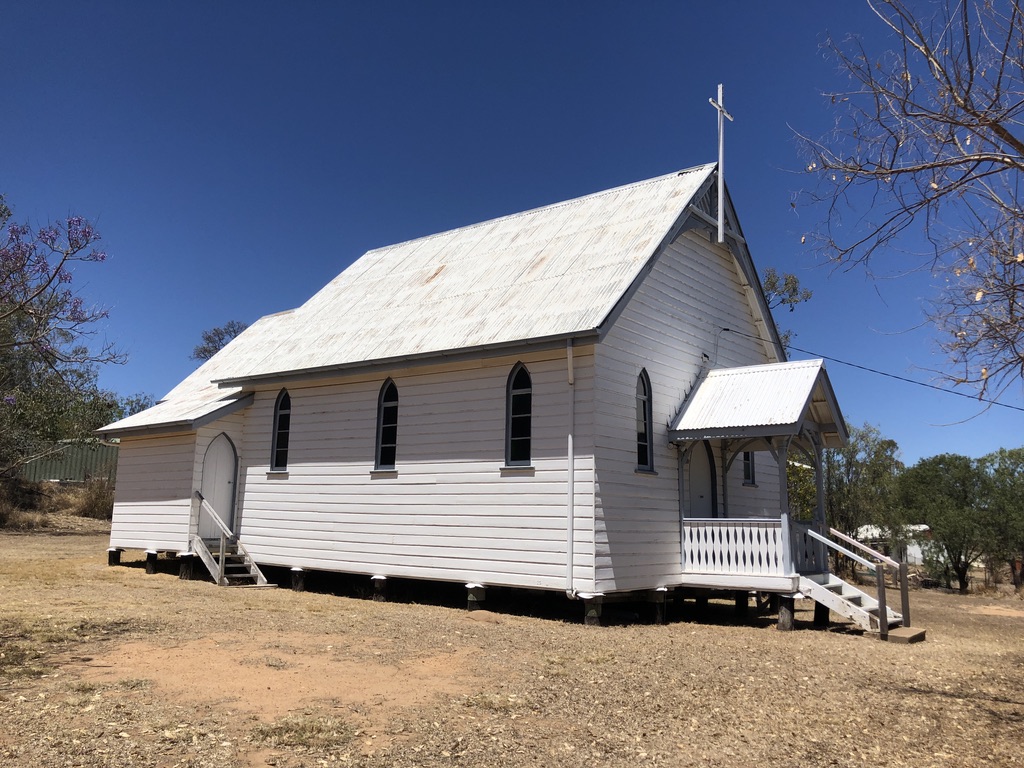
Congregations in traditional churches everywhere are shrinking. Sometimes small country churches like this are sold and renovated as homes, and people are sad about it.
In another country town where a church was sold and converted into a house, a local woman told me, “I couldn’t bear to live there. I’d never be able to forget all the coffins I’ve seen coming down the aisle.”
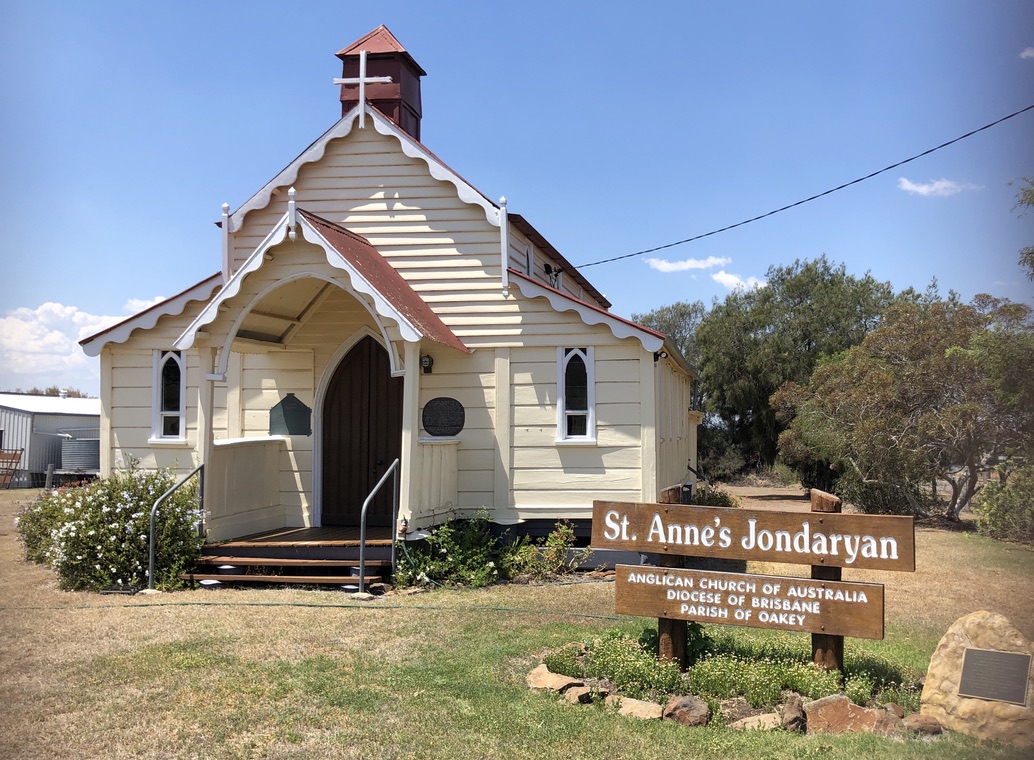
Country town churches are usually small, plain weatherboard buildings, but almost all of them have some fine detailing in their windows or their towers, and some are surprising and beautiful. The previous day, I’d visited tiny St Anne’s Anglican Church at Jondaryan, north of Toowoomba. Heritage Listed, it was constructed in 1859 of timber slab. It’s the oldest surviving church on the Darling Downs, originally built as the private chapel for Jondaryan Station. With its quaint windows and frilly timber facia boards, it’s charming.
St John’s Lutheran Church at Kalbar, in the Scenic Rim, is another one I like, with its fine, multi-sectioned tower.

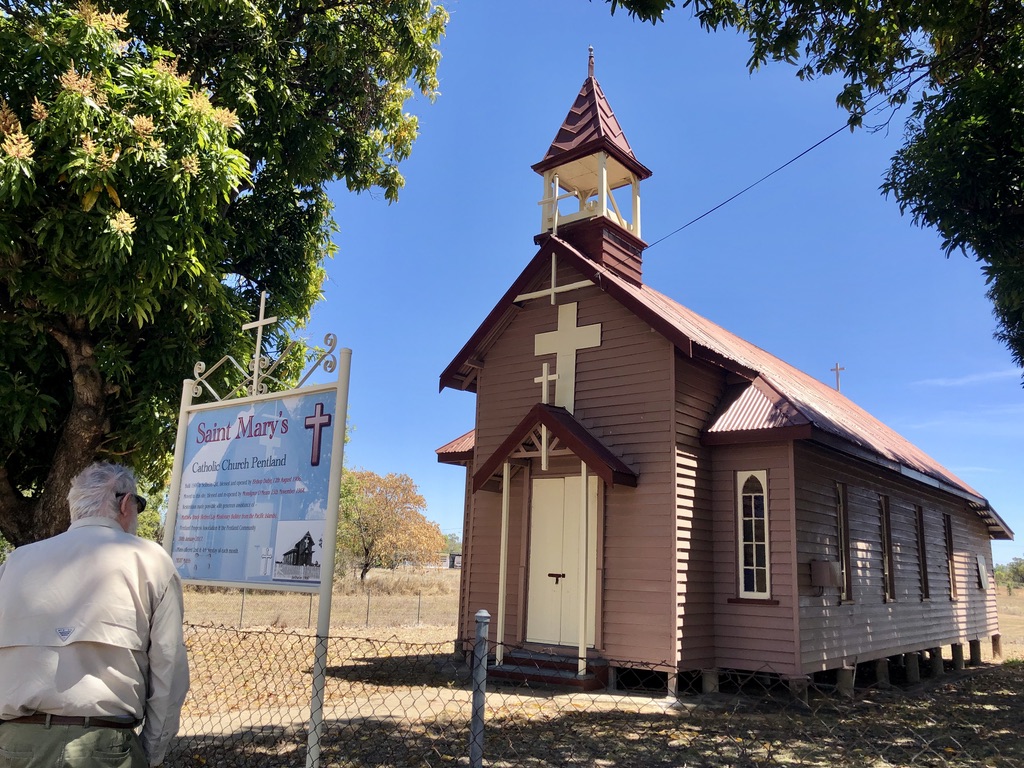
Another is the lovingly restored St Mary’s Catholic Church, nestling among shady mango trees at the old railway town of Pentland, on the Flinders Highway west of Charters Towers.
At Bell, Our Lady Help of Christians Catholic Church faces the Bunya Highway running through town. We went there to see the Bell Biblical Garden.

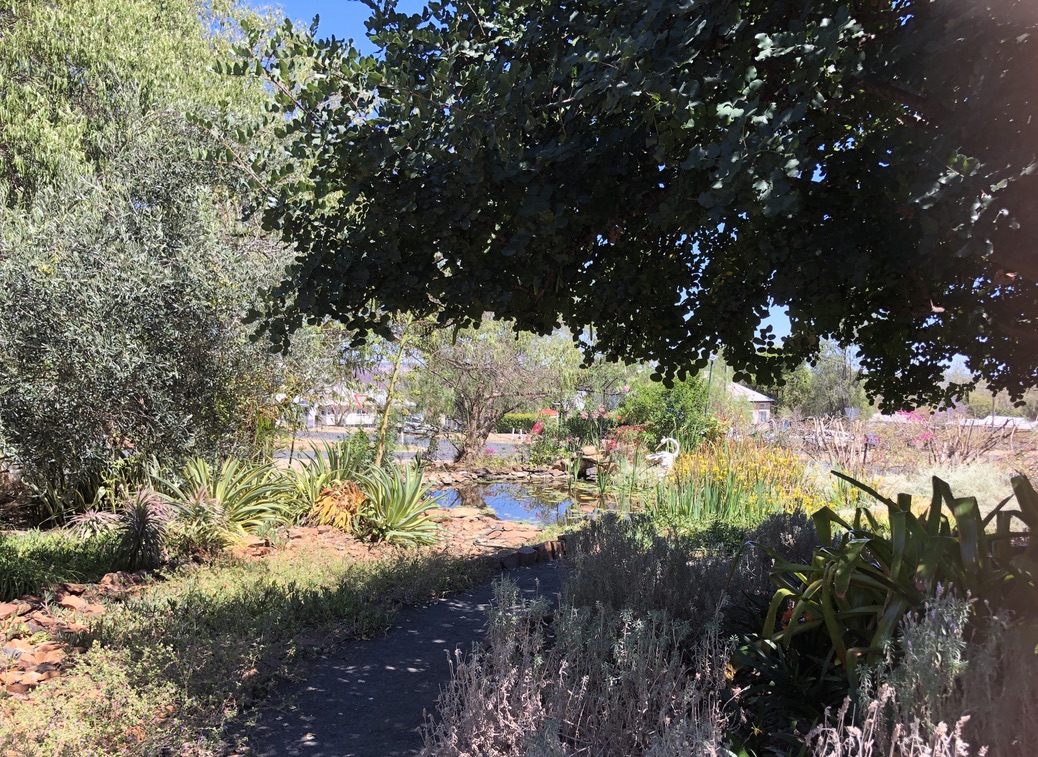
It was a hot day, and the countryside was brown with drought; but the garden was remarkably lush and beautiful.
Walking through the garden, we met a woman watering.
This was Megg Cullen: artist, gardener and Catholic parishioner. https://www.bellbiblicalgarden.org/about-the-artist/
Opened in 2012, this garden is the work of many, but Megg is at the heart of it.
On once vacant land there are now trees, flowers and a pond. A winding path follows the traditional Stations of the Cross, with accompanying mosaic artwork and carvings, resting places, and an impressive crucifix of barbed wire and corrugated iron.
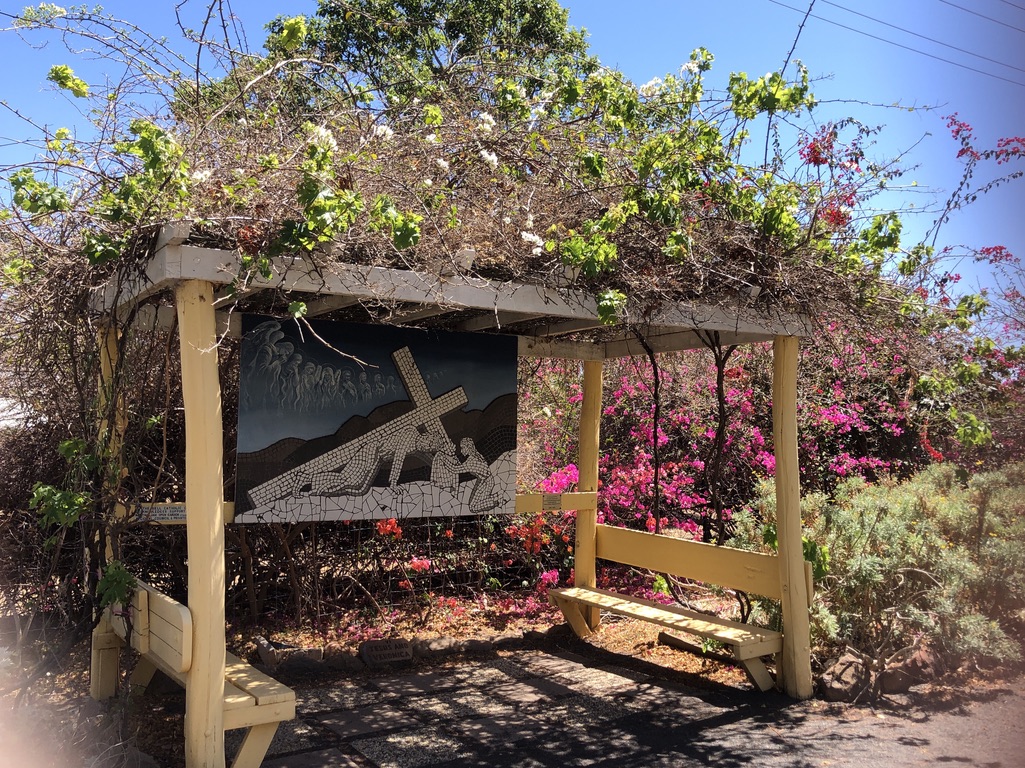
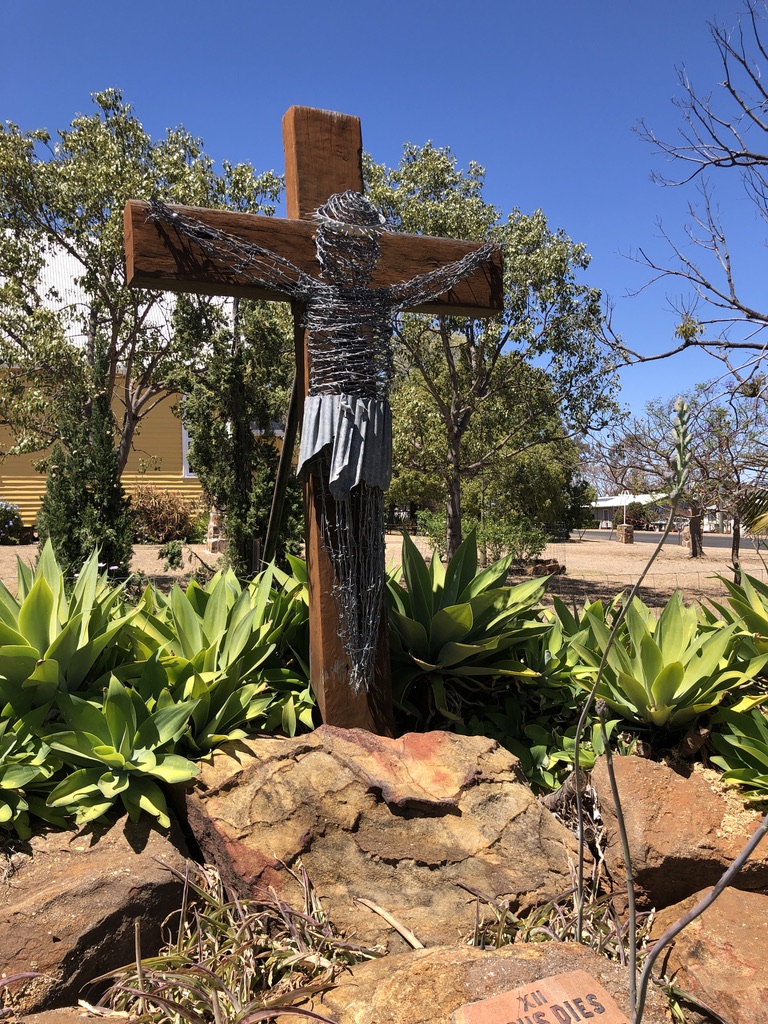
“We had over forty people walking the Stations last Good Friday,” said Megg.
The garden contains as many as possible of the plants mentioned in the bible: olive trees, plane, almond, bay and fig trees, date palms, roses and hyssop and rue and many others. These are interspersed with hardy flowering plants such as bougainvillea and geraniums, as well as bottle trees and cacti.
“Have you seen inside the church?” Megg asked.
“Isn’t it locked?”
“No,” she said. “It’s always open. Churches shouldn’t be locked up.”
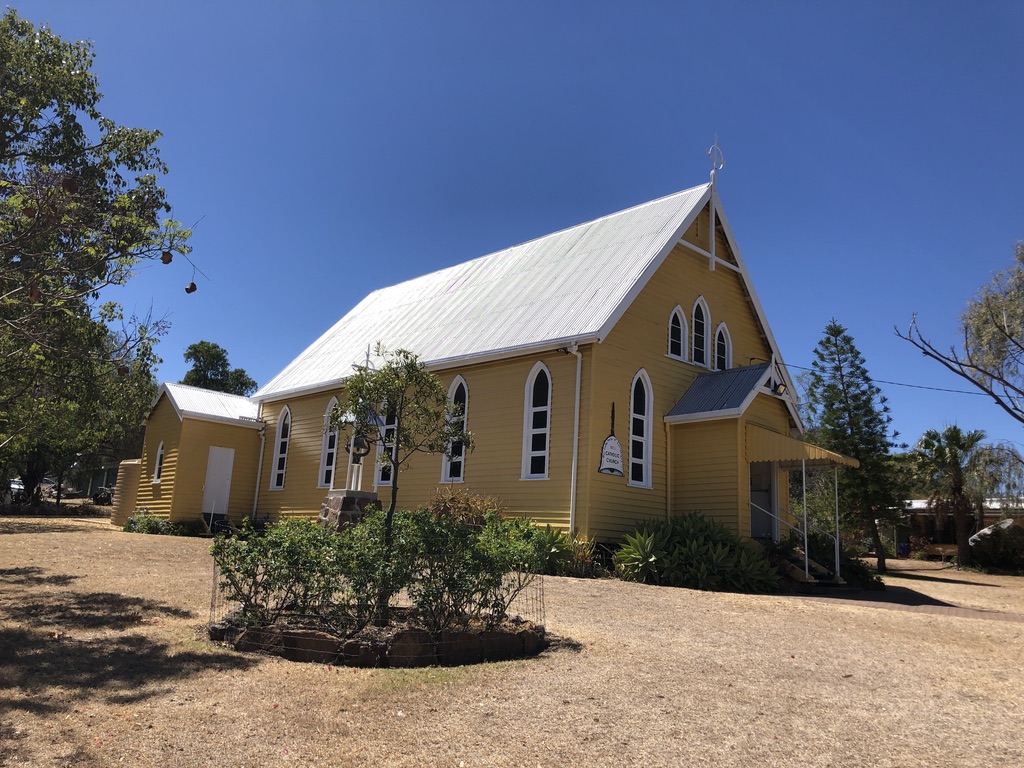
Painted yellow, with little stencilled bells in blue running up either side of its steps, this is an attractive building, and inside, it’s alight with paintings. In bright colours they illustrate Bible stories, from Adam and Eve onwards, with an emphasis on people, happiness, and hope. Megg Cullen was the artist.
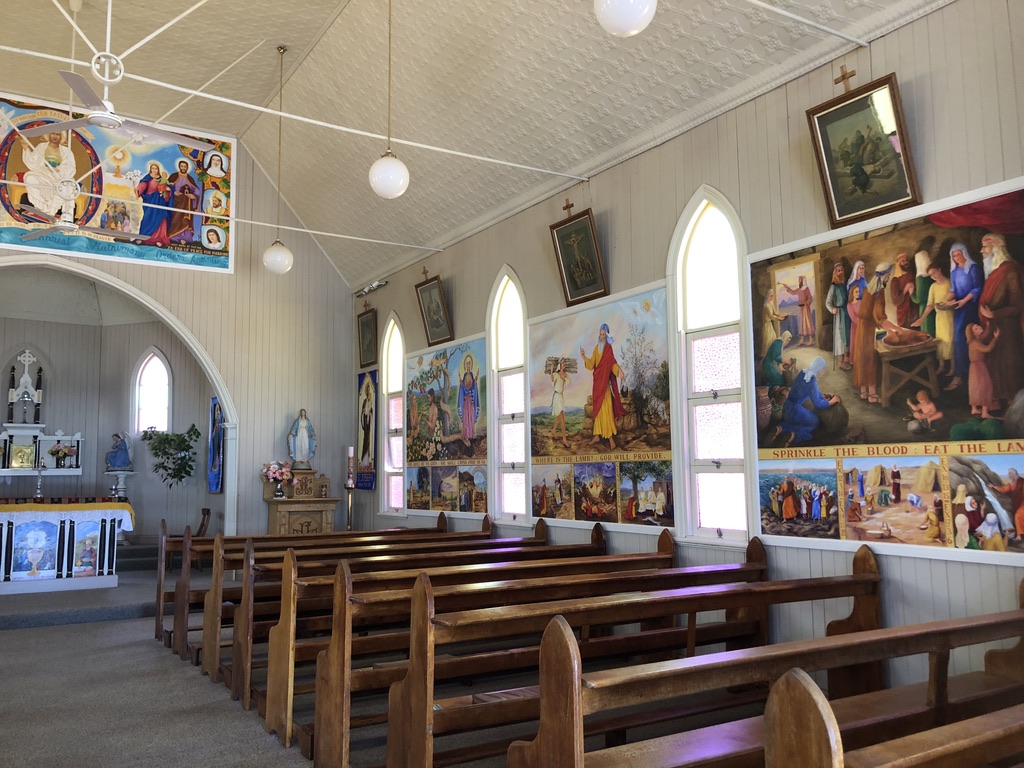
In 2022 Megg was interviewed for a series on local artists of the Western Downs: https://www.youtube.com/watch?v=XIyUxohTSh8
Even in the attractive booklets we later bought in the church, Megg’s name is hardly mentioned; but one person can have a big effect in a small town.
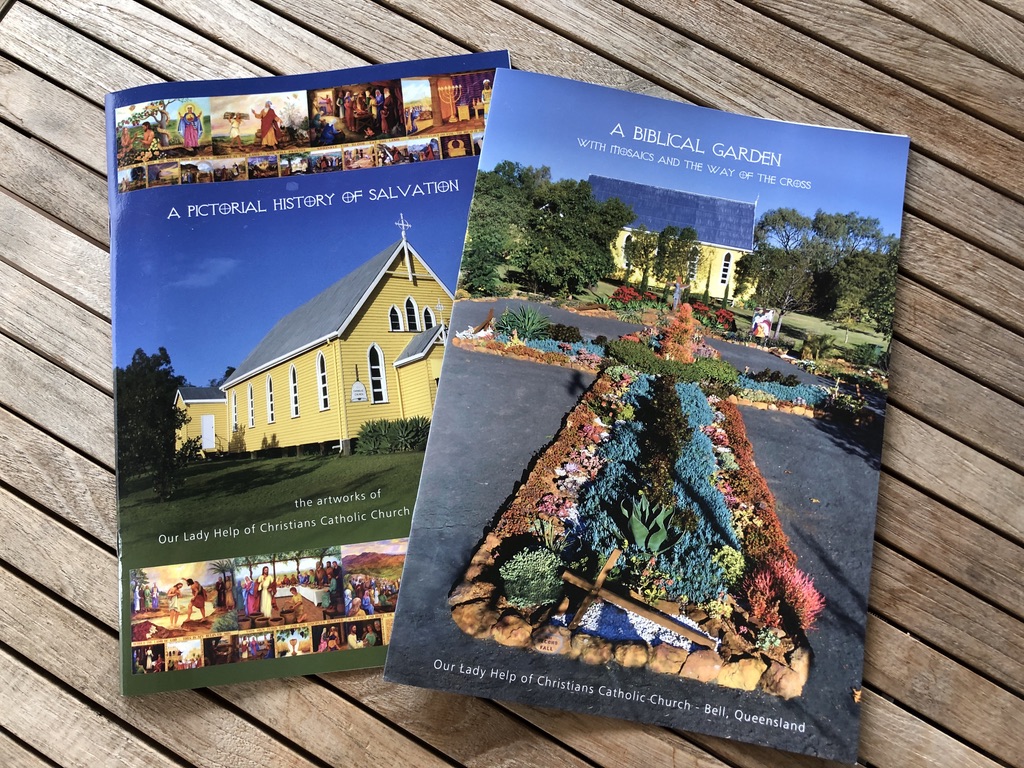
I love this place, with its garden, its artworks and its stories.
Bell has two large concrete grain silos, and the community has pushed for a few years for them to be painted. That may never happen, but it would be a great way of bringing more tourism to the town. People love to shop and drink coffee, and the Bell Bunya Community Centre, the Bellview Hotel, and the chic Pips’n’Cherries Café are among the businesses ready and willing to welcome them.

This will always be rich beef and grain country, and the Country people with their elastic sided boots and Akubra hats come to town to catch up at the pub and the cafe, and to support the annual Bell Races, the show and rodeo.
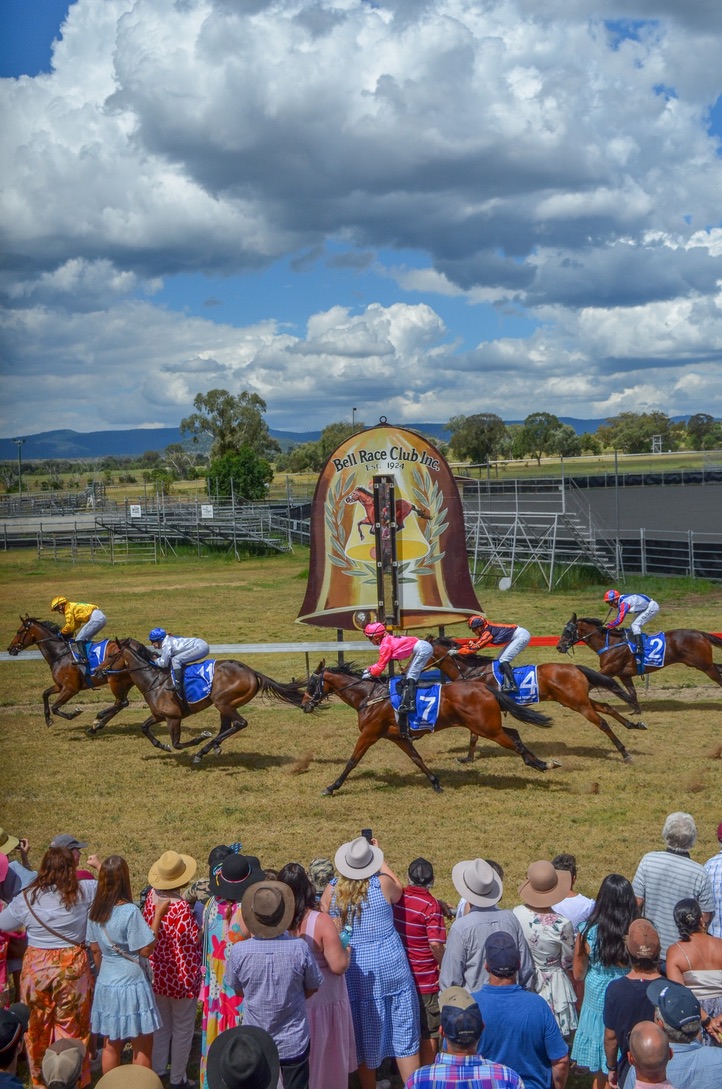
Most people driving the Bunya Highway, for work or visits to Dalby or the Bunya Mountains, slow down through this small town and speed on their way. It’s worth stopping for a closer look, and a cream scone or two.
 Queensland Stories
Great photos, and wonderful stories of lovely little towns I am guilty of driving straight passed. Will be rectifying that! G.
LikeLiked by 1 person
I love the old churches you find in country towns, so picturesque and so many stories no doubt.
LikeLiked by 1 person
I agree about the stories. Some of them must have been so hot though – especially at Christmas when they were crowded. Nearly always tiny windows!
LikeLiked by 1 person
What a lovely story. I’d guess that Megg is a bit of a ‘community dynamo’. The kind of people who often keep their little towns from extinction through hard work, wild ideas and amazing organisation skills. You’ve reminded me of the beautiful Bavarian style church in Toogoolawah.
LikeLiked by 1 person
Yes, it’s amazing how one person of drive and imagination can do to revive a town and its pride in itself. Meg has only lived in Bell for 20+ years, and that would have made it hard for her to convince the locals to support her.
LikeLike
It would have been hard for her. We see it time and again, where people revive their tiny towns. Girgarre near Shepparton is one such place. The butter factory had gone. The town was slowly dying when two enterprising women suggested a music festival. No one could even play an instrument back then. Now they bring in around a thousand people every year for their Moosic Muster. They all chip in and cook for the visitors. They have a free camp area all year round, they’ve built a sound shell and gardens. And have regular monthly jam sessions. It’s heart warming.
LikeLiked by 1 person
I must check out that church in Toogoolawah – thanks!
LikeLike
It’s a beauty!
LikeLiked by 1 person
And I must add, how Aussie is that…a cross of corrugated iron and Jesus of barbed wire.
LikeLike