Road Trip to Thargo

In late September I take a two-hour flight from Brisbane to Charleville to meet my son Joe and his family.

Rex Airlines is subsidised by the government for regional flights like this. In a two-prop Saab 340 with seats for about 30, with only a dozen or so passengers, I fly west over the ranges. Smoke from bush fires rises from the forests below.
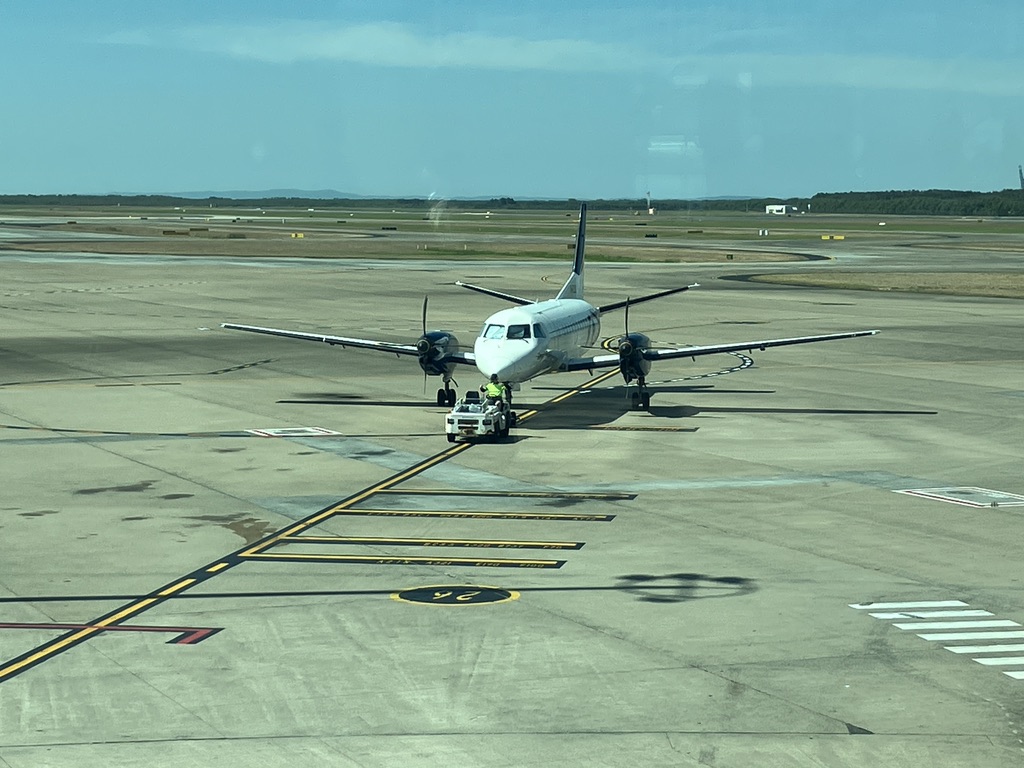
Rex plane for flight to Charleville

We’re told we can pick up our checked luggage from the carousel in the terminal. There is no carousel in the tiny Charleville Terminal. The bags are lined up on the floor.

I remember the Burketown airport, years ago, where a small tractor drew up outside the terminal and we grabbed our bags off its trailer at random. Joe tells me of a regional flight in Russia when their bags were tipped out unceremoniously in a pile in the snow.

Outside the terminal I’m greeted by Danny and Pete, aged 11 and 9. With Joe and Isabel they’ve driven 1,325 kms from their home at Babinda, south of Cairns; equivalent to driving from London to Edinburgh and back, but with less traffic. And fewer people.

They’ve spent nights at Charters Towers (pop. 8,040 in the 2021 census according to Wikipedia) and Blackall (pop. 1,365), with stops at Torrens Creek (pop. 46), Barcaldine (pop. 1,540) and Augathella (pop. 328).

This school holiday weekend, the Mulga Cup is being held in Charleville. Two hundred under 11 rugby league players in twenty-two teams, from as far away as the Gold Coast, are in town, with their families. Accommodation is hard to find.
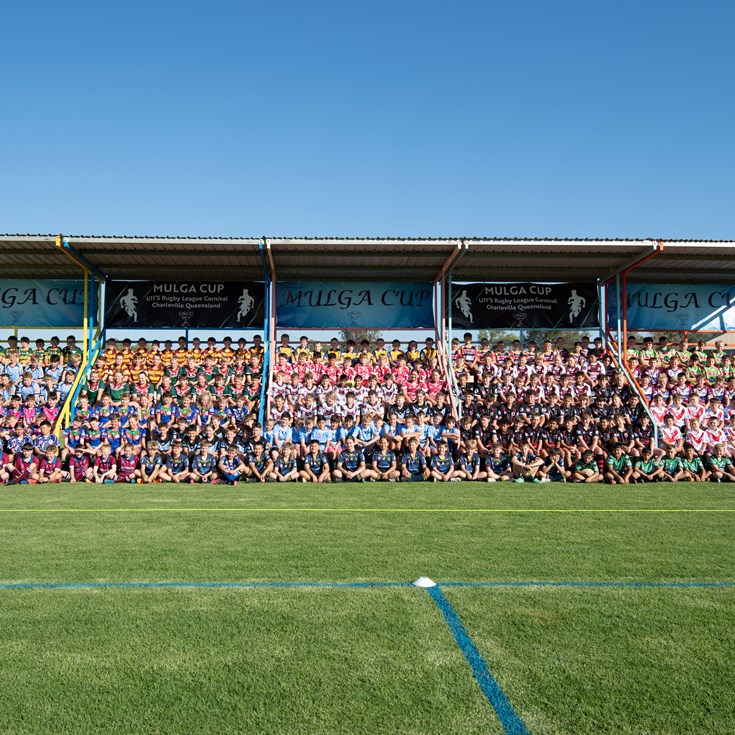
The teams for the 2025 Mulga Cup in Charleville qrl.com.au/news

In western Queensland, towns are far apart. We can either backtrack to Augathella, 84kms to the north, where there is one room available in the motel behind the pub, or head out to Quilpie, 211kms; but the whole of Quilpie (pop. 530) is booked out because there’s a wedding in town this weekend.

Before leaving Brisbane, I’d rung my list of Charleville motels again, and found a lucky cancellation. We get to stay here and see the Bilby Experience, look at the stars and planets at the Cosmos Centre, and visit the Royal Flying Doctor Service Visitors Centre.

At the Visitors’ Centre I give Pete a fifty dollar note to post in the donations box. He looks at me in surprise, but I’m remembering the two Flying Doctors emergency flights I’d had out of Burketown, years before. The RFDS is vital in the bush.

Then we’re off to the west.

90 kms out on the Diamantina Developmental Road to Quilpie, we stop at the iconic Foxtrap Roadhouse. This is a place with many stories to tell.
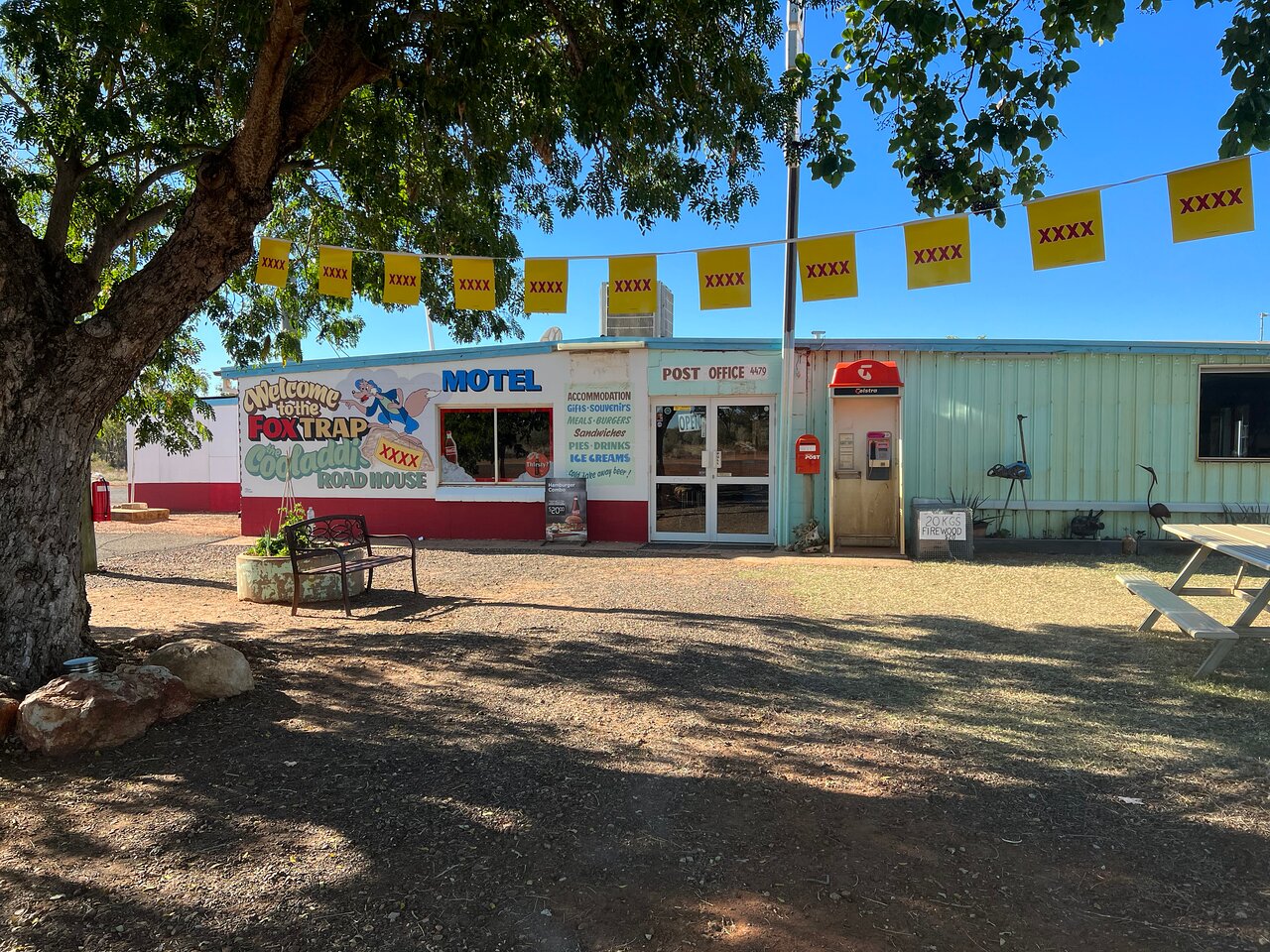
Foxtrap Cooladdi Roadhouse Tripadvisor

While we’re there, a man and a woman in work clothes come in and settle on stools near us. They’re from the cattle station across the road, and they smell like hard work and horses.

“I’ve been mustering and branding all morning”, the woman tells us. We have an interesting conversation. As a tourist it’s not often that you get to really talk to locals. It turns out that this little roadhouse, seemingly isolated, is the centre of a local community of station people and workers, and not lonely at all.

Much of western life is invisible in the towns. It lies down those unsealed side roads, marked sometimes by a sign, a mailbox and a cattle grid, that lead to the homesteads and outbuildings of cattle stations; or the roads leading to mines or gas fields.

People from the stations go to town only occasionally – for council meetings, the pub, the rodeo or the races, the doctor, or the school if they’re on a school bus route.

From Quilpie we turn south on the road to Thargomindah (pop. 220), with white and yellow wildflowers carpeting the verges and spreading across the paddocks in every direction. It’s springtime, and this country has had more rain than usual.
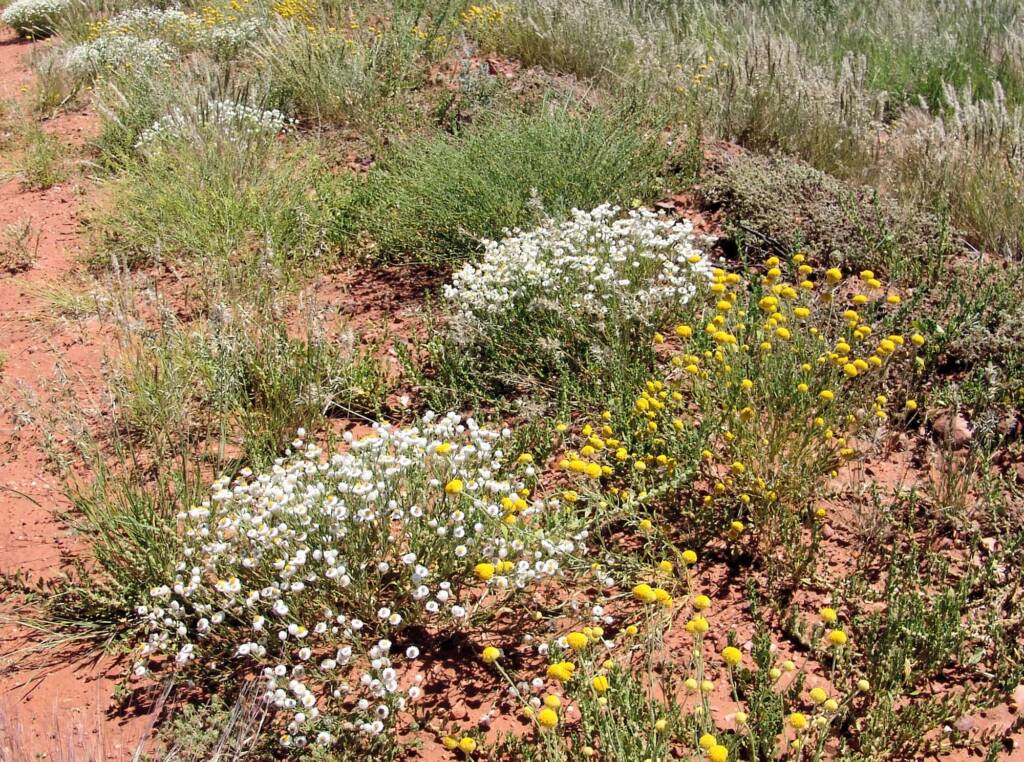
White paper daisies and other wildflowers that spread across inland Australia in Spring ausemade.com.au/flora-fauna


In the Thargomindah Explorers Caravan Park we stay in comfortable units built high enough to have avoided the flood that almost wiped out the town in mid-April 2025. Much of the Park looks as if the rushing water swept it bare.
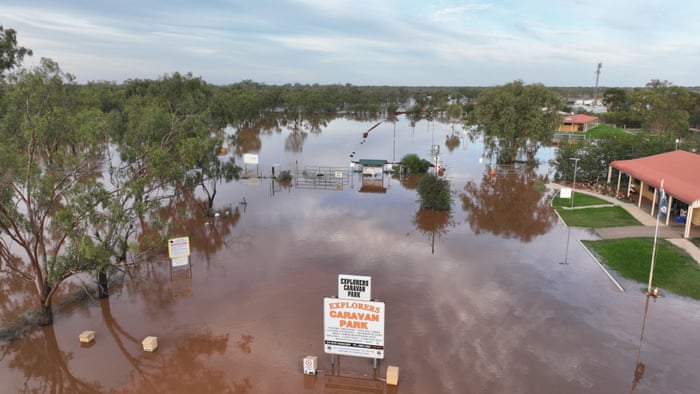
Thargomindah caravan park under flood water, April 2025 The Guardian

What the locals call Thargo is on the banks of the Bulloo River, and it was the Bulloo that did the damage. According to news reports, every business in Thargo and 90% of homes were inundated. Most of the population was air-lifted out of town, with some staying on higher ground at the airport in cars and campervans until the water went down.

https://www.abc.net.au/news/2025-04-14/outback-floods-thargomindah-levee-river-gauges-water-levels/105170880

Isabel visits the town swimming pool with the boys, but it’s closed, being cleaned for the third time to get rid of lingering mud.
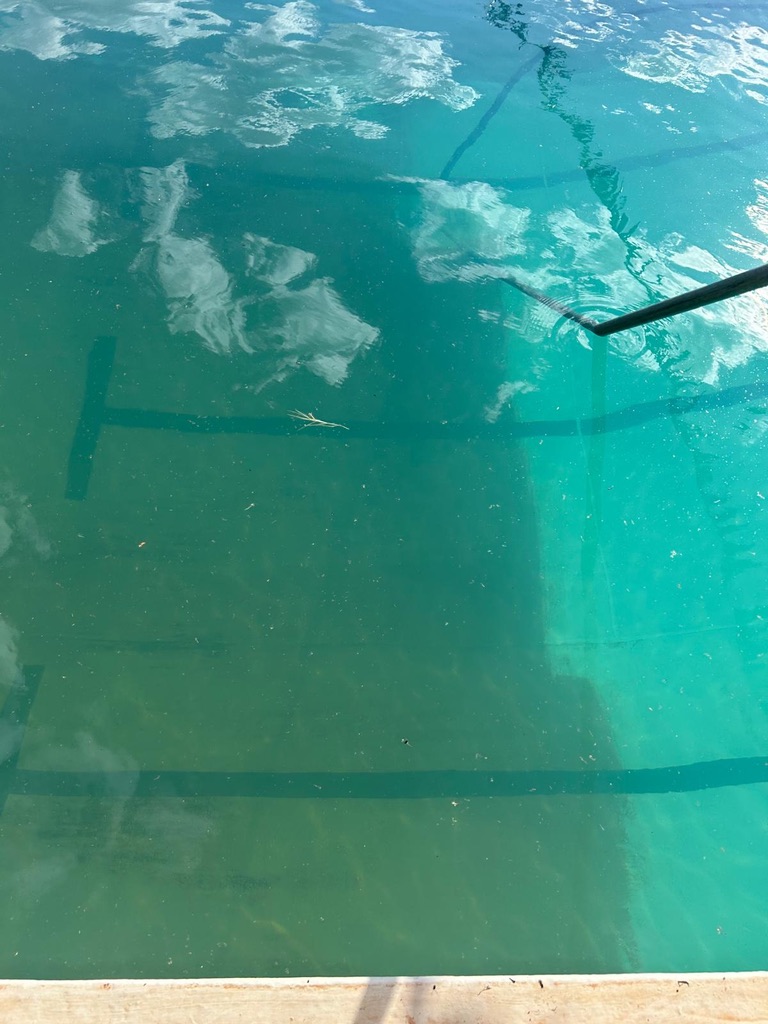
Thargomindah town pool being cleaned of mud, with clouds reflected in the water Photo: Alexandra Knott

Instead, we walk down to the river, and she and the boys go swimming in that milk coffee coloured water. For children who’ve grown up in the pristine creeks of Far North Queensland, swimming in water you can’t see through is something new. At least out here in the west they don’t have to worry about crocodiles.
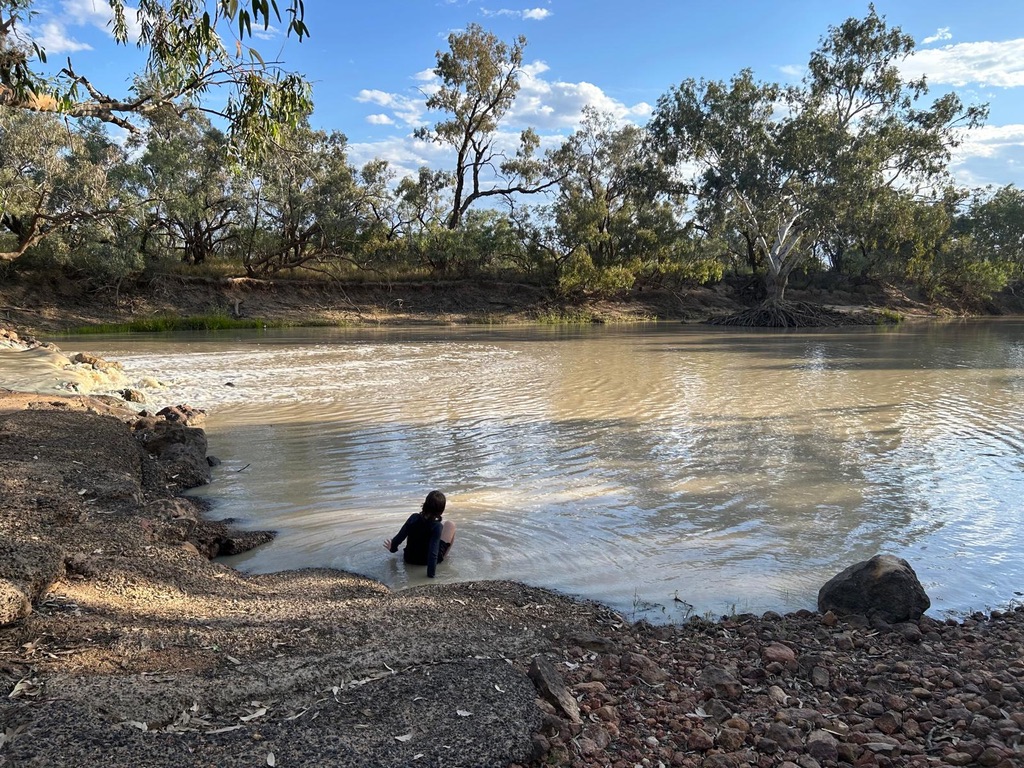
Swimming in the Bulloo River, Thargomindah Photo: Alexandra Knott

There are new houses and functioning businesses in town, and a sign-posted Heritage Trail, but to the boys, swimming in the river is the only interesting thing about Thargomindah.

Danny asks me, “Why are we driving all this way to places where there’s nothing to do and nothing to see?”

I try and explain.

“This is home for the people of Thargo. They need visitors like us to come and support their town after the flood. They’re Queenslanders like you, and they’ll be supporting the Broncos tomorrow night, just like you will be!”

The following night, the Brisbane Broncos meet the Penrith Panthers in a National Rugby League preliminary final. As Broncos supporters we must not miss the game.

At Eulo (pop. 94), 67 kms west of Cunnamulla, I book cabins behind the Eulo Queen Hotel.
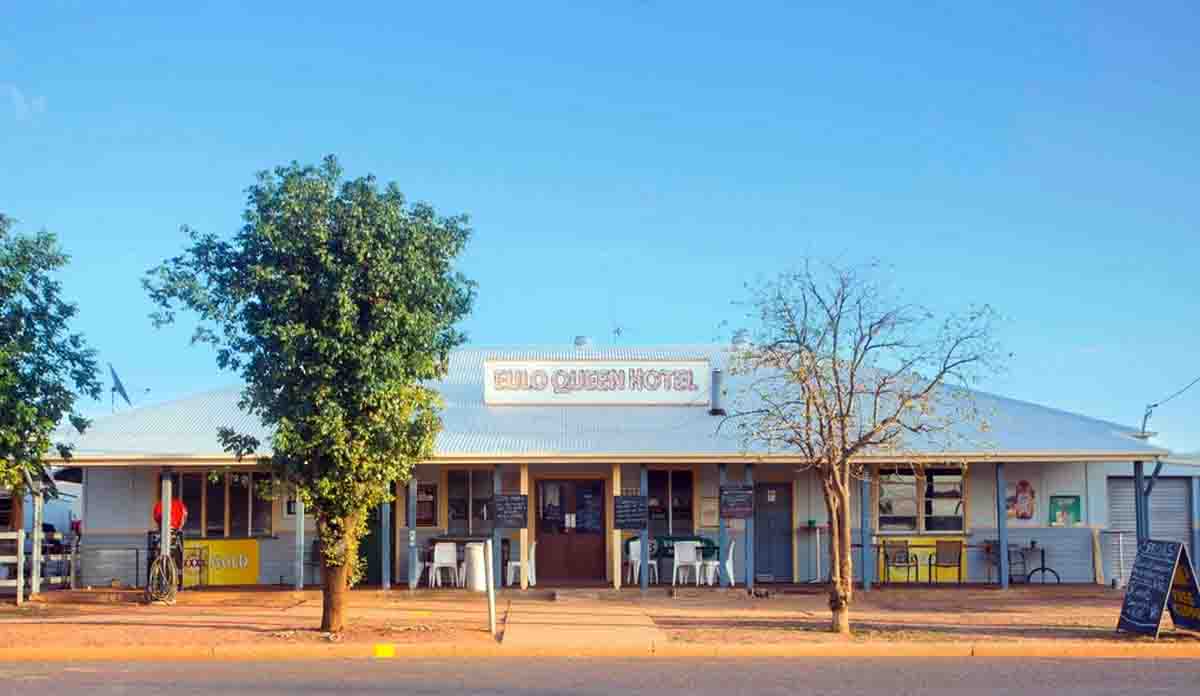
The Eulo Queen Hotel pubtic.com.au

The pub closes at 4pm on a Sunday, before the match is due to start, but the publican offers to take a television out to the shed. The new owners are from Tasmania, and I don’t know if they appreciate the importance of rugby league to Queenslanders. AFL would be a different matter.

There’s nowhere else in this tiny town to watch the game, except for private houses, so a number of people join us in the shed – the pub cook, a few travellers from the cabins, and a bloke from off the street. A fisherman, one of many heading out to catch yellowbelly in the brimming western rivers, comes along with his young son. It’s an exciting match, and to everyone’s delight the Broncos win.

From Eulo we pass through Cunnamulla (pop. 1233) to St George, a pleasant town (pop. 3130) where we stay in an old house restored as Airbnb accommodation. The boys and Izzie miss their anticipated swim in the Balonne River because there are brown snakes in the muddy water around the pontoon.

After Texas (pop. 790), on the New South Wales border, the road takes us through hilly sheep country to Stanthorpe (pop. 5286), the biggest town on this trip since Charters Towers.

Fine old towns like Barcaldine, Charleville and Cunnamulla were built on the wool industry, but these days it’s cattle across most of the state, and the towns have suffered. Fewer people, less money coming in.

In picturesque granite country, surrounded by orchards and vineyards, with a beautiful national park nearby, and within an easy drive of Brisbane, Stanthorpe has more obvious charm and prosperity that any of the other towns we’ve visited.
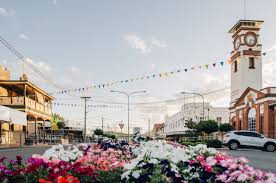
Maryland St, Stanthorpe granitebeltwinecountry.com.au

Con has come up from Brisbane to meet us, and next day he and I drive home together while the family heads further south.

Joe and his family have driven 2621 kms from Babinda to Stanthorpe, equivalent to driving from London to Prague and back. They’ll need a few days of rest before heading back to Brisbane, then starting the 1645km slog up the coastal Bruce Highway to their home.

Queensland has an area of over 1,700,00 square kilometres and a population of under six million. According to Queensland Government statistics, only 2% of Queenslanders live in the outback; and in the southern outback region that includes Thargomindah that number is dropping.
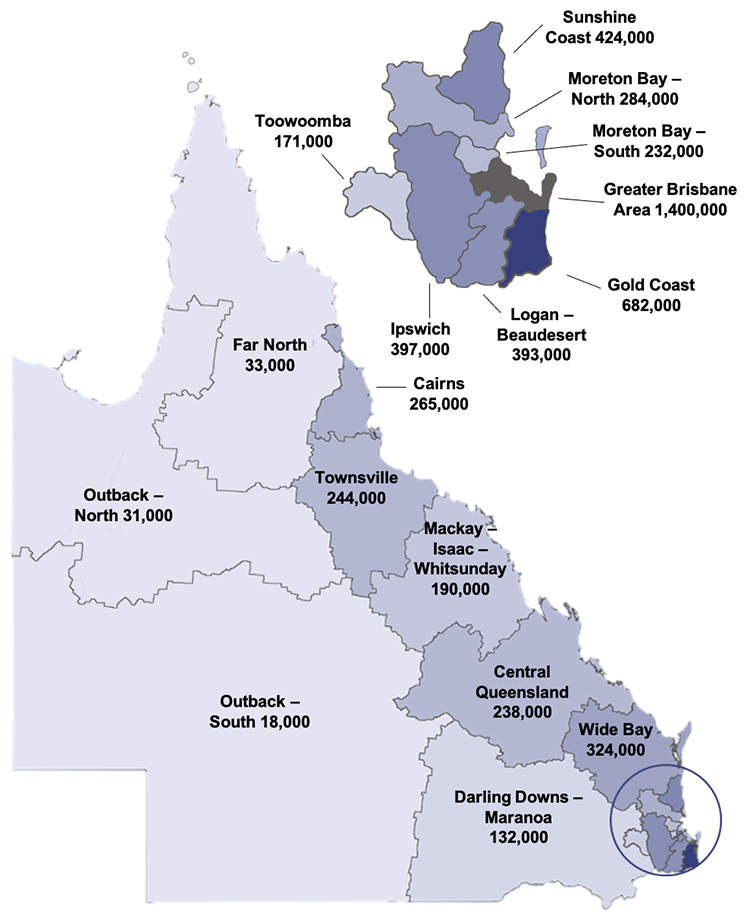
Queensland’s population by Region 2023 qao.qld.gov.au/reports

Flood, fire and drought can and do hit everywhere in Queensland. It’s just that much harder in the isolated western regions. It’s great that more and more people from coastal Queensland are taking their caravans, campers and kids to see what lies out beyond the coastal ranges.

While they’re there, they should donate to the RFDS.

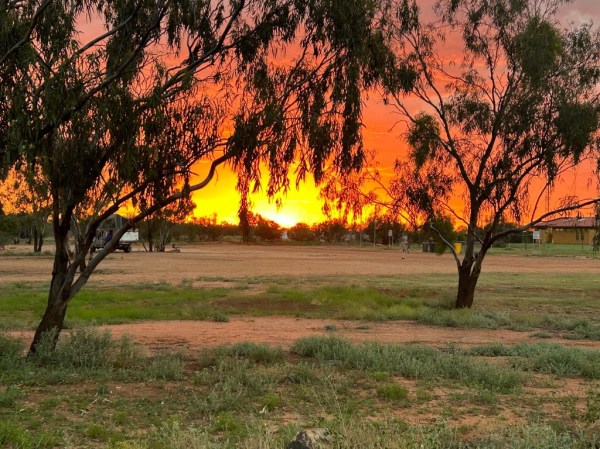
Main photo: Sunset over the Thargomindah Caravan Park photo: Alexandra Knott
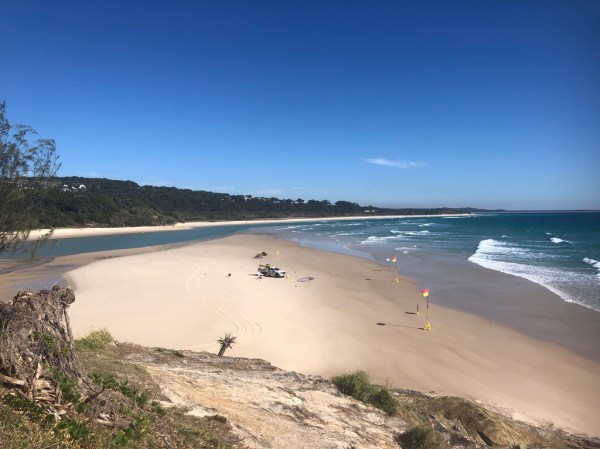
Out of Brisbane

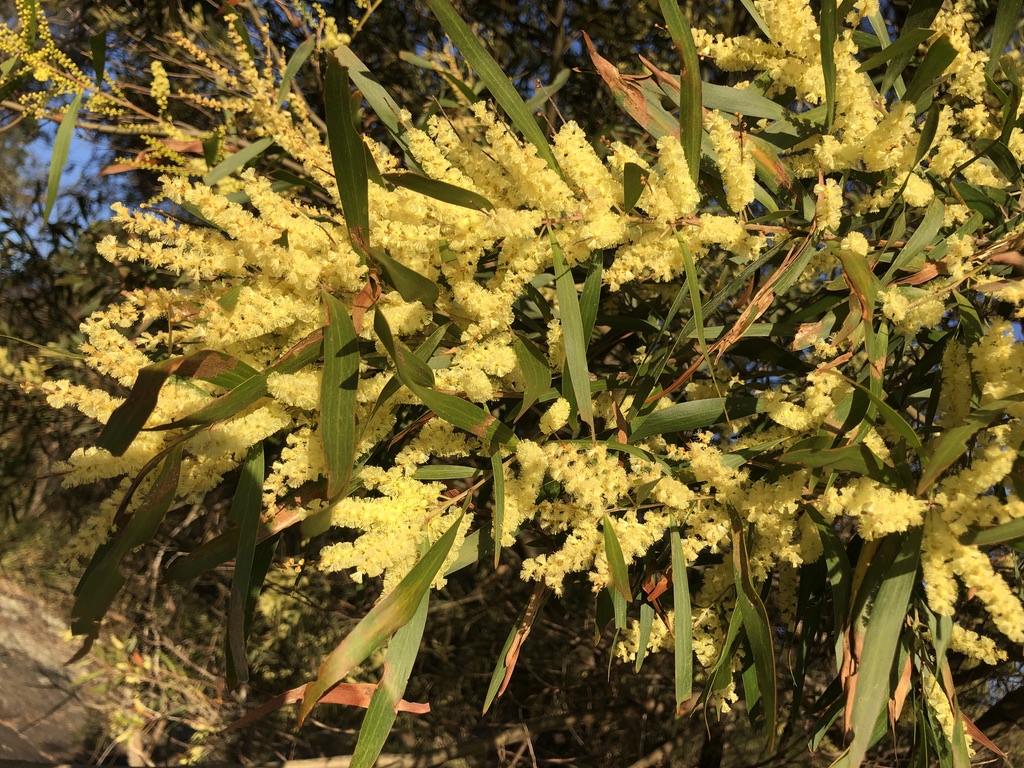
Along Quart Pot Creek, upstream from Heritage Park, the wattle trees are flowering.

Stanthorpe wattle

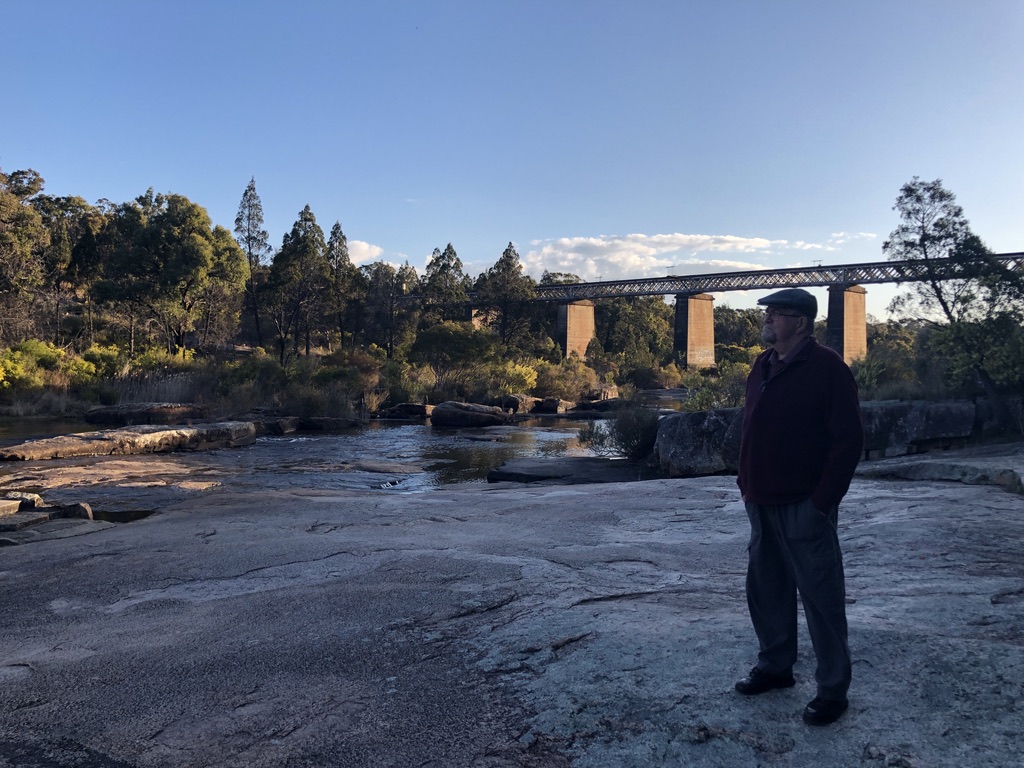
The path winds above the creek and under the railway bridge, across sloping granite to the creek and beyond. On the bank near the narrow footbridge, fairy wrens flit among the bushes.

Along Quart Pot Creek

In Stanthorpe this Spring when we visit, the water is cold. Not tempting. Perhaps in summer families come here to lie in the shallow pools and sunbake on the warm granite.

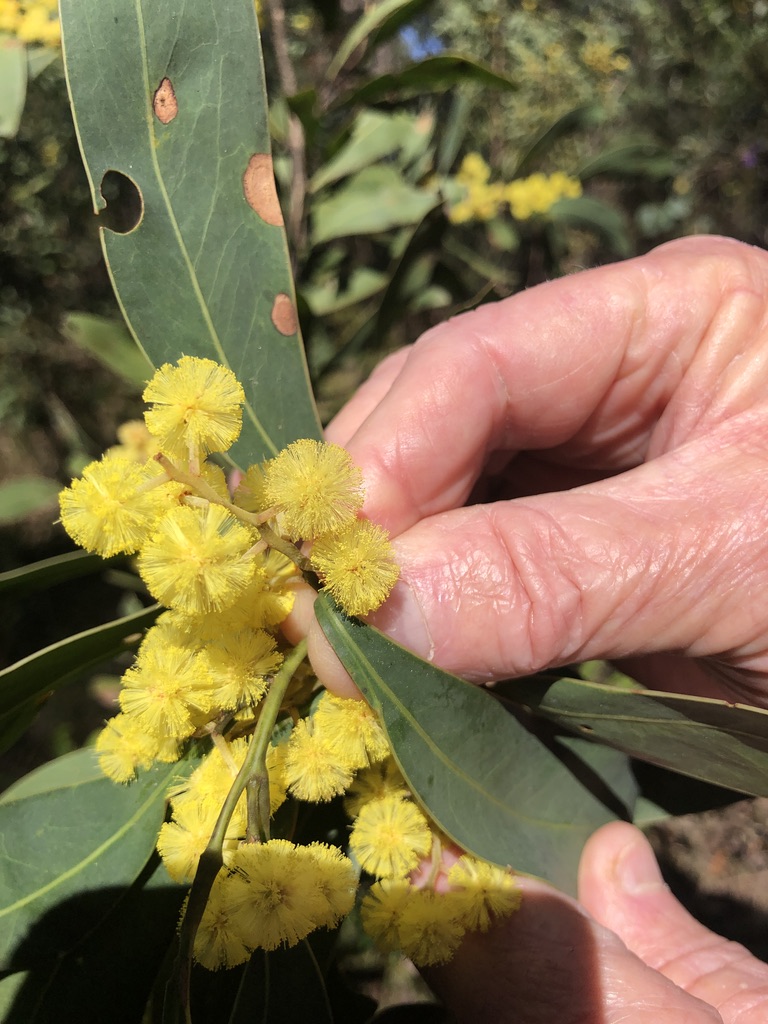
On this short trip out of Brisbane we are counting wattles. Leaving Stanthorpe, we drive over the New South Wales border to Bald Rock and then back home via the Bruxner Highway and Summerland Way, counting many varieties of wattles in bloom along the way. Green and gold everywhere.

Bald Rock wattle

In April 2023, I planned a fine road trip. It was the right time: the rivers were full but not flooding. The countryside was green. There was no threat of bushfires.

We would follow the inland rivers, from the Warrego at Cunnamulla, down the Darling to Burke and Menindee, to meet the Murray River near its mouth, at Gawler in South Australia. We would then trace the Murray upstream to where it meets the Darling at Wentworth in Victoria, then further east to Balranald, near where the Murray meets the Murrumbidgee. Following the Murrumbidgee to Wagga Wagga, we would then head north to the Lachlan River at Forbes; join the Newell Highway and cross the Macintyre back into Queensland at Goondiwindi.

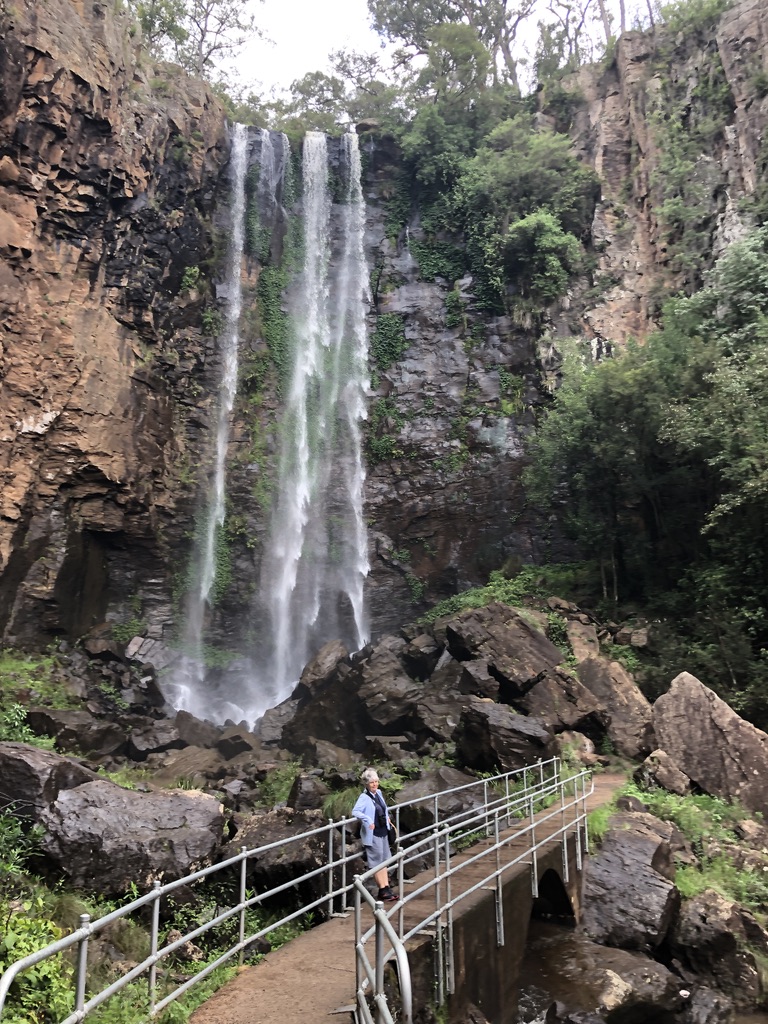
We’d meet the Condamine River at Warwick, then drive east to Queen Mary Falls where the river drops forty metres down from the ranges. Past towering Mount Superbus, the tallest mountain in south Queensland and the head of the Condamine catchment.

At Queen Mary Falls

In the right season, with plenty of rain and flow through the rivers, the water that plummets over Queen Mary Falls flows down the Darling and eventually ends up in the Southern Ocean at the mouth of the Murray, at the Coorong in South Australia.

What a neat trip that would have been. But life and illness got in the way, and we cancelled just days before we were due to leave.

That left us in Brisbane; but from Brisbane there are many interesting places to go for short trips. That is what we’ve been doing ever since.

In October last year we took a three-day trip to mainly new territory. A night in Dalby and a walk along Myall Creek in the middle of town, then up the Bunya Highway through Bell and Kingaroy to Murgon.

In Murgon there is a small but well set up Fossil Experience Museum called “55 Million Years Ago”. Local businesses, towns and shires seek for something that will encourage travellers to linger and spend. Federal, state and local governments support them. For places as widely spread as Murgon, Winton, Richmond, Hughenden, Eromanga, and even as far north as Chillagoe, Queensland’s finds of fossils and dinosaur bones attract visitors. Families plan holiday road trips to visit dinosaur sites.

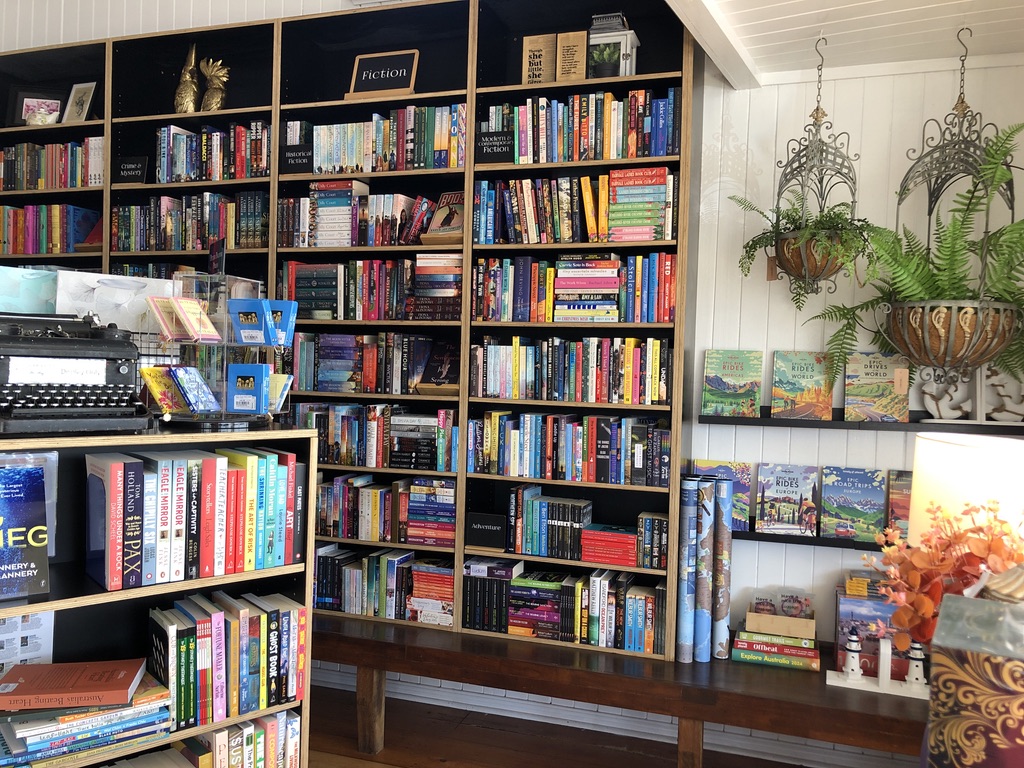
From Murgon we drove through Goomeri, stopping at the elegant Wimberley & Co Bookstore, then turned south to spend the night at Highfields, north of Toowoomba.

Wimberley & Co Bookstore, Goomeri

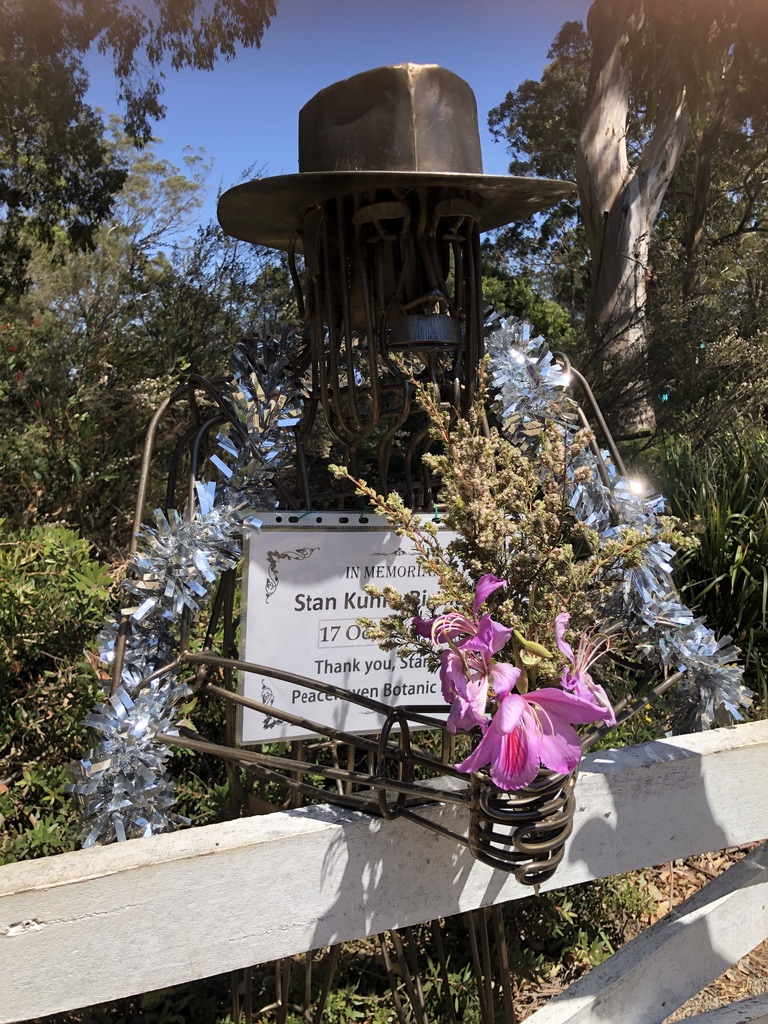
Highfields has a wonderful park – the 4.7-hectare Peacehaven Botanic Park. In 2004 local dairy farmer Stan Kuhl donated the land for a public park to promote peace.

Memorial to Stan Kuhl

The world is as far from peace as ever; but wandering these paths and plantings, watching parrots in the fine old eucalypts, with the Bunya Mountains in the distance, I appreciated old Stan’s intention.

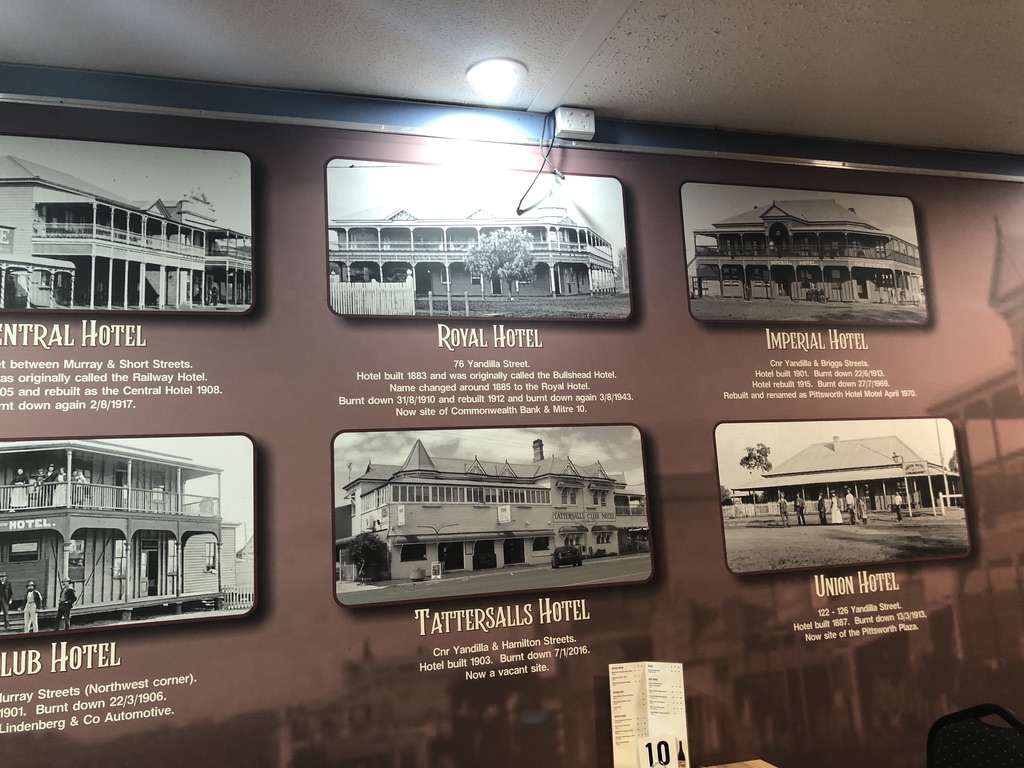
In the heat of February 2024, we took a three-day trip around the Darling Downs and out as far as Goondiwindi. The first night, we stayed in the humble motel behind the Pittsworth Hotel, “Pittsworth’s favourite hotel”. The only hotel in town as far as we can see, but its walls show a collection of photos of the many grand establishments that once existed here, only to succumb to fires, like so many old country hotels.

In the Pittsworth Hotel

Country towns celebrate their sports stars, from Rod Laver, the “Rockhampton Rocket”, to Laura Geitz, medal winner and former captain of the Australian netball team, celebrated in a bronze statue in her hometown of Allora.

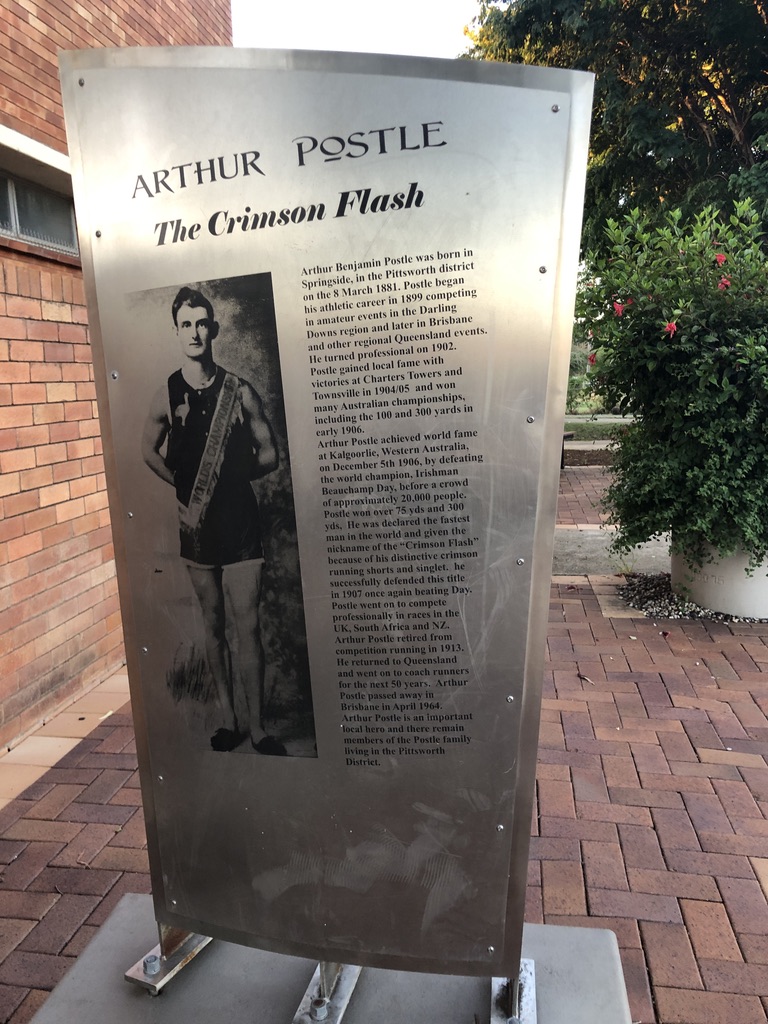
In Pittsworth, there is a memorial to Arthur Postle, the “Crimson Flash” – a local professional sprinter who won many Australian championships in the early twentieth century, even defeating a world champion.

On this trip we were exploring parts of the Darling Downs we hadn’t visited before, so I could look for old churches. My g-g-grandfather, James Matthews, was the Church of England Rector of Warwick between 1875 and 1886. In small farming settlements around the Downs, services in those days were held in inns or private houses; and James earned a name as a church builder. Perhaps he had the naming of them too, because at least one is dedicated to St James, and another to St Matthew.

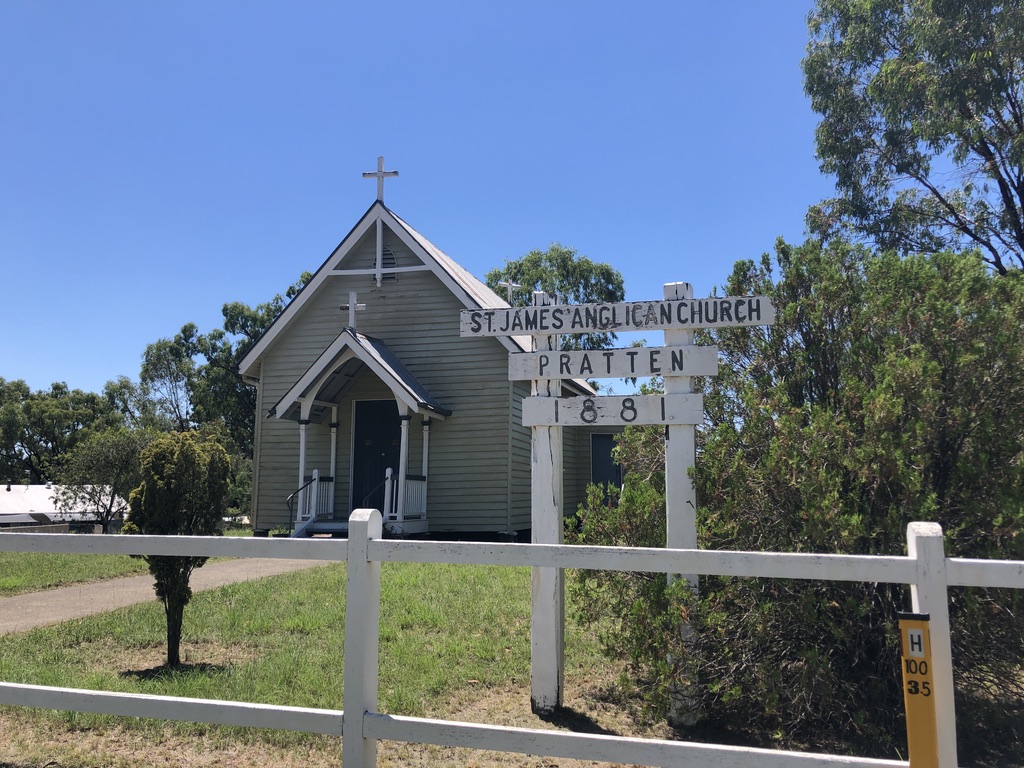
It was hot in Pratten, a tiny town west of Warwick and north of the Cunningham Highway. St James’s Church is a small wooden building on a hilltop, with a simple bell tower beside it.

The town lay still and silent under the sun, until Con pulled the rope and the church bell rang out.

Still, nothing moved.

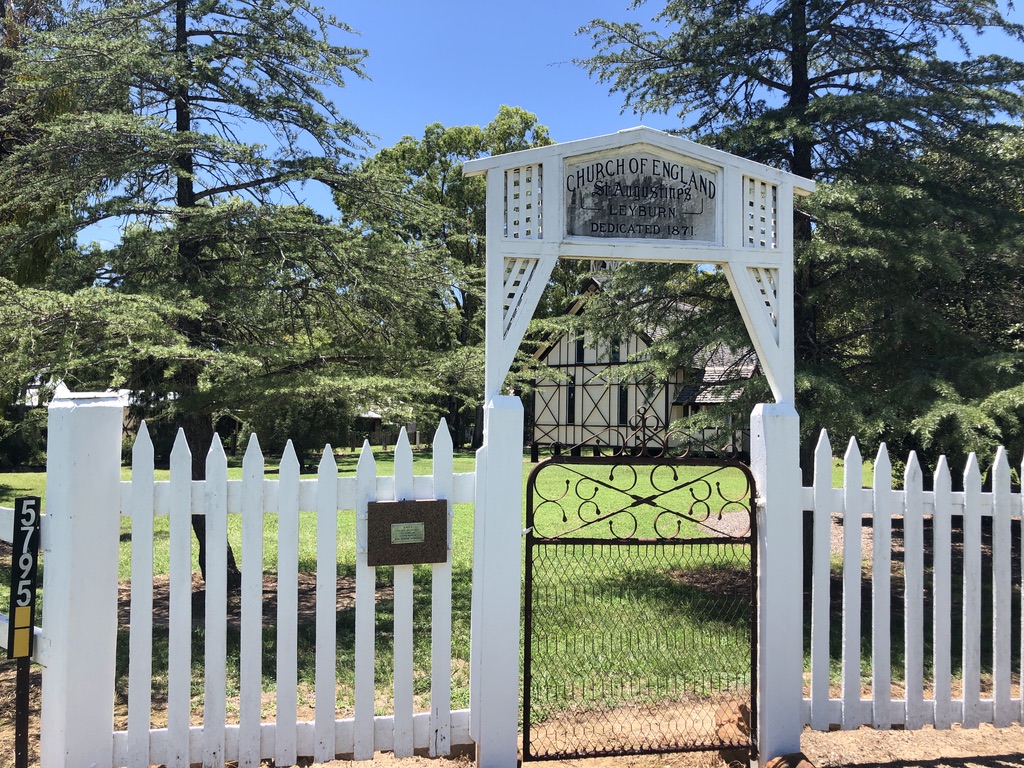
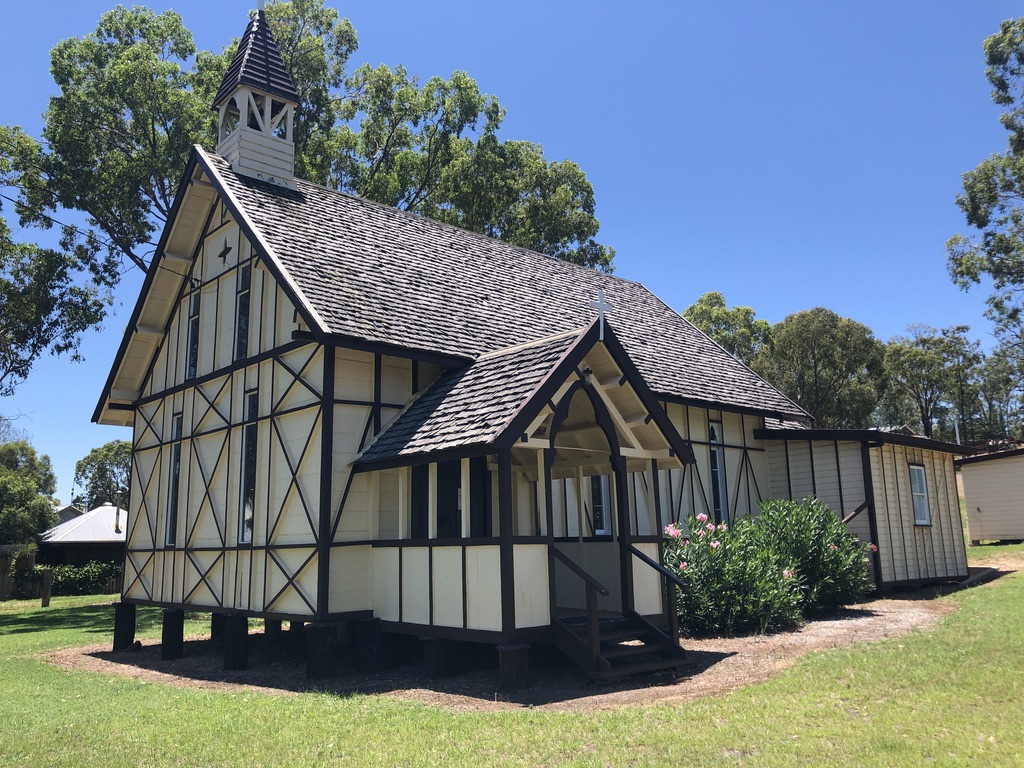
At the nearby town of Leyburn is another church visited by James Matthews. This attractive building was designed by architect Richard Suter, who designed Jimbour House, among many now heritage-listed buildings.

St Augustine’s Church, Leyburn

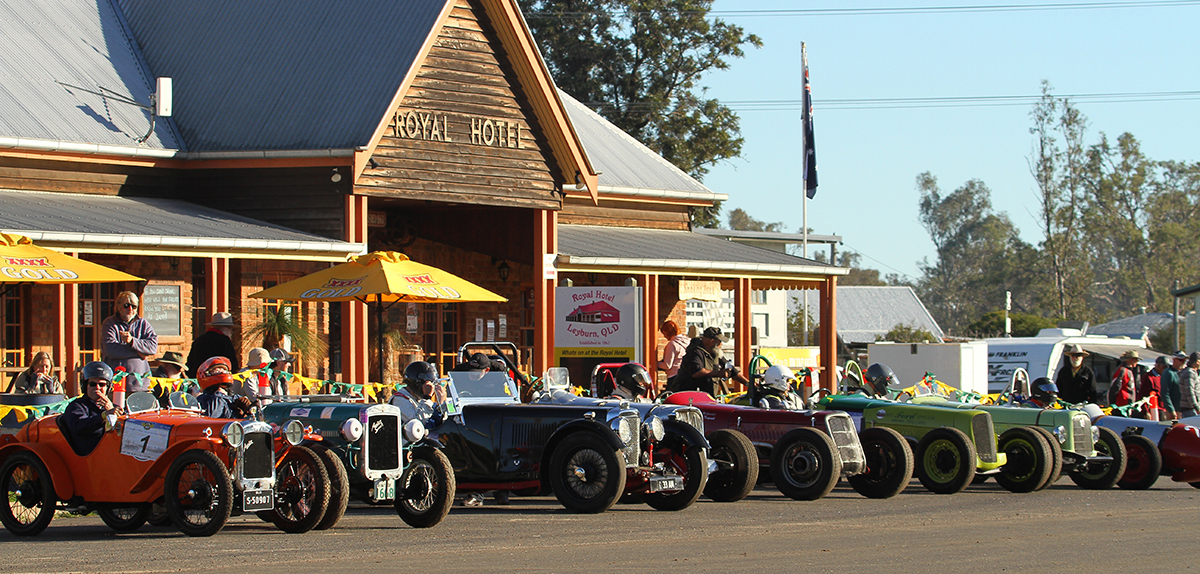
Leyburn has a pleasant pub, the Royal Hotel.  Along with the Grand View at Cleveland, it claims to be the oldest continuously licenced hotel in the state.  We were relieved to have our lunch in its air-conditioning.

Leyburn is known for motor racing. In 1949, seventy-five years ago this year, the Australian Grand Prix was held at here, attracting 30,000 visitors. The event has been recreated in the last few years as the Historic Leyburn Sprints, the main feature of a heritage festival with a motoring theme. The Sprints are held on a 137km route through the surrounding area, including Pratten. You wouldn’t have been able to hear the church bell ringing when the Sprint was running through town.

Royal Hotel, Leyburn, during the Historic Sprints festival

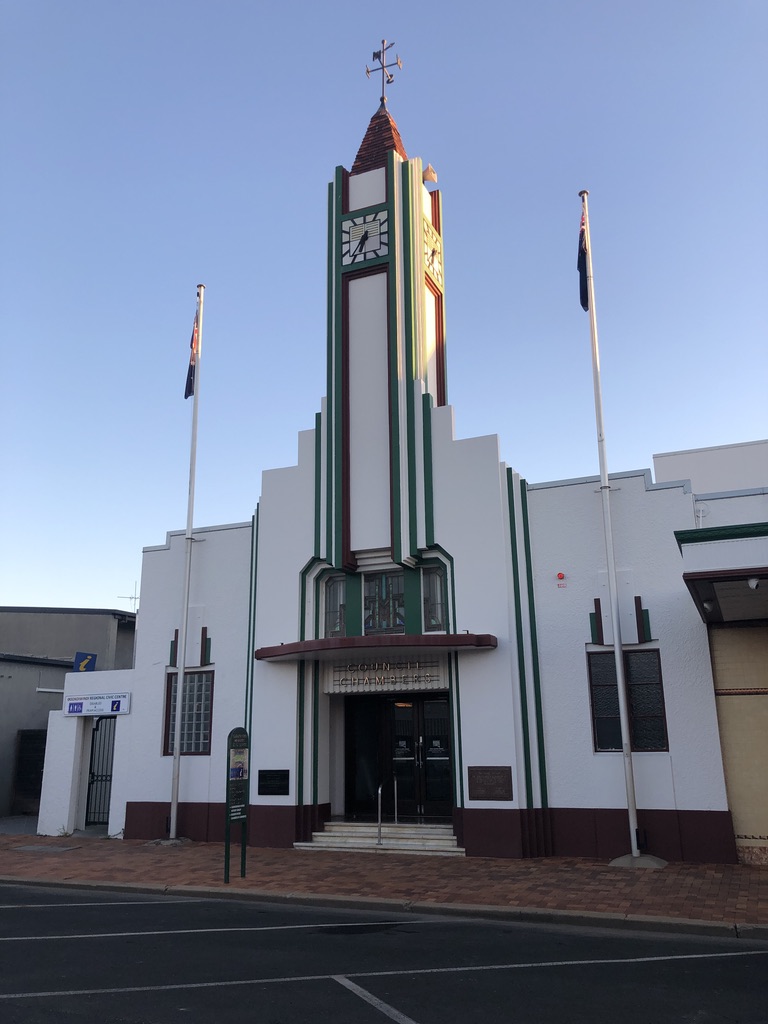
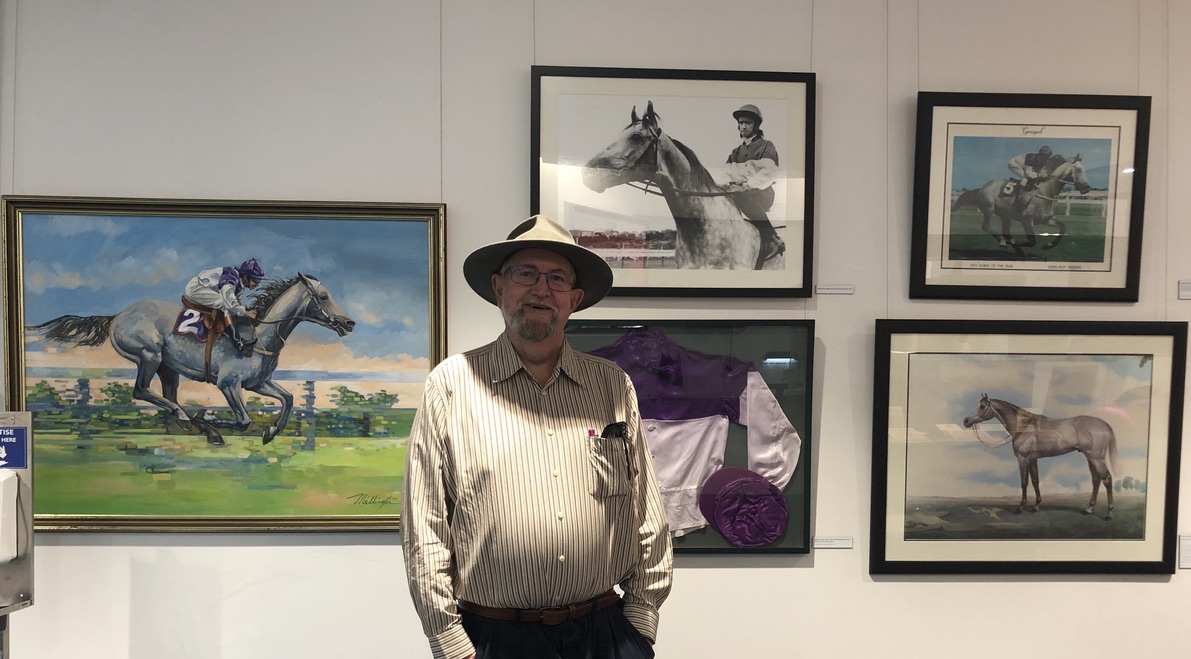
From Leyburn we headed to Goondiwindi to visit the Gunsynd Museum situated in the town’s elegant art deco council chambers. Another regional sporting hero, loved by Con.

Goondiwindi Council Chambers
In the Gunsynd Museum

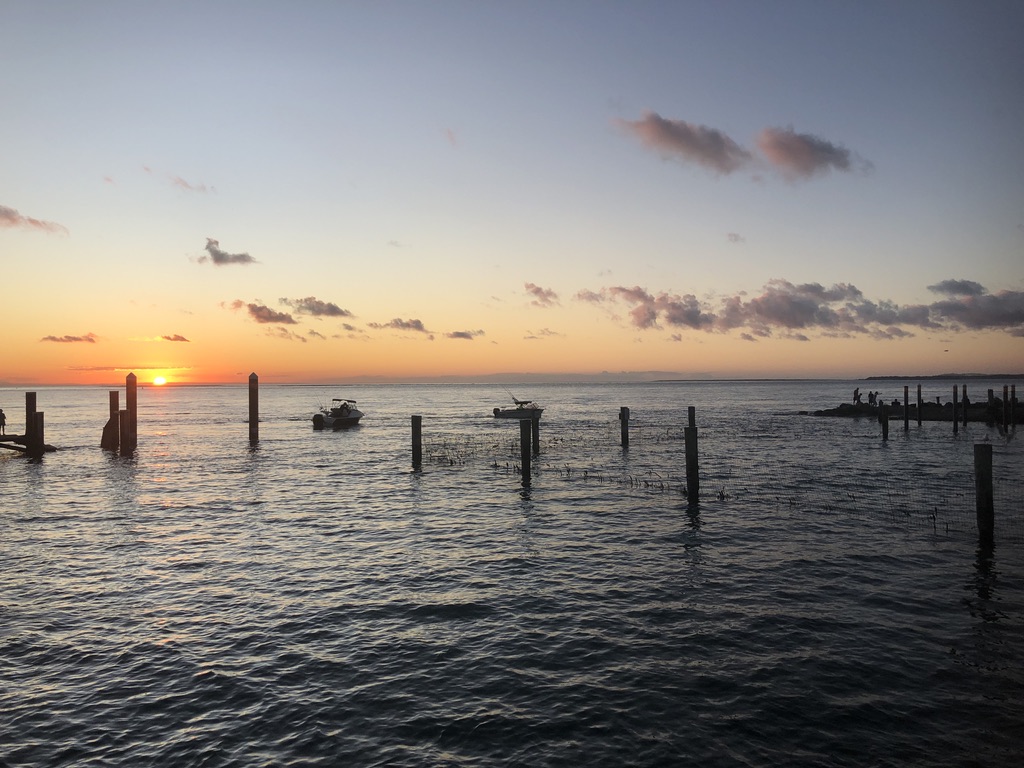
Last May, for my birthday, we spent three nights on Minjerribah North Stradbroke Island. This place is a treasure; and so close to Brisbane. White sand beaches, clear water, gorgeous freshwater lakes and swamps (so fresh that Island water is pumped to the other Bay islands and the mainland); birdlife, headland views, and small town life, as well as a strong Indigenous cultural presence.

Sunset at Amity Point, Stradbroke Island

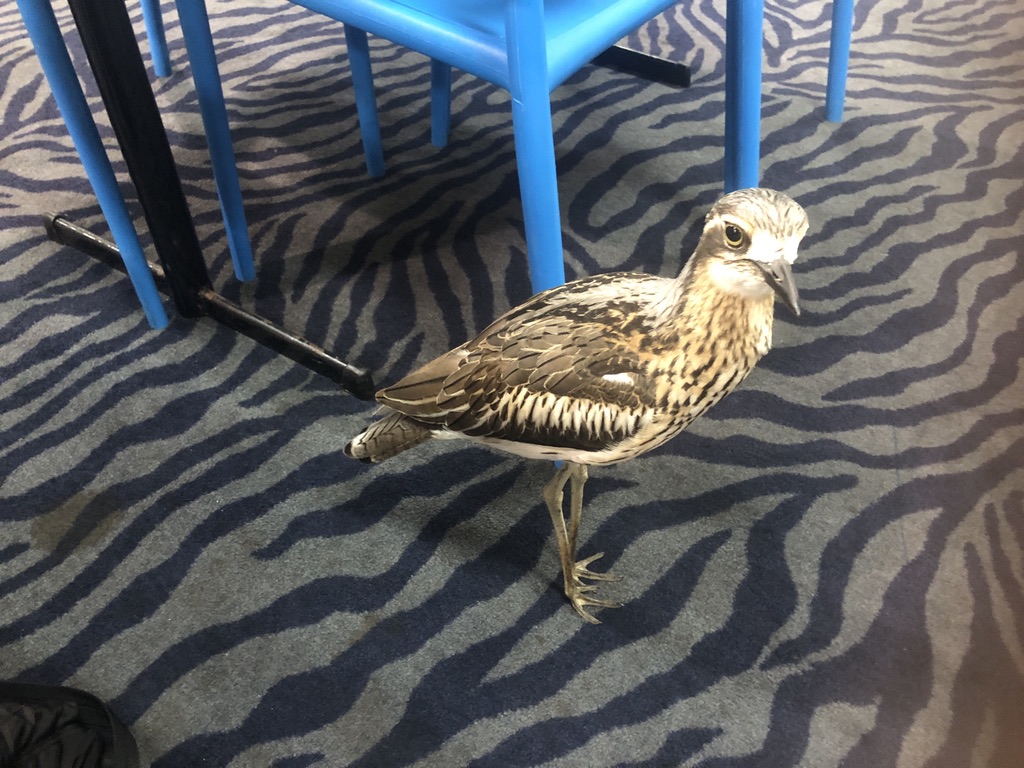
At the Point Lookout Hotel, perched above Cylinder Beach, I ate my birthday dinner accompanied by a beach stone-curlew that wandered among the terrace diners, searching for scraps with its huge, spooky eyes.

Straddie curlew

I’ve seen stone-curlews’ motionless forms and heard their haunting night-time cries from the suburbs of Brisbane to the tropics. Con tells me that on his first night at boarding school in Cairns he heard them and thought someone was being murdered.

We’ve made other out of town trips since our big trip was cancelled. Short trips to Grafton, Murwillumbah, Maryborough, Coolum, Toowoomba and Warwick.

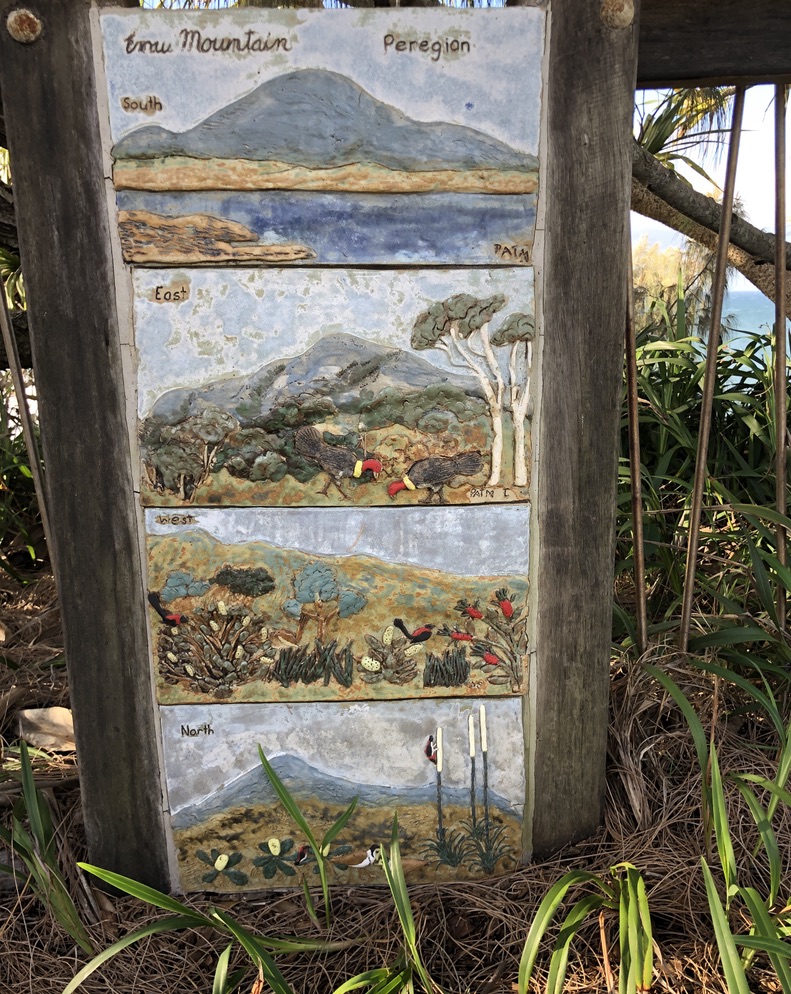
Attractive ceramic art work at Coolum

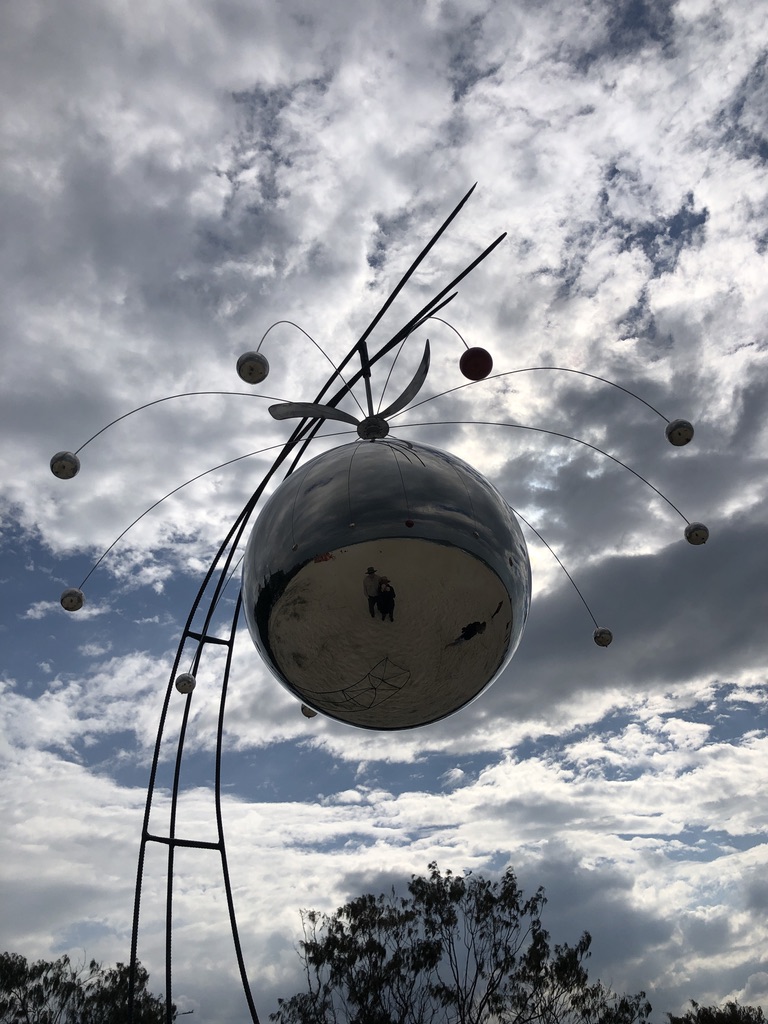
We also went to Currumbin to enjoy the Swell Sculpture Festival.

Us reflected, at Currumbin Swell

What next? Out to Glenmorgan, to pay a return visit to the Myall Park Botanic Garden? The wattles and wildflowers out there would be beautiful in Spring.

And maybe, next April, we’ll set off on that fine rivers road trip. Unless the rivers are flooding, or the countryside is burning…

Main photo: Cylinder Beach, Minjerribah Stradbroke Island

Glimpsing Bradman

On Boxing Day, 1936, in a soft-topped Essex motorcar and towing a trailer full of camping gear, my father Maurice, his two younger brothers, his father, E.B., and his grandfather C.B. left Nambour to drive to Melbourne. The Third Test was due to begin in January 1937, at the Melbourne Cricket Ground, and they wanted to see Don Bradman bat.

It was to be a two-week road trip – touring, as they called it then – through New South Wales and Victoria. The family often went touring. They didn’t know this would be their last long trip together.

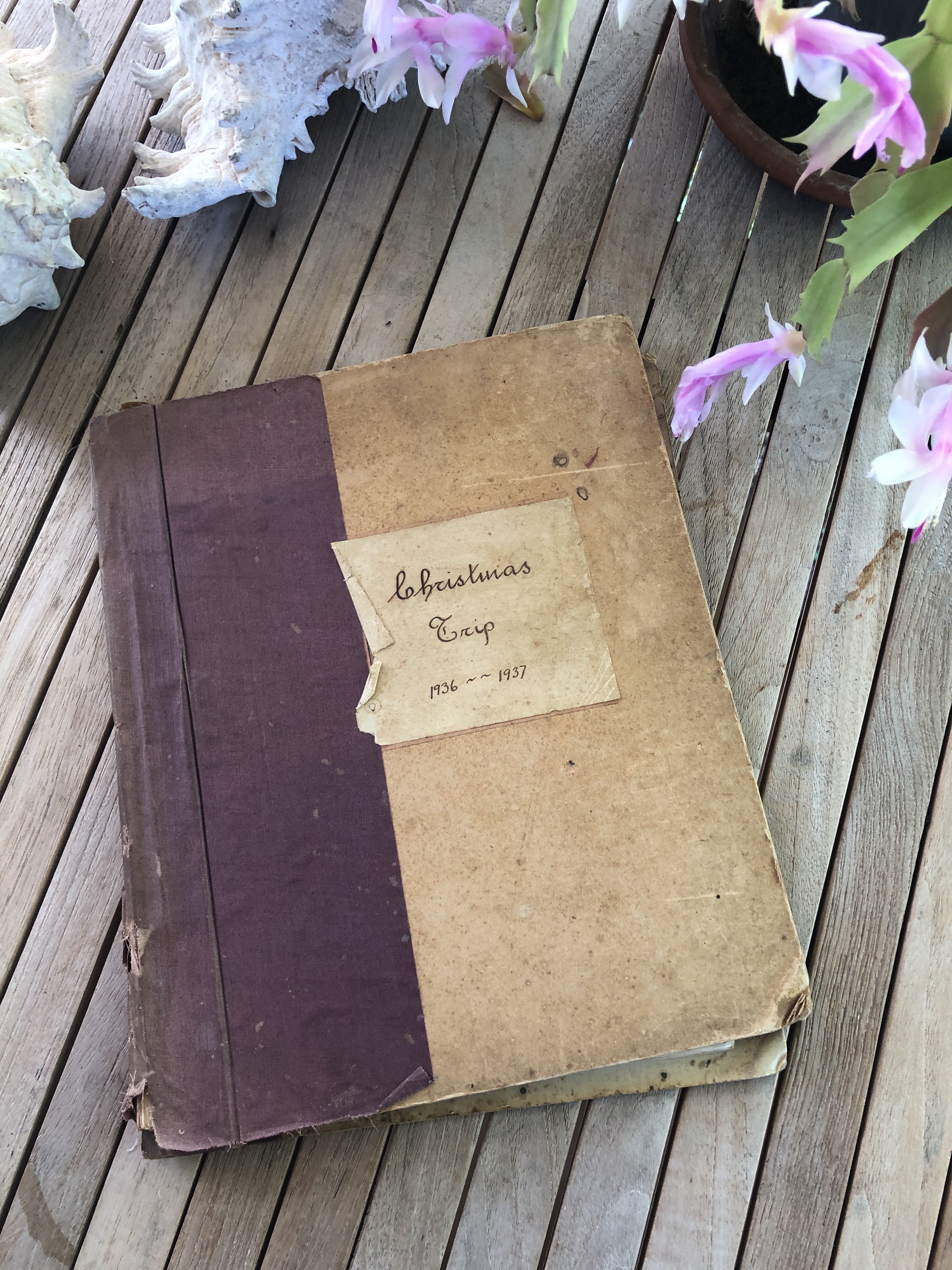
My Dad, Maurice, then an eighteen-year-old, kept a trip journal, full of details that seem quaint to travellers in the twenty-first century: border crossings, road conditions, camping, communications, access to funds along the way.

ED3897E1-9074-485A-8167-1C19EF181C99 Maurice’s trip journal 1936-1937

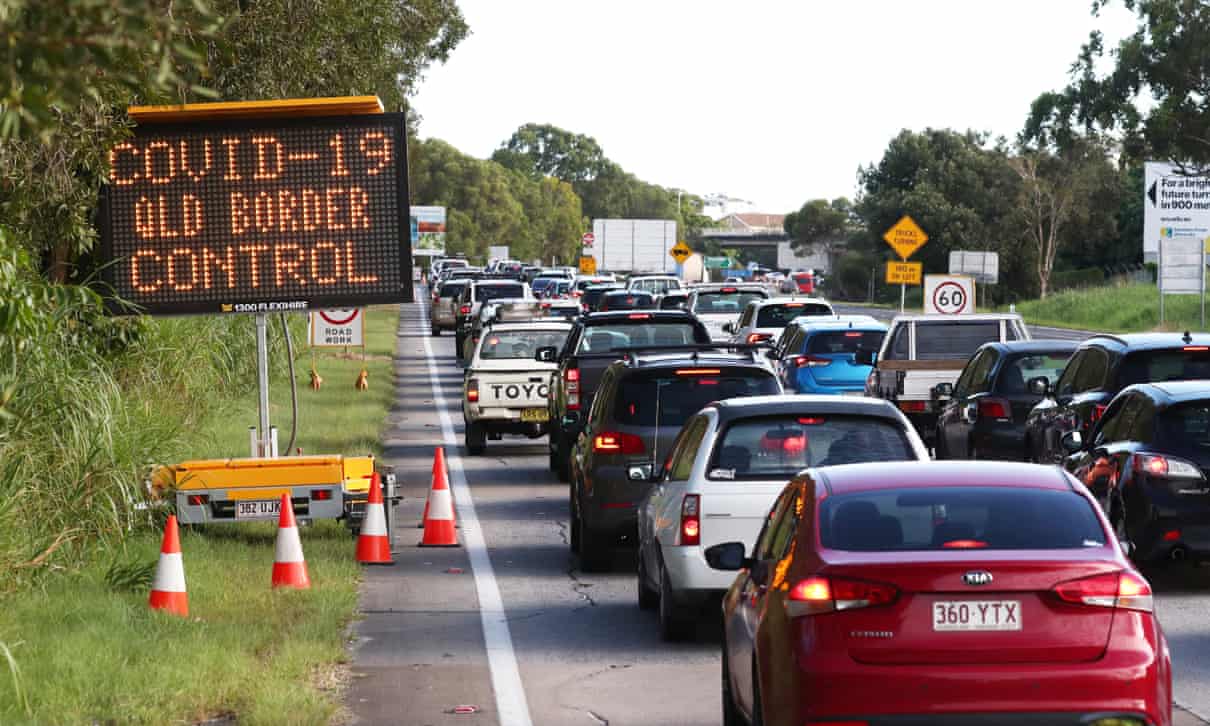
Now, in June 2020, the year of COVID-19, southerners are stopped at the border, not allowed to cross into Queensland without a special permit.

bradman covid closure guardian “Long delays as Queensland-NSW border closed for first time since Spanish flu in 1919” The Guardian, 26 Mar 2020

In 1936, cars and trucks going from Queensland to New South Wales were stopped and inspected at border gates. New South Wales didn’t want Queenslanders bringing cattle ticks south with them to infest stock. They still don’t.

Queensland has always been seen by southerners as a wild, bizarre place, a frontier region with its own quirky rules. We are the state of cyclones, cane toads, crocodiles, cattle ticks and mad politicians, and we’re oddly proud of that.

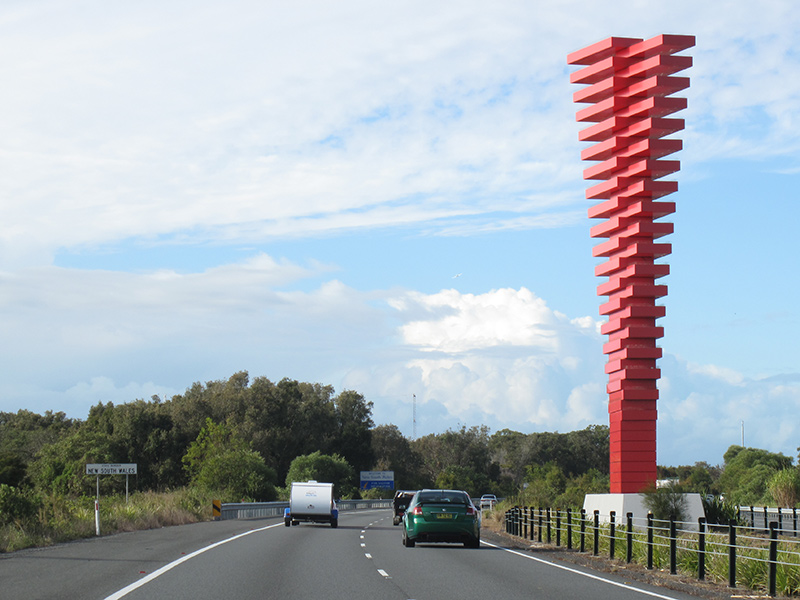
In normal times in the twenty-first century, cars drive straight across the borders without a pause; but still, when I cross into New South Wales on the Pacific Motorway, speeding past the big red border sculpture along the Tugun Bypass, or down through the rugged border mountains near Mount Lindesay, or at Wallangarra on the New England Highway, or Goondiwindi on the Newell, it feels like an event, with a little sense of visiting a foreign country; and crossing back into Queensland feels like coming home.

bradman red border sculpture Qld-N.S.W Border, Tugun goldcoastbulletin.com.au

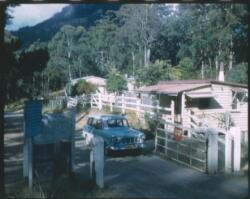
In 1936, Queensland travellers were advised to obtain an Interstate Motorists Permit before travelling south. Dad’s family crossed the border at Mount Lindesay, and in Armidale, their first stop in New South Wales, according to Maurice’s journal they sought the cop-shop, where a policeman was persuaded to come out and search for engine-numbers, chassis-numbers etc., and to give us an interstate pass and windscreen sticker.

bradmanborder gate The Border Gate at Mt Lindesay Frank Hurley, c.1961

They slept that night on the floor of a fruit packing shed outside Armidale, on the property of a family friend. From then on, nights were spent in their tent in what were called Tourist Camping Parks, or at likely spots beside the road wherever it suited them, as you could do in those less regulated days.

In 1936, the population of Australia was less than six million. Now, over twenty million people call Australia home, driving nearly twenty million vehicles, and so we can’t just set up camp wherever we want to anymore.

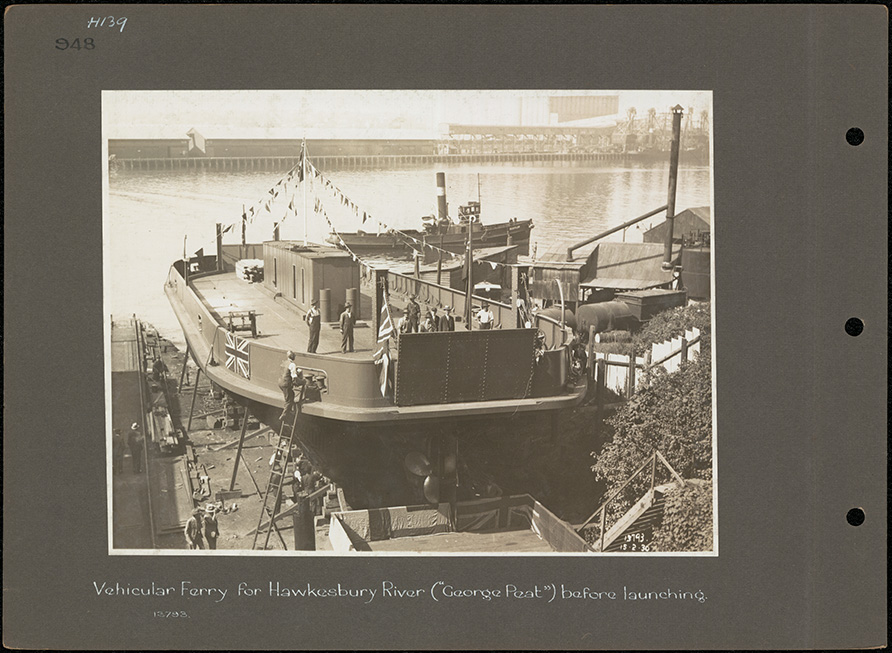
Roads were narrow and often steep and winding. Even major roads were rough and unsealed in places. There were many railway level crossings on the New England Highway; and instead of speeding high over the Hawkesbury River on the M1 as we do now, travellers crossed by Peat’s Ferry. It nine years later when the river was bridged at that point.

bradman peat's ferry 1930 NSW state archives Launch of the new Peat’s Ferry, 1930 records.nsw.gov.au

Thirty-seven other cars went on the ferry with the family’s Essex, and as they waited in line to board, Maurice and his brothers ate a bottle of local oysters, sold to waiting travellers by enterprising boys. Hawkesbury River oysters. That hasn’t changed.

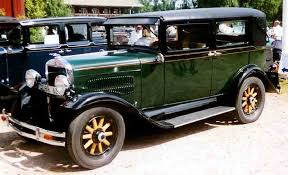
bradman 1931 essex Essex Super Six Model E, 1931 – probably the model used on this road trip commons.wikipedia.org

Road trip communications are different now, in ways that were unimaginable then. We use our phones to check directions and distances, traffic conditions and weather; to book accommodation, and listen to music, talking books and podcasts; all while travelling. To check weather conditions before heading to Mount Kosciusko, E.B. booked a trunk call to the weather bureau from Canberra Post Office, and to communicate with home they sent telegrams.

We’ve done over 100,000 kilometres in our Forester, with one puncture. We have it serviced every 12,000 kilometres or so. On highways, cruise control is set at 100 or 110 kph. Maurice and his family, on their 1936-37 trip of 3397 miles (5467 kilometres), changed three tyres because of punctures, stopped three times for grease-ups and oil changes, broke a spring, had the steering adjusted and repairs done to the trailer, and were pleased when on one straight road in Victoria they reached fifty miles (eighty kilometres) an hour.

As we all had to before the arrival of Bank Cards in the late 1970s, they’d sent specimen signatures ahead from their home branch of the Commonwealth Bank so they could withdraw money along the way. No ATMs or plastic cards then.

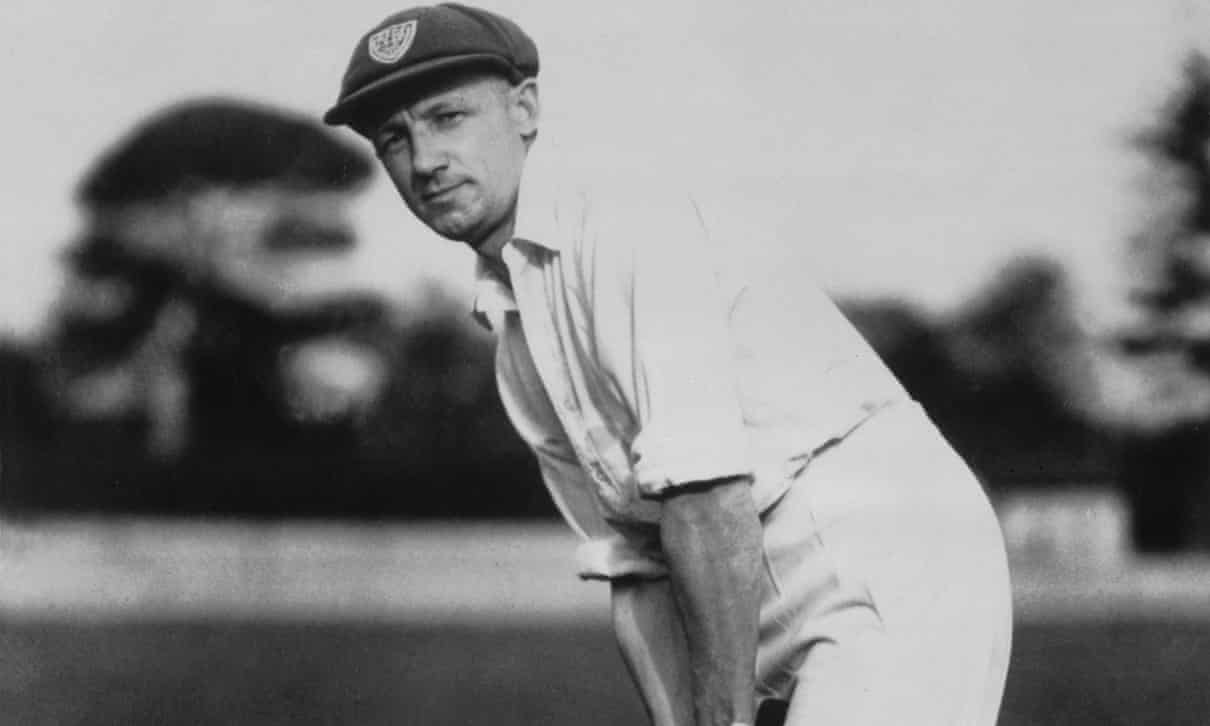
On 4 January 1937, Maurice and his group at last got to the M.C.G. to see Bradman. They arrived late. As Maurice put it, We went there on the day on which the world’s record cricket crowd – 87,000 – was present. We were among the 17,000 for which there was no room. We caught glimpses of the play – sometimes three quarters of a wicket keeper, or a single fieldsman and a patch of grass. One of the batsmen we could sometimes glimpse was Bradman.     

bradman Guardian Bradman at the crease, Third Test, second innings, Melbourne January 1937 20 Great Ashes Moments No. 4, The Guardian, 9 May 2013

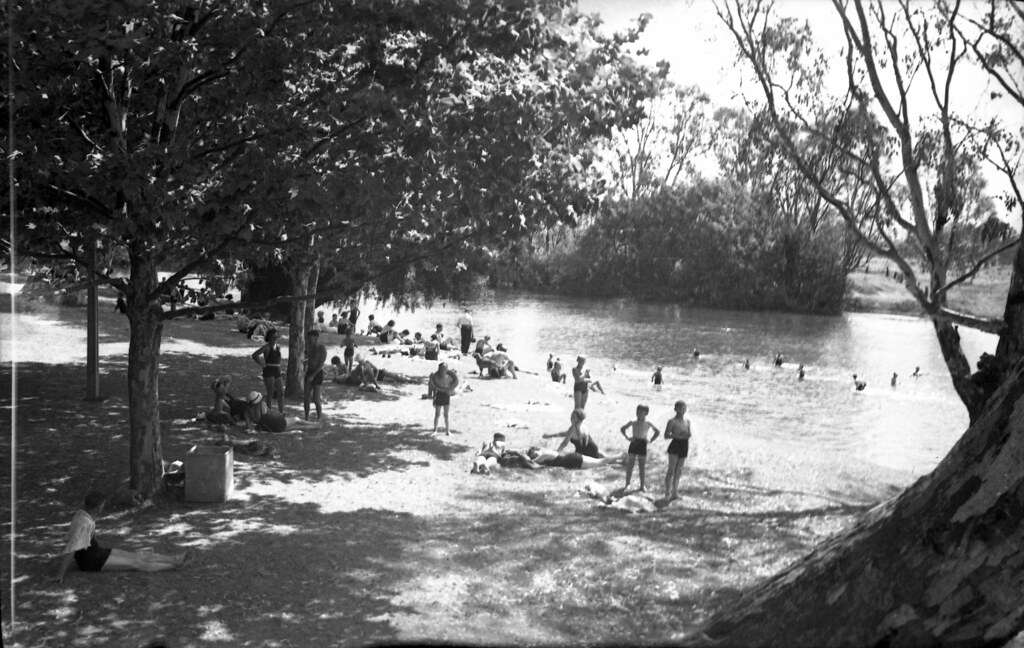
Next day they had to leave for home. With no car radio, they stopped along the way to hear the progress of the Test: in a café in Wangaratta, and again in a park at Albury, where people lay on the bank of the Murray in bathers, listening to the broadcast description of Bradman’s and Fingleton’s fine stand blaring forth from a speaker hung in a tree in the park.

bradman albury park The Murray River near Albury, 1930s. flickr.com

Next day, at a loudspeaker at a small refreshment stall at Hume Dam, we heard Bradman score the single which took his score to two hundred.

Bradman ended up scoring 270 runs – a record for a number seven batsman; and England lost the Test.

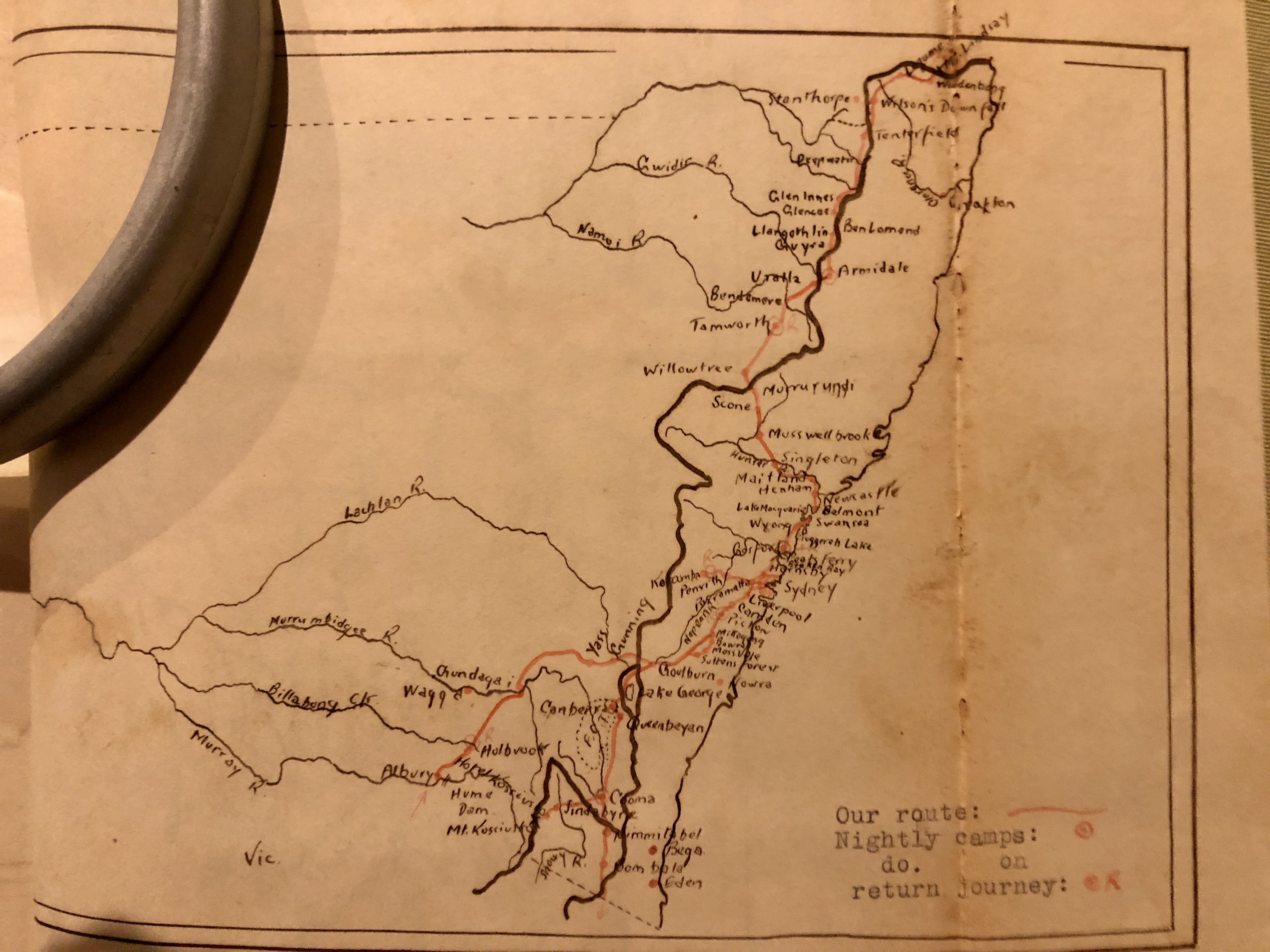
Sixteen days after leaving Nambour, Maurice and the family arrived back home. Maurice typed up the story, added maps and illustrations and had the journal sturdily bound.

20F2E6FF-1839-4DEF-98BB-D370417D242C_1_201_a Maurice’s hand-drawn map of the journey through N.S.W.

A month later, he started university. Three years later, he joined the 2/26th infantry battalion. He shipped out of Melbourne in 1941, bound for Singapore, part of the troop build-up in the face of the threat of invasion by Japan.

The following February, Singapore surrendered to the Japanese Imperial Army, and in 1943 Maurice was among the thousands of prisoners of war who were packed into rice wagons and taken north by train to work as slaves, building the infamous Thai-Burma railway.

In October 1945, twenty-seven years old, thin, jaundiced and exhausted, Maurice came home again to Nambour, to Mum, and to their little son.

At once, he bought a new car; and within two years, he and Mum were off on another road trip – the first of a new generation. My earliest memory is standing in the back seat of that little car, as kids did in those less regulated days, looking between my parents’ shoulders at a long, narrow road leading off into the distance.

My Dad got me addicted to road trips early. I’ve never gotten over it.

On the Queensland Railway Lines

We’re travelling north from Bowen on the Bruce Highway. The road follows the railway line.

Road trips provide lots of opportunities for reminiscing, and as I drive, we talk about our train trips of the past.

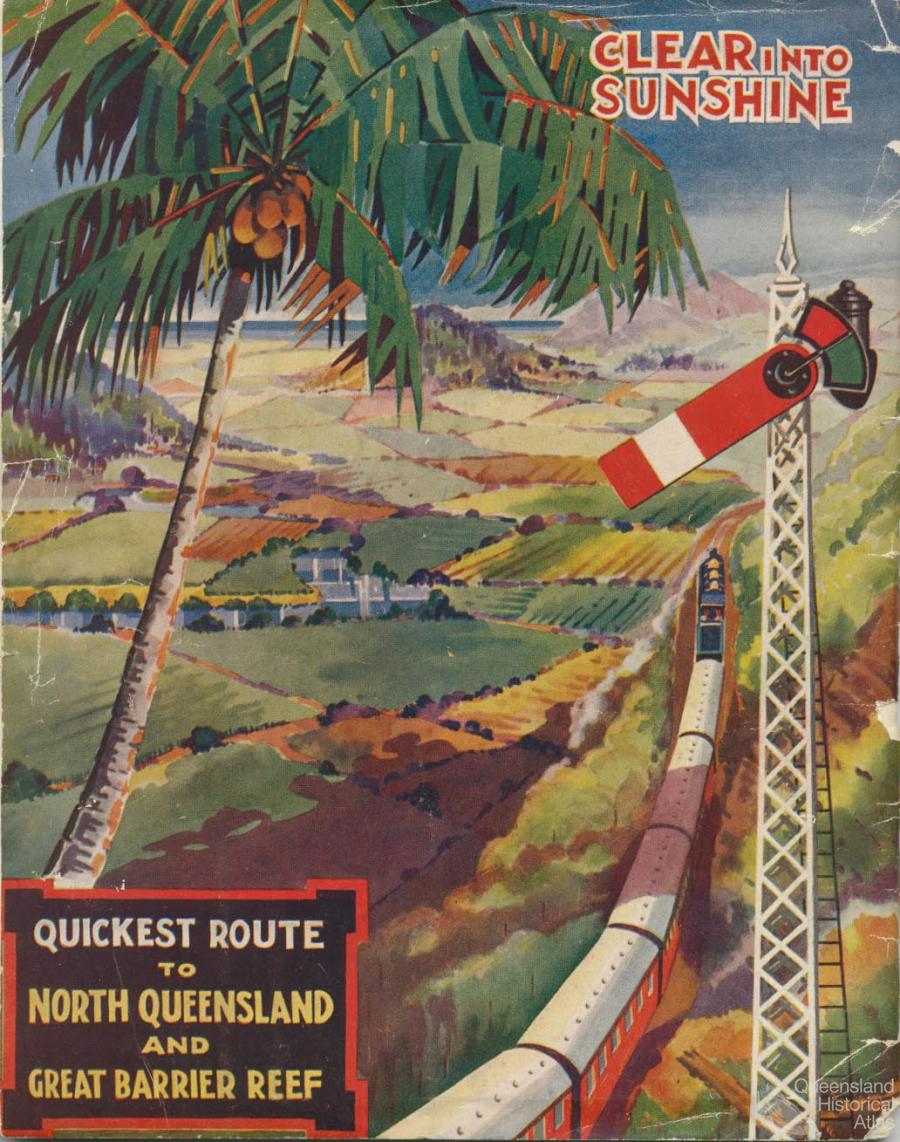
At school I learned off by heart the towns along the “Sunshine Route”, the railway trip from Brisbane to Cairns: Brisbane, Nambour, Gympie, Maryborough, Bundaberg, and onwards. One thousand, seven hundred kilometres: promoted by Queensland’s developing tourism industry as a great, romantic train journey, from the city in the south, through pineapple fields, cattle country and sleepy towns to the green mountains and purple-tipped cane fields of the far north.

qldrailway 2
Poster for the Sunshine Route

This railway line was not built just for tourists. Until the main north-south railway line was finally completed in 1924 with the opening of the Daradgee Bridge north of Innisfail, Cairns was isolated from the rest of the country except by sea. There was no highway. In a state dependent on farming and mining, the railway was vital.

Like everyone over a certain age who grew up in North Queensland, Con has lots of stories about trains.

“When I was eleven, the old man took me to Brisbane by Sunlander. It was new, diesel, and air-conditioned – the wonder of the ages. We had a second-class sleeper and ate in the dining car. I’d always been second-class sitting on the trains before. None of our family ever went first-class. We’d have gone third class if there was one.”

My first long train trip was a Y.A.L. trip from Brisbane to Cairns. The Young Australia League was founded early last century with the aim of promoting national pride in young people and educating them through travel. I tell Con about it as we drive.

“They took us to Kuranda and Ellis Beach. That was the first time I’d seen coconut palms. We went to Green Island, and I bought a piece of coloured coral set in plaster with ‘Cairns’ written on it.”

qld railway 3 sunshine route 4 clear into sunshine qld histl atlas 1936

I slept on a top bunk, and I recall the clicketty-clack of the wheels at night, and the sight of embankment gravel rushing past below the toilet bowl.

“I had a bit of coral like that, too!” says Con. “I was proud of it, and I gave it to Mum. She put it in the china cabinet with the good cups. I don’t know where it ended up.”

He continues as we pass the Abbot Point turnoff.

“My next trip was by myself. I was seventeen, and I went to Brisbane, to Teachers’ College. I had a rail voucher for a first-class sleeping berth. I was hoping I’d meet a beautiful girl on the train, and we’d fall madly in love and make good use of the berth. No luck with that.”

“What a disappointment!”

“It wasn’t all wasted, though. When the train pulled in at Tully I went to the railway refreshment rooms and bought my first packet of cigarettes. By the time we got to Townsville I’d made myself sick, but I persevered. I smoked for the next forty years.”

We stop at the roadhouse at Guthalungra for fuel. Back on the road, we pass through Gumlu, still following the train line.

“Each Teachers’ College holiday the trains were bursting with students. Drinking was banned, but that was just a challenge to us. I looked older than my age, twenty-one at least (the legal drinking age), so I’d get off at stations with a blanket wrapped around me and head for the refreshment rooms bar. The hard part was climbing back on to the train without the bottles clinking under the blanket.”

“A thousand teenage students from North Queensland travelled on those trains, drinking, laughing, cuddling, playing cards and singing. You get through a lot of songs on a forty-hour train trip.”

Last century, nearly every country town had trainlines, carrying cattle and sheep, bananas and oranges and mail, and the products of the mines. Most closed as roads improved and road transport took over, but you can sometimes see the line of the old tracks on Google Earth: Rockhampton to Yeppoon, Monto to Gayndah, Dalby to Bell, Cloncurry to Dajarra.

They look like ghost tracks now, or like the outlines of ancient Roman forts as seen from the air in the green English landscape.

Most of the trains live on only in memory, but their comforts and discomforts are celebrated in song –:

On the Queensland railway lines,

There are stations where one dines,

Private individuals

Also run refreshment stalls.

Bogan-Tungan, Rollingstone,

Mungar, Murgon, Marathon,

Garthanungra, Pinkenba,

Wanko, Yaamba; ha, ha, ha!

Males and females, high and dry

Hang around at Durikai;

Boora-Mugga, Djarawong,

Giligulgul, Wonglepong.

Pies and coffees, baths and showers,

Are supplied at Charters Towers;

At Mackay the rule prevails

Of restricting showers to males.

Iron rations come in handy,

On the way to Dirranbandi,

Passengers have died of hunger,

During halts at Garradunga.

Let us toast before we part,

Those who travel stout at heart,

Drunk or sober rain or shine,

On the Queensland railway line.

qldrailway

Blog at WordPress.com.

Up ↑