“It’s the Freedom!”

IMG_20180703_103540_resized_20180714_112650945
Two powerful rigs at the Marlborough Roadhouse, Central Queensland

All the cupboard doors flew open on the way north. When we stopped for lunch, cans of baked beans were rolling around on the floor among plastic plates and cups and packets of biscuits. On the way home, the door fell off on to the road.

This was my first and only experience of caravanning. I was seven. It was a rented plywood van pulled by the family Vanguard, from Nambour to Yeppoon. The grey Vanguard: what an ugly car that was.

fullsizeoutput_3e99
Caravan holiday with Vanguard

We never went caravanning again. From then on, it was Dad’s old army tent, from Melbourne to Cairns, out west to Barcaldine and beyond. I remember nothing but pleasure on those economical tent holidays. I was hitched on road trips, but not on caravans; unlike so many other grey-haired people today.

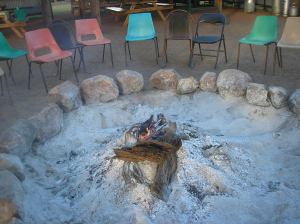
One winter, Con and I took a trip to western Queensland and spent a night at Nardoo Station campground, north of Cunnamulla. At Happy Hour, twenty or so grey nomads sat chatting, drinks in hand, resting their feet on the warm stones of the fire pit. All of them were on long trips with caravans or motor homes.
OLYMPUS DIGITAL CAMERA
After Happy Hour – the fire pit at Nardoo Station

I spoke to people from all over the eastern states that evening, from the Adelaide Hills to the suburbs of Sydney.  When I asked them why they made these extended journeys each winter, they all said the same thing. “It’s the freedom.”

Freedom from family obligations, from work, from lawn mowing. It’s a fine thing to leave it all behind, liberated from routine and drudgery, and stimulated by new sights and sounds, friends and stories; perhaps feeling really alive for the first time in years.

Then Happy Hour was over, and everyone disappeared back into their campers and vans to watch television.

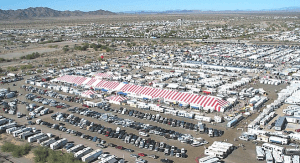
In the United States, retirees who migrate south for the winter are called snowbirds. Seniors from cold states leave home before the first snow of winter and travel to Florida or Arizona, to Palm Springs or Sun City. Thousands drive their recreational vehicles to the same RV resort each year. The parks advertise themselves as “Snowbird Friendly” and they attract so many large campers and caravans the shining roofs turn the countryside white.
quartzsite_arizona_rock_city_1_t658
Snowbirds at Quartzsite, Arizona Photo from San Diego Reader

In Australia, the move is from south to north, from May to October. Thousands of units of all shapes, sizes and capabilities head up the main roads, many of them travelling on or over the speed limit, others cruising along with semi-trailers and work vehicles packing up behind them, waiting for a passing lane.

Caravans are fancier these days – friends of mine bought one recently and had to take it back straight away because the wine cooler wasn’t working – but not everyone wants a huge, luxury caravan. There are different cultures amongst grey nomads, and different values. Younger retirees call themselves adventure travellers, and tow sturdy off-road camper trailers. They tackle the Birdsville Track and Tanami Desert, and scorn cheesey camper slogans: “Adventure before Dementia”, or “Spending the Kids’ Inheritance”.

I met one such couple who had camped at the basic, unpowered campgrounds of Karijini National Park in Western Australia’s Pilbara, a most beautiful place.

Back on the coast at Karratha, they’d told other travellers about Karijini.

“It’s wonderful!” they said to a woman in a neighbouring van. “Are you going there?”

“No,” she said. “We don’t have the battery capacity.”

“Can’t you run the lights off the car battery?”

“Yes, but not the TV. I can’t miss ‘Home and Away’.”

Each year, travelling retirees bring millions of dollars to country town economies; but they are careful with their money. The most they spend in any one town may be a few dollars for groceries, a meal at the RSL Club, and fuel. Like backpackers, they watch every dollar.

There’s a story, true or not, of a couple of men going into the bar of a country hotel. They order schooners of beer. To their astonishment, the publican charges them only ten cents a glass. They drink their beers and order another round, and the same thing happens.

The publican explains. “I won Gold Lotto, and I decided I’d buy this pub and charge everyone just ten cents a beer.”

“What a great idea!” says one of the visitors. “But tell me, those blokes sitting at the end of the bar, they haven’t ordered a drink the whole time we’ve been here. Why is that?”

“They’re grey nomads,” said the publican. “They’re waiting for the half-price drinks at Happy Hour.”

Crocodile Watch

Rollingstone Creek is deep and clear, with a sandy bottom. The water is blessedly cool on this tropical summer’s morning.

My sister-in-law Margaret is sitting on a folding chair in the shade, watching for crocodiles.

This swimming hole, so innocent-looking, is a few hundred metres upstream from an estuary where crocs are known to lurk. We wallow in the shallows, close to the bank, and Margaret watches the water.

It’s mid-January, and hot. So hot. That’s why we’re risking the crocodiles.

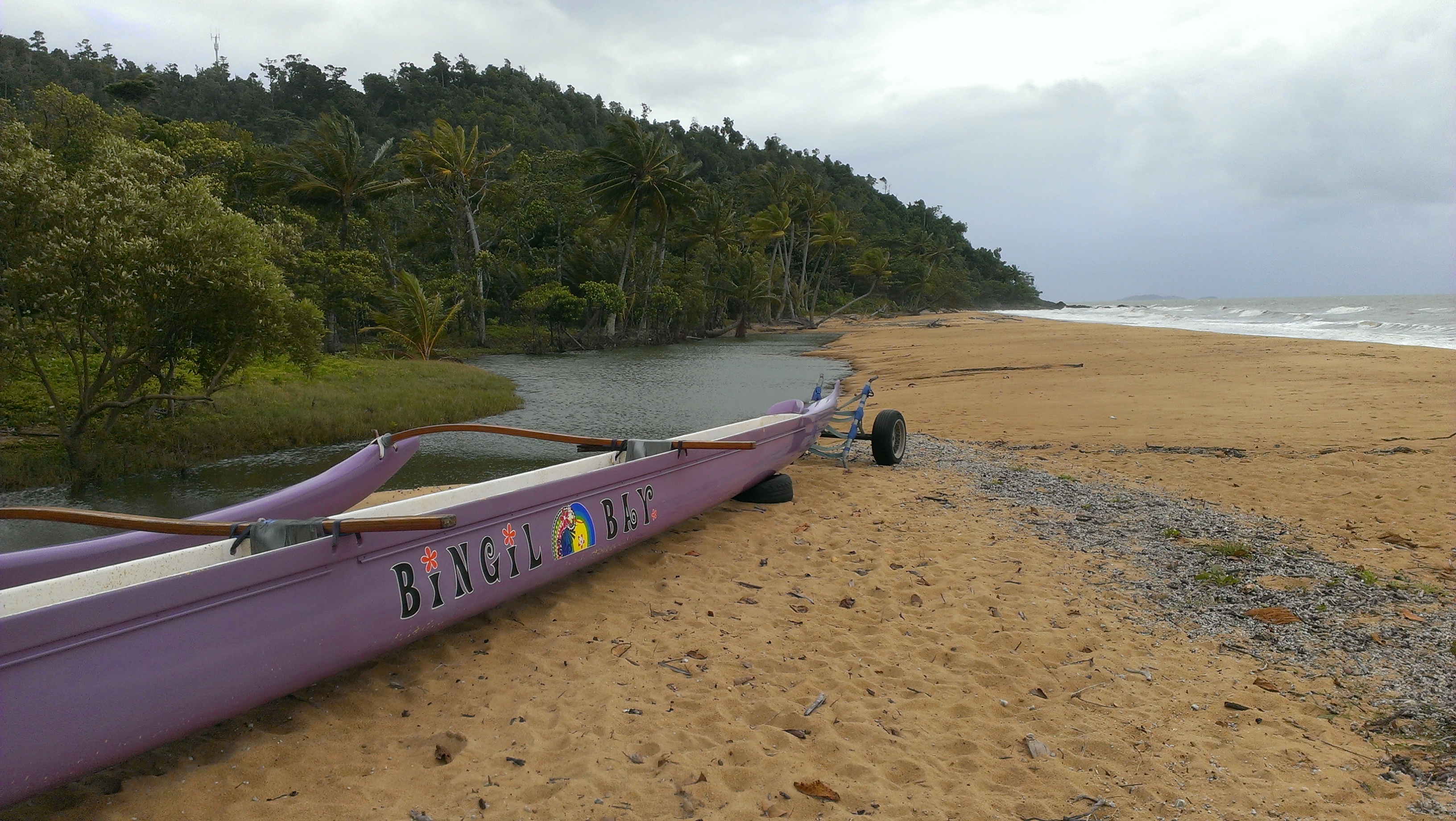
Balgal Beach, where we’re staying, is a quiet spot north of Townsville. Like the other Queensland beaches sheltered by the Great Barrier Reef, it has no surf. Not many people swim at northern beaches in summer, in spite of the heat and the picture postcard beauty of places like Balgal, Bingil Bay and Etty Bay. From October to March, stinger nets are set up on popular beaches. Swimming outside of them you risk being killed by a box jellyfish.

IMAG0820_BURST002_COVER

Occasionally the television news shows a crocodile in one of the stinger nets, making people a little nervous – especially tourists. No much fazes the hardy locals.

The quiet northern beach towns are ideal for early-morning walks, fishing, bird watching, or a peaceful retirement; and in the caravan park at Balgal Beach contented campers and caravaners with interstate number plates sit reading in the shade of the trees.

Perhaps they’ll buy fish and chips for dinner and eat looking out over the water towards Palm Island, while gangs of red-tailed black cockatoos screech and quarrel in the fig trees above.

IMAG1007

There are many gorgeous swimming spots in North Queensland, year-round, where even in July daytime temperatures rarely drop below twenty-five degrees. They’re in creeks running through rainforest, tumbling over granite boulders and falling into clear pools. Famous places like The Boulders at Babinda, or hidden creeks only locals know about. You just have to find a spot above the range of the crocodiles.

babinda


North of Tully there’s a swimming hole called Alligator’s Nest, at the junction of two clear creeks, in spite of its name beyond the reach of crocs. It was a cool and drizzling July day when we went there, and the creek was deserted. I had no swimmers, but I went in anyway, in my skin. It was a perfect swim.

I’ve enjoyed many perfect swims. One was at Wineglass Bay, on the Freycinet Peninsula in Tasmania. Con and I climbed the steep track to the famous look-out spot, then down the other side to the bay. It took us an hour and a half, and when we came out of the scrub on to the beach, the only sign of human life was a yacht moored in a little hook of the bay, off to the south. The clear water looked wonderfully inviting. Again, I went in in my skin. It was cold –  but perfect.

fern pool, karajini nat pk

The clear pools and red gorges of Karijini National Park, in Western Australia’s iron ore country, have many perfect swimming spots, although they’re much too popular for skinny dipping; but the place I love the most, even more than the creeks of North Queensland, is Greens Pool, on the southern coast of WA.

Greens Pool is a wide stretch of calm water sheltered from the Southern Ocean by a string of granite boulders. Other boulders, the famous Elephant Rocks, stand in a group in the middle of the Pool, bigger than elephants, and you can leap off them into the deep, clear, salty water. Breakers send up spray over the protective rocks beyond the Pool. The water is cold, but the initial shock is soon forgotten in the pleasure of it all.

In South Queensland, the water is warm. I remember a perfect day in the surf at Alexandra Headland, when I was twelve. The waves were smooth, no dumpers, a gorgeous green. I lay on my back, and each wave lifted me gently to its crest then glided me down the other side. The sun shone through the water, dappling the sand below.

Across the road from my childhood holiday house at Maroochydore was a small beach we kids considered our own, with a jetty at one end. At high tide, the river would reach up close under the jetty, and my brothers and I would bomb-dive off it with delight.

I grew up on beaches. I love the water.

scan


That day in Rollingstone Creek, though, it was a comfort to have Margaret watching for crocs.

Photos: Bingil Bay; Balgal Beach; a North Qld creek; Weano Gorge, Karajini NP; Alexandra Headlands.

Blog at WordPress.com.

Up ↑