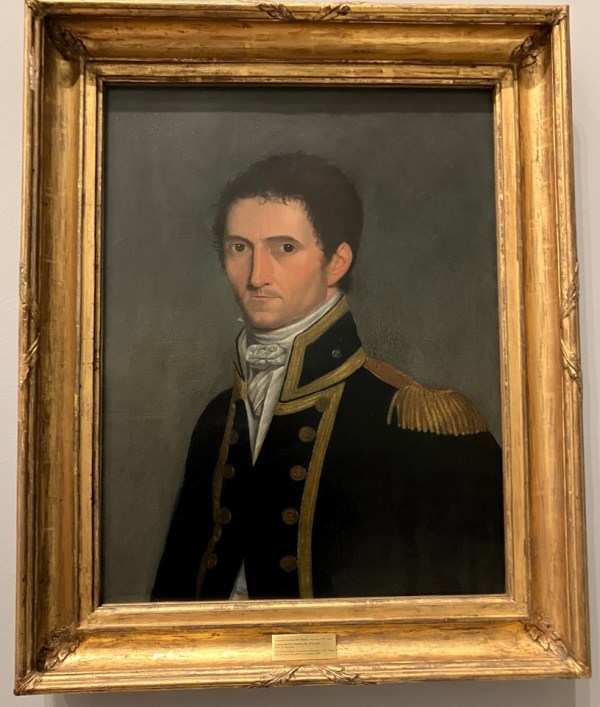
Searching for Matthew Flinders

I’m always intrigued by place names and how they came about. Queensland places have had their names and their stories for tens of thousands of years; but when Europeans arrived, they knew nothing of ancient local cultures. For their maps and charts, they named places after important people and sponsors of their voyages, or their friends; their hometowns; dangers, accidents and incidents; places of home.

James Cook was the first to sail up the east coast. Among many other places, he named Queensland’s Glasshouse Mountains.

Matthew Flinders was next. He named Skirmish Point, at the southern tip of Bribie Island, because it was here after some trading of articles that the locals, laughing, tried to steal his hat, then threw a spear when the visitors were rowing away. That’s when the muskets came out, and locals were wounded.
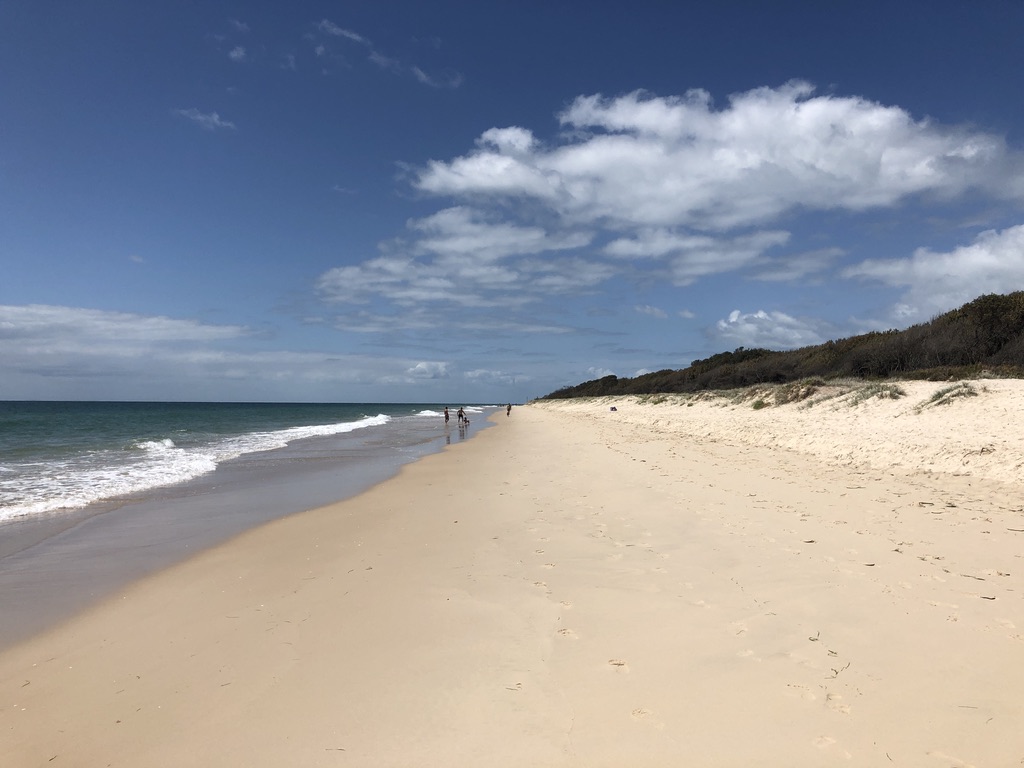
Skirmish Point, Bribie Island

Flinders, on his extended mapping voyages along the coasts of Australia, had several positive encounters with locals, but when it came to a disagreement, conflicts were decided in the usual British military way, with guns; and that is what happened at Skirmish Point.

Bungaree, or Bongaree, after whom a suburb of Bribie Island is named, was a member of the Garigal clan of the Broken Bay people from north of Sydney, and he was recruited by Flinders for the voyage in the Norfolk, as well as the later Investigator voyage and others. Bungaree was respected as a person, and as an interpreter and diplomat, making positive contact with local people even though they mostly spoke different languages. Often, these were the first encounters between Europeans and Indigenous Australians.
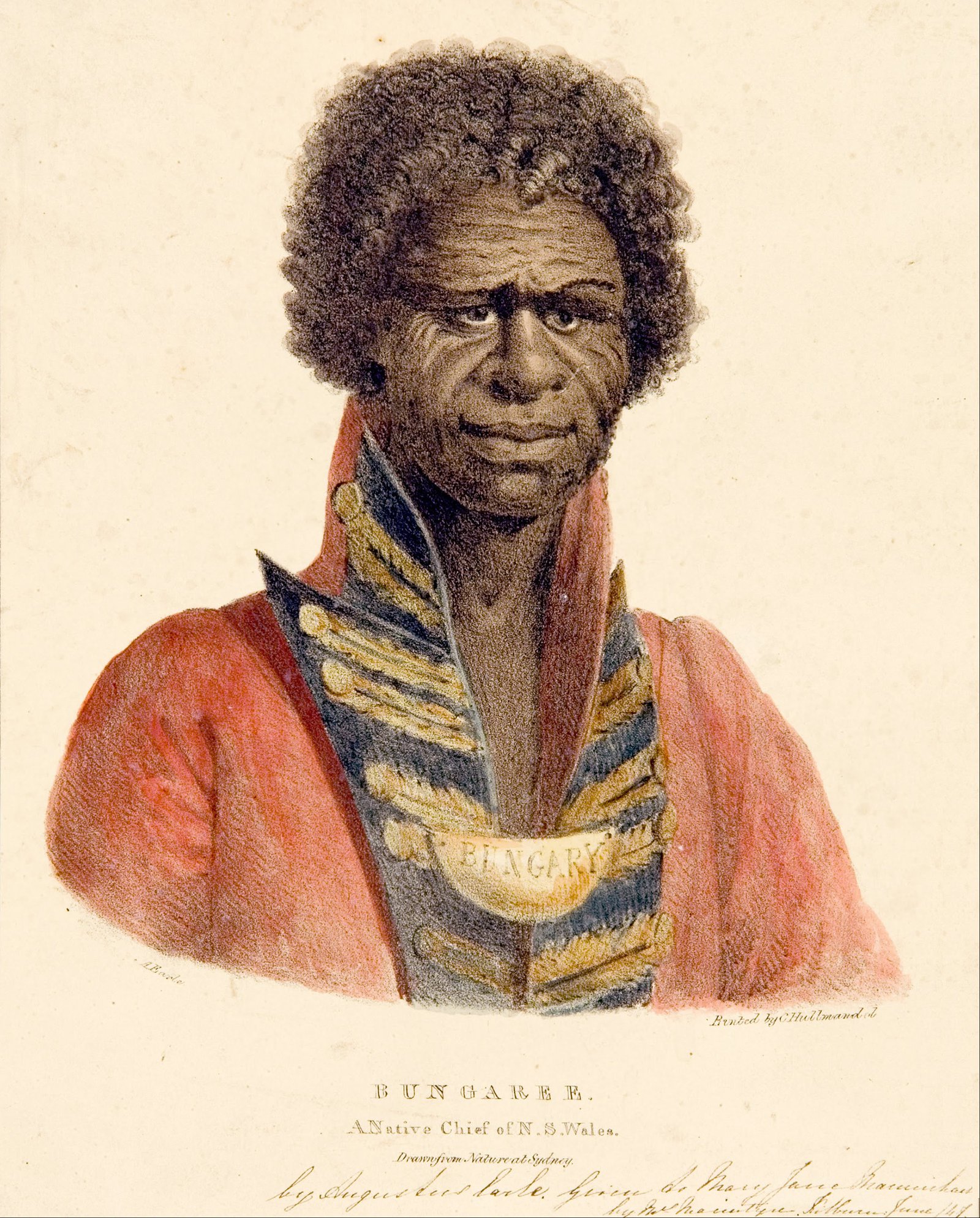
“Bungaree”, by Augustus Earle australian.museum

This has been a Flinders year for me. In May, I visited the charming holiday town of Victor Harbor, in South Australia.

Victor Harbor sits on the shore of Encounter Bay, named by Flinders, near where in April 1802, as commander of HMS Investigator, Flinders met up with the French scientific and mapping expedition under Nicholas Baudin, commanding Le Géographe and Naturaliste.
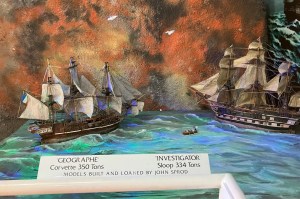
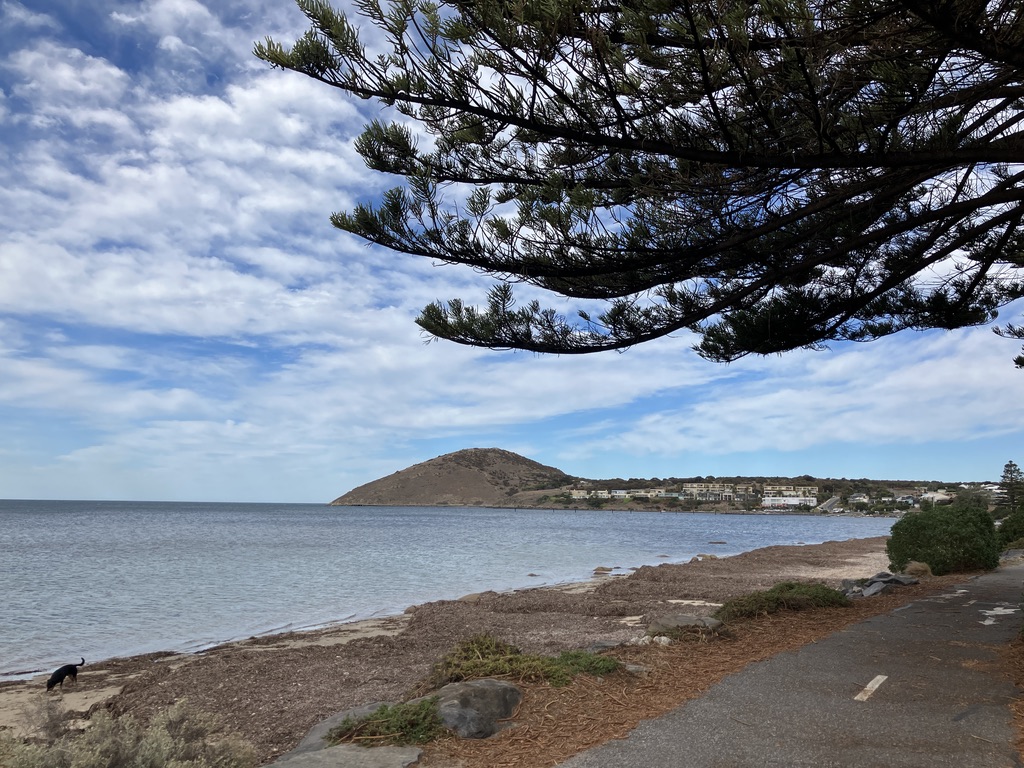
Model of Flinders’ encounter with Nicholas Baudin’s expedition at Encounter Bay National Trust Museum, Victor Harbor
Encounter Bay, South Australia

The Investigator expedition, under Flinders, had been mounted by the British government for the “complete examination and survey” of the coast of New Holland, mainly to make sure the French didn’t lay claim to it, so this meeting was a tricky one, although friendly.

The National Trust Museum at Victor Harbor tells the story well.

Flinders had already mapped the southern coast, across the Great Australian Bight, past Kangaroo Island and Port Lincoln and many other points all named by him. He had climbed a mountain in what were later named the Flinders Ranges. The name now pops up all over the southern and eastern states of Australia. Australia itself was named by Matthew Flinders, and it’s said that his map of the continent was still being used until the mid-twentieth century.

During the arduous voyage in the leaky, unfit Investigator, ultimately circumnavigating Australia, Flinders named places in what would become Queensland. He named Bowen, and in exploring the Gulf of Carpentaria, named Mornington, Bentink and Sweers Islands.

It was Flinders who named the Great Barrier Reef(s).

In 1799, three years earlier, Flinders had been commissioned to sail north from Sydney looking for rivers – potential harbours and ways to reach the unknown inland. Sailing through Moreton Bay in the tiny HMS Norfolk, he mapped and named several Moreton Bay islands and Red Cliff Point.
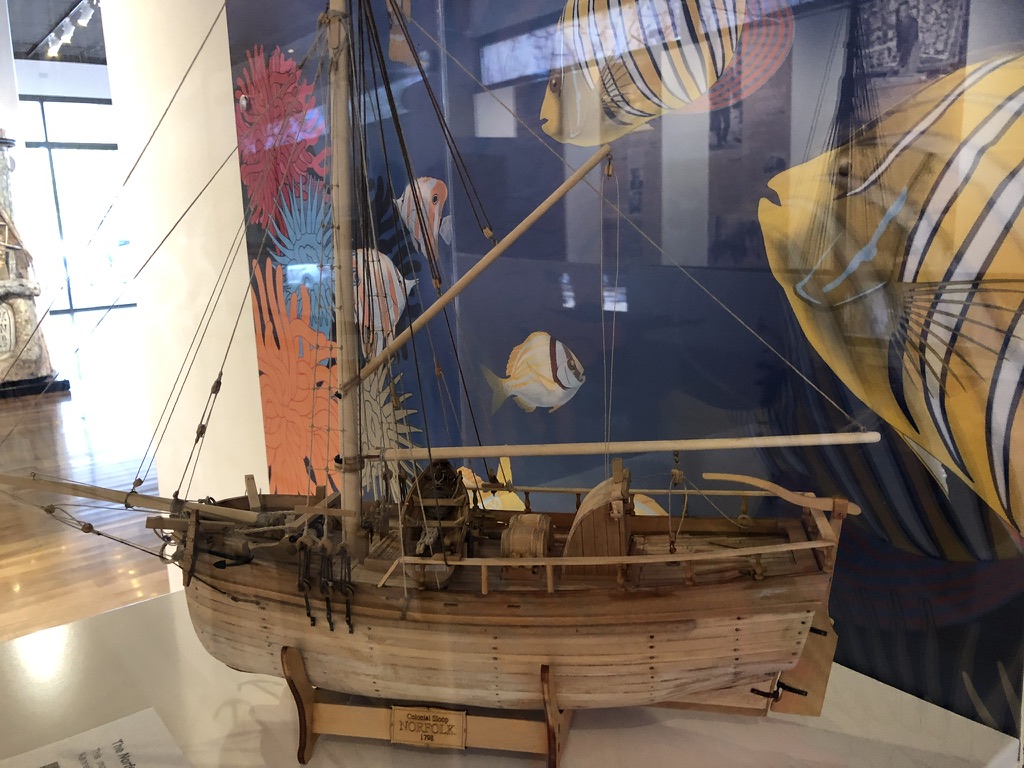
Model of HMS Norfolk Bribie Island Seaside Museum

The mangroves and sandbars of Moreton Bay hid from him the Logan, Brisbane and Pine Rivers, but he gave Pumicestone Passage its name, calling it, hopefully, Pumicestone River.

Anchored off the southern end of Bribie, Flinders went seeking a lookout point, heading for the nearby Glasshouse Mountains.
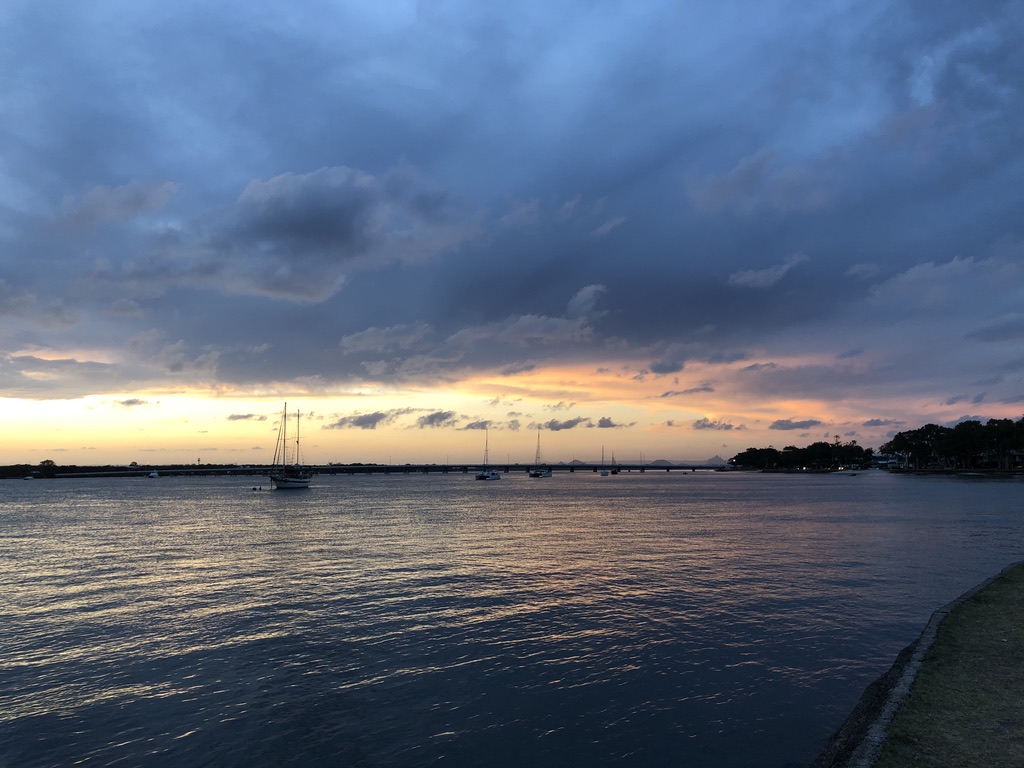
Flinders anchored near this spot, off the southern end of Pumicestone Passage

From near today’s Donnybrook, with Bungaree and two seamen, Flinders reached Beerburrum and climbed it. Tibrogargan, a little to the north, was too difficult, and the group camped nearby beside Tibrogargan Creek.
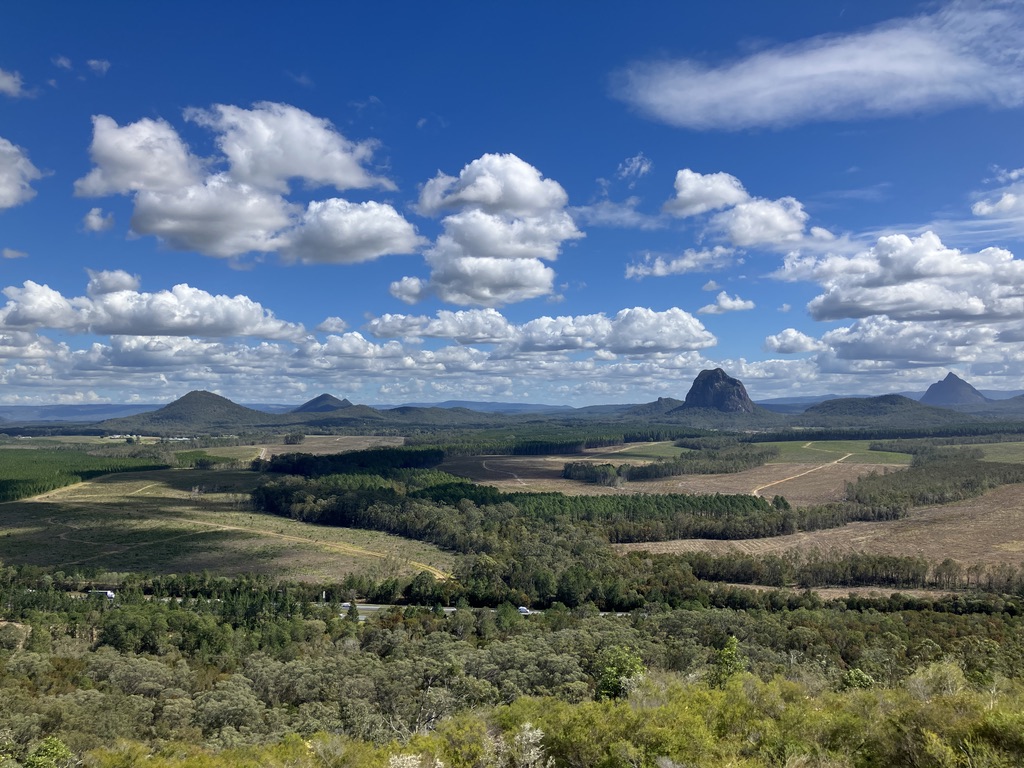
The Glasshouse Mountains, as seen from Wild Horse Mountain. Beerburrum on the left, Beerburrum the high mountain second from the right

There is now a cairn commemorating the expedition in the Matthew Flinders Park Rest Area near their campsite.
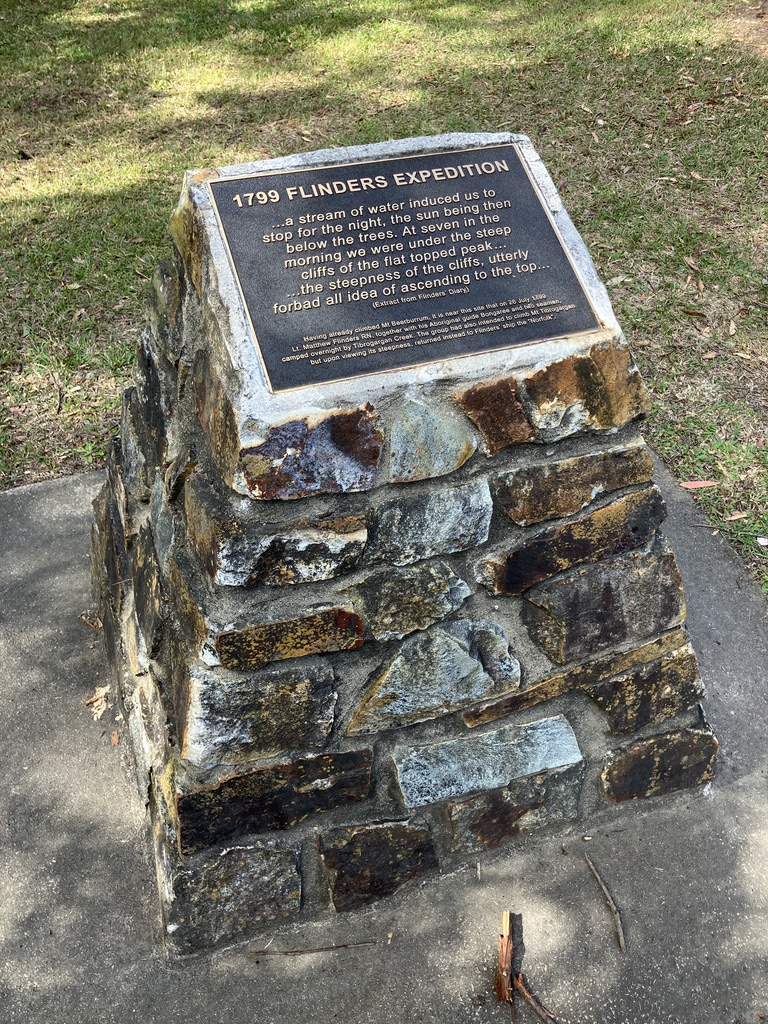
Cairn in the Matthew Flinders Park Rest Area

In August 1803, Flinders left Sydney in the Porpoise for England to arrange a better ship for survey work. 450 kilometres off Keppel Bay (Emu Park) the Porpoise and companion ship the Cato were wrecked on the reef still known as Wreck Reef. The survivors were marooned on a sandbank, including Flinders and his cat.

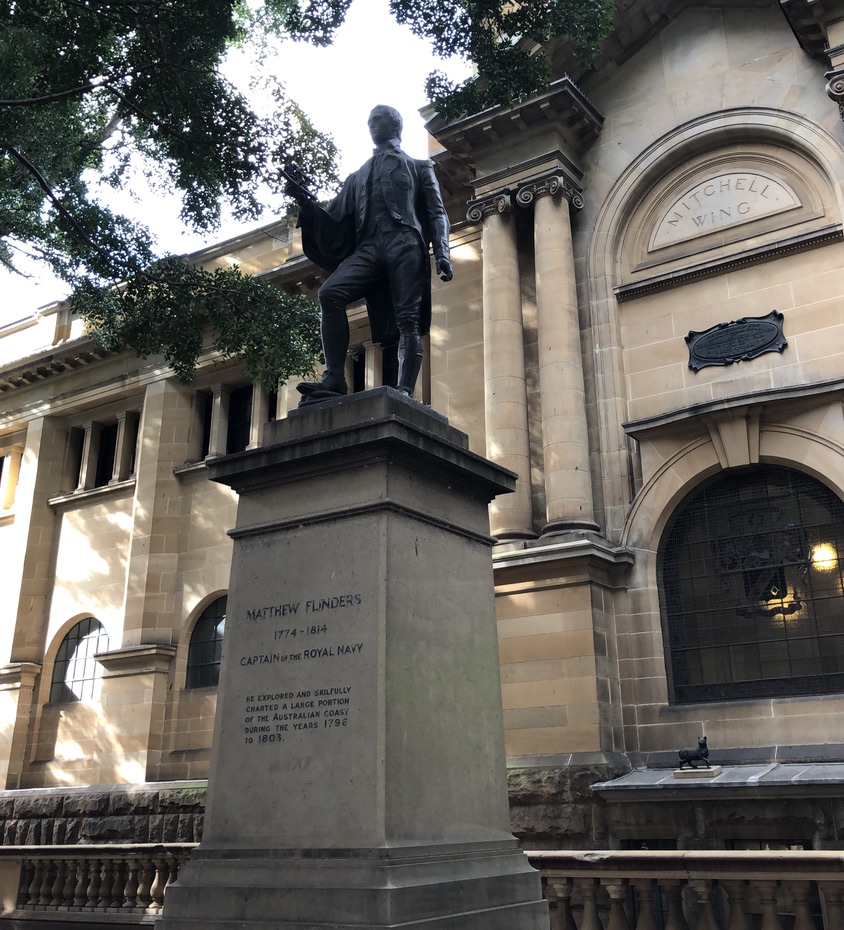
Trim, the cat, had been born on HMS Reliance in 1799, during its voyage to Sydney with Flinders as master’s mate. Trim and Flinders were companions during their voyages on the Norfolk, the Investigator, the Porpoise and the Cumberland. Wherever you find a statue of Matthew Flinders, his cat will be with him.
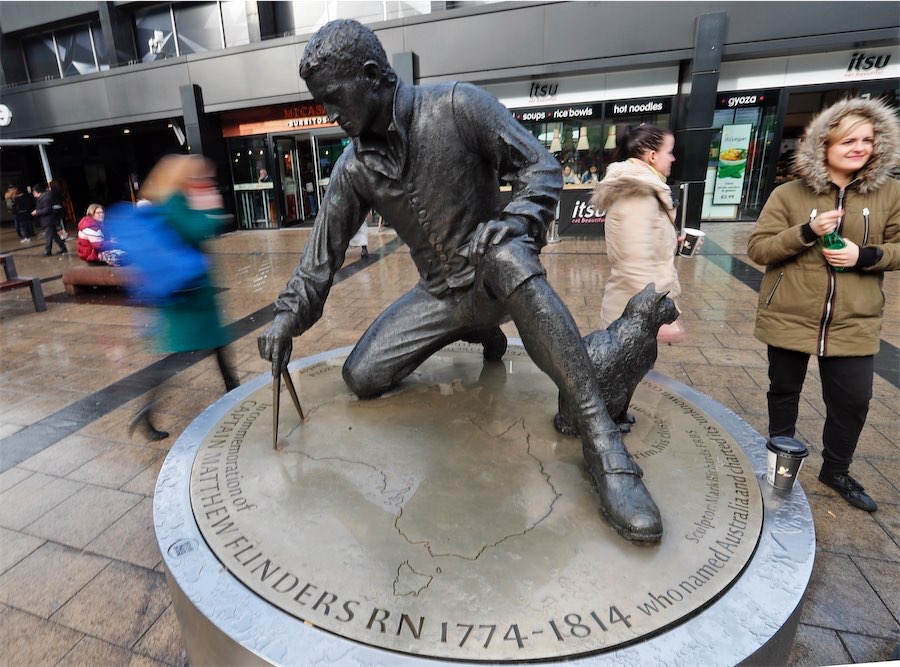
My favourite statue of Matthew Flinders and Trim, at Euston Station AP Photo
Matthew Flinders statue outside the Mitchell Library Sydney. Trim stands on the window ledge behind him

Flinders wrote charmingly about Trim, his account published in the little volume “Trim”, which I bought at Bribie Island Seaside Museum.
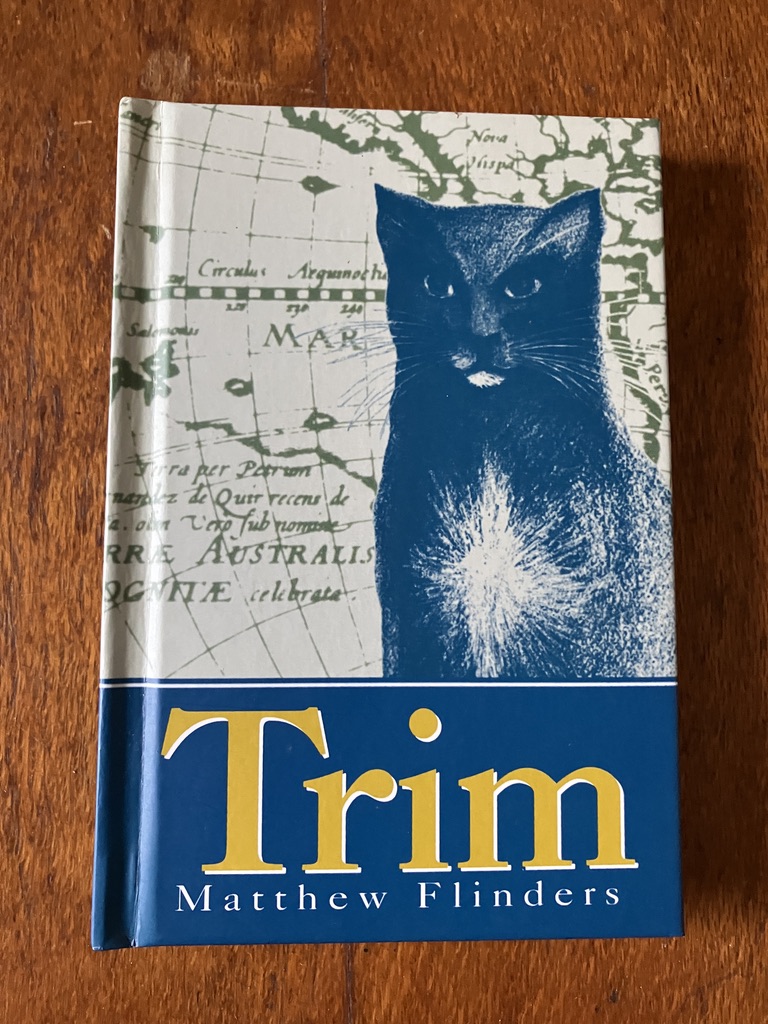
Stuck on a sandbank and expecting no rescue, Flinders with a crew of thirteen set off in a cutter to row and sail the 1100 kilometres back to Sydney for help. In less than two weeks they arrived there, and headed back in the small, barely seaworthy Cumberland, with two other ships, to rescue the stranded men, and the cat, from the sandbank.

Determined to get back to England and arrange his ongoing explorations, after the rescue of the marooned crew, most of whom returned to Sydney, Flinders headed north and west in the Cumberland, eventually landing for repairs at the French colony of Mauritius, not knowing that the French-British wars had broken out again. He was taken prisoner, and spent six and a half miserable years there before being allowed to return home.

It was on Mauritius that Trim was lost.

This long imprisonment contributed to Matthew Flinders’ death at the age of forty, in July 1814. “A Voyage to Terra Australis” the book that summarised his life’s work, was published the day before he died.

In the splendid O’Connell’s Bookshop in Adelaide I got to see a valuable copy of this work, the result of so much adventure, pain and determination.
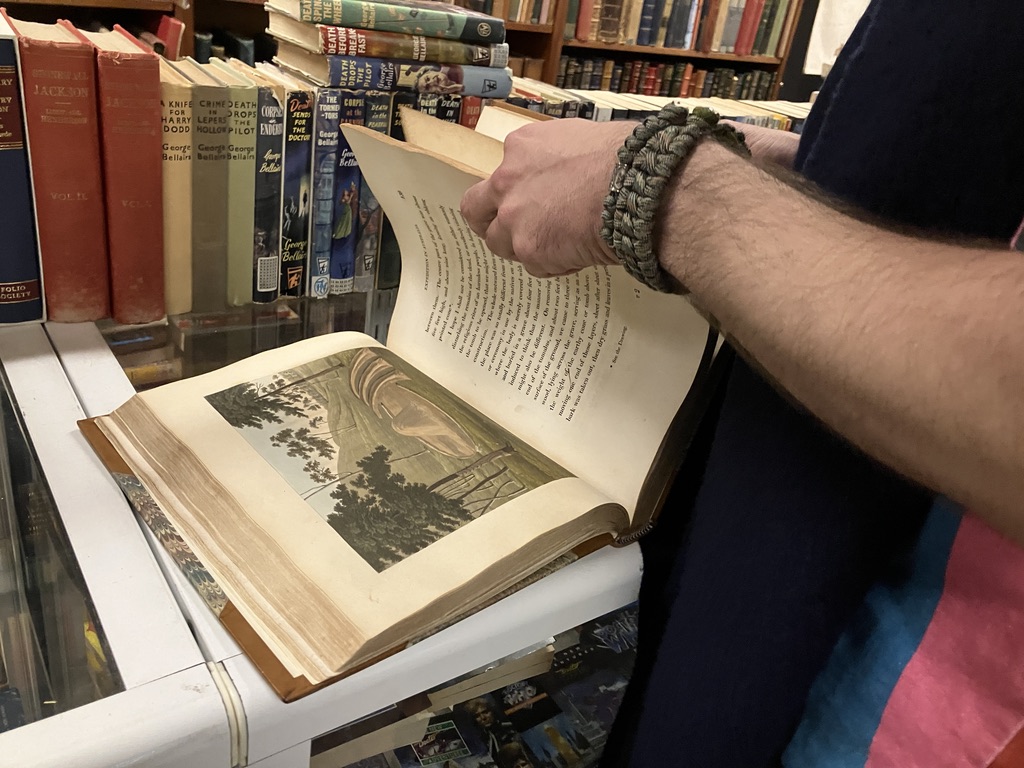
In O’Connell’s Bookshop, Adelaide, being shown a copy of Flinders’ “A Voyage to Terra Australis”

Matthew Flinders was buried in a London church graveyard, but the site was redeveloped in later years and his grave was lost.  In 2019, archaeologists undertook a survey of the old graveyard, near Euston Station, prior to construction of a new branch of the London Underground, and found the lead breastplate which marked his grave.

It was exciting news. The “Matthew Flinders Bring Him Home” group began to work towards his reburial in his hometown of Donington, Lincolnshire.

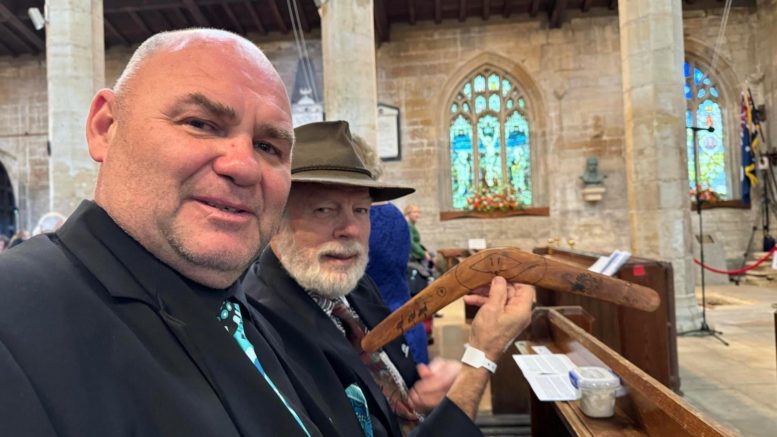
In July 2024, 210 years after his death and with full military honours,  Matthew Flinders was laid to rest in the Church of St Mary of the Holy Rood, Donington. As well as descendants of the Flinders family, two descendants of Bungaree were at the ceremony.
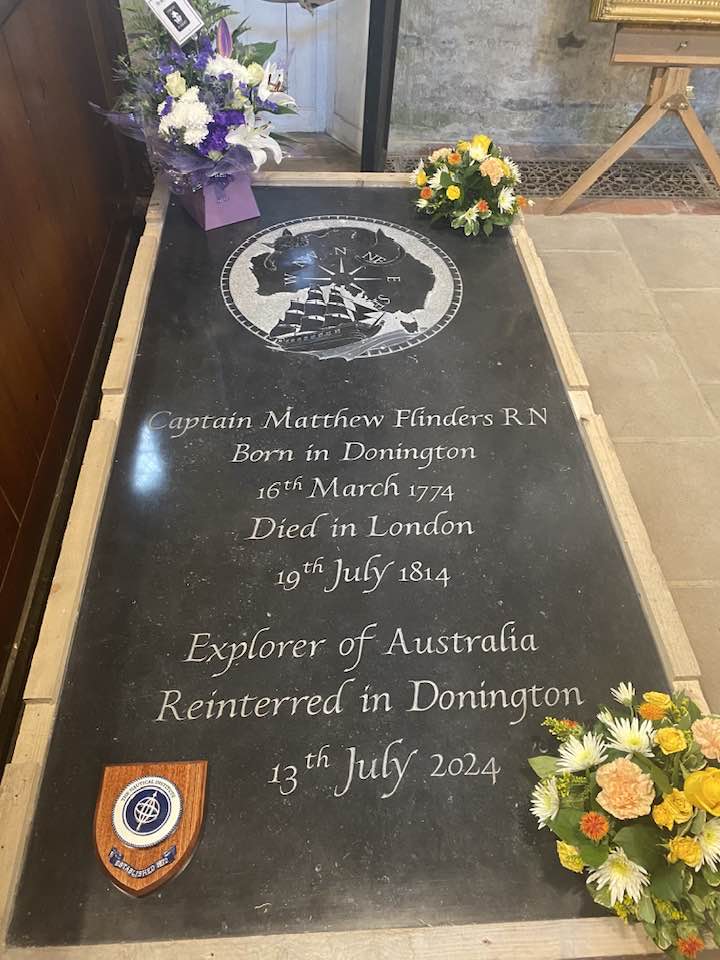
Matthew Flinders gravestone in the Church of St Mary and the Sacred Rood, Donington, UK, includes a mao of Austrlia and a picture of Trim Photo: “Matthew Flinders Bring Him Home” Group
Shad Tyler and Laurie Binison, descendants of Bungaree, at Matthew Flinders reburial Photo: pittwateronlinenews.com

The name of Flinders now appears all over Australia, including on major streets in both Melbourne and Townsville, and on Flinders Parade, Sandgate, where my great-grandparents lived a hundred years after the little Norfolk sailed by on its way up the bay.

I’ve walked the track to the top of Beerburrum, and climbed Tibrogargan (the western, easier side); and I’ve also been to the top of a peak which can be seen to the south-west from many of Brisbane’s high points: Flinders Peak. It was a scramble in places, but worth it for the view.
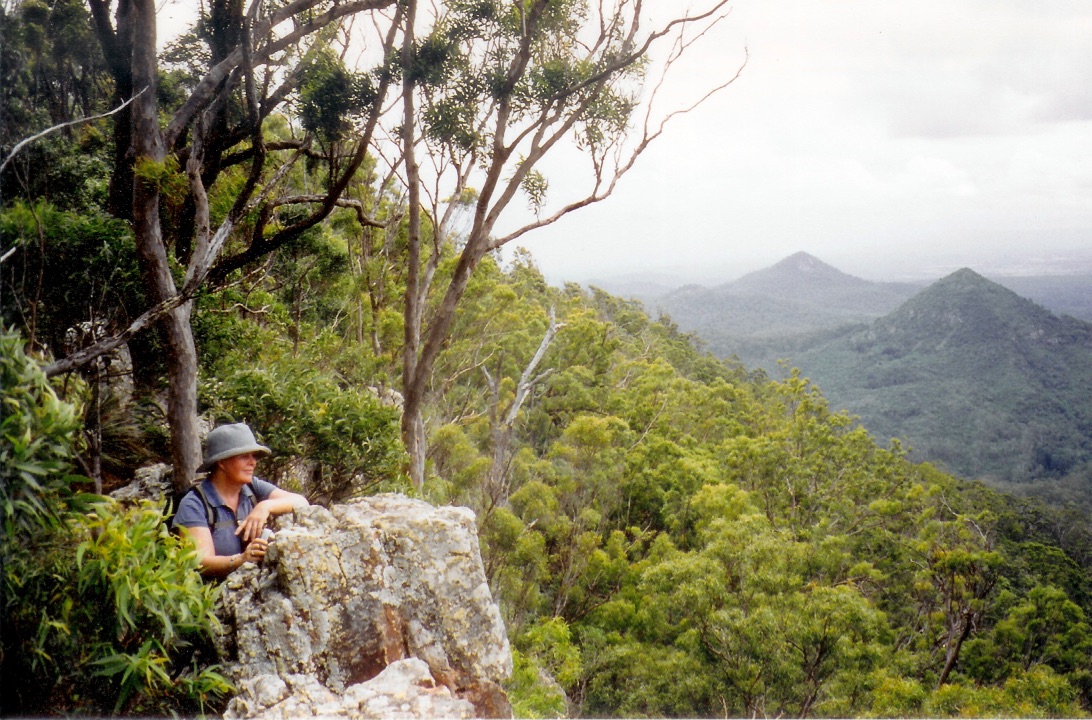
The writer on Flinders Peak

In 1799 Flinders spotted the peak from the sea and named it “High Peak”. When John Oxley sailed this way twenty-five years later, searching for a suitable place to build the convict settlement that would later become Brisbane, he renamed it Flinders Peak.

Of course, like all of these places, it already had a name: Booroong’pah. Like all of these places, it already had its own long-established stories.

The Matthew Flinders story is just another story of Australia, and of Queensland; but it will always be a story both inspirational and moving.

About Matthew Flinders

  • “Flinders: The life, loves and voyages of the man who put Australia on the map”, Grantlee Kieza, 2023. Excellent biography, based on primary sources
  • “My Love Must Wait”, Ernestine Hill, 1941, my first introduction to the story Of Matthew Flinders
  • “A Biographical Tribute to the Memory of Trim”, Matthew Flinders, published 1977, from the archives of the National Maritime Museum, Greenwich
  • “In the Footsteps of Flinders: Memorial to great navigator unveiled,” article by Clem Lack for Royal Historical Society of Queensland, 1963, describing Flinders’ expedition to  Beerburrum.
  • “Matthew Flinders’ Cat”, Bryce Courtney, 2002. A novel of Sydney, with Trim’s story vividly told.

Main picture: Portrait of Captain Matthew Flinders, RN, 1774-1814. Toussaint Antoine de Chazal de Chamerel. 1806-07, Mauritius Art Gallery of South Australia
Sweet Potato

At lunch time, behind the school, Con and his mates used to dig up sweet potatoes.

“We gave the big ones to the nuns, but us kids would eat the small ones, raw. They were sweet and juicy.”

Con went to the Good Counsel Convent school in Innisfail, run by the Good Samaritan Sisters (the Good Sammies, as they were affectionately known.) The red volcanic soil of Innisfail is ideal for growing sweet potatoes, but they’ll grow happily anywhere in Queensland, if there’s warmth, soft soil and good rain. They’re a staple across the South Pacific. They flourished in Nambour, too: in my family’s backyard.

Our yard, on a then new sub-division on Mapleton Road, sloped down towards a farm with a bull paddock. The fence was flimsy. Once, when plumbers were working on our septic tank, they occupied their smoko time with teasing the bull. My mother watched out the bedroom window, expecting the bull to break through the fence at any moment and chase the plumbers up the slope. She was disappointed when it didn’t happen.

“I’d have liked to see them trying to run up that slope, catching their feet in the sweet potato vines,” she said.

In Con’s tropical Innisfail yard there were banana plants, papaws, mangoes, passionfruit vines and citrus trees. It’s still the same in the North.

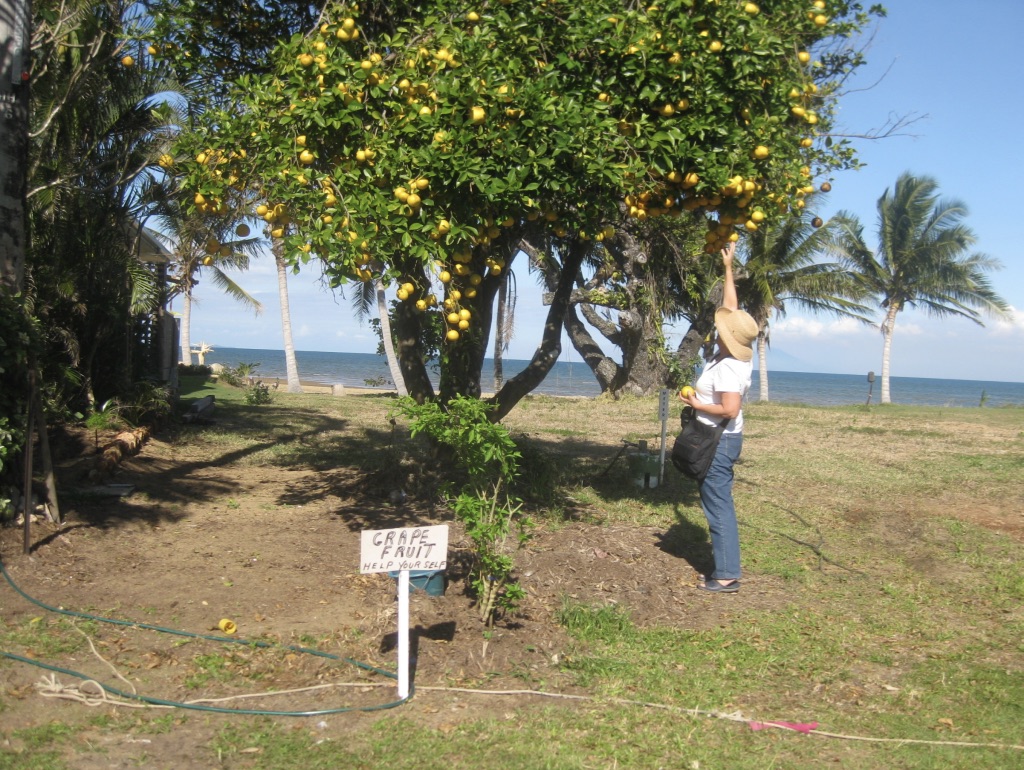
Citrus growing by the beach, Tully Heads
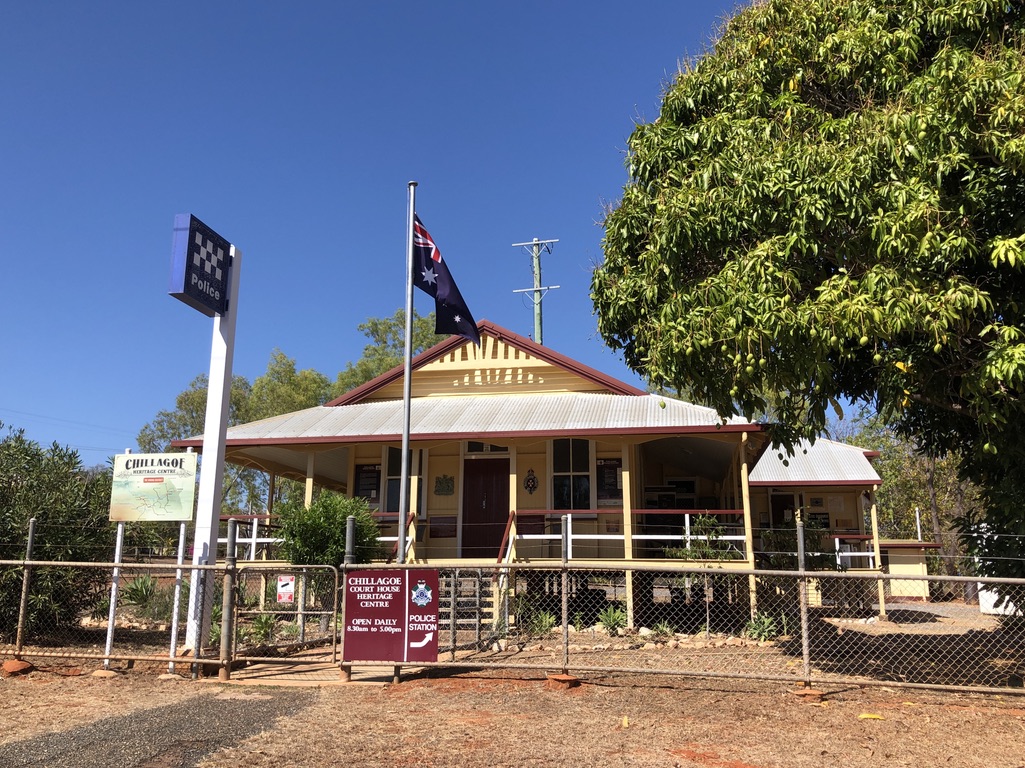
Loaded mango tree outside the police station in Chillagoe, west of Cairns

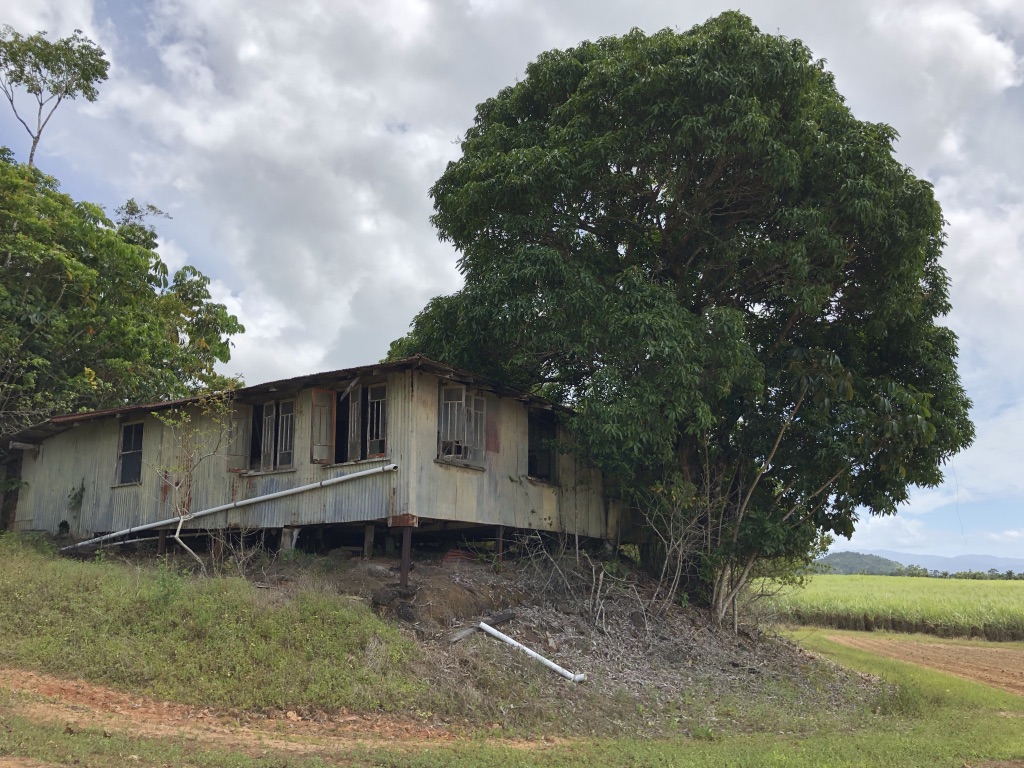
Our garden in Nambour, a 1500 km drive south and officially in the sub-tropics, had bananas and papaws, too, and also loquats, guavas, rosella plants, a mulberry bush and a big mango tree, left over from farm days. Across the state, a group of fine old mango trees, Moreton Bay figs and hoop pines often indicates that a farmhouse once stood there.

Mango tree flourishing beside a derelict farmhouse, Babinda

In Nambour, we never got to eat our guavas, because we would forget about them until we could smell the fruit. By then, it was too late – they’d be full of fruit fly grubs.

There was a flourishing choko vine on our fence. I haven’t eaten chokos since Mum used to cook them, serving them in white sauce to give them some flavour.

In these days of supply chain problems, we should all have a choko vine along the fence, along with all the other fruits and veggies that grow so well in Queensland.

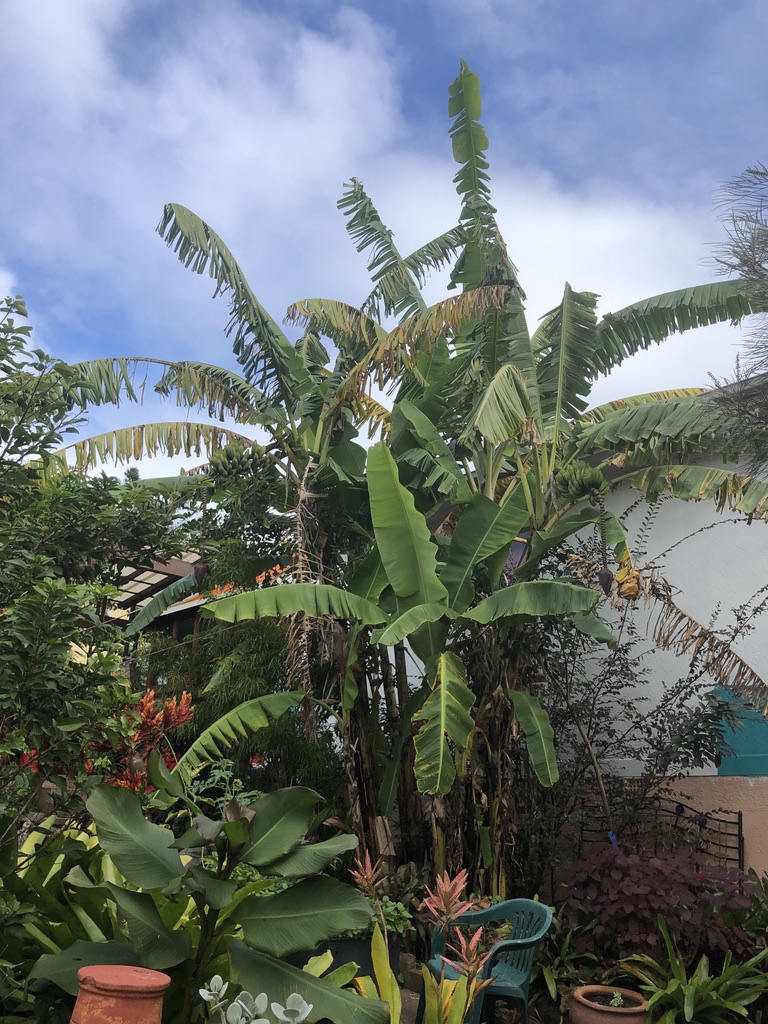
Bananas growing beside a West End house

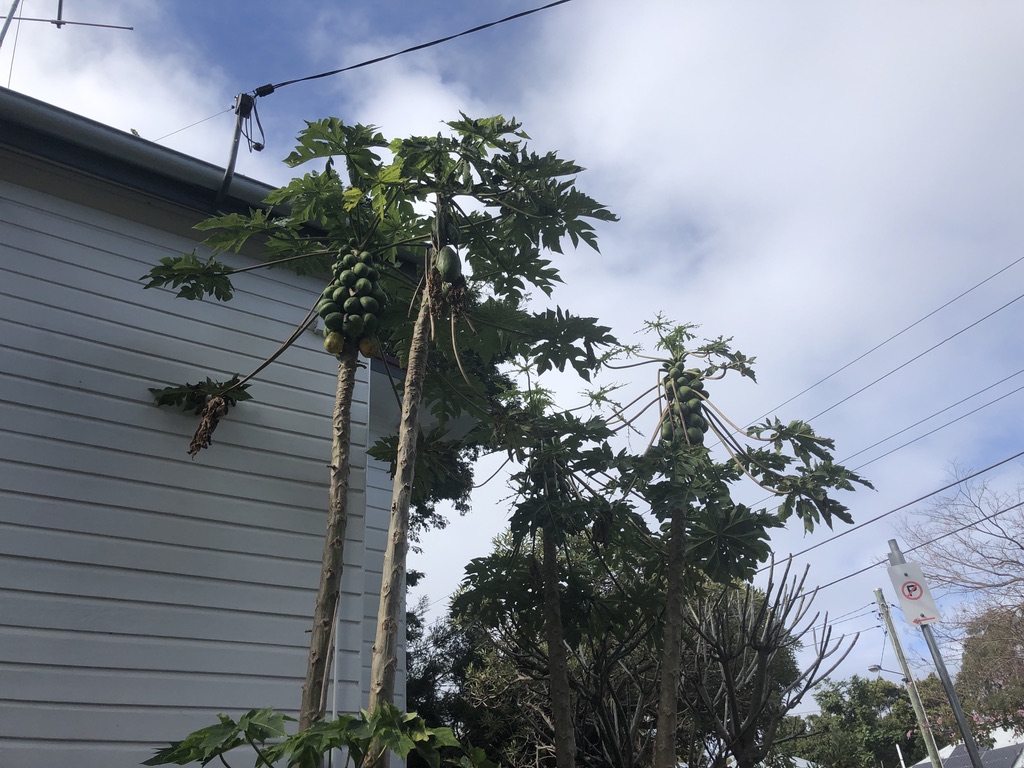
Sadly, in old migrant suburbs like West End, because of high property values and the move towards denser housing, many fine backyard fruit and vegetable gardens are disappearing.

Papaws, West End

The Sunshine Coast hinterland north of Brisbane is perfect for growing tropical fruits and citrus in the backyard. In our Woodford yard, as well as an old mango tree there were macadamias, lemons, bananas, and a large custard apple tree of the bullock heart variety.

Looking from under our Woodford mango tree towards the custard apple tree. In the background are macadamias and bananas

Huge productive avocado trees grow almost wild in Maleny backyards.

Dragon fruit vines smother Brisbane gum trees and loaded passionfruit vines festoon suburban fences; but the biggest passionfruit vine I ever saw was growing over the toilet block in the yard of the Silkwood Hotel, north of Tully. It provided shade over people enjoying a drink in the beer garden, and masses of fruit; possibly nourished by the septic tank.

In the beer garden of the Silkwood Hotel, under that enormous passionfruit vine

We tend to take all this splendid bounty for granted, since it grows in spite of us and requires no care. Fruits that are rarities in cold climate countries are part of our everyday environment in much of Queensland, and visitors are amazed by them. When taking a drive around the Glasshouse Mountains with overseas visitors we stopped beside a pineapple farm with its neat rows of plants and young, green pineapples. Pines, as we used to call them. Our German friend looked at them in amazement. “So that’s how they grow!” he said.

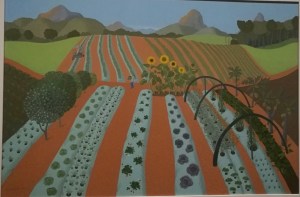
“Mixed Farm with Sunflowers, Glasshouse Mountains”, painted by Anne Marie Graham

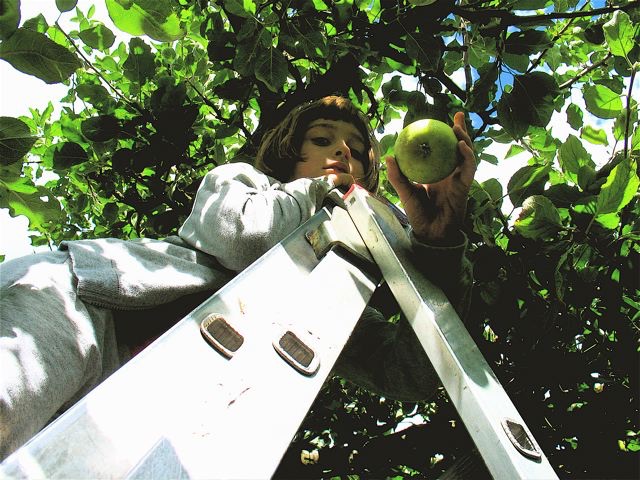
I feel the same amazement when I visit Europe and see apple trees in fruit, hanging over people’s garden walls, or when I look at photos of my granddaughter picking apples in her Opa’s Berlin garden.

Picking apples in a Berlin garden

In York, U.K., in my friend’s wintery garden there was an enormous pear tree. It had one yellow pear still hanging on it on, metres above the ground. I’d had no idea that pear trees grew so big, and that you could just grow them in your back yard.

That big Nambour mango tree is long gone now, making way for brick and concrete; and in the old bull paddock there is a sprawl of houses. I’d be willing to bet sweet potato vines are still flourishing somewhere nearby, though.

When I first had a meal at my future mother-in-law Min’s house in Innisfail she said, “Do you like sweet potato?”

I didn’t, but of course I said yes. From then on, it was always on the menu when we ate there.

Years later when we visited, Min, now elderly, looked exhausted.

“What have you been doing, Mum?” Con asked.

“Well, I didn’t have any sweet potato, and I know Rose loves it, so I walked into town to buy some,” she replied.

A kilometre each way in the tropical heat.

It wasn’t the right time to tell her the truth. That time never came.

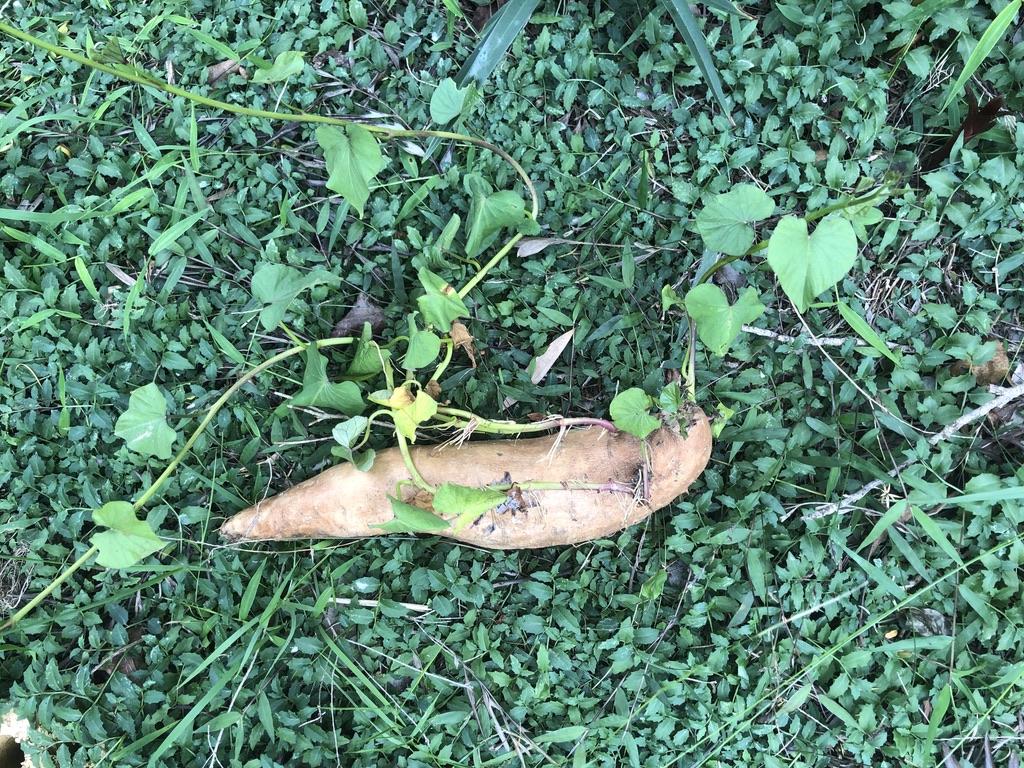
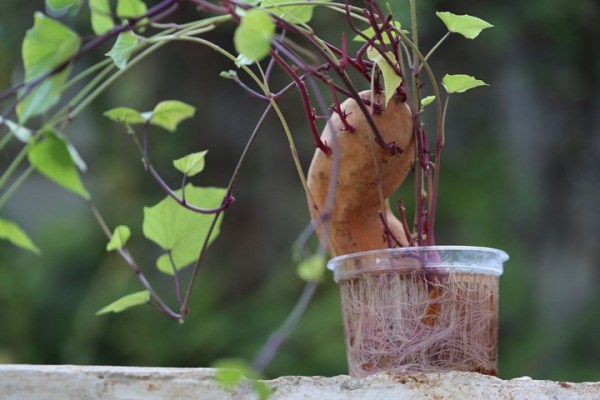
Every now and then I buy sweet potatoes, in Min’s memory, and put them in the potato basket and forget about them. By the time I notice them again they have sprouted, so I throw them out in the garden to rot away and nourish the soil.

Thrown-out sweet potato that won’t die

They don’t rot, though; they keep growing until I trip over the vines.

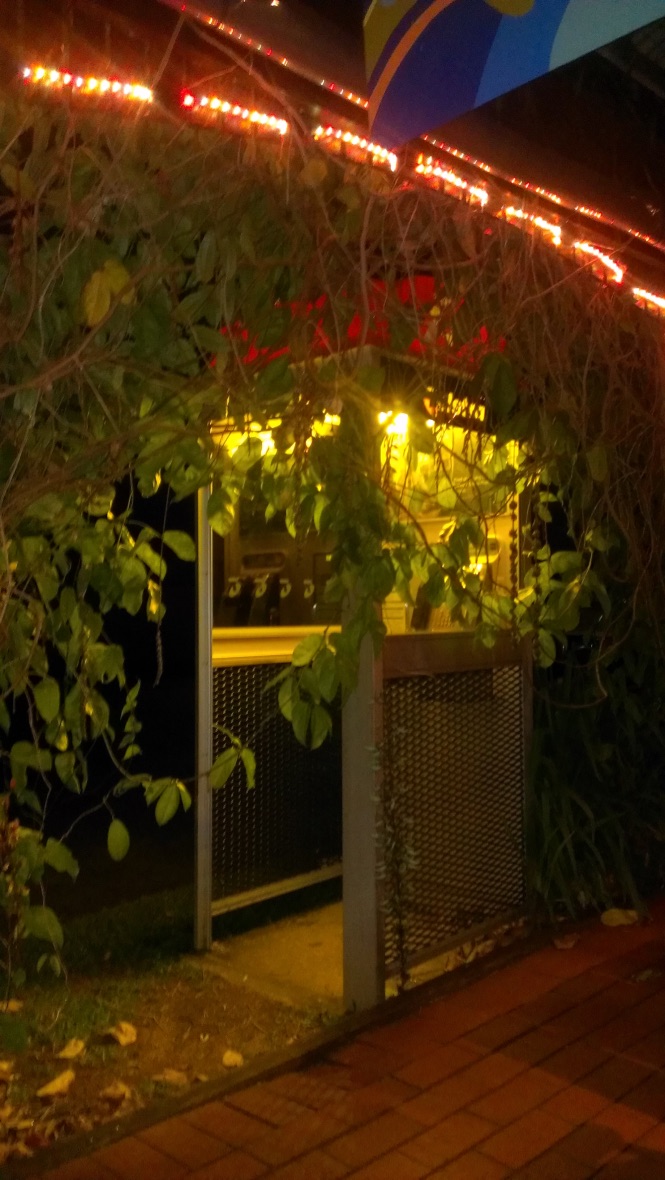
Passionfruit vine growing over a telephone booth, Bingil Bay

Queensland at Christmas

We were slow to put up a Christmas tree that year. Matt, seven years old, got anxious. Maybe we weren’t going to have a tree? He couldn’t bear the thought.

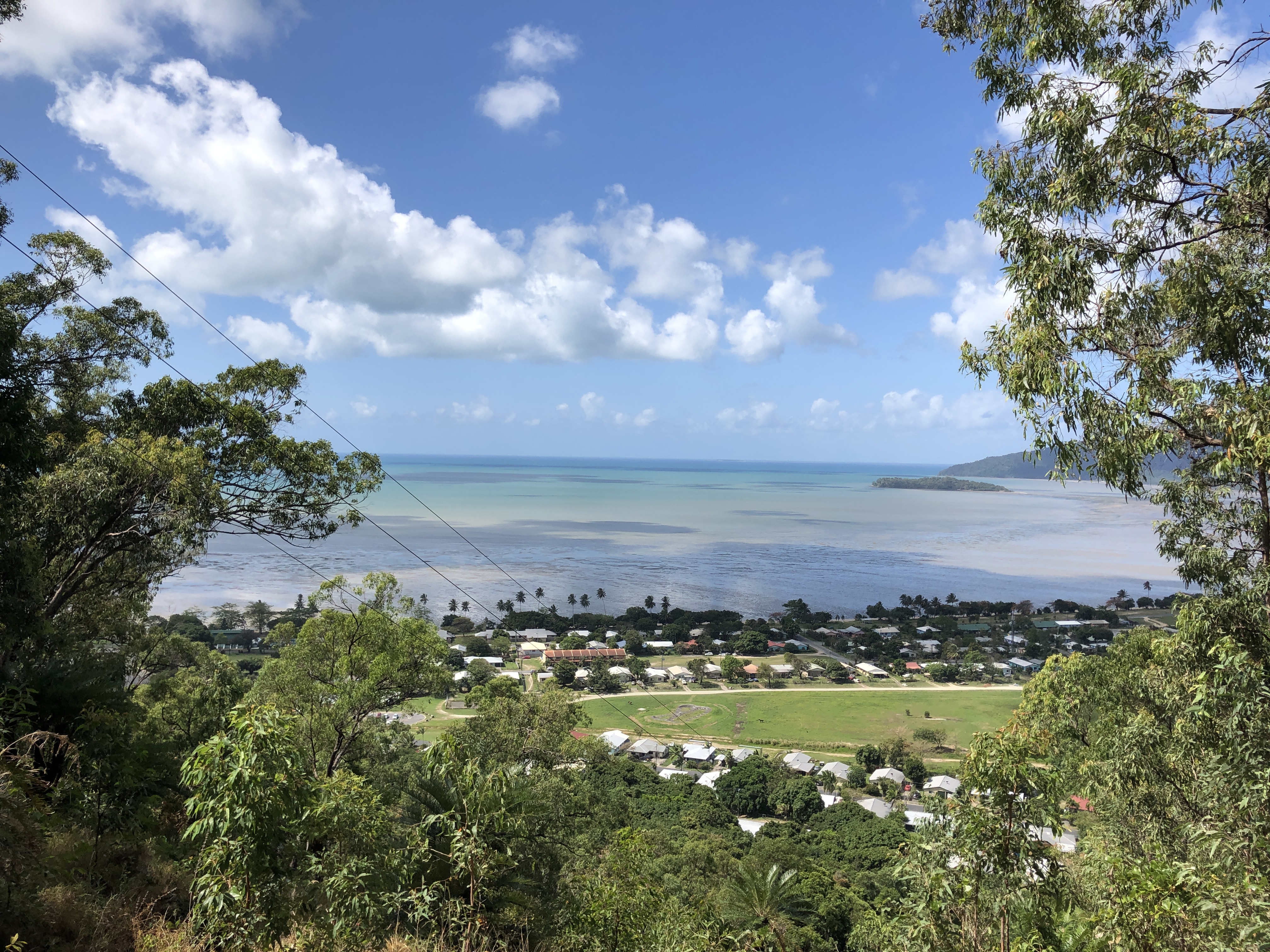
At the time we were living in Yarrabah Aboriginal Community, in a house was just a hundred metres from the edge of the Coral Sea, at the bottom of a steep hillside covered in tropical forest. Following the coconut palm-lined beach, a dirt track led around to the Point, a popular fishing spot.

Looking over Yarrabah

Matt went under the house and found the old blockbuster, heavier and blunter than an axe and nearly as big as he was. He dragged the blockbuster down the dirt road past our house and out along Point Road to a spot where casuarina pines were growing; then he set about chopping one down.

Half an hour later, Matt arrived back at our front door, accompanied by a local man who had been walking along the track with his family on the way back from fishing. He had been amused to find little Mattie trying to chop down a tree twice as tall as he was, and kindly chopped it down for him. Then he brought Matt, the blockbuster and the tree home to our house.

It was a surprise to me, because I thought Matt had been playing under the house the whole time.

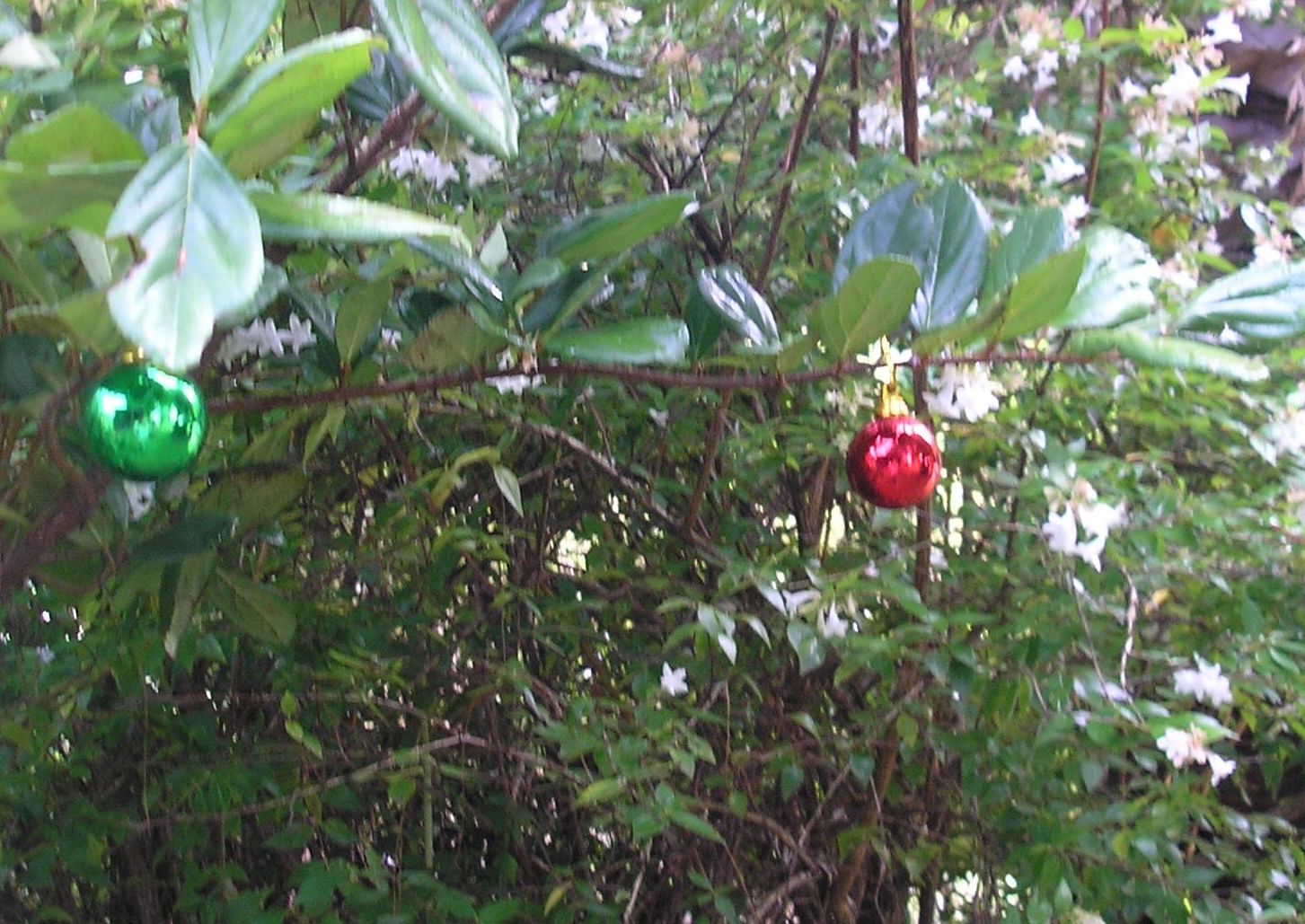
We always have some kind of Christmas tree. If we’re away from home I’ll find something green to hang a few baubles on and put presents under. An artificial plant in a holiday apartment at Maroochydore (holiday apartments always have some kind of artificial greenery, it seems), shrubs outside our cabin the year we spent Christmas in a caravan park at Dorrigo, N.S.W.

Christmas at Dorrigo, NSW

One year I found a dead tree branch, sprayed it white, planted it in a basket full of rocks and hung tinsel and decorations on it. I felt smug about my creativeness, but my kids weren’t impressed. Kids have their standards about what a Christmas tree should look like.

Living in Woodford, west of Caboolture and not far from the sprawling Caribbean pine plantations of the Glasshouse Mountains area, before Christmas we would drive down a dirt track in the pine forest until we found a suitable-sized tree, one that had seeded beside the track. Those exotic species sprout everywhere, even in people’s roof guttering and plant pots.

Glasshouse Mountains pine forest Qld Parks and Wildlife Service

We would chop the tree down and bring it home for a Christmas tree. The kids didn’t like that much, either – Caribbean pines smell good, but they’re not lush and thick, and they don’t have a traditional Christmas tree shape.

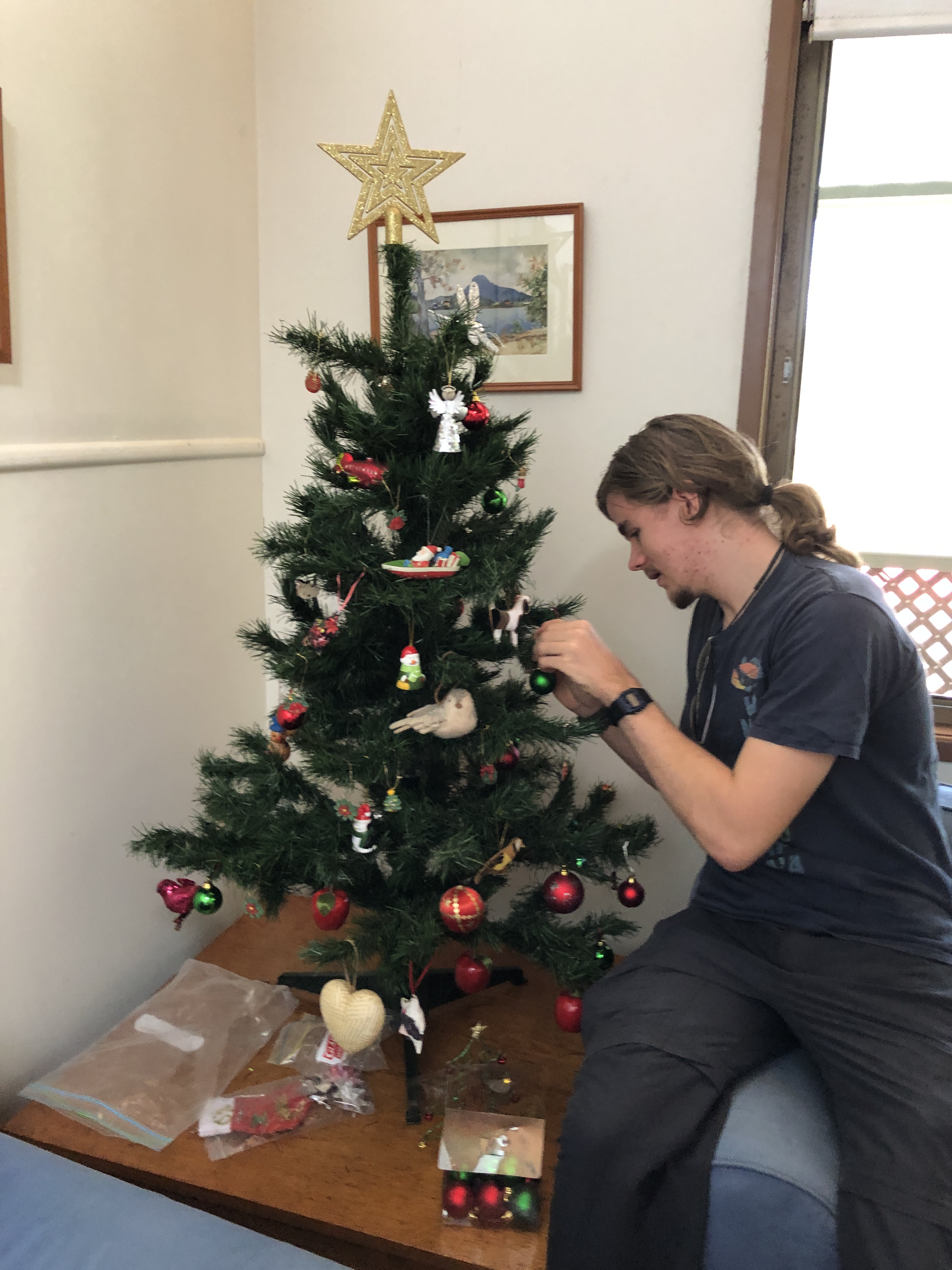
Eventually I got tired of chopping down trees, and to the scorn and outrage of the family, I bought a plastic one. We’ve now been using that same plastic tree for thirty years and three generations.

2020 – another generation decorates the old plastic tree

Sometimes in Queensland we have a fairly mild Christmas, as we did in Brisbane in 2020: 28C and cloudy. Occasionally we get a wet Christmas.  It’s safest, though, wherever you are in the state, to plan for heat. That Christmas evening in Dorrigo we ate under a fine, cool mist; but we arrived back in Brisbane a couple of days later to find that candles we’d left on the sideboard had melted and drooped in the heat.

One memorable 25 December in Jandowae, on the Northern Darling Downs, when I was a teenager, the temperature must have been in the mid-40s. My mother was trying to cook a traditional Christmas roast dinner in our wood-burning stove, but it wasn’t drawing properly and she couldn’t get the oven hot enough. My brother climbed on to the corrugated iron roof in the blazing sunshine to try and unblock the chimney. The whole kitchen was like an oven. The plastic tea towel rack melted and sagged and the tea towels slid off on to the floor.

Mum cooked a hot roast dinner every Christmas, roast veges and all, then a hot Christmas pudding. That year in Jandowae she said, “Never again.” It was cold meats and salads from then on; but she still did the pudding.

The further you go from the coast in Queensland, the hotter it’s likely to be – well into the 40s in such places as Quilpie and Thargomindah; but usually it’s a dry heat.  The coastal hinterland can deliver something special: high temperatures plus humidity. That’s what we got one year at Rosevale, south west of Ipswich.

It was the Christmas of 1972, and Con and I had a full house. Family camped in the field next door, devoured by mosquitoes every night; and the back yard toilet had to be emptied more often than usual.

That was Con’s regular job. He would dig a hole in the paddock beyond the back fence and bury the contents of the toilet pan. On Christmas Eve he conscripted my brother John to help him (the same one who’d gotten on the roof on a previous Christmas to clear the chimney – a useful bloke).

The pan was full almost to the brim. “Tread carefully”, Con warned him as they carried it across the yard, one on either handle. “We don’t want it to spill.”

“I was never more sure-footed in my life,” said John.

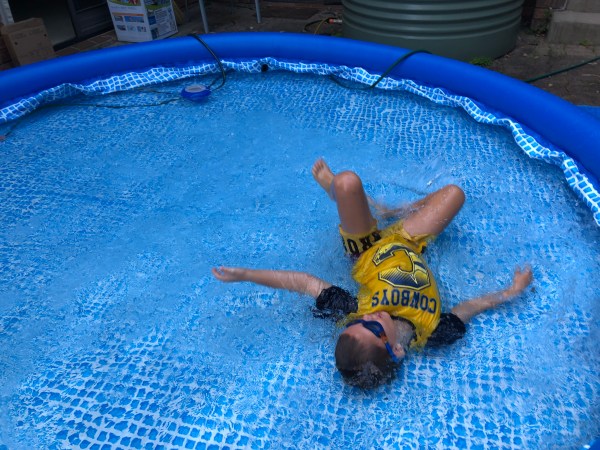
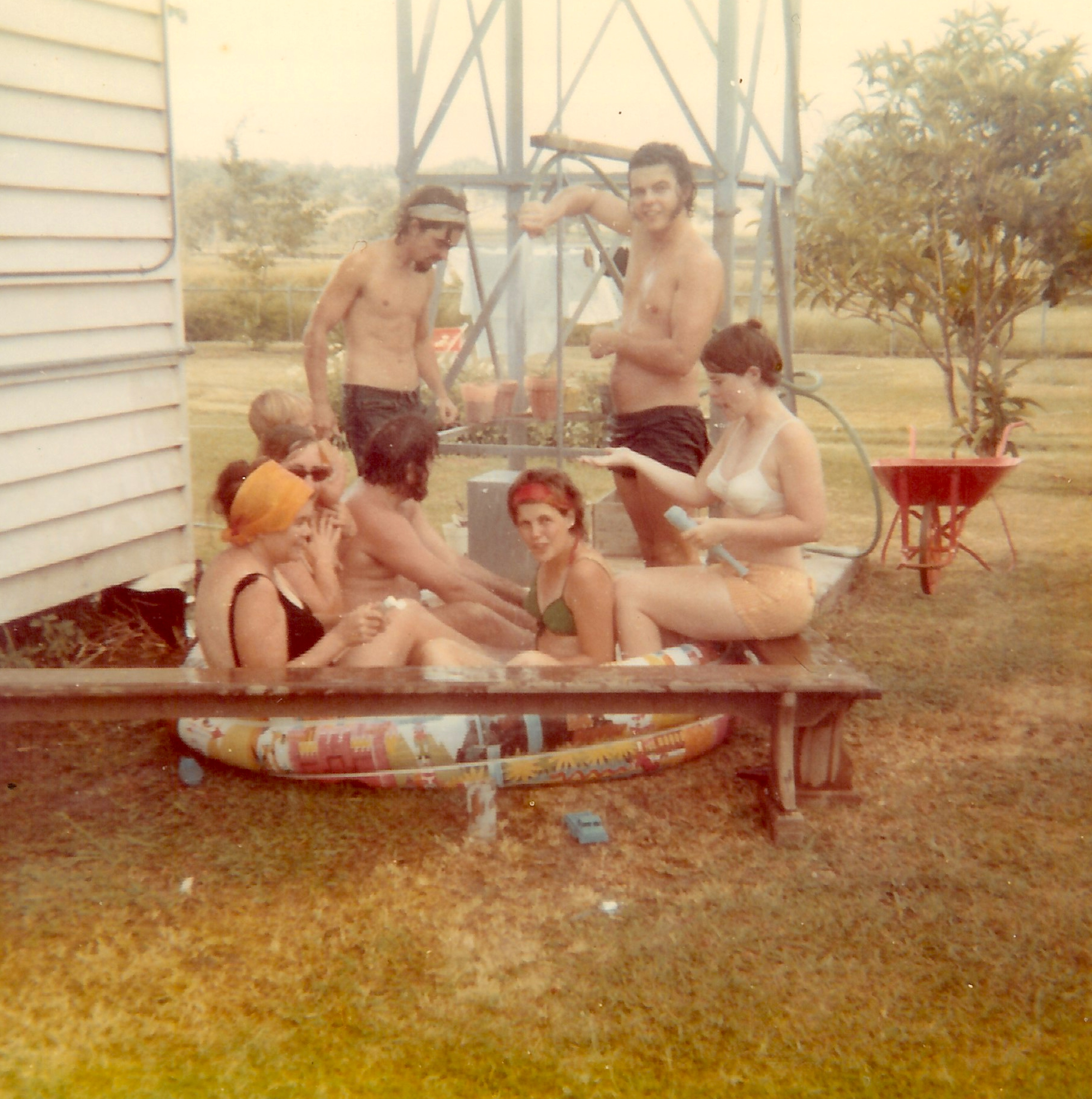
On Christmas Day, desperate from the heat, we pumped up the kids’ little inflatable pool next to the tank stand and all got in it, under the hose: three generations squeezed in together.

Three generations in the paddling pool – Rosevale, Christmas Day, 1972

That Christmas Day was reportedly Brisbane’s hottest on record: 39C. As the hinterland is regularly hotter in summer by several degrees, Rosevale would have reached 42C at least. 

At the State Library of Queensland, a year or so ago, there was a display of old photos of Queenslanders doing typical Queenslander things. Among them, to my delight, was a photo of a Beaudesert family on that same Christmas Day in 1972, trying to keep cool the same way we were at Rosevale, just an hour’s drive away.

Same day, an hour’s drive away State Library of Qld: “Rolley and Croker families at Beaudesert 1972”

These days as a family we’re spoilt at Christmas, with a cold lunch of ham and salads, fans and air-conditioning, and even indoor, flushing toilets.

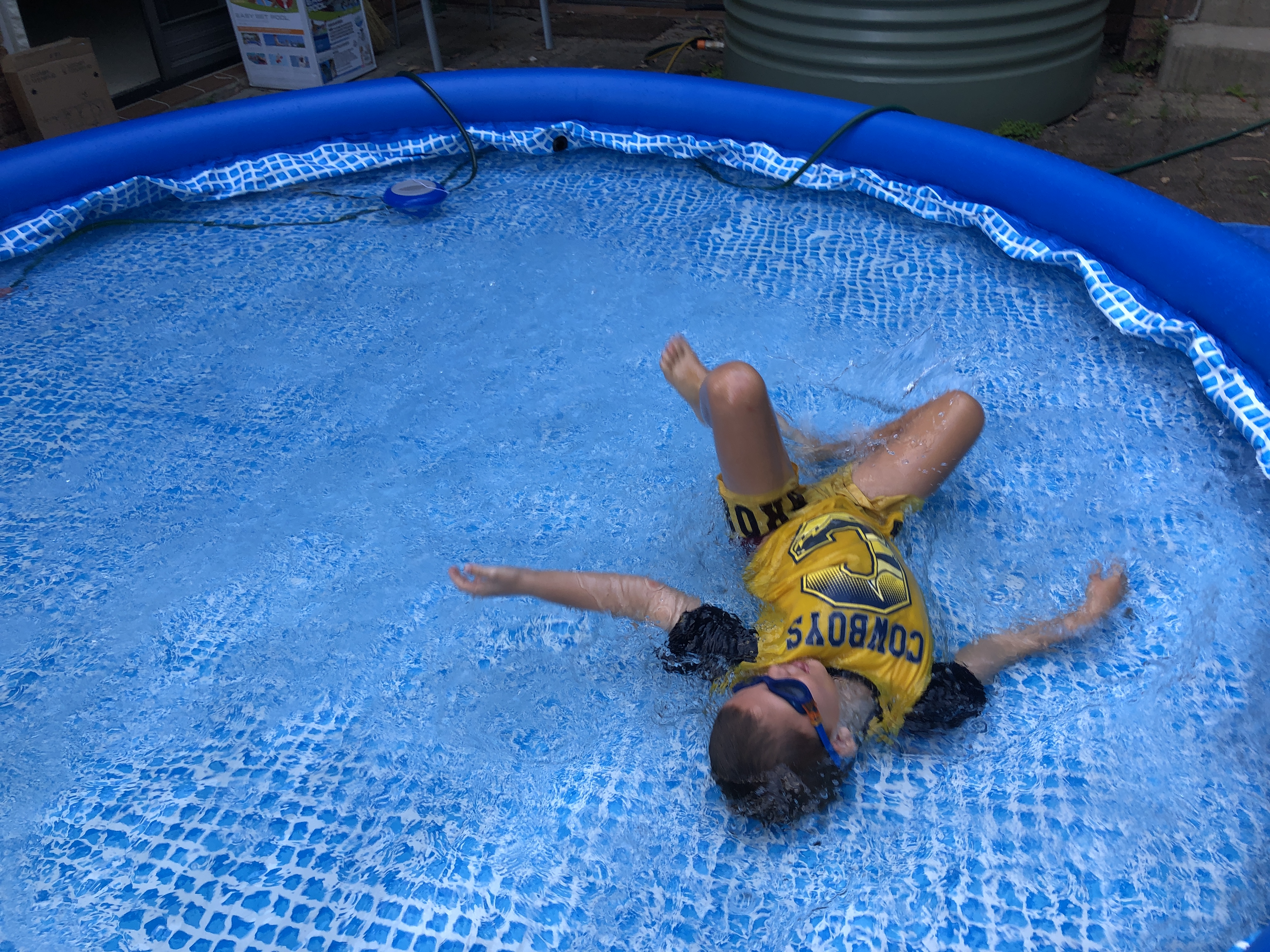
We still have an inflatable back-yard pool, though – and the old plastic Christmas Tree. Some traditions should never die.

Backyard Christmas 2020 – NQ Cowboys shirt, Brisbane Broncos shorts. Can’t get much more Queensland than that.

Artists’ Eyes

The Glasshouse Mountains are beautiful and mysterious. They’ve been sitting there since long before James Cook came past in his little ship and named them, and for many thousands of years they’ve had their own Indigenous names and their own stories.

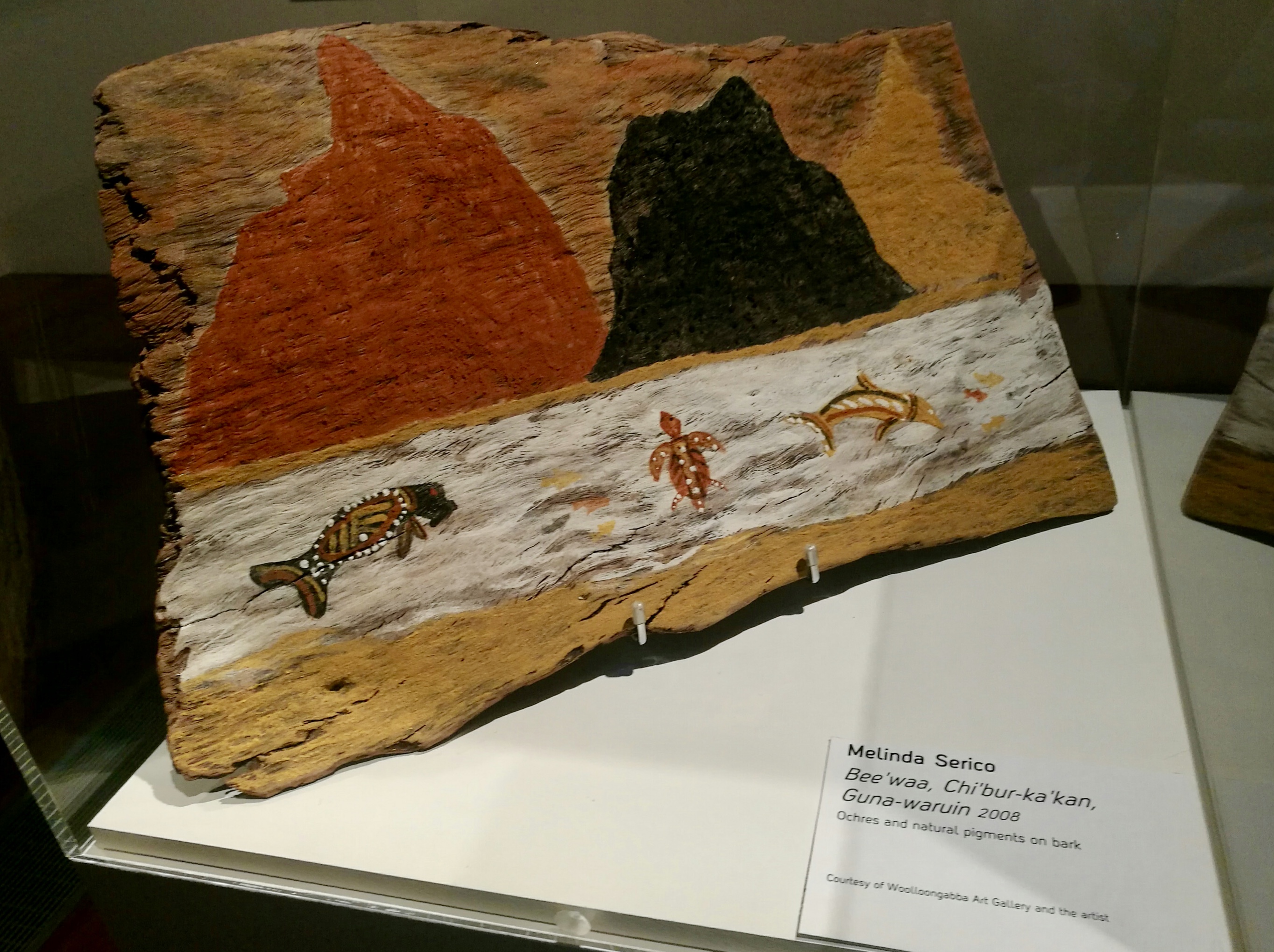
Moreton Bay Regional Council has three art galleries that specialise in exhibitions of the way artists represent local places. One of these, the Caboolture Art Gallery, has shown a range of artists’ depictions of the Glasshouse Mountains, including Indigenous artists, such as Melinda Serico.

fullsizeoutput_3d71

Many artists try to capture the atmosphere of the Glasshouses, but Lawrence Daws is my favourite. He lived near the mountains for years, and his paintings show the quality of the light, the glimmer of creeks and farm dams, the familiar shapes of Tibrogargan, Beerwah, Coonowrin and the other peaks.

fullsizeoutput_324c
Golden Summer, Lawrence Daws

I can see the beauties of landscape for myself, as I did when from the slopes of Ngun Ngun I took this photo of Tibrogargan; but seeing them through the eyes of an artist gives me an extra layer of appreciation.

fullsizeoutput_3d6e
Tibrogargan II, Lawrence Daws

fullsizeoutput_3d6c

It’s difficult to paint rainforests effectively: the trees are so tall, the undergrowth so thick. Queensland artist William Robinson found ways to paint the forests of Beechmont, in the beautiful hills near Lamington National Park, which puts us above and below the forest, looking up at towering trees and down at the valleys below, all on the same canvas. He painted the birds and animals, magnificent skies, and the stars and moon reflected in mountain pools.

fullsizeoutput_398a
Sunset and Misty Morn, Beechmont, William Robinson

Mount Barney, on the New South Wales border, is iconic to bushwalkers.

IMG_20180402_092753_resized_20180403_101159671
Mount Barney under cloud

Hulking and multi-peaked, with hidden valleys and forested slopes, it is a challenge to climb, and to paint. John Rigby painted a colourful image of Mount Barney in all its jagged beauty.

fullsizeoutput_3d6f
Mount Barney, John Rigby

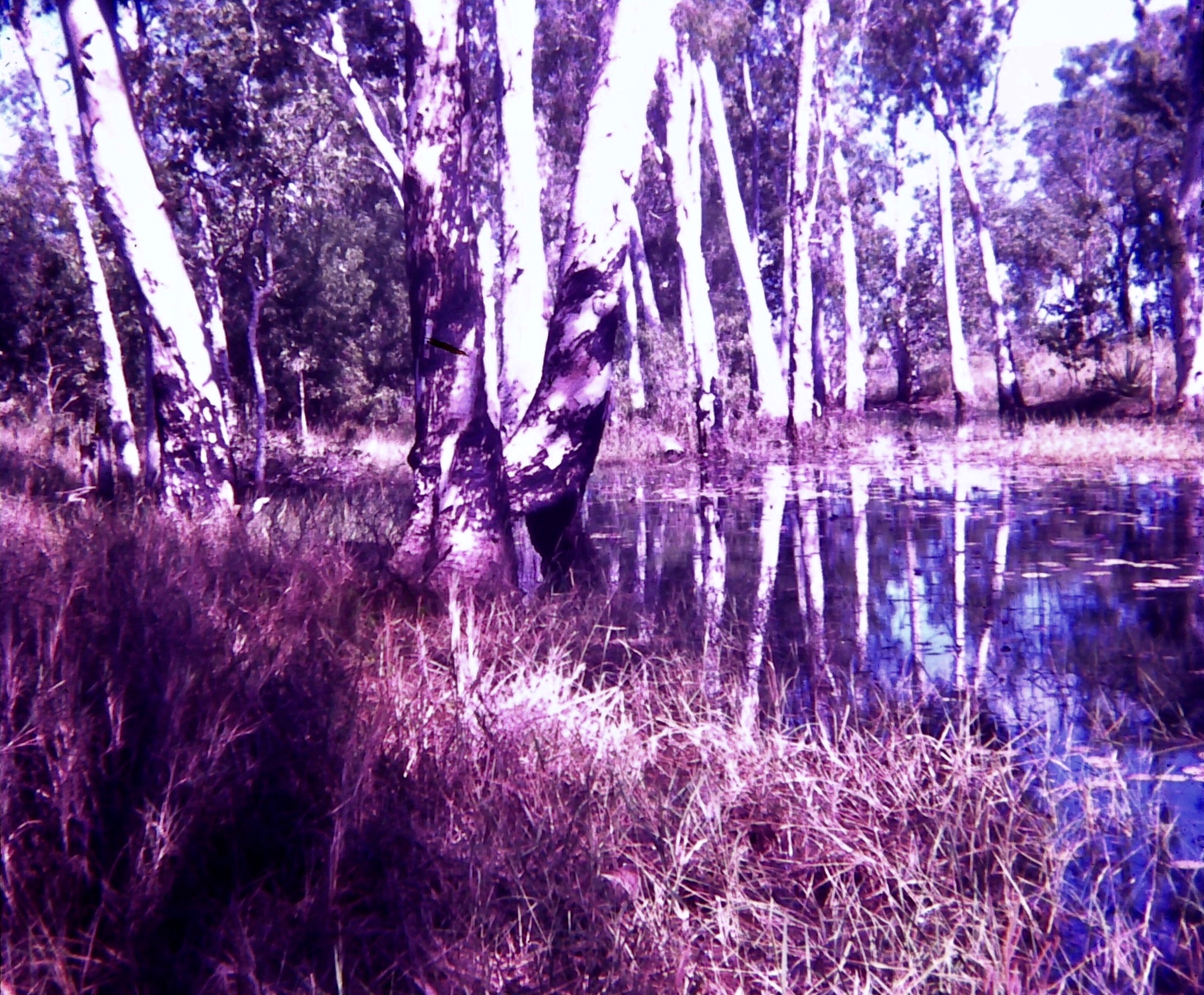
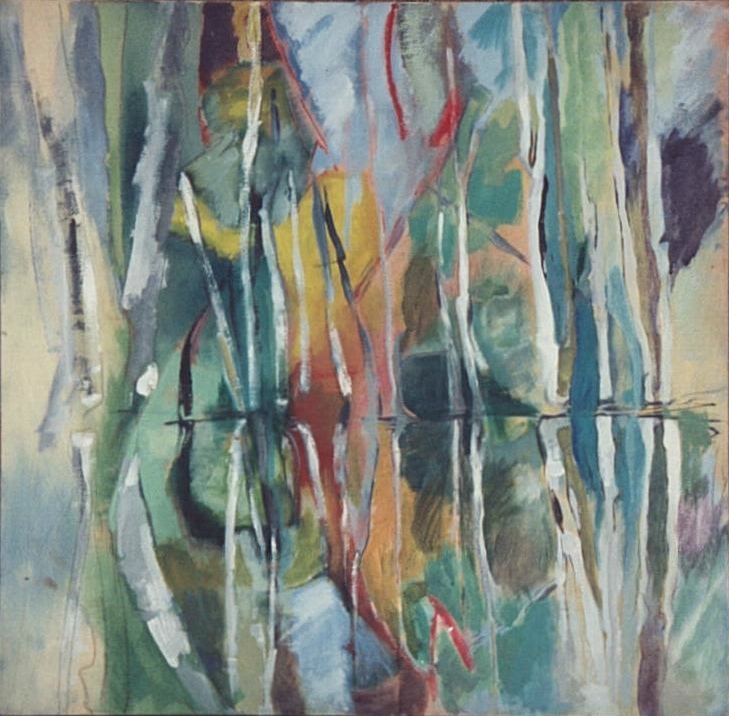
My artist mother, Pat Fox, spent time on Cape York in the 1970s, and she took a photo, now faded, of a well-known waterhole near Weipa.

fullsizeoutput_3d6d

Back home, she painted the scene, showing the reflection of saplings and trees in the still water. Comparing the two images shows how she heightened the impact through her choice of  colour and composition.

fullsizeoutput_39c5

It was a road trip through New South Wales, not Queensland, that taught me to appreciate how interesting it is to see landscape paintings and also visit the landscapes they represent. It was between Cowra and Bathurst, where the Mid-western Highway of New South Wales curves through rolling hills near Carcoar, and a river winds past the distinctive shapes of weeping willows and poplars.

Con was driving while I sat musing on the passing landscape, brown now at the end of a long summer. The land seemed familiar, but couldn’t be: I’d never been this way before.

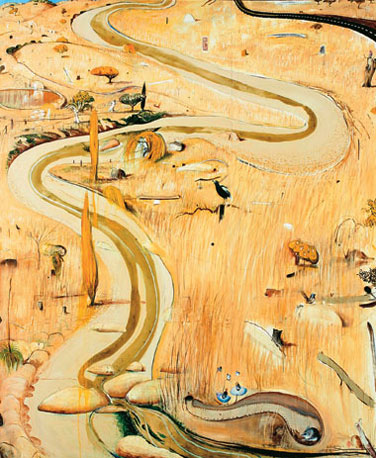
Then I realised. Brett Whiteley painted this country. We’ve got a print of it on the wall at home.

summer-at-carcoar-1977
Summer at Carcoar, Brett Whiteley

The painting is called “Summer at Carcoar”. As well as characteristic lush curves of road and river, there are magpies and a wren, a burrowing mouse, and a fox with head and tail above the tall, gold-brown grass. It’s a beautiful picture, the pride of the Newcastle Art Gallery. I’ve since found out that Brett Whiteley often painted the country round Bathurst.

That day, for the first time, it occurred to me that there is delight in seeing the actual country painted by artists, and that it doesn’t need to be Monet’s Garden at Giverny, or Van Gogh’s Arles.

The same pleasures are to be found here at home.

Miles to Go

The Grand View Hotel at Cleveland is a fine pub, Queensland’s oldest licensed hotel. We ran trivia nights, Con and I, at the Grand View.

One evening before the quiz began we came across several blokes in the bar, wearing high visibility gear, enjoying an after-work drink. Finding that we were there to run the trivia, one of them said to me, “So you think you know a lot, do you?”

“I know everything,” I replied. (It’s true. If you’re the one who makes up the questions, you do know all the answers.)

“Oh, really?” he scoffed. “What’s my favourite colour, then?”

“Maroon”, I answered, and he had to concede.

Maroon is the favourite colour for most blokes you’ll meet after work in a Queensland pub.

Con likes maroon, too. Our present car is maroon, and so were the two that went before it. We have covered many kilometres in red cars.

forester wattleWe composed our pub trivia questions ourselves, and they often had a local slant.

“Thenus orientalis is a famous product of Moreton Bay and surrounding waters. What is it?”

Moreton Bay bug. Easy when you know.

“In Longreach the streets are named after trees, and in Barcaldine they’re named after birds. True or false?”

False – it’s the other way around. As the town that pioneered artesian water supply, Barcaldine was proud to call itself the Garden City of the West, and named its streets after trees.

A classic Longreach joke is that a new police officer in town arrested a drunk in Cassowary Street. He couldn’t spell it, so he took him over to Duck Street to charge him.

I enjoyed thinking up questions with a Queensland flavour. Queensland is my home: the Glasshouse Mountains, red dirt and mango sap, hot sand, soldier crabs and mangrove pencils; long, straight roads, rainbow lorikeets, wattle. Floods, droughts, and perfect spring days.

IMG_20180120_180203_resized_20180120_090804411Australians are great travellers. For all of us, journeys lie in the not-too-distant past.

Three branches of my family came here from Britain in the 1860s, when the new state of Queensland was recruiting migrants. They came to Queensland for opportunities denied them at home. And for the climate.

A fourth branch of my family emigrated from Germany in 1838. They were missionaries, come to minister to Aborigines in the Brisbane area.

They all made long sea voyages and they went on travelling once they got here. My great-great-grandfather, within days of arriving in the country, went by river to Ipswich and walked from there, up Cunningham’s Gap, to take up a position in Warwick.

His son, in turn, took his young family, by steamer and goods train, from Brisbane to Barcaldine, where he had been transferred as bank manager.

My father’s travelling began with family car trips in the 1920s and 1930s. A few years later, Dad was on a trip of another kind – up through Malaya as a Prisoner of War, travelling in railway rice wagons, to work on the Thai-Burma railway.

I was born on the Sunshine Coast, but Con and I were married in Stanthorpe, where we were both working in the local state school. Born in Innisfail, until his transfer to Stanthorpe he’d lived in Far North Queensland all his life. As my children themselves have done, I married someone whose hometown was far away. We’d be doing plenty of travelling.

Together we’ve lived in the Darling Downs and the Granite Belt, the Ipswich area, Gulf Country, Cairns region and Townsville. I’ve explored the state by road, rail and air. I’ve taken the Sunlander to Cairns, the Inlander to Mount Isa and the Spirit of the Outback on its twenty-four hour journey from Longreach to Brisbane. I’ve flown over Cape York in a small plane, I’ve done the Gulf circuit with Bush Pilots, bumping over rough station landing strips and dodging cattle to drop off mail and supplies, and I’ve twice been to Mount Isa with the Flying Doctor. It hasn’t always been easy, or pleasant; but it has been magnificent.

Many Australians have been to Paris, New York or Bali, but not nearly as many have been to Cooktown, Burketown or Ravenswood. As well as watching the sun set over Manhattan, sending a pink glow down its canyons of glass, I’ve seen soft evening light fall across the tidal flats of the Gulf of Carpentaria. I’ve flown across the winter darkness of northern Siberia, with the sun low in the southern sky all day; but I’ve also admired the dawn light shining through steam rising from a hot bore drain at Cunnamulla.

And still, I look at a map of Queensland and think about all the roads I haven’t yet been down, all the places I have yet to see. Quilpie, Birdsville, Coen, Baralaba, Lady Elliott Island – the whole state is out there to be explored.

I need to get a move on. I’ve got miles to go yet.

Blog at WordPress.com.

Up ↑