Floods

Floods.

I’ve written many stories about many parts of Queensland on this blog, and so many of them describe floods.

Maryborough, Ipswich, Rockhampton. https://roseobrienwriter.blog/2024/02/06/maryborough/

Townsville, Bundaberg, Ingham, Charleville. https://roseobrienwriter.blog/2021/07/24/road-trip-to-ingham/

The Brisbane, Bremer, Mary, Burdekin and Flinders Rivers. https://roseobrienwriter.blog/2020/12/12/syphoning-petrol/

The Gulf Country, the Horror Stretch and the Cassowary Coast. https://roseobrienwriter.blog/2018/11/08/horror-stretch/

These are places I know well, and I feel for the people who live and work there; especially in the north. People wading through the ruins of their flood-damaged homes; cane, banana and beef farmers coping with the ruination of their hard-won livelihoods.

I remember the cattle farmers of the Flinders River catchment who, during the 2019 floods waited helplessly for the waters to go down as helicopters brought back images of mobs of cattle, including precious breeding herds and cows with calves, dead of cold and hunger, crowded against fences and on small patches of higher ground. It is estimated that 500,000 head of stock died in that flood.

And now floods have happened again – are still happening – in tropical Queensland. The State premier, an Ingham native, holds a press conference describing the community’s sorry situation: highway cut both north and south, houses flooded, no electricity, a breakdown in the water supply, supermarkets empty, and two lives lost. Further north, in and around Cardwell, houses flooded that have never been flooded before.

The Herbert River catchment of 9000 square kilometres has its headwaters in the Great Dividing Range near Herberton, and it collects a lot of tropical rain before it makes its way down to the flat canefields around Ingham. The Cardwell Range is steep and high and close to the town, so the catchment there is not nearly as big. But what is going to happen, when almost two metres of rain falls in three days?

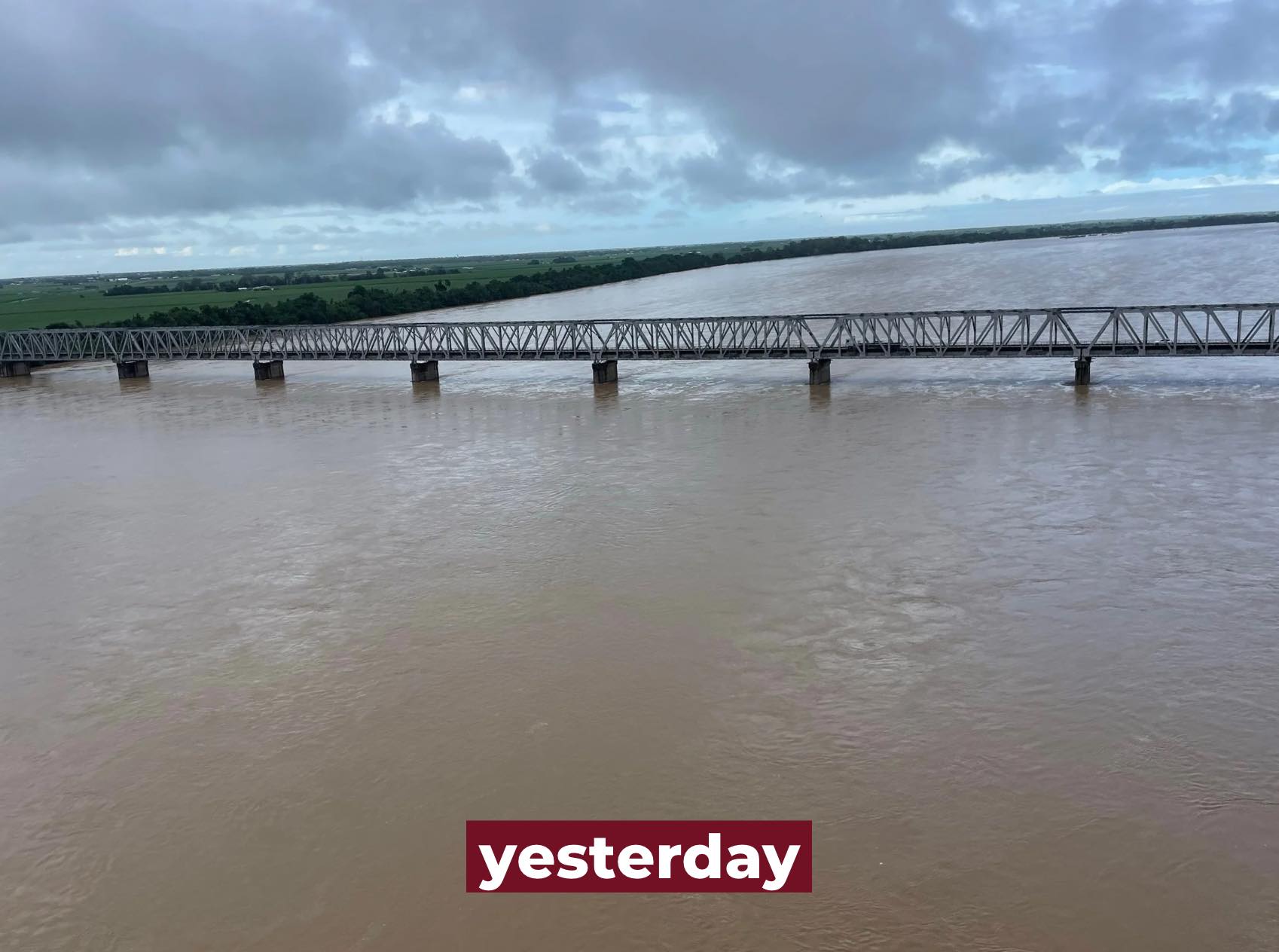
The Burdekin River catchment of over 130,000 square kilometres is the size of England and stretches from north of Charters Towers and Greenvale to south of Alpha. Charters Towers has been flooding all week, and that water is heading for Ayr and Home Hill on the coast.
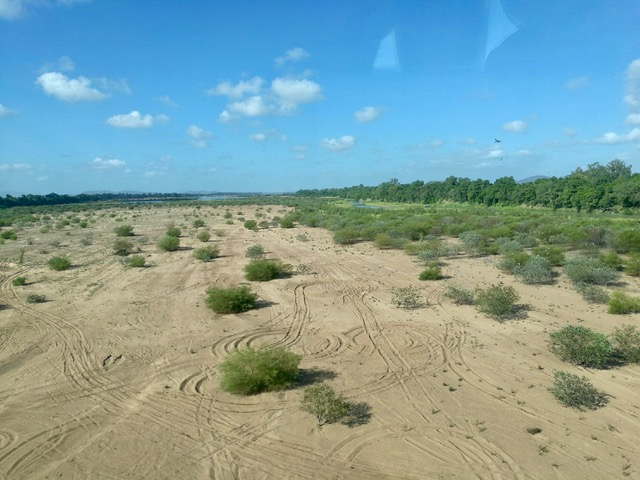
Burdekin River at Home Hill in the dry season, looking upstream from the Bridge
Burdekin River at Home Hill this week Dale Last, Member for Burdekin. Facebook

Sugarcane can be laid low by a flood, and recover, if the water doesn’t lie there too long. On the rich flood plains around Ingham, water has been lying for days, and still it rains.

An agriculturist, an expert in banana growing, told me that in the case of a cyclone, if a farmer lops the plants back they will survive and regrow. How would you go about that? It would take days, and a huge amount of work, and even with excellent modern forecasting, satellites and radar, cyclones are unpredictable. They can veer south or north or move back out to sea.

More heavy rain is forecast across North Queensland. The water will run to the coastal towns and farms and also to the vast plains of the inland, where rivers like the Flinders will break their banks and spread across the land, cutting the few sealed roads and the one railway line that runs east-west across the State.

In Queensland, rich in resources though it is – agriculture and mining in particular – we don’t have many people. The US state of Texas, iconic to Americans for its size, has an area of 697,000 square kilometres, compared to Queensland’s over 1,700,000 square kilometres. However, Texas has a population over five times the size of Queensland’s. That makes a huge difference when it comes to tax base and industry. It seems we don’t have the population, or the votes, to create better, more resilient transport infrastructure.

We also have a more extreme climate than Texas, especially when it comes to floods. Tornados are deadly, but they move quickly across the land. Rain depressions hang around.

Queensland has only one highway and one railway going along the coast, and because of shortage of population and extremes of climate, there are almost no entirely sealed roads west of the ranges linking north and south.

During this month’s major flood event in North Queensland, the one main railway line was soon cut in several places. https://www.railexpress.com.au/rail-bridges-submerged-as-floods-batter-north-queensland/

When the Bruce Highway bridge at Ollera Creek was washed away over the weekend, north of Townsville, Far North Queensland was cut off from the world except by air and sea.
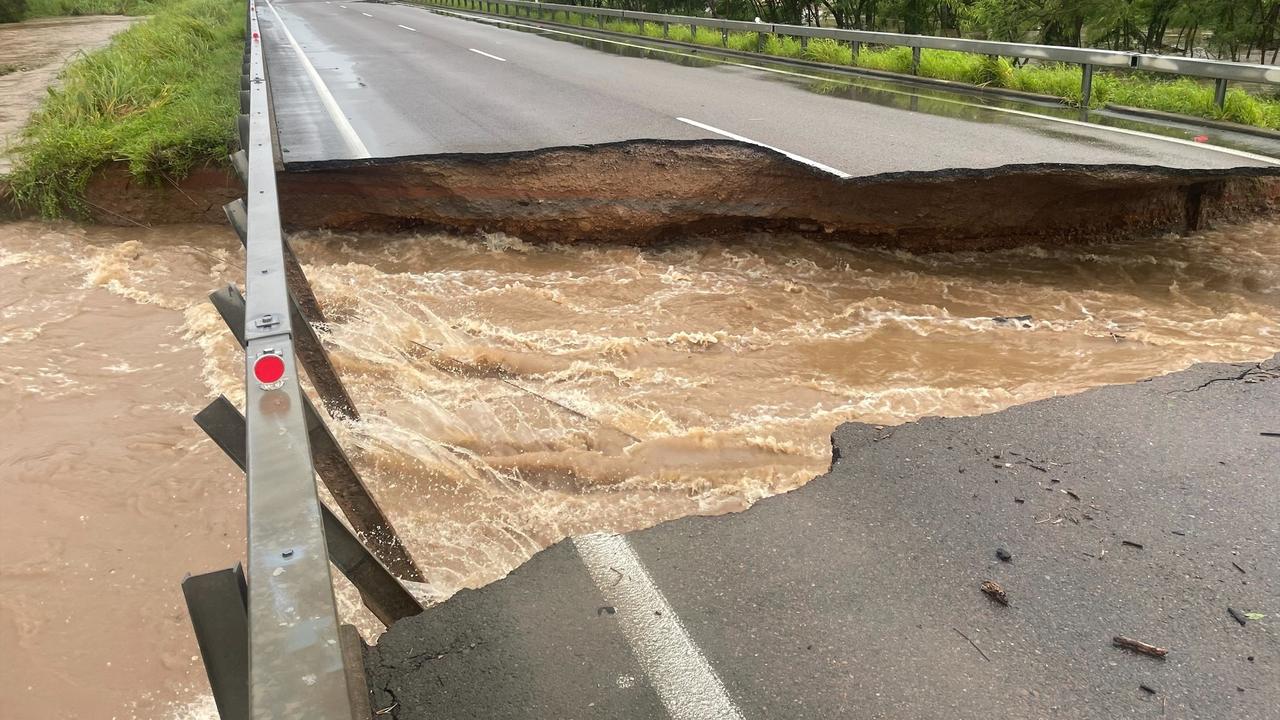
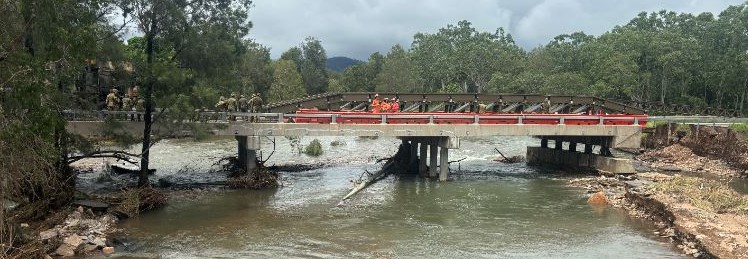
Ellora Creek bridge washed away Townsville Bulletin
Ellora Creek bridge , as repaired by the army for emergency vehicles mypolice.qld.gov.au

Trucks carrying supplies to the Far North and people trying to return home faced an extra 1200 kilometres’ journey, travelling by western Queensland sealed roads, to reach Cairns. And these roads are under threat of closure at any time. Many are stranded. https://qldtraffic.qld.gov.au/
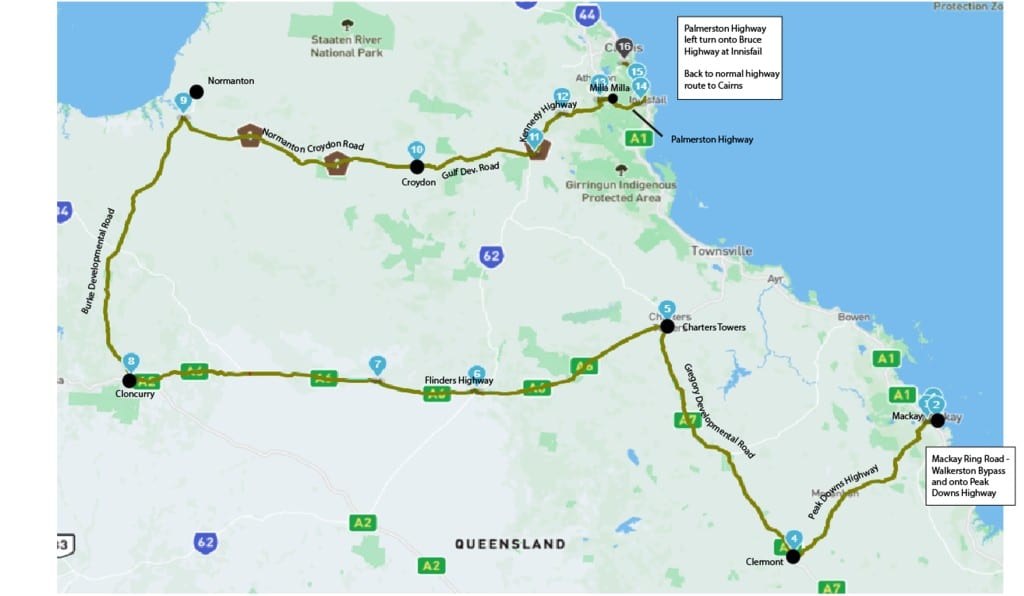
Alternative route to flooded Far North Queensland Transport and Main Roads Department, bigrigs.com.au
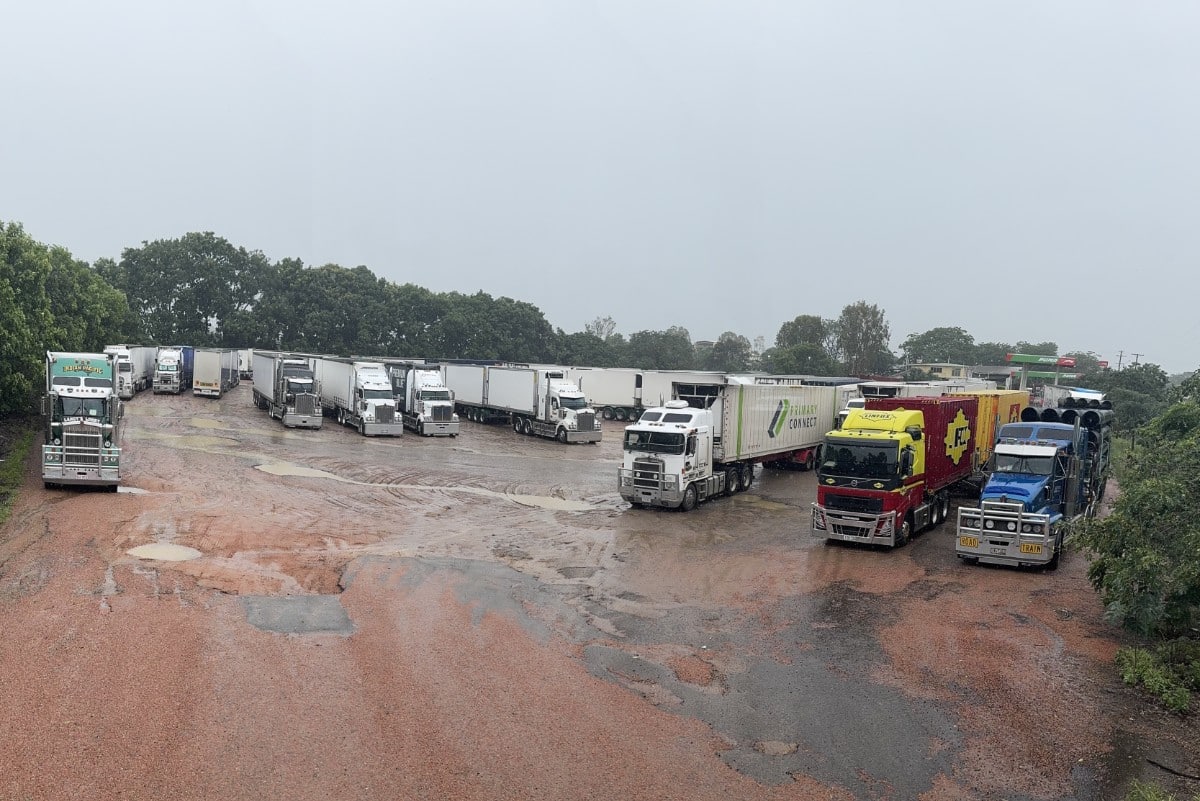
Stranded truckies parked up at the Puma Roadhouse in Charters (Towers) Image: Deano Hutch bigrigs.com.au

If the continuing flood rain results in damage to the railway and highway linking Townsville and Mount Isa, as happens all too often, transport and supply of essential goods may be affected for weeks.

For all sorts of reasons, including strategic concerns, the continuing and increasing vulnerability of Queensland’s transport routes is a major threat to our way of life and security.

People who live and work in the north and west of the State feel bitter that regions that produce so much of Queensland’s wealth continue to be so vulnerable to the weather. And as climate change deepens, it will only get worse.

It’s a worry.

In the southern states and Canberra, people have always regarded Queensland with a kind of affection as a weird, distant place, a place of extreme weather, crocodiles, bogans and dodgy politicians. Greater Brisbane makes up half the population of the State, and a lot of Brisbane people seem to be largely ignorant of regional areas. To them, north means Noosa, and west means Toowoomba.

So where is the will to sink vast sums into flood-proofing North Queensland for the future? Bipartisanship in politics would be a start.
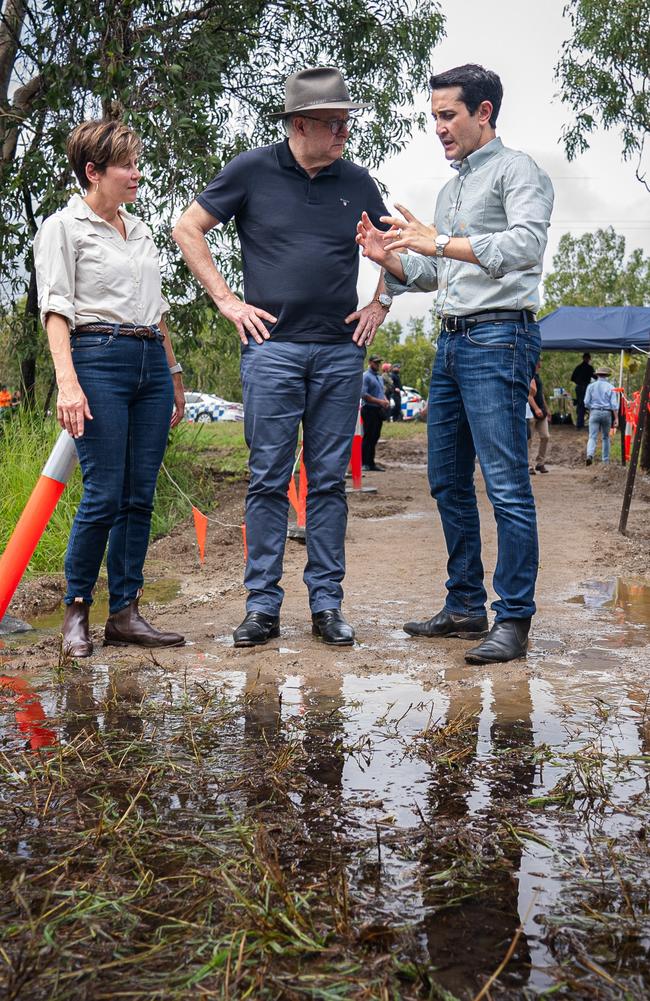
It’s a start. Federal Labor Senator Jenny MacAllister, Labor Prime Minister Anthony Albanese, and LNP Premier of Queensland David Crisafulli, taling about recovery in FNQ theaustralian.com.au

I’m tired of writing about floods.

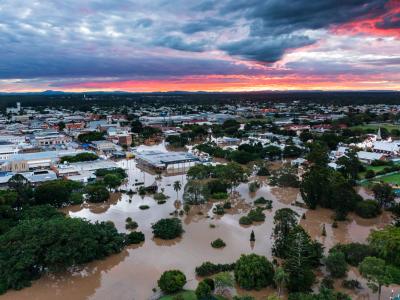
Main picture: Maryborough flooded at Sunset. 2022 Qld Reconstruction Authority

Thursday Island

Beyond the reef
Where the sea is dark and cold,
My love has gone,
And our dreams grow old.
There’ll be no tears,
There’ll be no regretting.
Will she remember me,
Will she forget?
I’ll send a thousand flow’rs
When the trade winds blow….


My mother Pat got her motorbike licence on Thursday Island. The bike was a 50cc Honda step-through she’d bought for getting around the island. Thursday Island is only 3.5 square kilometres in area but is sometimes very hot and humid – not comfortable for walking.

Nervous about the test and delighted that she’d passed it, Mum got back on the bike, started it while it was in gear, lurched forward into a ditch, broke her wrist, and never rode it again. That story became part of our family mythology.

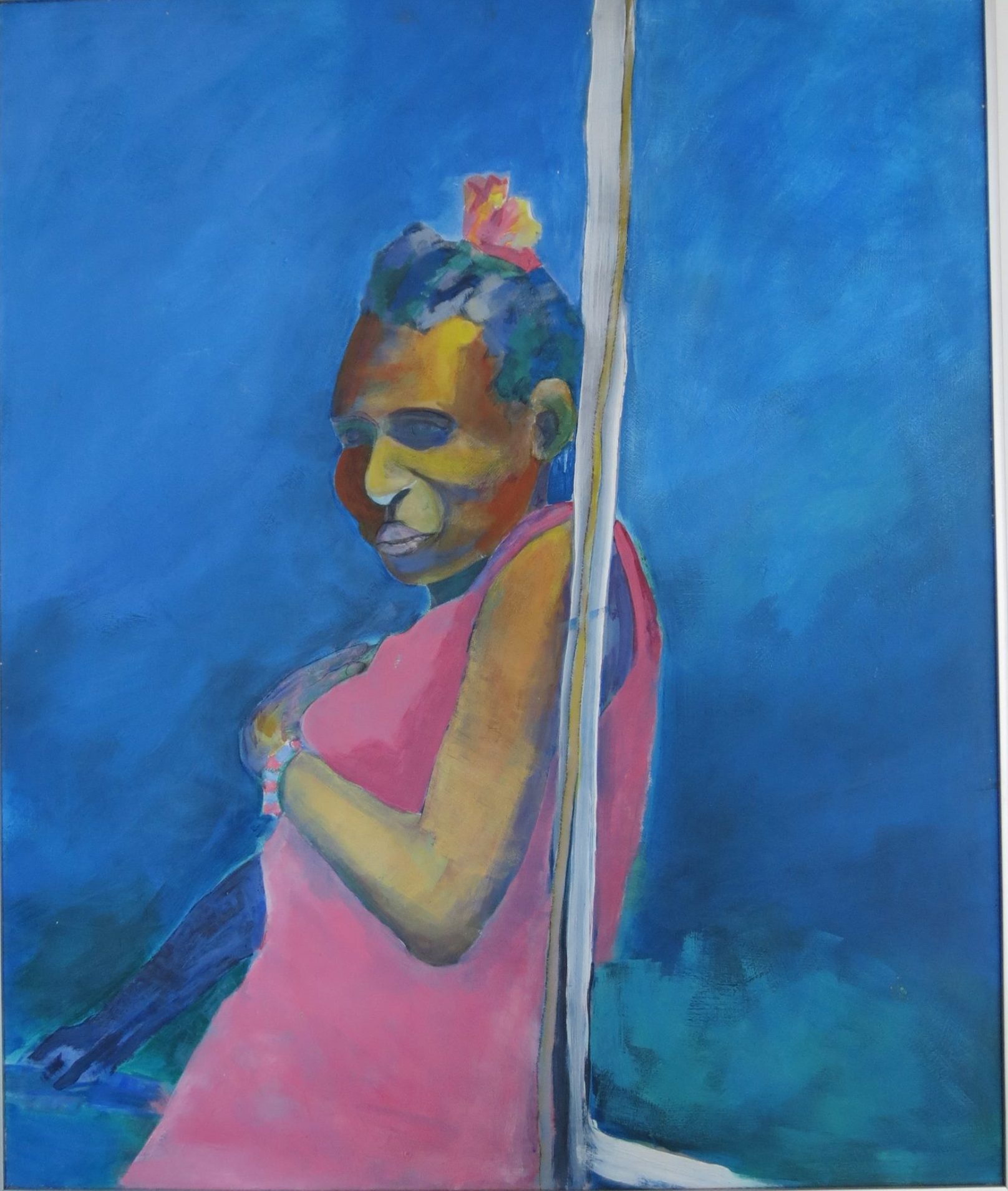
Mum was an artist, and wherever she and Dad went, on T.I. and on the other islands of the Torres Strait, she revelled in the colours of sea and sky and island life.

AEE356AE-A167-4B31-9076-CE83A44BDC6E
“Island Girl”, Pat Fox

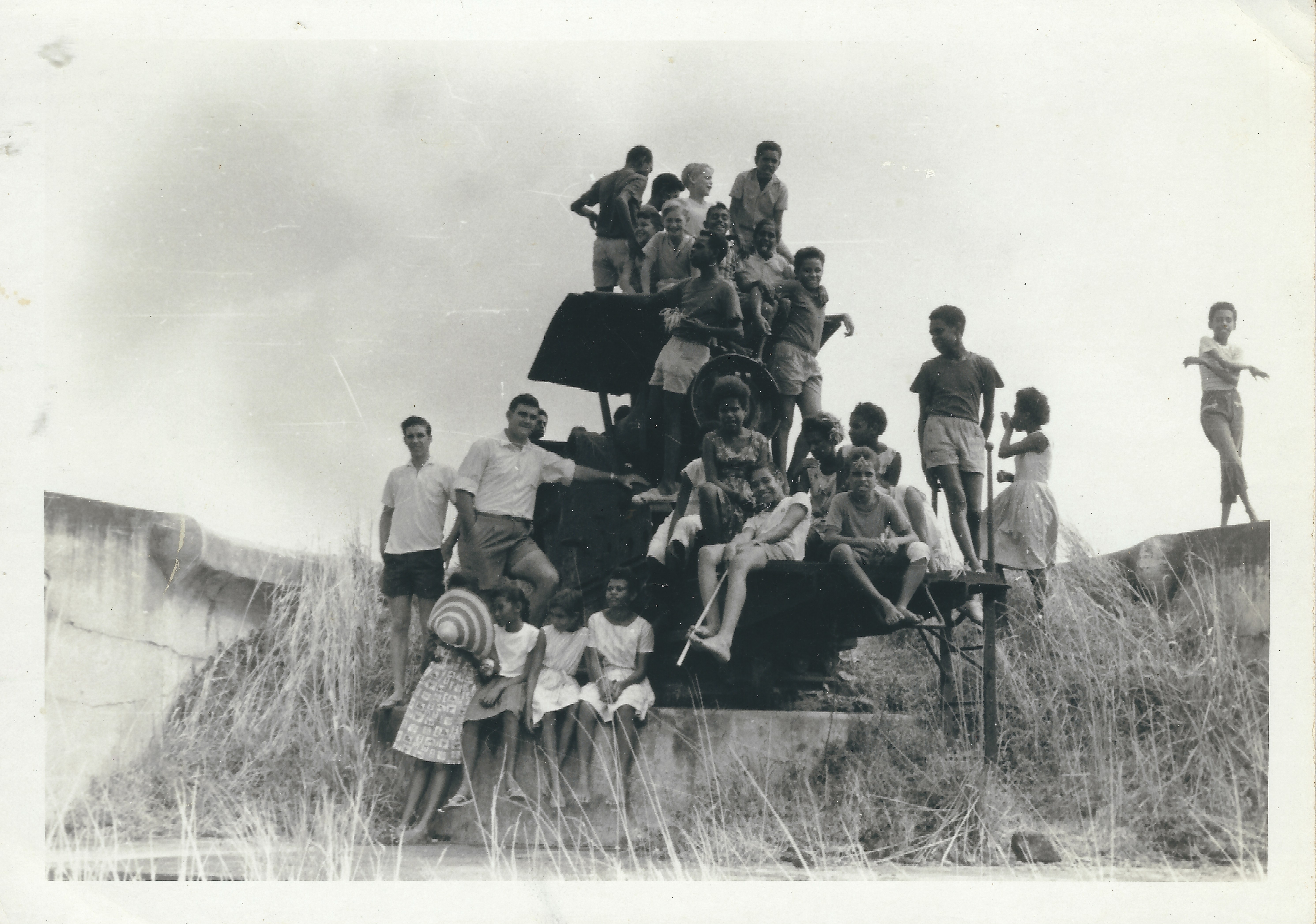
My husband Con had been a teacher on Thursday Island, too, and he’s never grown tired of talking about the place: the amazing blue of the sea; turtle feasts; sharks under the wharf; the thrilling harmony of the singing in church. It seems music is life in the Torres Strait. Con talks about children who sing like angels and love to laugh, about the expressive Torres Strait Creole, or pidgin English as it was known; and he’s described the island itself to me.

EE4DAB12-97A7-487D-BC44-0272E76D40C6_1_100_o
Con with his class at old fortifications on Green Hill, Thursday Island. 1964

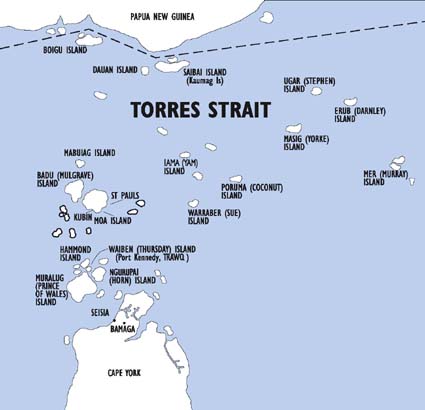
Thursday Island (Waiben to the locals, or “place of no water”) is the administrative centre for the Torres Strait Islands. Many of them are idyllic coral islands, with lush greenery, coconut palms, golden beaches and reefs; but T.I. is like a dry, rocky extension of the mainland. All the same, because of its lack of reefs Thursday Island became the port and main town for the Strait.

The Torres Strait links the Arafura Sea and the Coral Sea; the Indian Ocean and the Pacific; and its islands are Queensland’s most northerly communities – some within eyesight of Papua New Guinea.

TI map
Torres Strait Islands Torres Strait Regional Authority

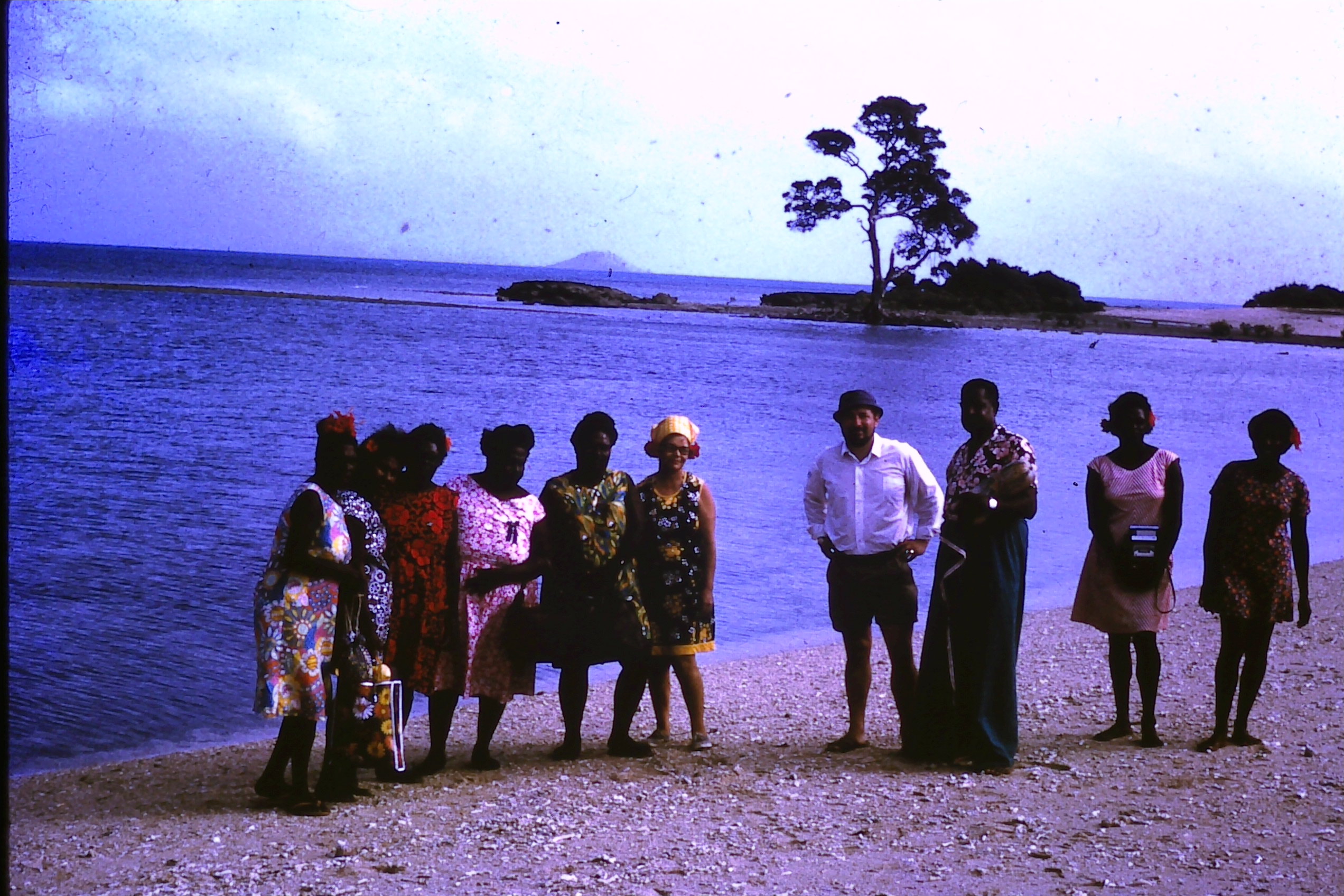
Torres Strait people mix local Melanesian culture with Malay, Japanese, Papua New Guinea, Chinese, Aboriginal and European influences. Visitors come from far away: scientists, media personalities, adventurous travellers, celebrities looking for something unique.

My parents lived on Thursday Island for three years in the mid-1970s, and Mum loved it, in spite of the isolation, cyclones and hot, wet summers. She wrote about it to her god-daughter Nadine, in Sydney – a world away in culture and lifestyle.

“I’m writing this early in the morning in bed. I can’t see much point in getting up, as it is teeming with rain – just pouring straight down. It’s the monsoon, and our back yard is one huge expanse of water. Everything is green outside, and many shades of grey inside, with a fine covering of mildew all over the walls, our shoes etc. Our clothes smell like mushrooms.

“From April to December there is almost no rain; then the south-easterly Trade Winds stop, the wind moves to the north west and the monsoon season begins. For nine months it is dry and brown and dusty, but when the Wet starts, everything starts to grow and the whole place becomes wonderfully green.

CB24FDD5-619B-4FBD-90D9-5BB5E14F9584
My mother Pat Fox (in yellow headscarf) with a group of Torres Strait locals, 1970s

“We’ve just come back from a fortnight at St Paul’s Community on Moa Island, about thirty miles north of here. Where we stayed, the ceiling is made of beautifully plaited bamboo strips with huge unsawn logs across it and holding up the walls. There are full-length louvre windows, and mats plaited from coconut palm leaves covering the floor. Coloured glass floats in rope covers hang from the ceiling beams, and draped on the walls are old fishing nets with brightly coloured shells hanging in them.

“There are coconut palms everywhere. Every now and then there is a great “thump” and down comes a coconut. I don’t understand how people aren’t killed by them. The trees are so high and the nuts so big!”

TI crooke_ray-thursdayislands1
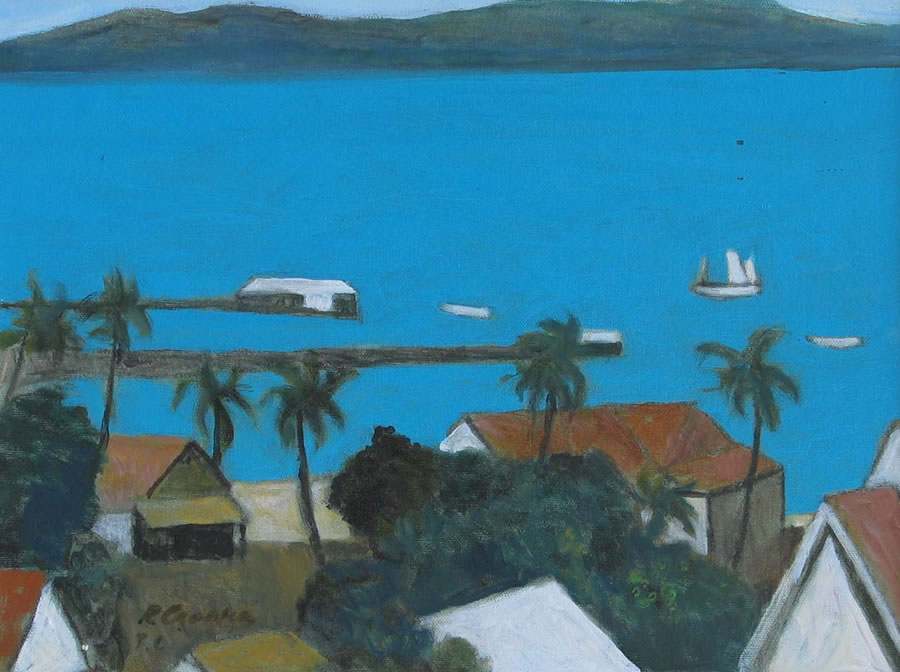
“Thursday Island Harbour”, Ray Crooke

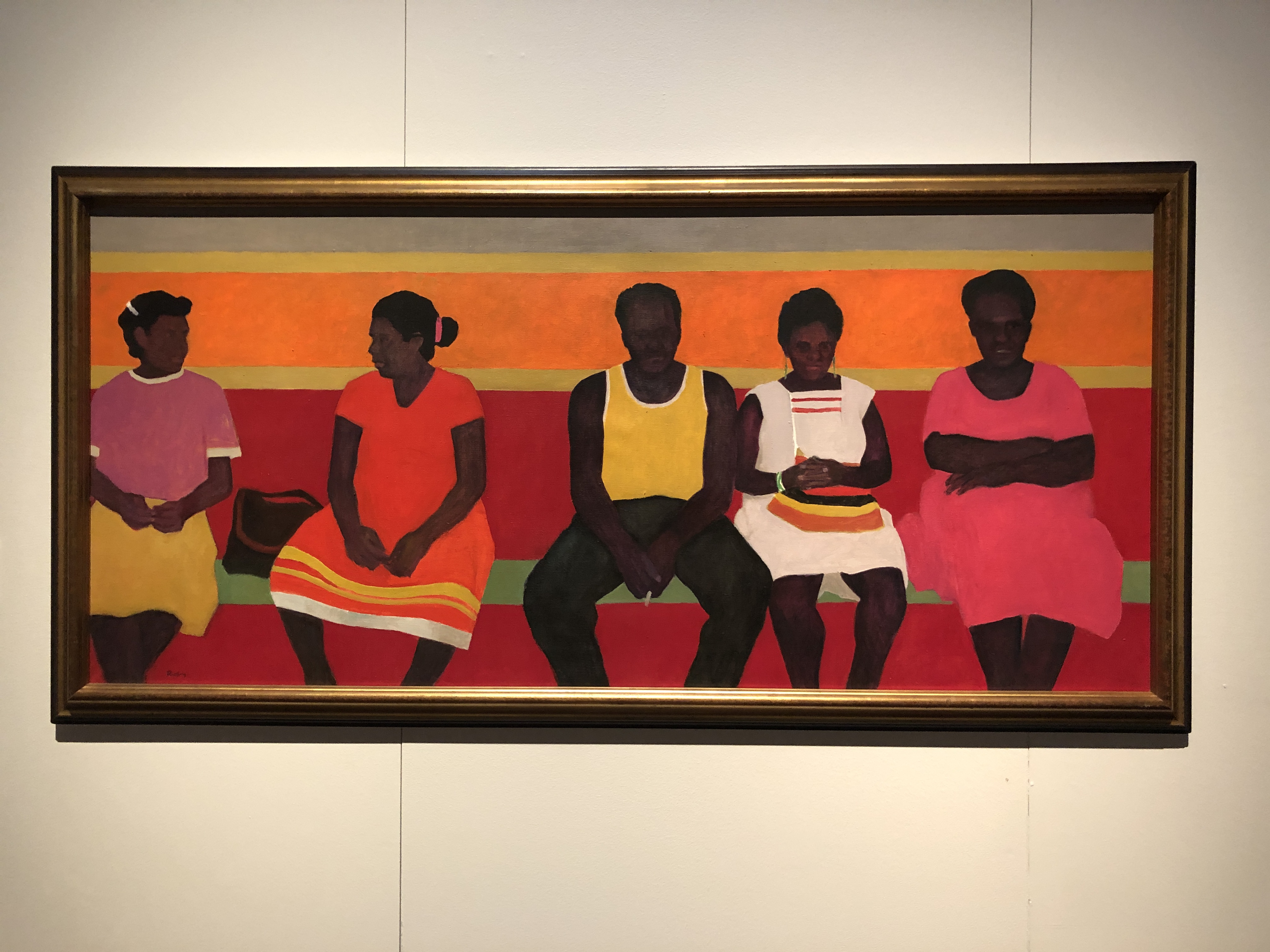
Established artists have painted the beauty and colour of the Torres Strait Islands.

46645582-A8C0-4FED-A20C-30BB493DCAF5
“Waiting, Thursday Island”, John Rigby

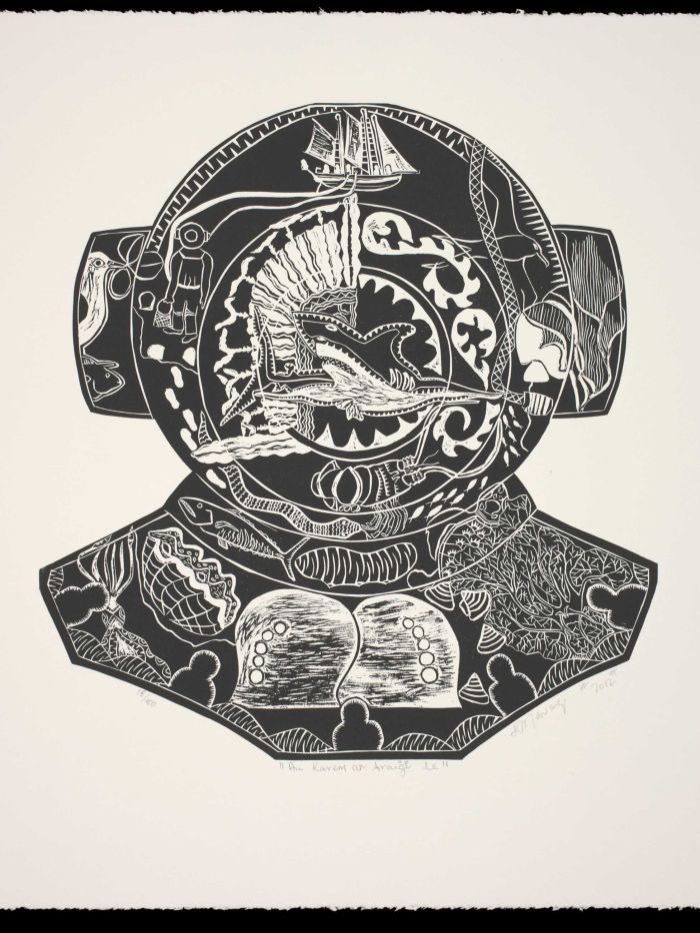
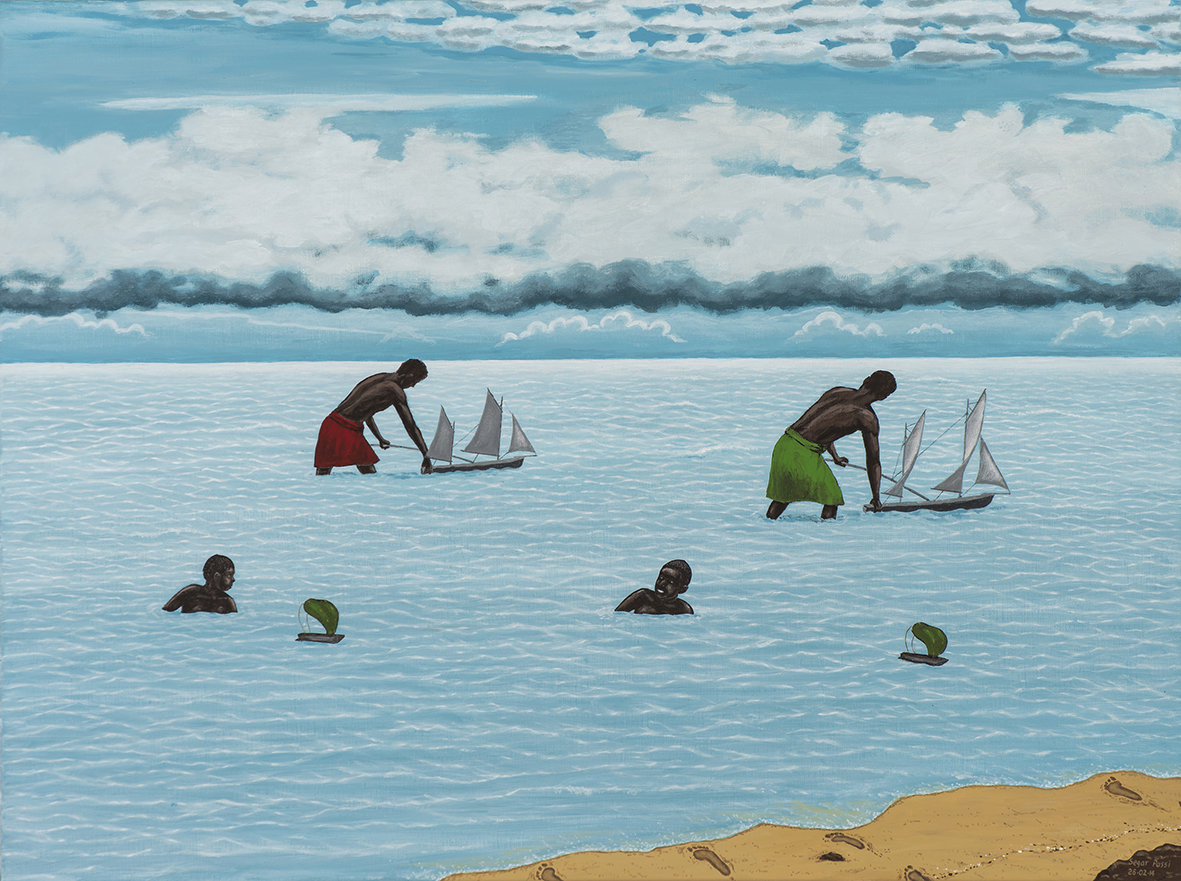
There is also a great blossoming of local artists, working in paints, sculpture and distinctive black and white lino prints, depicting the history and culture, pearl diving, dugongs, turtles, and above all the life of the sea, the weather, and the islands.

TI art helmet
“Helmet: Au Karem ra Araigi le (Deep Sea Divers)”, lino print, Ellarose Savage. Torres Strait Islands Regional Council

TI passi
“Model Canoe Racing”, by Segar Passi, an artist who uses paintings to depict different cloud formations – predictors of weather. Cairns Art Gallery

Men from Torres Strait are famed as railway fettlers. They helped build the railways throughout Australia. Their descendants live all over the country, and many Islanders still move to the mainland for education and work; but a longing for the life of turtles and palm trees, the sea and fishing, of family feasts and singing and traditional dancing is always with them, it seems. Neil Murray wrote the iconic “My Island Home” for the Warrumpi Band, about living in Central Australia and longing for the islands of the Northern Territory; but in the version sung by Christine Anu it’s a city girl longing for the Torres Strait:

I close my eyes and I’m standing
In a boat on the sea again
And I’m holding that long
Turtle spear
And I feel I’m close now
To where it must be

My island home is a-waitin’ for me

Con still likes to sing the sentimental favourites, such as “Old T.I.”:

Old TI, my beautiful home,
That’s the place where I was born;
Where the moon and stars that shine
Make me longing for home.
Old TI, my beautiful home.
Take me across the sea,
Over the deep blue sea,
Darling, won’t you take me,
Back to my home TI.

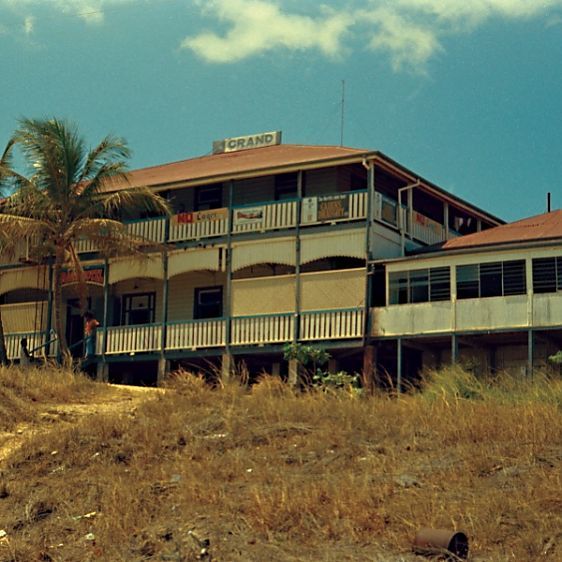
He tells me that there were four pubs on Thursday Island when he was there – the Royal, the Grand, the Federal, and the Torres Straits. He swears that at any time, day or night, there would be someone in one of those pubs singing “Beyond the Reef”.

Someday I know

She’ll come back again to me.

Till then my heart will be

Beyond the reef…

The Grand Hotel, Thursday Island. Voice to be Heard, A. 1974
The Grand Hotel (since burned down and rebuilt), Thursday Island National Film and Sound Archive

When the world has gone back to as close to normal as it ever will after COVID -19, and we can travel again, I want to go to Thursday Island. To get there, you can drive up to the tip of Cape York in a 4WD, then catch a ferry. Lots of hard, dry cattle country, crocodiles-infested rivers and corrugated roads, but exciting and interesting.

Perhaps fly from Cairns, over the beautiful Great Barrier Reef, land at nearby Horn Island and take a ferry. Boats are everything in the Strait.

I think it would be more romantic to take the MV “Trinity Bay”, the passenger carrying cargo boat sailing every week from Cairns, up through the reef and the islands.

Back to the place my family has never forgotten.

TI Peddell's ferry town
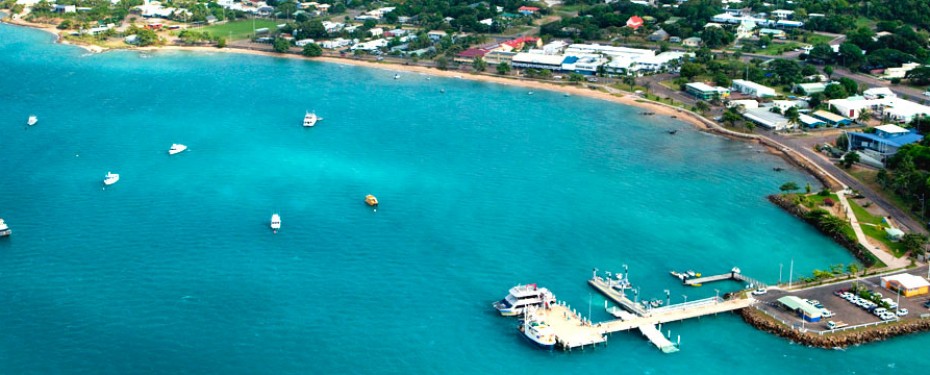
Thursday Island Peddells Ferries

Golden Gumboot

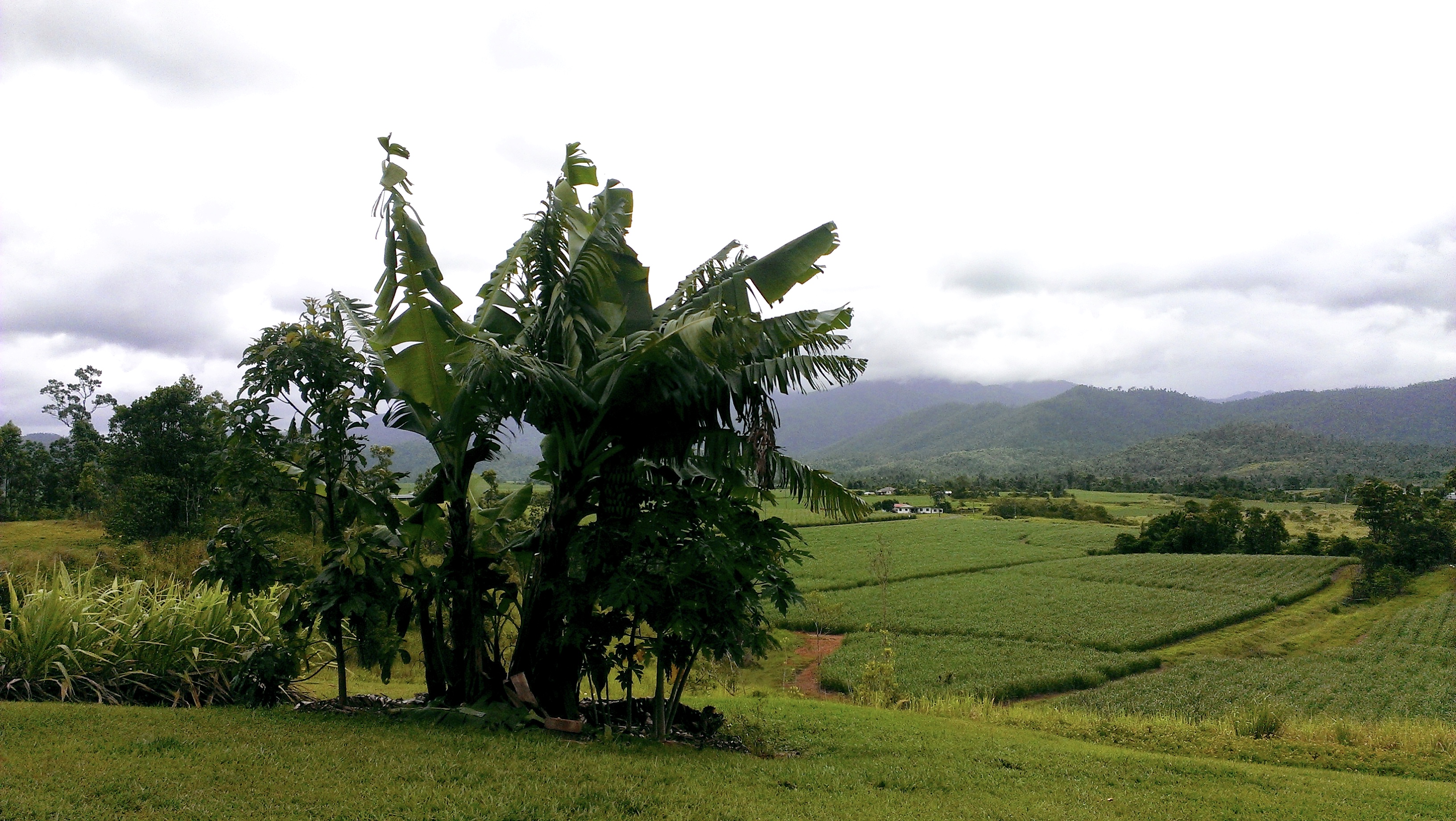
It’s December in the Wet Tropics of Queensland, and the chimneys of Tully Sugar Mill are quiet. Crushing has finished for the year. Behind the town, the rainforests of Mount Tyson are cloaked in rain.

06FF0145-4C62-4F82-A470-A090615A3B76_1_201_a
Wet Tropics

This is Golden Gumboot country. The Golden Gumboot is an unofficial, hotly contested yearly competition for the highest rainfall, between the Far North Queensland towns of Tully and Babinda.

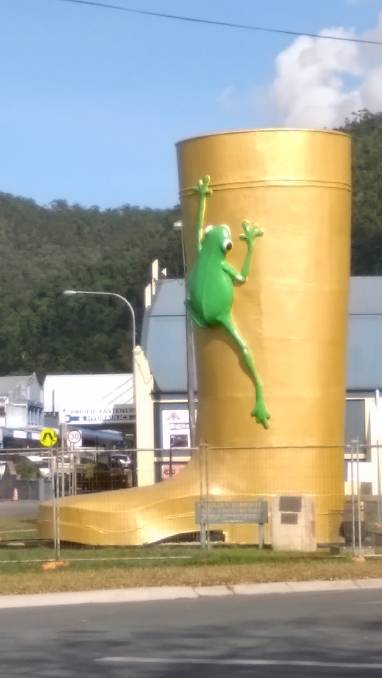
Tully, 140 kilometres south of Cairns, has at the start of its main street a concrete gumboot 7.9 metres high with a frog crawling up it. Having survived two fierce cyclones, the boot was recently refurbished by means of a state government grant and given a spectacular coat of gold paint. There is a staircase to the top, and a viewing platform. 7.9 metres is the amount of rain that fell here in 1950: the highest annual rainfall ever recorded in a populated area of Australia. Tully’s average annual rainfall, according to the Bureau of Meteorology, is 4 metres.

golden gumboot new
Tully’s Golden Gumboot with renewed gold

Tully has a Golden Gumboot Festival each year whatever the totals are; but in recent decades Babinda, 80 kilometres further north, has had the higher rainfall, averaging 4.28 metres annually, compared to Tully’s 4.09 metres. It’s Babinda that has the Golden Gumboot bragging rights.

To give an idea of what these numbers signify, Brisbane has an average rainfall of just over one metre a year.

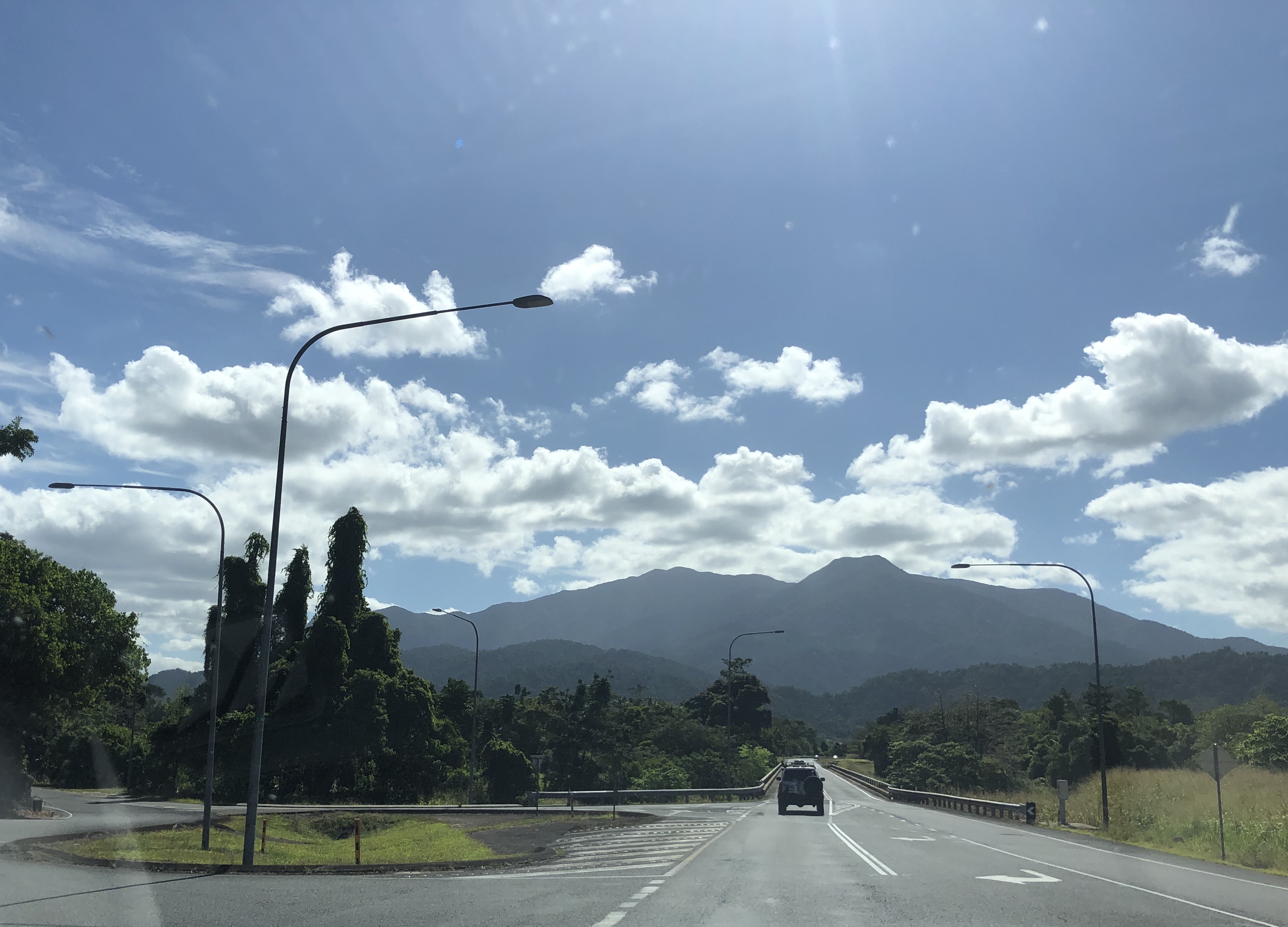
Babinda nestles close to the rainforest-covered slopes of Mount Bartle Frere, Queensland’s highest mountain. If you can see the top of Mount Bartle Frere, so locals say, it’s going to rain. If you can’t, it is raining.

FA23E2EE-F506-45C2-B4E3-089F01CB3ED6_1_201_a
Towards Mount Bartle Frere, Queensland’s highest

People in these northern towns and farms face a challenging climate, economic threats and agricultural tribulations. Bananas and papaws are major industries around here, but the focus of Tully’s economy is its sugar mill. Chinese-owned, it is the economic heart of this working town. Tully Mill crushes the second highest tonnage of any in the country.

Banana crops, papaw trees and sugar cane are vulnerable to disease, and all are at the mercy of the market – and the weather. Because the rainfall in this region is so reliable, farmers don’t irrigate.

The locals are down-to-earth and practical. They drive twin-cab utes, often with a pig dog cage on the back, and there are boats parked in many back yards. Men dress in boots, work shorts, polo shirts and hi-vis. Women favour denim shorts, black singlet tops and rubber thongs.

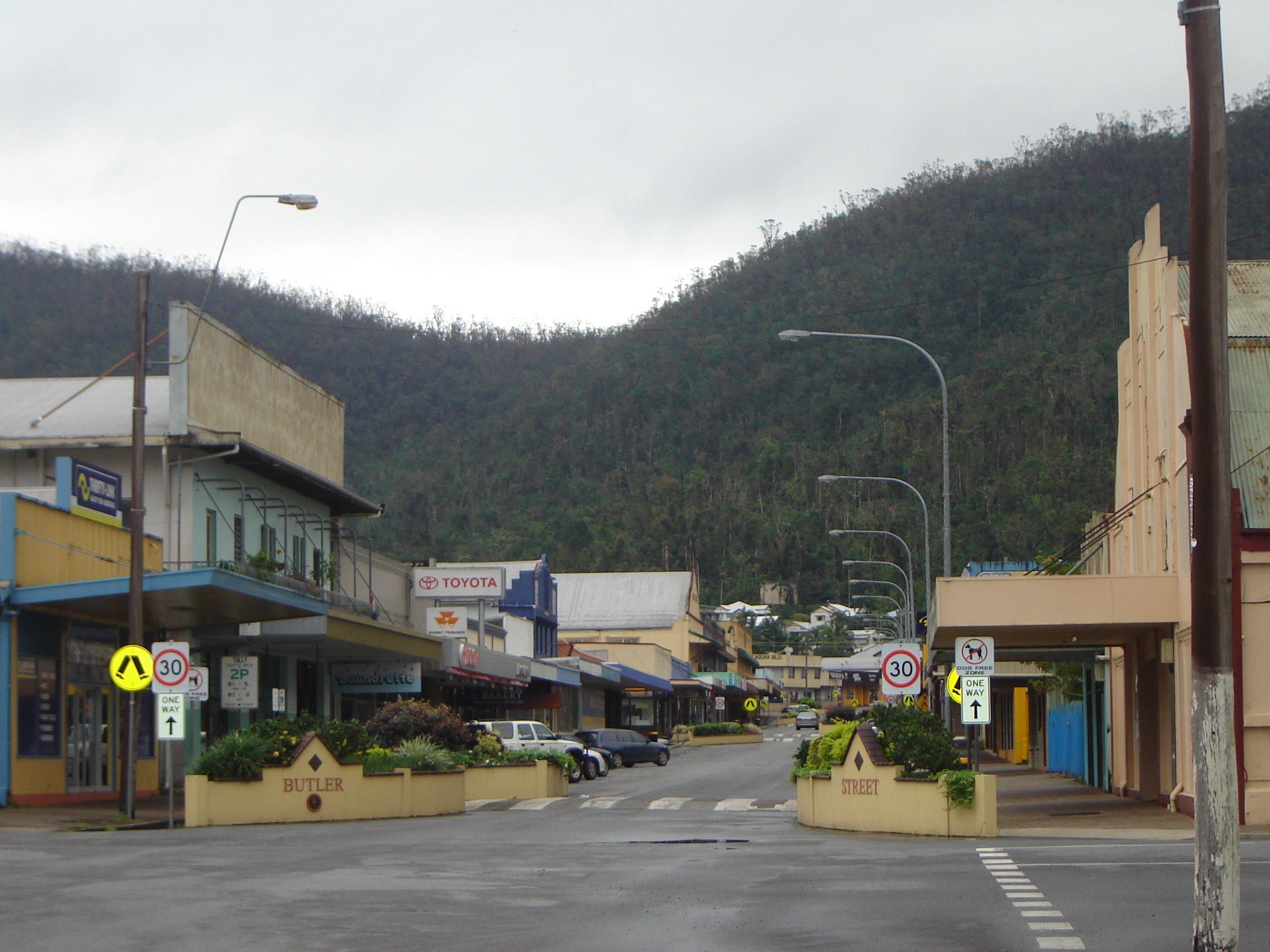
The locals relish an earthy form of humour. For instance, a visitor to Tully might talk about driving up the main street, Butler Street; but to a local, it’s “going up the Butt.”

golden gumboot butler st
Up Butler Street, Tully, towards Mount Tyson

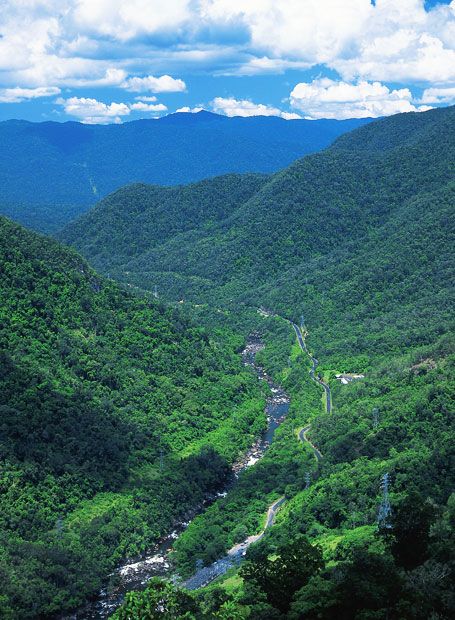
Both Babinda and Tully have spectacular tourist draw cards nearby. The famous Tully Gorge, where white-water rafting tours ride the outpour of water from the Kareeya hydro-electricity plant, runs right up against the ranges of the Atherton Tableland and the three hundred metre drop of Tully Falls. The falls lie directly below Tully Falls Lookout on the map, but the distance between the two by road is over two hundred kilometres.

golden gumboot tully gorgr
Tully Gorge seen from Tully Falls Lookout, 200km away by road

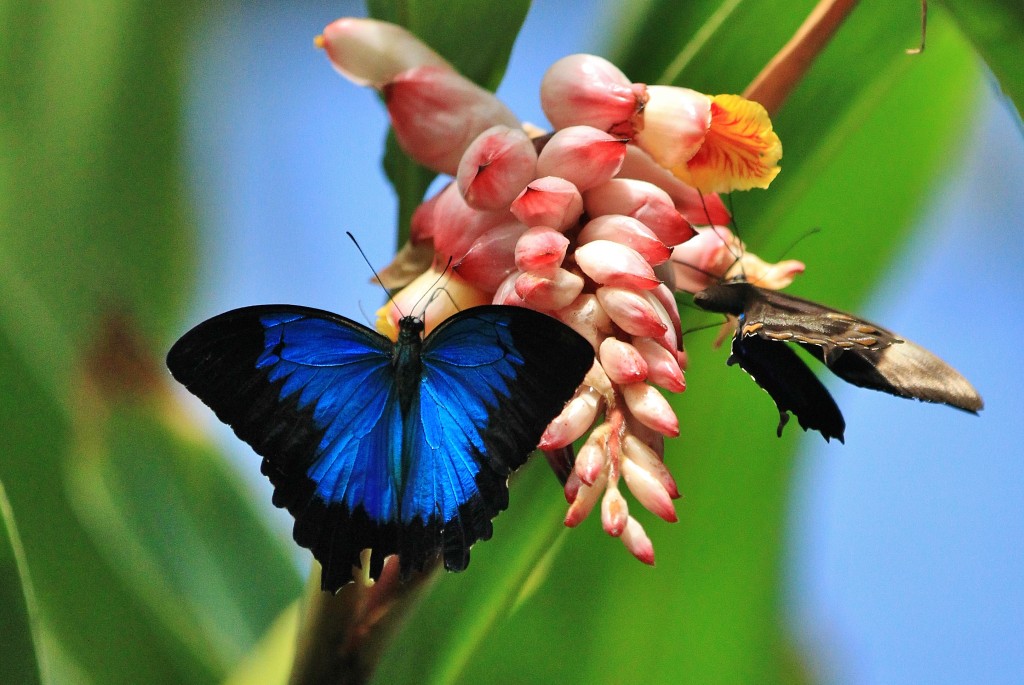
Electric-blue Ulysses butterflies flit through the forests along the gorge.

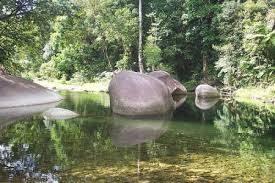
Babinda has The Boulders, a famous swimming hole and granite boulder-strewn creek of matchless beauty. We called in there for a swim a few years ago, floating in that clear pool in the rain as if in a cool, green heaven.

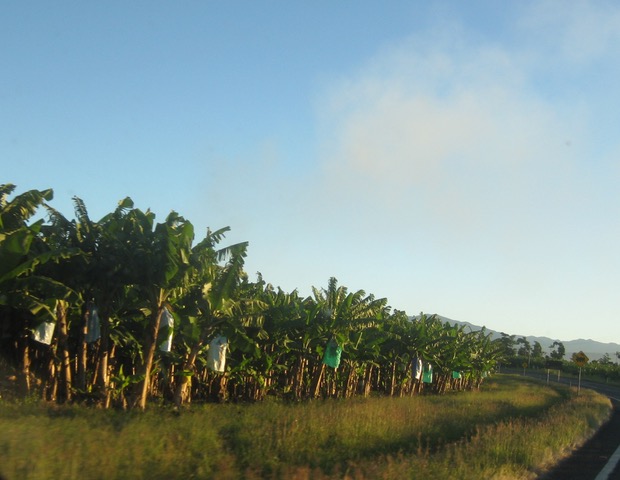
“We used to come to The Boulders for picnics,” Con told me, kicking against the gentle flow of the water. Con grew up in Innisfail, which lies between Tully and Babinda, looking out towards Mount Bartle Frere. Innisfail, famous for its papaws, averages a mere 3.4 metres of rainfall annually.

golden gumboot bananas
Innisfail banana farm

“Downstream from the main swimming hole there’s a place we called the Chute, which was like a fast water slide. It was great. And the Devil’s Pool – you’d have to be crazy to jump in there, but people did.”

This is a dangerous place for people who venture too close to where the creek is sucked down among huge granite boulders. Adventurous young men have died here.

“When I played for Innisfail Brothers League team and we had a game in Babinda, we’d come to The Boulders afterwards for a swim. We played at the Babinda showgrounds, and there was no such luxury as showers there.”

I first visited The Boulders with my family during a road trip from the south. My dad climbed up on a large boulder and swung out on a rope swing before performing a cartwheeling belly flop into the creek. He swam ashore with his chest scarlet from hitting the water. We were laughing; he didn’t see the funny side.

golden gumboot boulders
The Boulders, Babinda

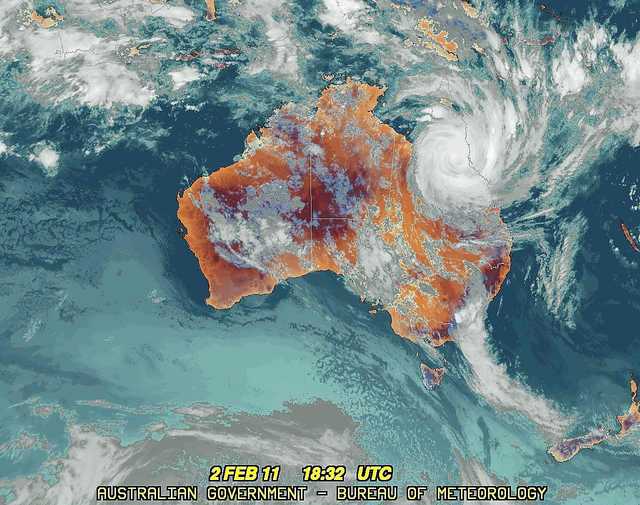
In 2011, Cyclone Yasi brought disaster to a thousand kilometres of  Queensland coast, its eye crossing the coast at Mission Beach, the closest coastal town to Tully.

golden gumboot yasi bom
Cyclone Yasi crossing the coast

Yasi’s devastation still shows in an occasional roofless building and in the thinned rainforest on the hillsides. Mission Beach people were isolated for days. A couple of years after Yasi I spoke to a young Frenchwoman living there. I asked her how she had fared.

“During the cyclone, I got a call from my family in Paris,” she told me. “My mother had died. I wanted to get out, to get to the airport in Cairns and fly home. The roads were blocked with debris. The army was clearing them with chainsaws, but no one was allowed in or out.

“I finally managed to get a ride out to the highway with the police, and a bus to Cairns, but the funeral was over long before I reached home.”

We visited friends at South Mission Beach in their beautiful timber house on the hill, and stood on their verandah looking down through greenery towards the tranquil beach where Yasi made landfall.

“Did you leave, when Yasi was coming?” I asked.

“No, we stayed here. We bunkered down in the bathroom, but it was scary. The noise was incredible. The glass doors at the back blew out, and the garden was a mess of shredded trees and debris. We couldn’t get down the road for smashed branches and tree trunks.”

golden gumboot yasi 2
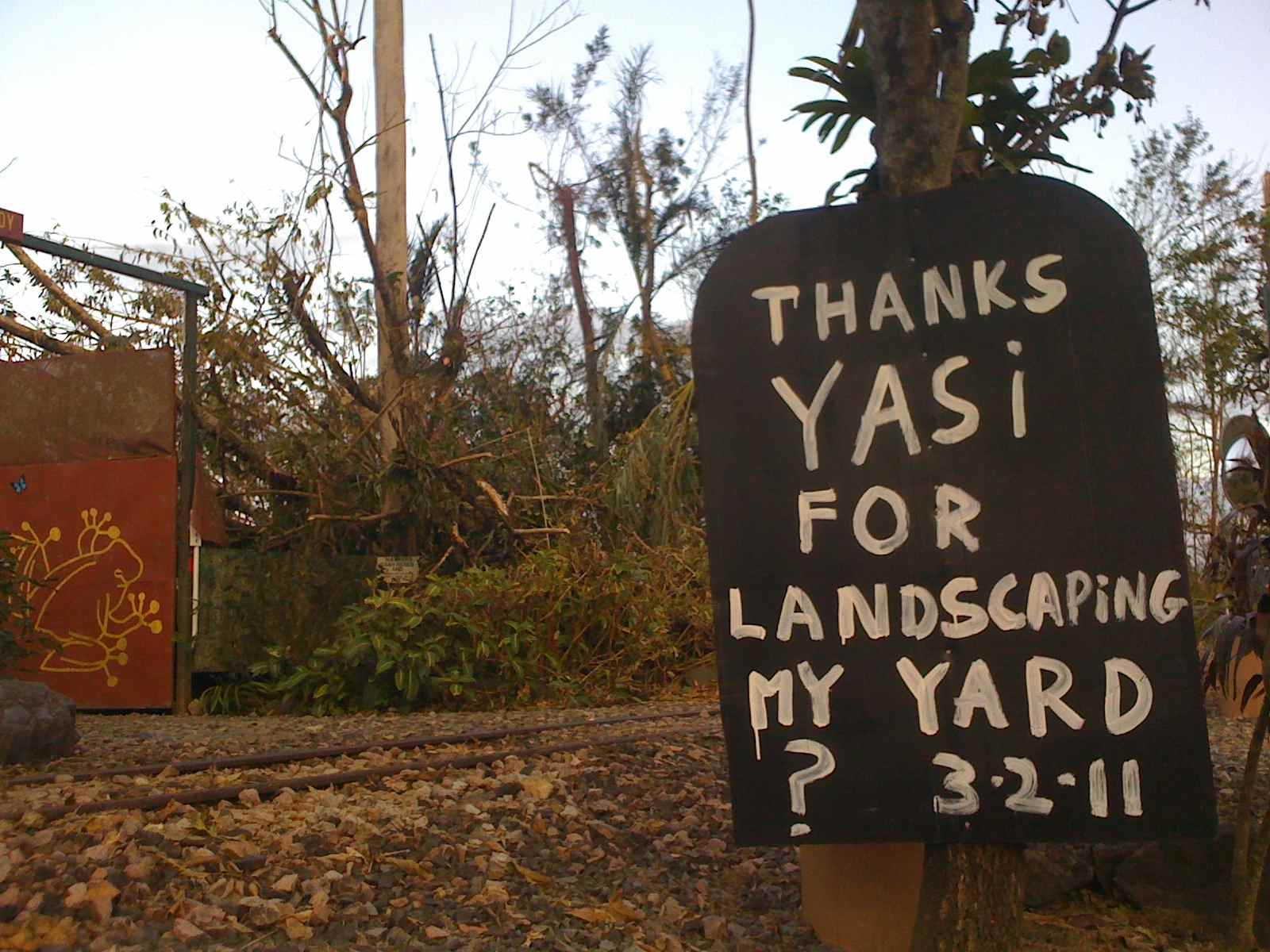
A local’s comment on Cyclone Yasi

In the Tully branch of Cassowary Coast Libraries there is a display of local historical photographs. Looking at them and seeing the difficulties involved in land clearing, timber felling, road building and transport in the old days, and considering the difficulties they still face today from the weather and the markets, it’s easy to see why the locals need to be tough.

2019 has been drier than usual, even here in the Wet Tropics. The Cassowary Coast Council, which includes Tully and Innisfail, has announced Level 3 water restrictions. The beautiful creek at The Boulders is at its lowest level for years. Babinda and Tully have both recorded much less than their average rainfalls, and little rain is forecast for the rest of the year.

The Wet Tropics is still the greenest place in the state. Sugar, banana and pawpaw farmers are watching the forecasts, though. They must wonder what the future will bring.

golden gumboot Australian_Butterfly_Sanctuary_Ulysses-8-1024x685
Ulysses butterflies

Blog at WordPress.com.

Up ↑