Doing the Washing

When we lived in Jandowae, on the northern Darling Downs, our clothesline was held up with a notched wooden prop.

Previously, we’d lived in houses with that backyard icon of the time, a Hills Hoist. It was efficient. The height could be adjusted, it rotated and it had lots of hanging space.

The Jandowae clothesline, perhaps ten metres long, was height adjustable too, in that you could stand the long prop up at an angle. It was unpredictable, though. A sudden wind gust could fling the drying sheets across to the other side of the line or drop them in the dirt.

A sudden gust will just send a rotary clothesline into a fast spin. Sheets and towels will flap wildly, but they won’t fall in the dirt.

21st century Queensland backyards rarely have space for a Hills Hoist, or a prop line either, even though clothesline props are still being sold, in improved styles. The travelling clothes prop man is a thing of the distant past, and even rotating clothesline are becoming objects of nostalgia. Throughout the suburbs, and across the sprawling, grey roofed, close packed housing developments that surround so many country towns, there is scarcely room for plants.

Last Christmas, Con wrote his Christmas letter on a theme, as he does every year. This year the theme was “clotheslines”. He was searching for a subject more interesting than the usual screeds on family, travel, illnesses and renovations.

Replies to his letter were rich with humour and nostalgia.

One old friend has recently lost his wife of many years. He misses her. But there is a positive side, as he wrote, and it concerns how he hangs out the washing now she’s gone.

  • No more separate washing for whites and colours.
  • No more hanging tops from the bottom and bottoms from the top.
  • No more delicates.
  • No more taking pegs off the line and into the peg basket.
  • No more socks by the toes. No more pockets turned out.

Surely one of the small freedoms we can allow ourselves is to hang out the washing any way we  like. Leave the pegs on the line, or put them in the basket? Hang the socks in pairs, or randomly? Wooden pegs or plastic? One peg, or two? Please yourself.

From my verandah I can look across the next-door backyards with their rotary clotheslines and I notice how they hang out their washing. The young couple next door hangs clothes entirely randomly, and not always using pegs. Next yard across, the retired couple hangs theirs out according to a strict pattern. Six white knickers in a row, six black underpants, six singlets.
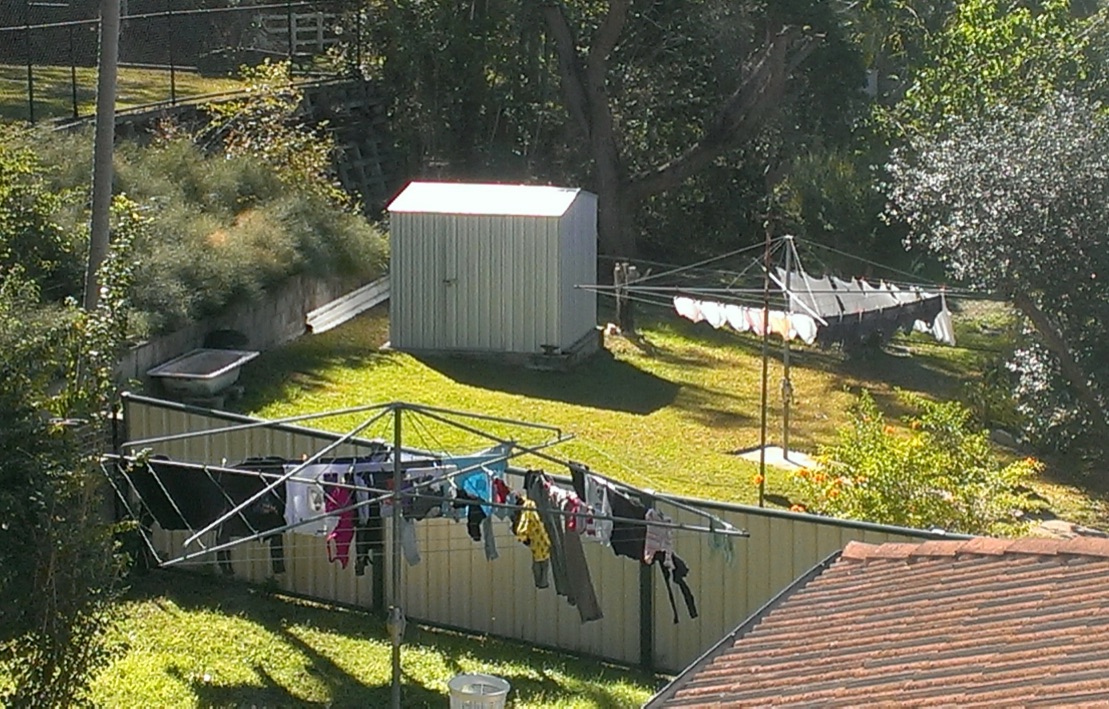
It seems they shop for underwear in an orderly way too.

Our friend in Chicago responded to Con’s letter wistfully. In the depths of winter and living in an apartment, she has no chance of drying her washing in a sunny, breezy garden.

Queensland climate varies dramatically across its huge area. When we lived in Burketown and Townsville, I had no problem drying the clothes either outdoors, or if it was raining, on lines strung under the house. However, Townsville, as they say, is a “dry old hole” most of the time; and Burketown is almost desert for a lot of the year. In Burketown, I would hang my washing under the house in the cool of the evening, and next morning everything would be dry.

Things changed when we moved to Yarrabah, on the coast near Cairns, with a ten-day old baby, and pouring rain and a cyclone predicted. Faced with the thought of managing wet cloth nappies, Con came home from the local store with a tumble drier.

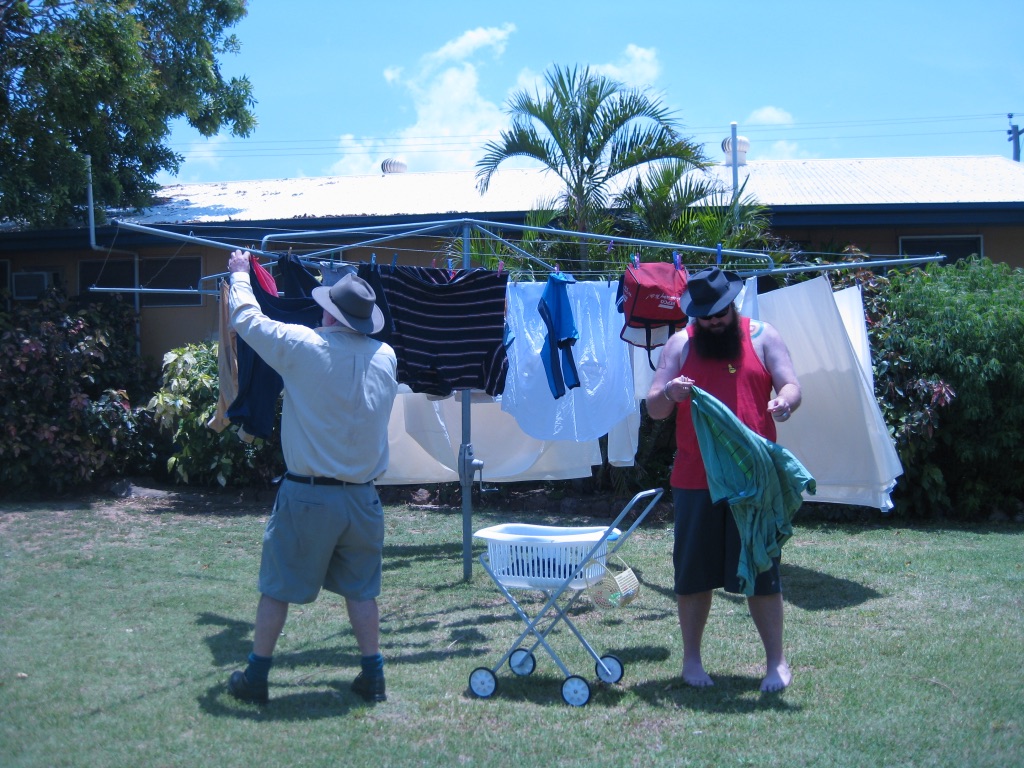
Con enjoys doing the washing. He has hung out clothes in Gulf Country heat at Karumba;
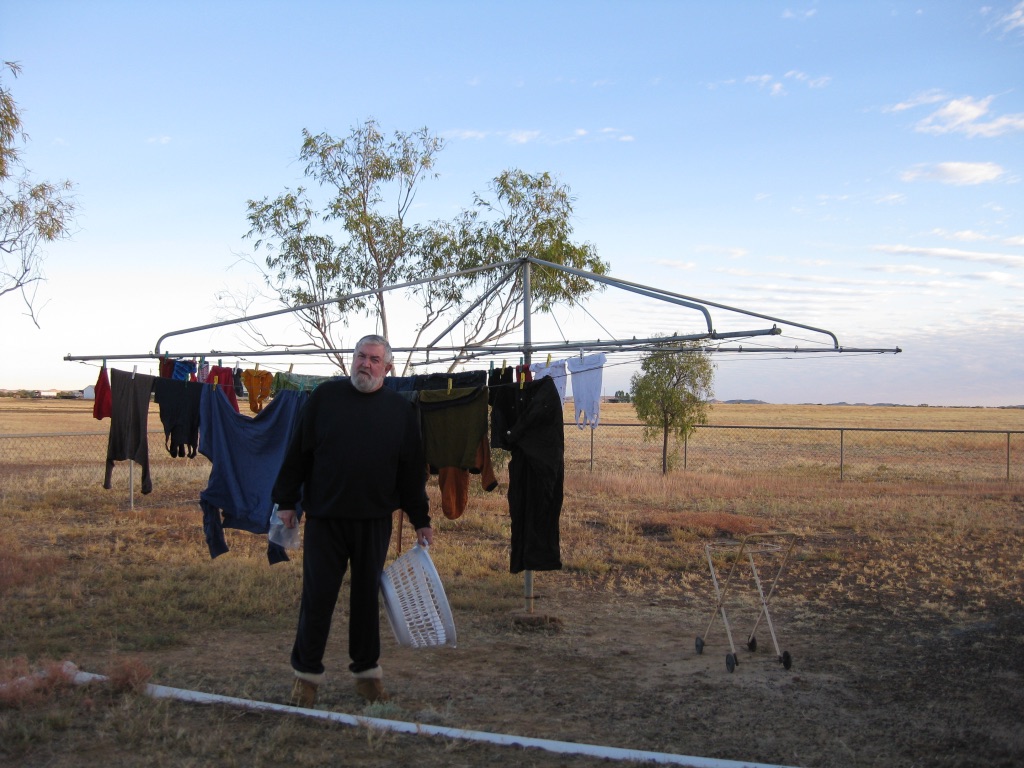
at the back of the old shearers’ quarters on Carisbrooke Station, west of Winton;
on the elevated clothesline behind a Silkwood farmhouse in Far North Queensland.
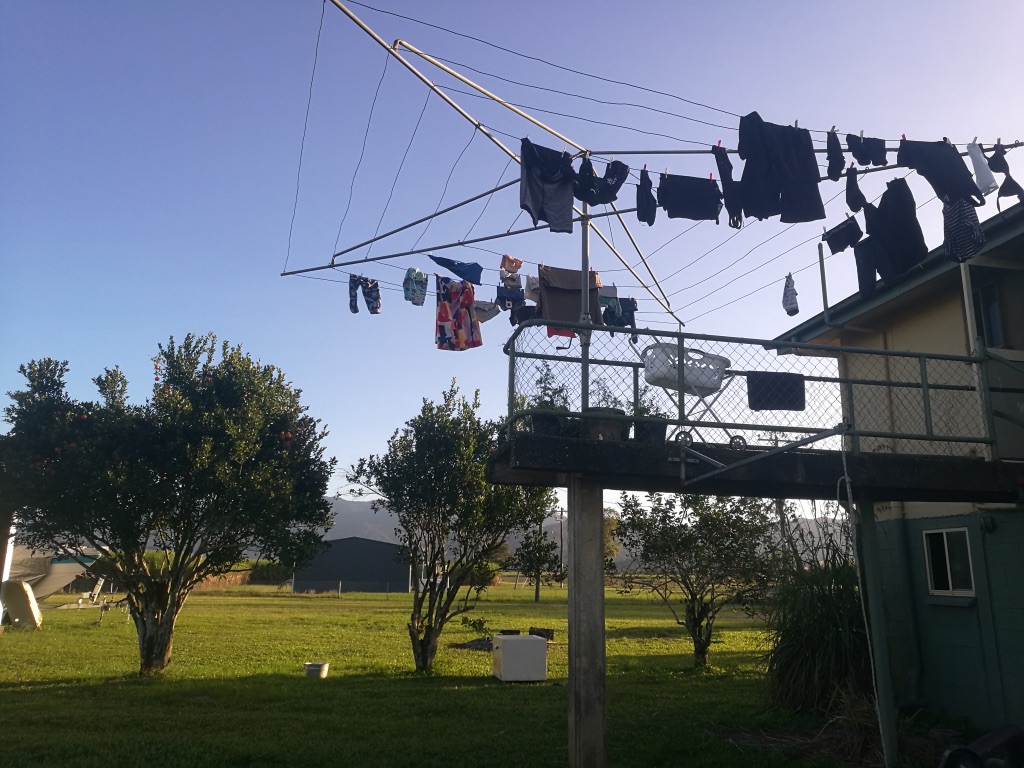
It’s a unique feature of elevated FNQ houses, a relic from the 1950s and ‘60s: a Hills Hoist mounted on the end of a concrete walkway leading from the back door.

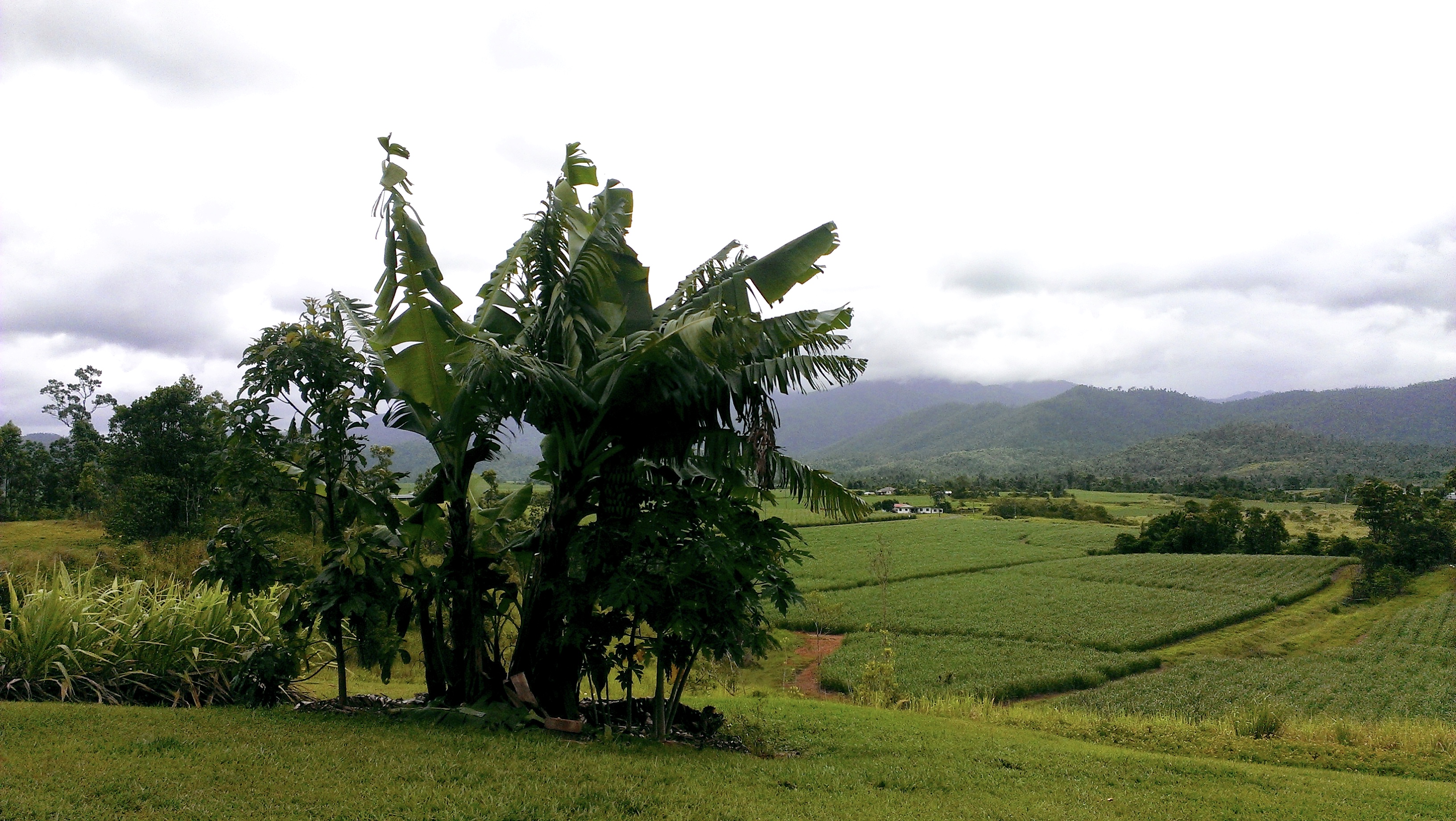
Otherwise, hanging out washing in a wet, tropical climate is not easy. Taking advantage of the first good drying day following a week of downpour, you stand in rubber thongs in the mud, flinging towels and sheets across the line, hoping nothing drops or drags on the ground.

One North Queensland wet season we stayed with Con’s brother and sister-in-law at Balgal Beach, north of Townsville, for their wedding anniversary party.

On the party tables, Margaret had used all her beautiful old tablecloths. Next morning we washed them. The grass was still soaked from a downpour, and it was tricky, hanging out those gorgeous old cloths without trailing them in the wet grass and mud.
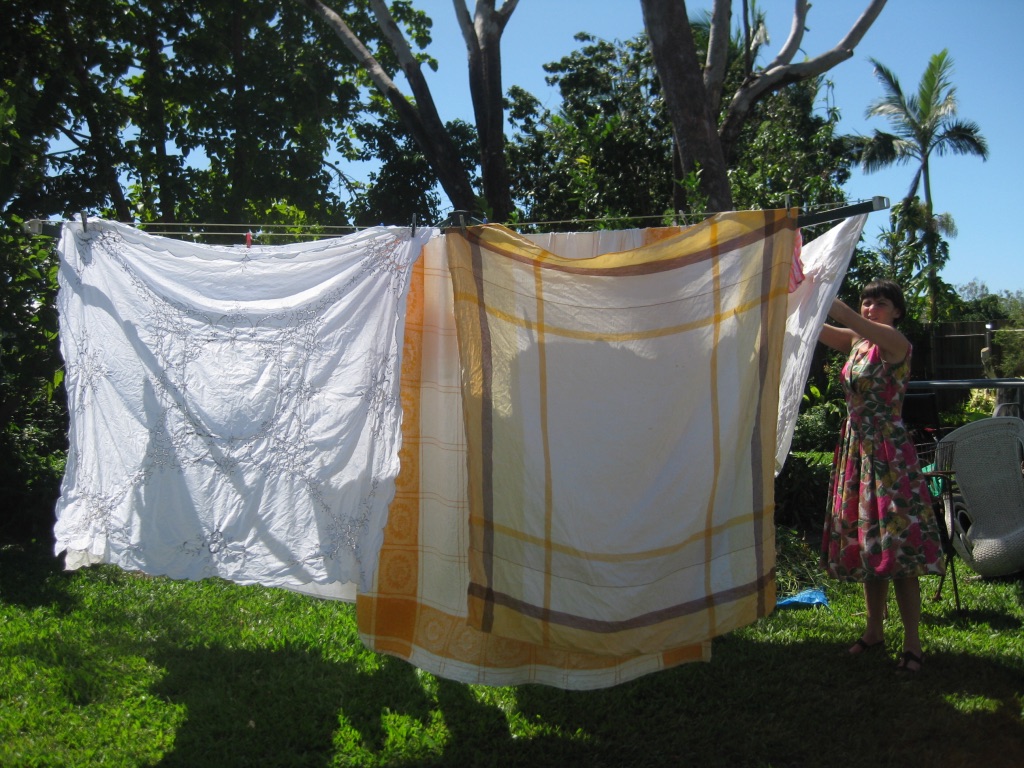
Hanging out those beautiful tableclothes

Washing moving in the breeze can be beautiful. It’s the fresh air and sunshine, the colours, patterns and fabrics. The sight has inspired many artists.

A feature of Queensland Art Gallery’s collection is “Washing Day at Éragny”, one of French Impressionist Camille Pissarro’s many beautiful paintings of women washing and drying clothes.
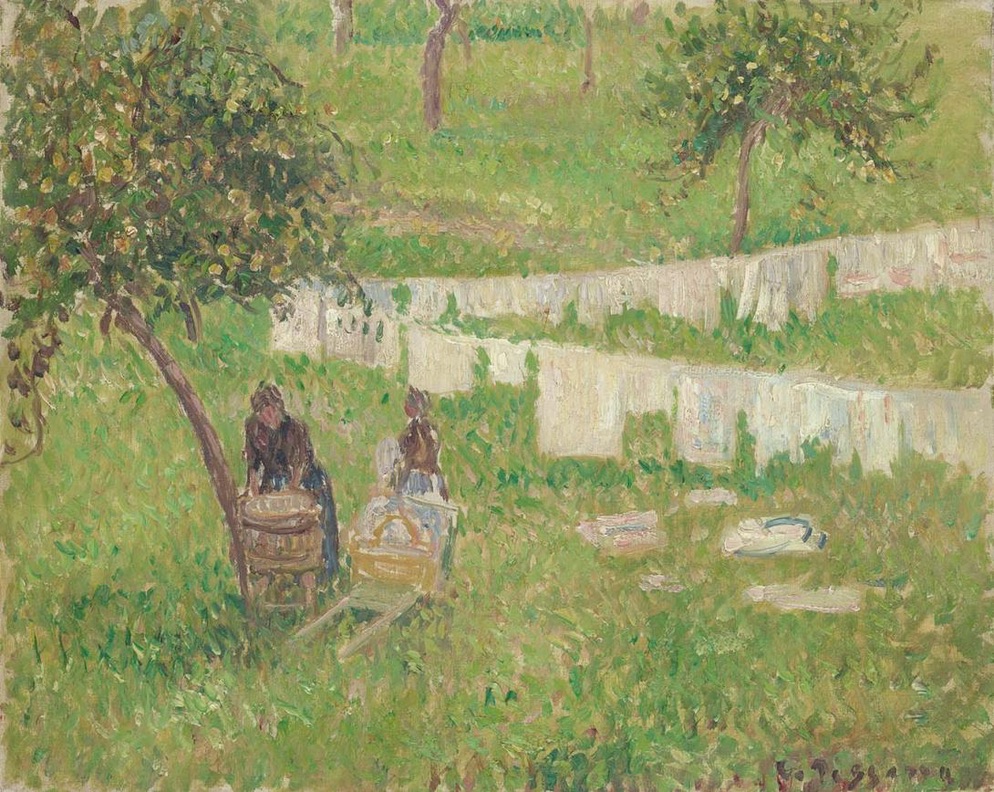
Washing Day at Éragny, Camille Pissarro. Queensland Art Gallery

Another of QAG’s treasured paintings, “Monday Morning” by local artist Vida Lahey, depicts a traditional washing day, with women scrubbing clothes, bending over the concrete laundry tubs that were once a feature of Queensland laundries and are now seen in the bathrooms of trendy pubs.
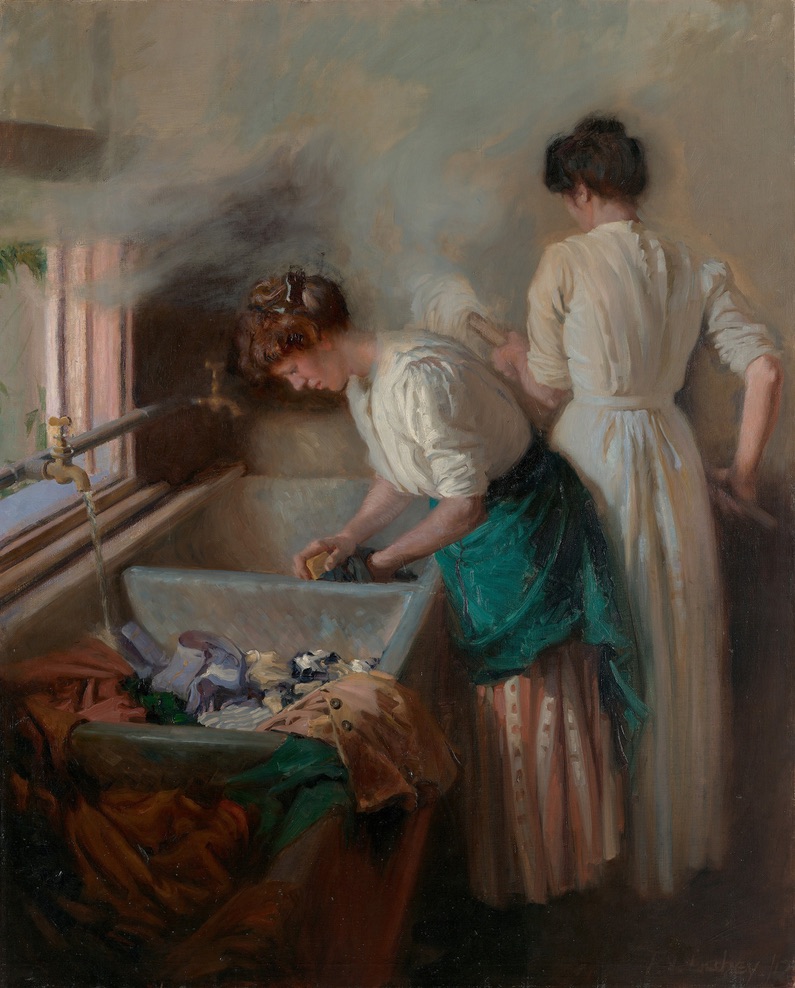
Monday Morning, Vida Lahey. Queensland Art Gallery

Another friend reminded us of the work that went on around those laundry tubs. I can still see my hard-working Mum dragging the boiled sheets out of the copper with the boiler stick, then on to the hand-turned wringer and out on to the propped up washing line, only to sometimes blow down into the mud!

My friend Marion, married to a vet, also responded to Con’s Christmas letter.

For the first time in my life I no longer have a washing line. For years I’ve joked that it was my daily exercise, carrying baskets of washing up and down stairs, bending and stretching to hang the washing in the open air.

My worst washing memories are of cleaning Malcolm’s overalls after he had done a messy calving case out in a muddy paddock somewhere. No washing machine, no hot water in the accommodation we were living in, in the dairy country of the Illawarra. Had to use the bath for a while until we bought a second-hand washing machine. The memory still lingers, particularly the smell of muck and blood. Lovely new calves came into the world though. Clever vet.

The harsh Queensland sun dries towels and sheets fresh and clean. The sun is a great purifier, a killer of germs and mould, although I had an aunt, a meticulous housekeeper, who told me darkly what she thought of this theory as applied to lazy laundry habits: “Some people leave far too much to the sun…”

I had a near-disaster one washing day.

Our cat had gone to sleep among the dirty clothes in the top-loading washing machine. Not noticing, I added powder, closed the lid and started the wash cycle. Seeing some clothes I’d missed I opened the lid again to put them in. The wet and terrified cat jumped out, disappeared out the door and was not seen again for hours.
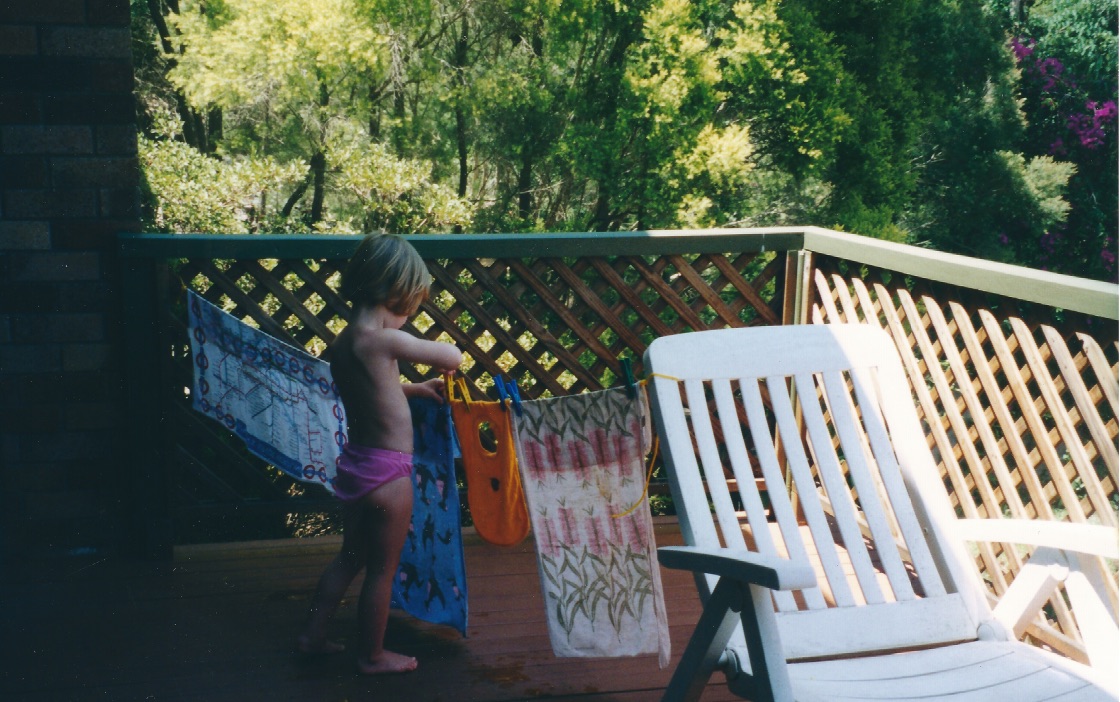
On my verandah

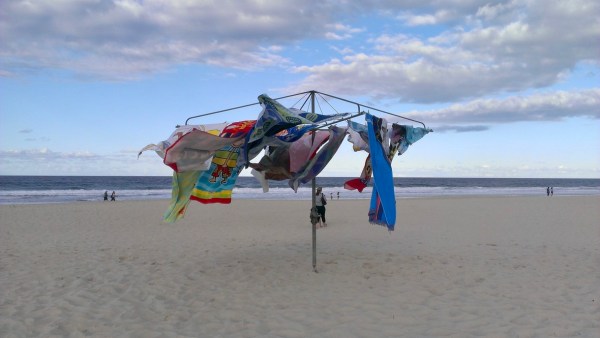
Main picture: Swell Sculpture Festival, Currumbin Beach, Queensland. 2015

Golden Gumboot

It’s December in the Wet Tropics of Queensland, and the chimneys of Tully Sugar Mill are quiet. Crushing has finished for the year. Behind the town, the rainforests of Mount Tyson are cloaked in rain.

06FF0145-4C62-4F82-A470-A090615A3B76_1_201_a
Wet Tropics

This is Golden Gumboot country. The Golden Gumboot is an unofficial, hotly contested yearly competition for the highest rainfall, between the Far North Queensland towns of Tully and Babinda.

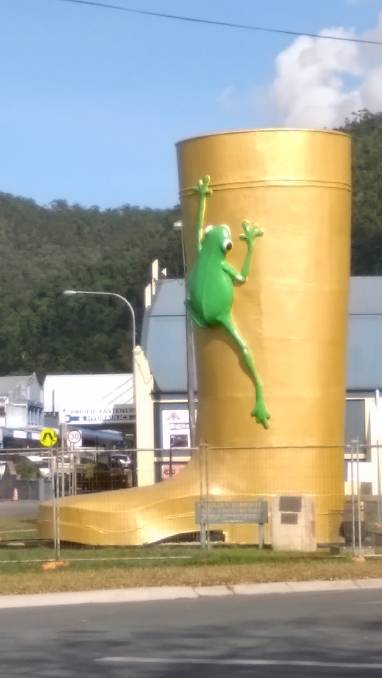
Tully, 140 kilometres south of Cairns, has at the start of its main street a concrete gumboot 7.9 metres high with a frog crawling up it. Having survived two fierce cyclones, the boot was recently refurbished by means of a state government grant and given a spectacular coat of gold paint. There is a staircase to the top, and a viewing platform. 7.9 metres is the amount of rain that fell here in 1950: the highest annual rainfall ever recorded in a populated area of Australia. Tully’s average annual rainfall, according to the Bureau of Meteorology, is 4 metres.

golden gumboot new
Tully’s Golden Gumboot with renewed gold

Tully has a Golden Gumboot Festival each year whatever the totals are; but in recent decades Babinda, 80 kilometres further north, has had the higher rainfall, averaging 4.28 metres annually, compared to Tully’s 4.09 metres. It’s Babinda that has the Golden Gumboot bragging rights.

To give an idea of what these numbers signify, Brisbane has an average rainfall of just over one metre a year.

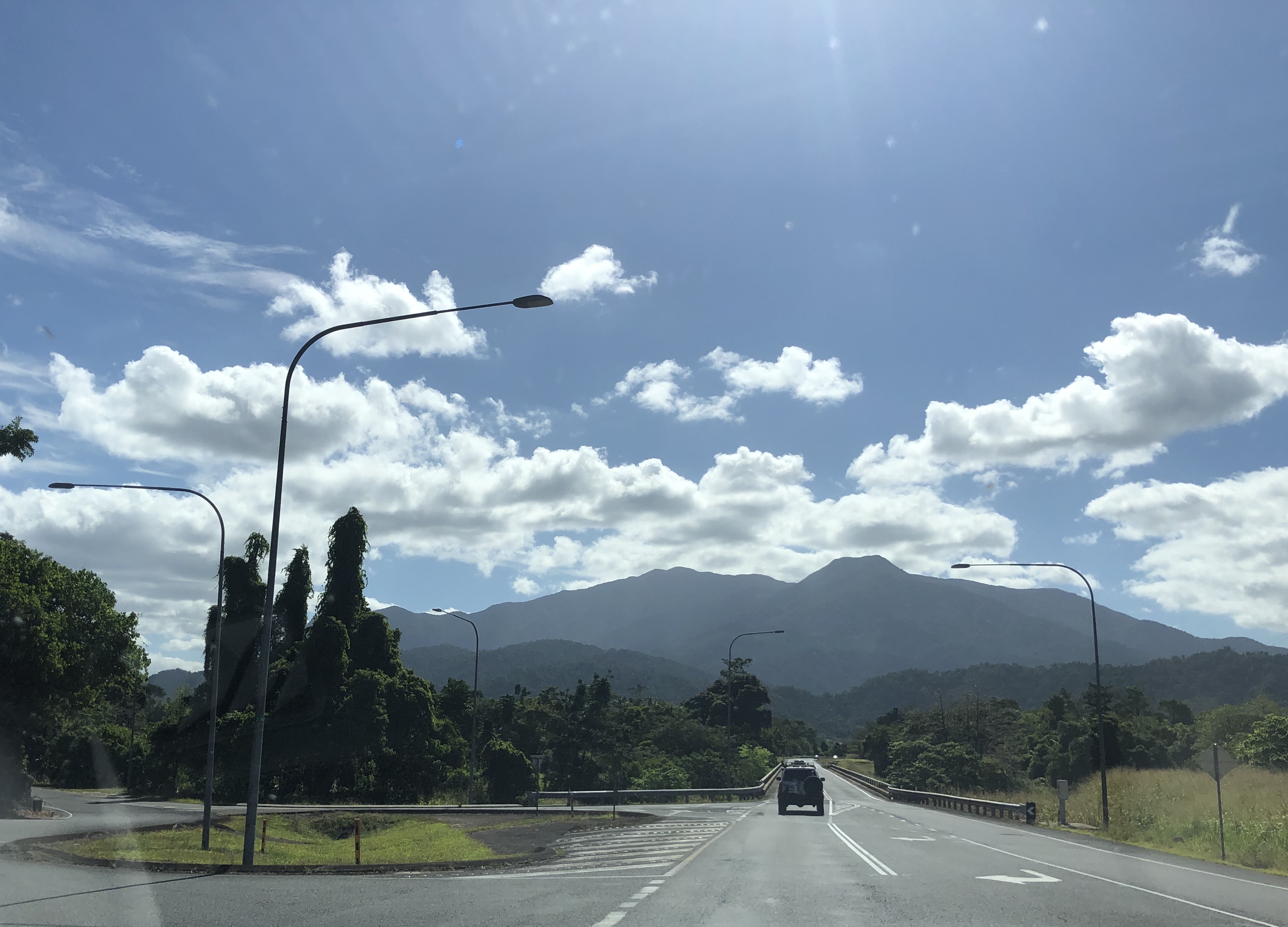
Babinda nestles close to the rainforest-covered slopes of Mount Bartle Frere, Queensland’s highest mountain. If you can see the top of Mount Bartle Frere, so locals say, it’s going to rain. If you can’t, it is raining.

FA23E2EE-F506-45C2-B4E3-089F01CB3ED6_1_201_a
Towards Mount Bartle Frere, Queensland’s highest

People in these northern towns and farms face a challenging climate, economic threats and agricultural tribulations. Bananas and papaws are major industries around here, but the focus of Tully’s economy is its sugar mill. Chinese-owned, it is the economic heart of this working town. Tully Mill crushes the second highest tonnage of any in the country.

Banana crops, papaw trees and sugar cane are vulnerable to disease, and all are at the mercy of the market – and the weather. Because the rainfall in this region is so reliable, farmers don’t irrigate.

The locals are down-to-earth and practical. They drive twin-cab utes, often with a pig dog cage on the back, and there are boats parked in many back yards. Men dress in boots, work shorts, polo shirts and hi-vis. Women favour denim shorts, black singlet tops and rubber thongs.

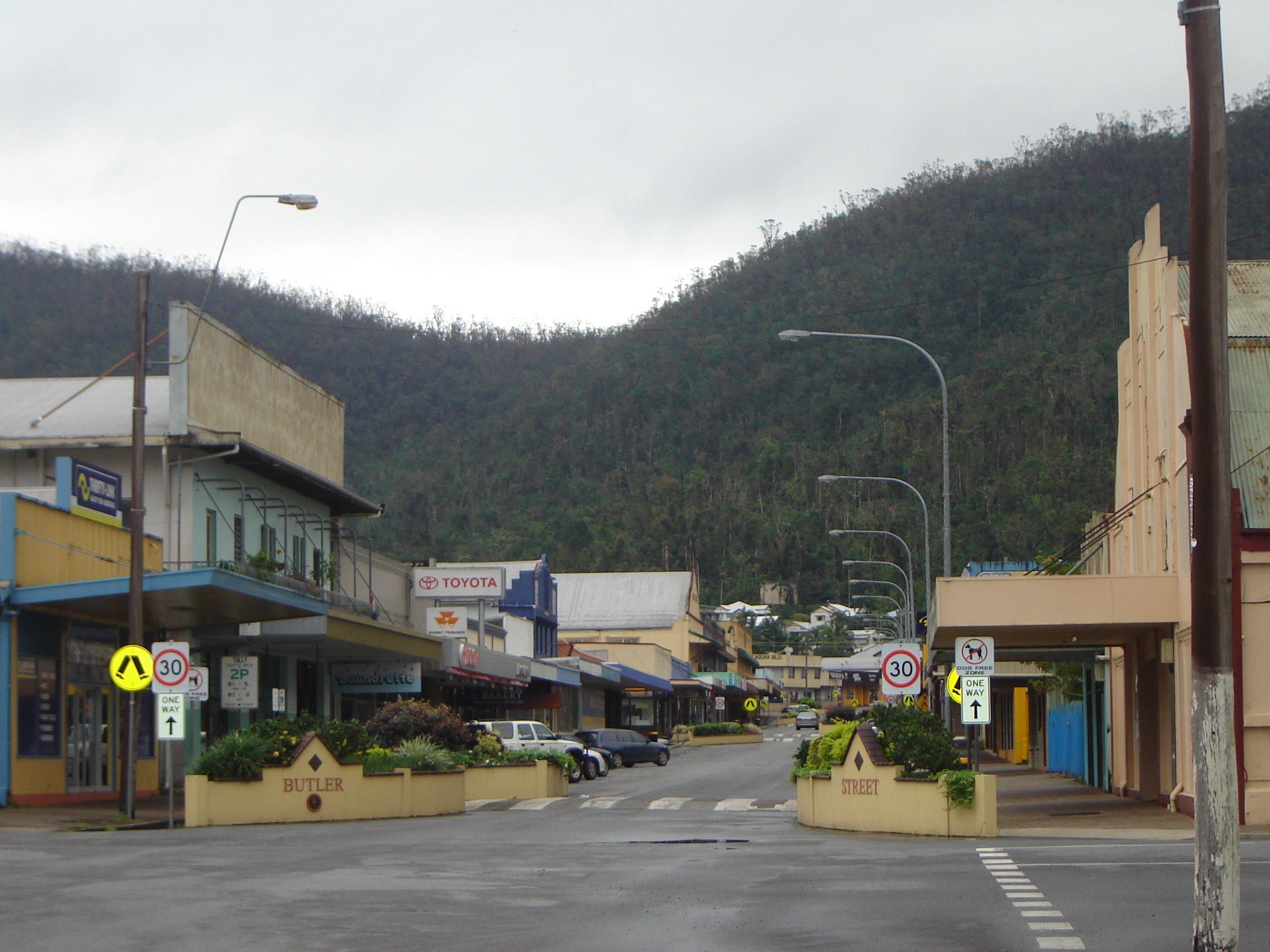
The locals relish an earthy form of humour. For instance, a visitor to Tully might talk about driving up the main street, Butler Street; but to a local, it’s “going up the Butt.”

golden gumboot butler st
Up Butler Street, Tully, towards Mount Tyson

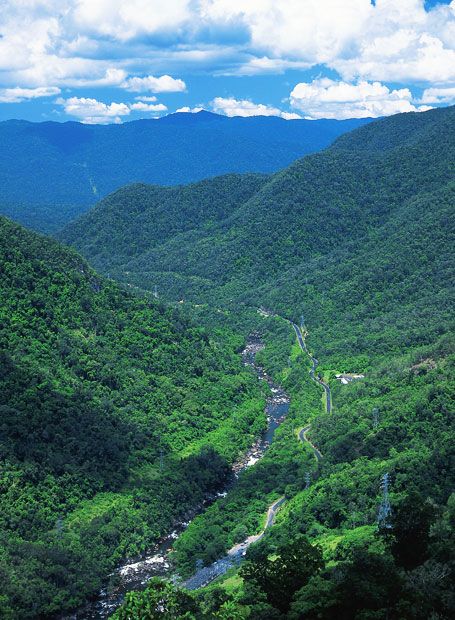
Both Babinda and Tully have spectacular tourist draw cards nearby. The famous Tully Gorge, where white-water rafting tours ride the outpour of water from the Kareeya hydro-electricity plant, runs right up against the ranges of the Atherton Tableland and the three hundred metre drop of Tully Falls. The falls lie directly below Tully Falls Lookout on the map, but the distance between the two by road is over two hundred kilometres.

golden gumboot tully gorgr
Tully Gorge seen from Tully Falls Lookout, 200km away by road

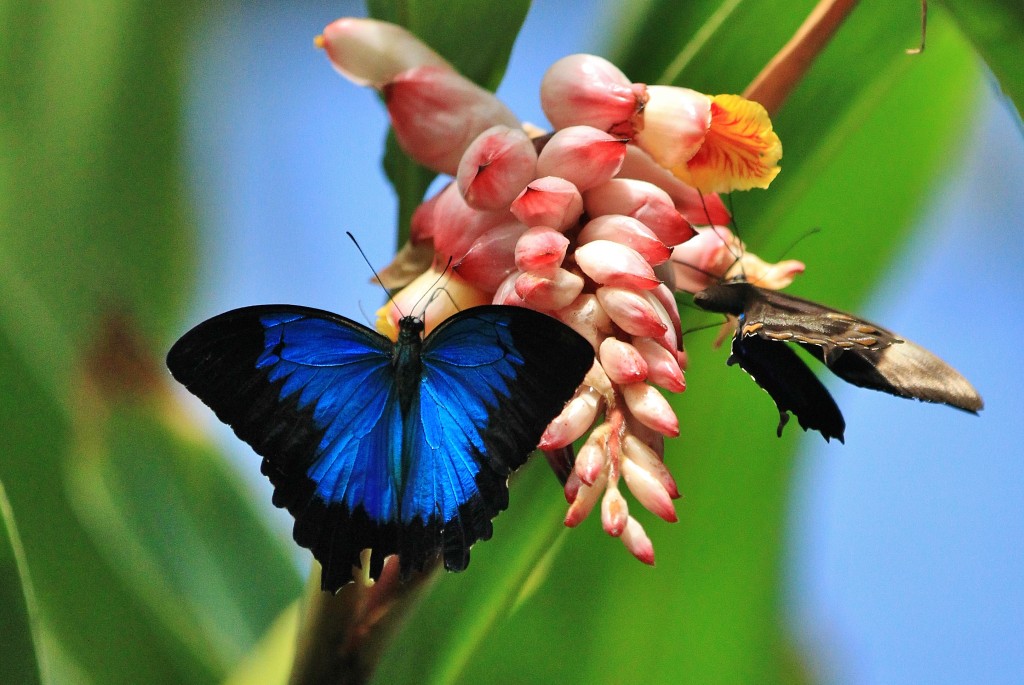
Electric-blue Ulysses butterflies flit through the forests along the gorge.

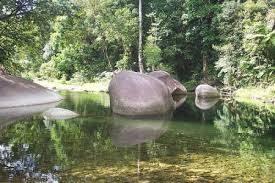
Babinda has The Boulders, a famous swimming hole and granite boulder-strewn creek of matchless beauty. We called in there for a swim a few years ago, floating in that clear pool in the rain as if in a cool, green heaven.

“We used to come to The Boulders for picnics,” Con told me, kicking against the gentle flow of the water. Con grew up in Innisfail, which lies between Tully and Babinda, looking out towards Mount Bartle Frere. Innisfail, famous for its papaws, averages a mere 3.4 metres of rainfall annually.

golden gumboot bananas
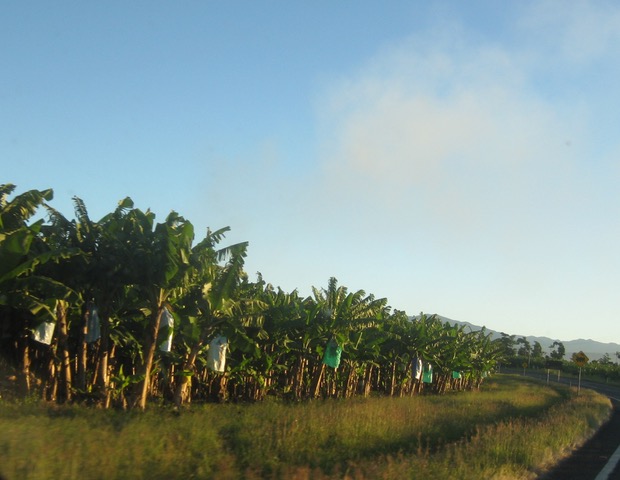
Innisfail banana farm

“Downstream from the main swimming hole there’s a place we called the Chute, which was like a fast water slide. It was great. And the Devil’s Pool – you’d have to be crazy to jump in there, but people did.”

This is a dangerous place for people who venture too close to where the creek is sucked down among huge granite boulders. Adventurous young men have died here.

“When I played for Innisfail Brothers League team and we had a game in Babinda, we’d come to The Boulders afterwards for a swim. We played at the Babinda showgrounds, and there was no such luxury as showers there.”

I first visited The Boulders with my family during a road trip from the south. My dad climbed up on a large boulder and swung out on a rope swing before performing a cartwheeling belly flop into the creek. He swam ashore with his chest scarlet from hitting the water. We were laughing; he didn’t see the funny side.

golden gumboot boulders
The Boulders, Babinda

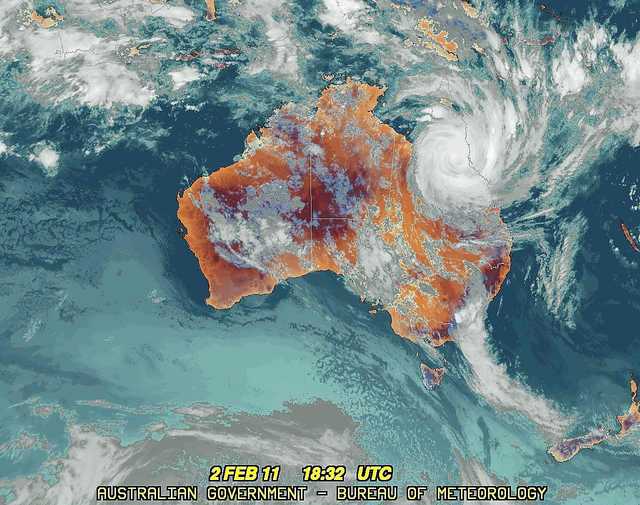
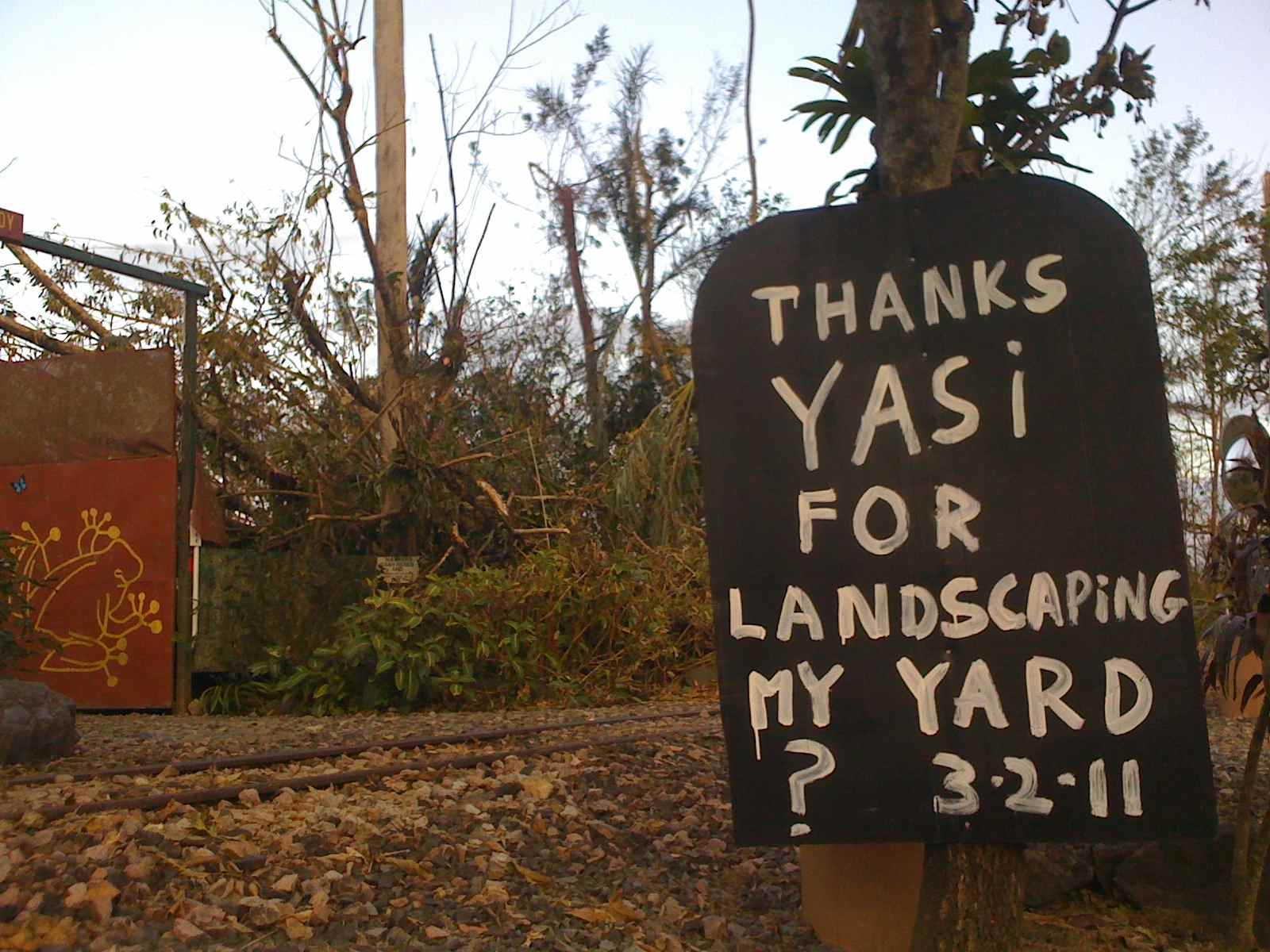
In 2011, Cyclone Yasi brought disaster to a thousand kilometres of  Queensland coast, its eye crossing the coast at Mission Beach, the closest coastal town to Tully.

golden gumboot yasi bom
Cyclone Yasi crossing the coast

Yasi’s devastation still shows in an occasional roofless building and in the thinned rainforest on the hillsides. Mission Beach people were isolated for days. A couple of years after Yasi I spoke to a young Frenchwoman living there. I asked her how she had fared.

“During the cyclone, I got a call from my family in Paris,” she told me. “My mother had died. I wanted to get out, to get to the airport in Cairns and fly home. The roads were blocked with debris. The army was clearing them with chainsaws, but no one was allowed in or out.

“I finally managed to get a ride out to the highway with the police, and a bus to Cairns, but the funeral was over long before I reached home.”

We visited friends at South Mission Beach in their beautiful timber house on the hill, and stood on their verandah looking down through greenery towards the tranquil beach where Yasi made landfall.

“Did you leave, when Yasi was coming?” I asked.

“No, we stayed here. We bunkered down in the bathroom, but it was scary. The noise was incredible. The glass doors at the back blew out, and the garden was a mess of shredded trees and debris. We couldn’t get down the road for smashed branches and tree trunks.”

golden gumboot yasi 2
A local’s comment on Cyclone Yasi

In the Tully branch of Cassowary Coast Libraries there is a display of local historical photographs. Looking at them and seeing the difficulties involved in land clearing, timber felling, road building and transport in the old days, and considering the difficulties they still face today from the weather and the markets, it’s easy to see why the locals need to be tough.

2019 has been drier than usual, even here in the Wet Tropics. The Cassowary Coast Council, which includes Tully and Innisfail, has announced Level 3 water restrictions. The beautiful creek at The Boulders is at its lowest level for years. Babinda and Tully have both recorded much less than their average rainfalls, and little rain is forecast for the rest of the year.

The Wet Tropics is still the greenest place in the state. Sugar, banana and pawpaw farmers are watching the forecasts, though. They must wonder what the future will bring.

golden gumboot Australian_Butterfly_Sanctuary_Ulysses-8-1024x685
Ulysses butterflies

Blog at WordPress.com.

Up ↑